




An eCommerce PHP script is a ready-made online store you buy once and host yourself, which is why it remains the cheapest realistic way to launch a shop or marketplace in 2026. Instead of paying a developer for months, you install the script, brand it, connect your payment gateways, and start selling.
The market is worth chasing. Global eCommerce sales are projected to reach about 7.41 trillion dollars in 2026, roughly 8 percent up on 2025, and mobile now drives the majority of transactions, according to Statista data compiled by Shopify. A good eCommerce PHP script lets a small team compete in that market without enterprise money.
This guide compares the 10 best eCommerce PHP scripts for 2026 with consistent pricing, honest pros and cons, and a clear best-fit for each. Full disclosure up front: Nazmart, Safecart, and Zaika are our own products, and I have said so in each entry so you can weigh the recommendation yourself.
What is an eCommerce PHP script?
An eCommerce PHP script is pre-built store software written in PHP, usually on a framework like Laravel, that you buy as a one-time license and install on your own hosting. It ships with the parts every store needs: a product catalog, a cart and checkout, payment gateway integrations, order management, and an admin dashboard.
The difference from Shopify or BigCommerce is ownership. A hosted platform rents you space and charges monthly, sometimes taking a cut of sales. With an eCommerce PHP script you own the code and the data, pay no recurring platform fee, and can change anything you like.
The trade-off is honest and worth stating. You are responsible for hosting, security updates, and maintenance. If you want zero technical involvement, a hosted platform is a better fit. If you want control and low running costs, a script wins.
Table of Contents
Why choose an eCommerce PHP script?
The case comes down to three things: cost, speed, and ownership.
| Option | Typical cost | Time to launch |
|---|---|---|
| Custom development | 25,000 dollars and up | 3 to 6 months |
| Hosted SaaS platform | 30 to 300 dollars per month, forever | Days |
| eCommerce PHP script | 39 to 119 dollars one-time | 1 to 3 days |
Beyond price, a self-hosted eCommerce PHP script gives you full source-code access, no per-sale commission, freedom to add local payment gateways, and the option to resell or white-label the platform. Most run on standard shared or VPS hosting, so infrastructure stays cheap.
These scripts suit small retailers going online, founders testing a marketplace idea, agencies building for clients, and anyone in a region where the big hosted platforms lack local payment support. Before you buy, it helps to know which features an eCommerce website actually needs.
Single vendor or multi-vendor: pick your model first
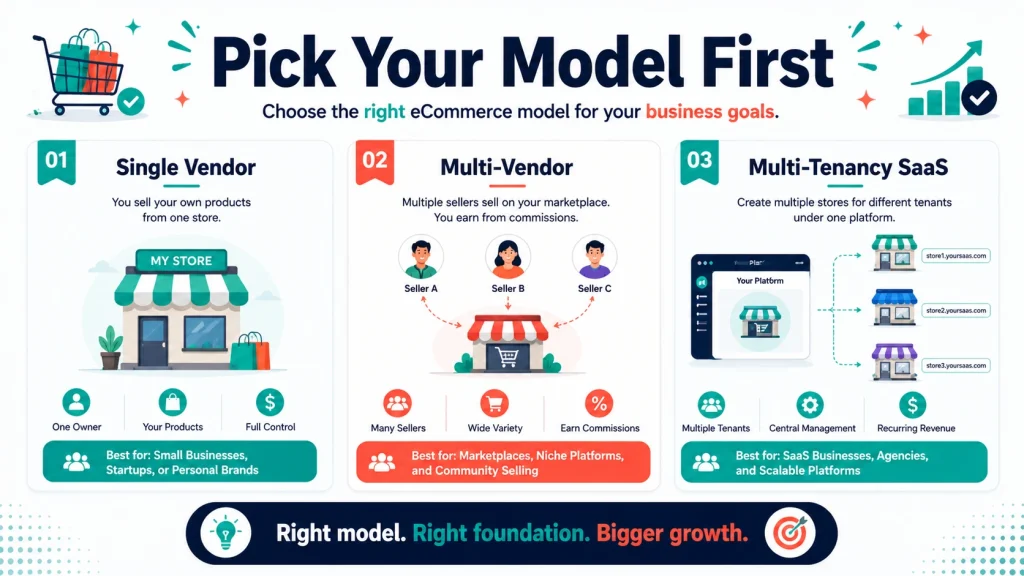
Choose your business model before you choose an eCommerce PHP script, because it narrows the list immediately.
- Single vendor. You sell your own products. Simpler to run, cheaper to host, faster to launch. Best for a retailer, a brand, or a first store.
- Multi-vendor marketplace. Other sellers list on your platform and you take a commission. Harder to run because you need sellers and buyers at once, but it scales without you holding inventory.
- Multi-tenancy SaaS. You sell stores to other people, each on their own subdomain. This is the most technical model but the most profitable per customer, since you earn subscriptions rather than margins.
Get this decision right and the rest of the comparison becomes simple. Get it wrong and you will outgrow or overpay for your script within a year.
Key features to look for in an eCommerce PHP script
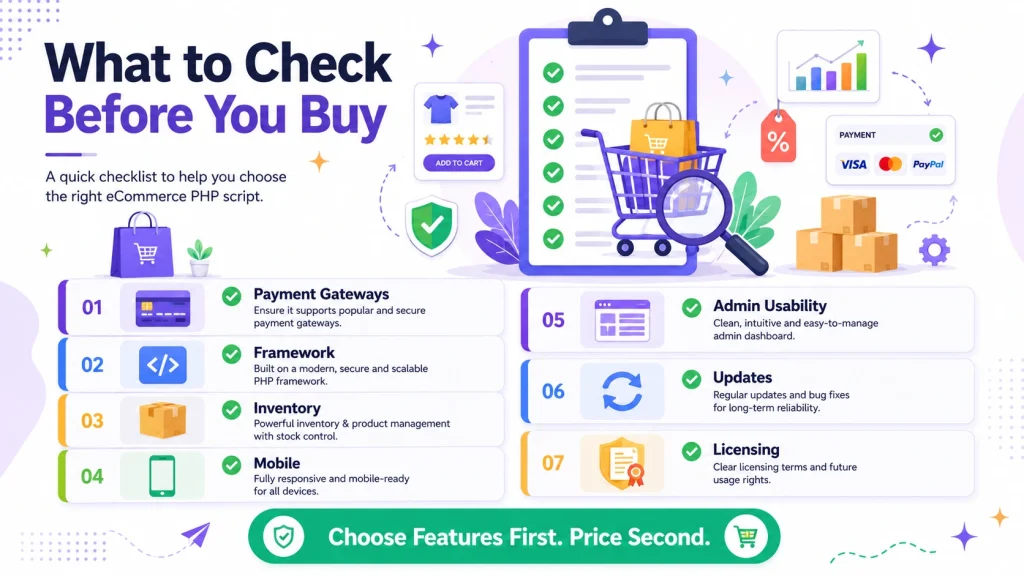
A low price means nothing if the platform is missing something you need on day one. Run any eCommerce PHP script through this checklist before you buy.
- Payment gateways. This is the one that quietly kills stores. Count matters less than coverage, so confirm your local gateways are supported, not just PayPal and Stripe.
- Framework and code quality. Most modern options are built on Laravel, which means a large developer pool and easier hiring when you need customization. An eCommerce PHP script on an older framework can be harder to extend.
- Product and inventory handling. Check how the script manages variations, stock, and bulk imports. Apparel and grocery stores in particular break cheap catalog systems fast.
- Mobile experience. Mobile drives most eCommerce traffic now, so a responsive storefront is the minimum and a PWA or bundled app is a genuine advantage.
- Admin usability. Open the demo and time yourself adding a product and processing an order. If the back end is clumsy, you will feel it every day.
- Updates and support. A cheap eCommerce PHP script with no maintenance becomes a security liability. Check when the vendor last shipped an update and how they answer complaints.
- Licensing terms. Confirm whether the regular licence covers a commercial store, and whether you need an extended licence to resell or run a SaaS model.
Most marketplaces let you filter by these before buying. Browsing the CodeCanyon eCommerce category and sorting by rating and recent updates is a quick way to sanity-check any eCommerce PHP script against its rivals.
The point is simple. The best eCommerce PHP script is the one that scores well on the features your store actually depends on, not the one with the longest feature list on the sales page.
The 10 best eCommerce PHP scripts at a glance
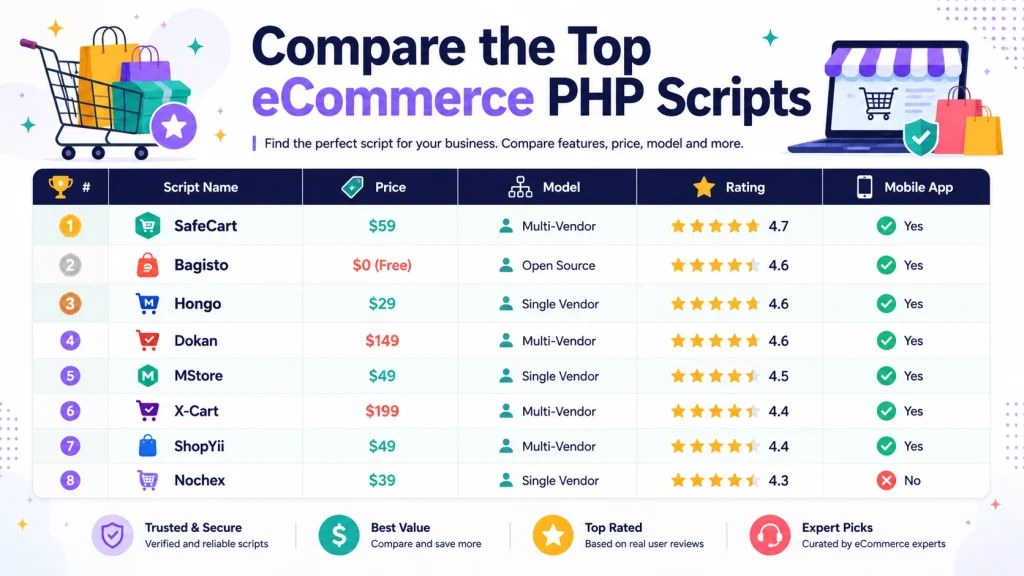
Here is the full list before the detail. Prices are one-time regular licenses and should be confirmed on the marketplace before you buy, since vendors adjust them.
| # | eCommerce PHP script | Price | Rating | Model | Best for |
|---|---|---|---|---|---|
| 1 | Nazmart | $59 | 4.5/5 | Multi-tenancy SaaS | Selling stores as a service |
| 2 | Safecart | $39 | 4.8/5 | Multi-vendor | Best multi-vendor value |
| 3 | FleetCart | $59 | 4.6/5 | Single vendor | Clean Laravel single store |
| 4 | Active eCommerce CMS | $59 | 4.4/5 | Multi-vendor | Established marketplaces |
| 5 | Martfury | $119 | 4.9/5 | Multi-vendor | Design and polish |
| 6 | Yoori | $49 | 4.3/5 | Both | PWA and mobile-first |
| 7 | Zaika | $69 | 4.4/5 | Single vendor | Security-focused stores |
| 8 | GeniusCart | $59 | 3.9/5 | Single vendor | Fashion and clothing |
| 9 | OmniMart | $39 | Not rated | Single vendor | Budget all-in-one |
| 10 | Isshue | $49 | 4.4/5 | Single vendor | Retail with POS |
1. Nazmart
Price: $59. Rating: 4.5/5. Model: multi-tenancy SaaS. Disclosure: this is our own product.
Nazmart is the only eCommerce PHP script here built for selling stores rather than products. Each customer gets their own store on a subdomain or custom domain, with subscription packages you control, so you run a Shopify-style business instead of a single shop.
Pros:
- True multi-tenancy with subdomains and custom domains
- Subscription package management built in
- 20+ payment gateways and wide currency support
- Full admin control over tenants and plans
Cons:
- Overkill if you only want to sell your own products
- Needs more server resources than a single-store script
- Steeper setup than a basic storefront
2. Safecart
Price: $39. Rating: 4.8/5. Model: multi-vendor. Disclosure: this is our own product.
Safecart is a multi-vendor Laravel marketplace at the lowest price on this list. Sellers get their own dashboards, you take commission, and buyers shop across vendors in one storefront.
Pros:
- Cheapest multi-vendor option here
- Per-vendor dashboards and commission handling
- Strong user rating at 4.8/5
- Mobile app available
Cons:
- Fewer premium design themes than Martfury
- Marketplace models need seller recruitment to work
- Some advanced features need customization
3. FleetCart
Price: $59. Rating: 4.6/5. Model: single vendor.
FleetCart is a well-regarded Laravel eCommerce PHP script for running one polished store. It is stable, well documented, and popular with people who want a straightforward shop without marketplace complexity.
Pros:
- Clean, modern Laravel codebase
- Strong documentation and active updates
- Good performance out of the box
- Simple admin for non-technical owners
Cons:
- Single vendor only, no marketplace mode
- Fewer built-in marketing tools
- Theme choice is limited
4. Active eCommerce CMS
Price: $59. Rating: 4.4/5. Model: multi-vendor.
Active eCommerce CMS is one of the longest-running multi-vendor scripts, with a large install base and a wide add-on ecosystem for extending the platform.
Pros:
- Mature multi-vendor feature set
- Large add-on and extension library
- Frequent updates and a big user community
- Mobile app add-ons available
Cons:
- Many features sit behind paid add-ons
- Interface feels dated next to newer scripts
- Can get heavy with everything enabled
5. Martfury
Price: $119. Rating: 4.9/5. Model: multi-vendor.
Martfury is the highest-rated eCommerce PHP script on this list and the most design-led. If you want a storefront that looks premium without hiring a designer, this is the one.
Pros:
- Highest user rating here at 4.9/5
- Polished, modern storefront design
- Multi-vendor and multi-language support
- Well-maintained by an established vendor
Cons:
- Most expensive script on the list
- More features than a simple store needs
- Customization takes some Laravel knowledge
6. Yoori
Price: $49. Rating: 4.3/5. Model: single and multi-vendor.
Yoori is a progressive web app eCommerce PHP script, which means customers can install your store to their home screen and browse it like an app without an app store download. Given that mobile drives most eCommerce traffic, that matters.
Pros:
- PWA support for app-like mobile shopping
- Works as single vendor or multi-vendor
- Modern Vue-based frontend
- Good performance on mobile connections
Cons:
- PWA adds setup complexity
- Smaller community than the veterans
- Some features require the higher licence tier
7. Zaika
Price: $69. Rating: 4.4/5. Model: single vendor. Disclosure: this is our own product.
Zaika is a single-vendor Laravel eCommerce PHP script built around a clean, secure checkout, with several homepage options and a Flutter app available separately.
Pros:
- Solid security practices and clean checkout
- Multiple homepage layouts
- 15+ payment gateways
- Flutter mobile app available
Cons:
- Single vendor only
- Mobile app is a separate purchase
- Fewer third-party extensions
8. GeniusCart (fashion and clothing)
Price: $59. Rating: 3.9/5. Model: single vendor.
GeniusCart is aimed at fashion and apparel stores, with product variation handling (sizes, colors, styles) built for clothing catalogs.
Pros:
- Strong product variation handling for apparel
- Fashion-oriented storefront design
- Straightforward for non-technical owners
Cons:
- Lowest rating on this list at 3.9/5
- Narrow niche focus limits reuse
- Reviews mention slower support response
9. OmniMart
Price: $39. Model: single vendor.
OmniMart is an inexpensive all-in-one single-vendor eCommerce PHP script for owners who want a working store without extras. It covers the basics competently and little more.
Pros:
- One of the cheapest options at $39
- Covers all core store functions
- Quick to install and configure
Cons:
- Limited advanced features
- Around 12 payment gateways, fewer than premium rivals
- Smaller user base and less public feedback
10. Isshue
Price: $49. Rating: 4.4/5. Model: single vendor.
Isshue stands out for bundling a point-of-sale system, so a shop with a physical counter and an online store can run both from one platform. Note it is built on CodeIgniter rather than Laravel.
Pros:
- Built-in POS for in-store and online selling
- Multi-store management
- Good value at $49
Cons:
- CodeIgniter base, less modern than Laravel rivals
- Smaller developer pool for customization
- Fewer integrations than Laravel scripts
Full feature comparison
| eCommerce PHP script | Price | Model | Framework | Mobile app |
|---|---|---|---|---|
| Nazmart | $59 | Multi-tenancy SaaS | Laravel | Yes |
| Safecart | $39 | Multi-vendor | Laravel | Yes |
| FleetCart | $59 | Single vendor | Laravel | No |
| Active eCommerce CMS | $59 | Multi-vendor | Laravel | Add-on |
| Martfury | $119 | Multi-vendor | Laravel | No |
| Yoori | $49 | Both | Laravel + Vue | PWA |
| Zaika | $69 | Single vendor | Laravel | Separate |
| GeniusCart | $59 | Single vendor | Laravel | No |
| OmniMart | $39 | Single vendor | Laravel | No |
| Isshue | $49 | Single vendor | CodeIgniter | No |
How to choose the right eCommerce PHP script
Match the script to your situation rather than chasing the longest feature list.
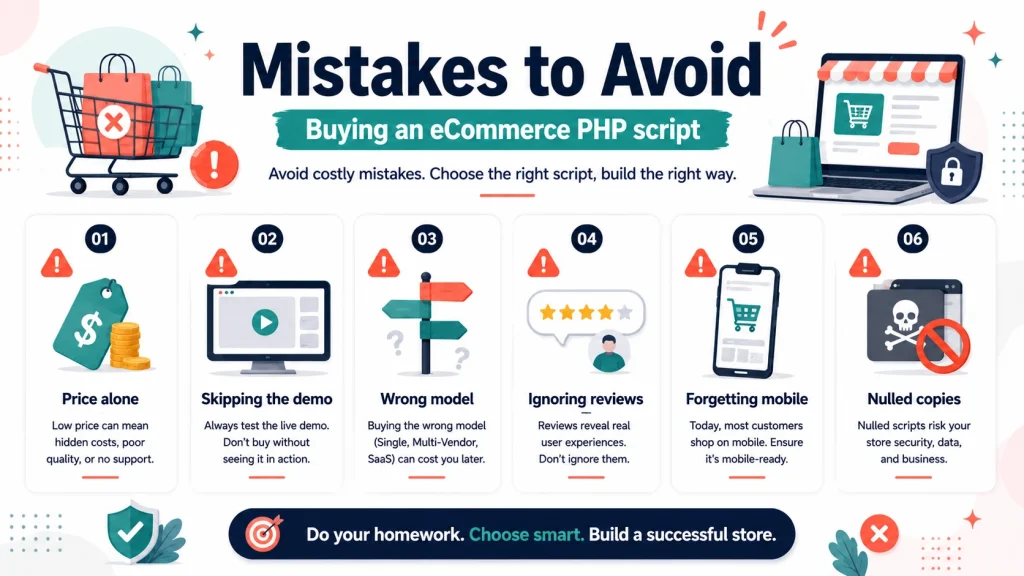
- Selling your own products. FleetCart ($59), Zaika ($69), or OmniMart ($39) if budget is tight. Simple, focused, quick to launch.
- Building a marketplace. Safecart ($39) for value, Active eCommerce CMS ($59) for maturity, or Martfury ($119) if design matters most.
- Selling stores as a service. Nazmart ($59) is the only true multi-tenancy option here.
- Mobile-first audience. Yoori ($49) for its PWA support.
- Physical shop plus online. Isshue ($49) for the built-in POS.
- Fashion and apparel. GeniusCart ($59) for its variation handling.
Two practical checks before you buy any eCommerce PHP script. Confirm it supports the payment gateways your customers actually use, since local gateways matter more than the count. And open the live demo, create a test product, and run a test checkout. A script that feels awkward in the demo will feel worse in production. Our guide to reliable eCommerce payment gateways covers which to prioritize.
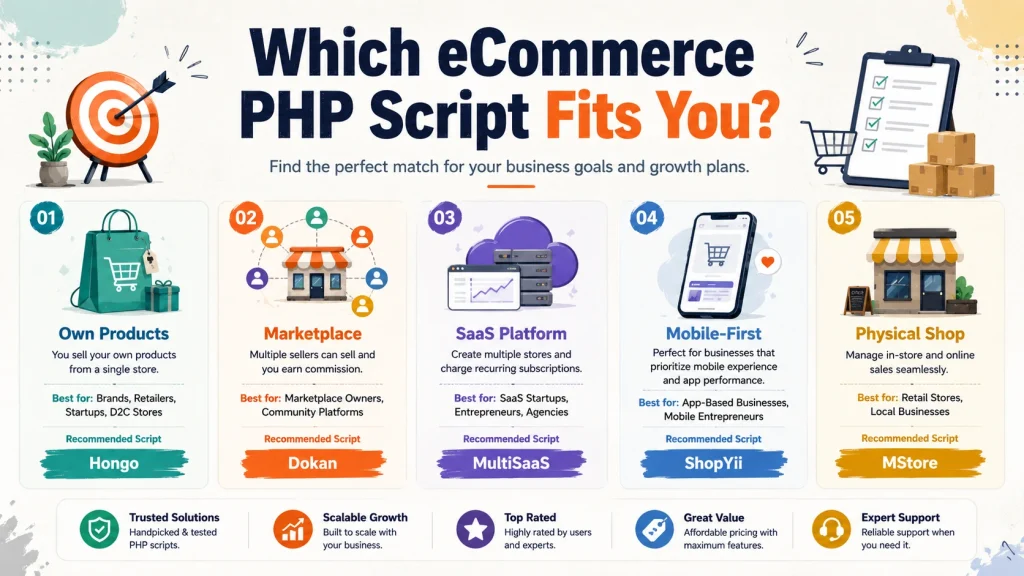
What it really costs to run
The licence is the small part. Budget for the whole first year so there are no surprises.
- Script licence. 39 to 119 dollars, one-time.
- Hosting. Roughly 120 to 300 dollars a year for a VPS that handles a real store.
- Domain and SSL. Around 15 to 65 dollars a year, though many hosts include SSL free.
- Optional extras. A mobile app, premium theme, or paid add-ons if you need them.
That puts a realistic first year somewhere between 200 and 500 dollars, against 25,000 dollars or more for a custom build and an indefinite monthly bill on hosted platforms. That gap is the whole argument for an eCommerce PHP script.
Once you are live, launching your eCommerce website properly and applying solid design tips for conversions will matter far more to your revenue than which script you picked.
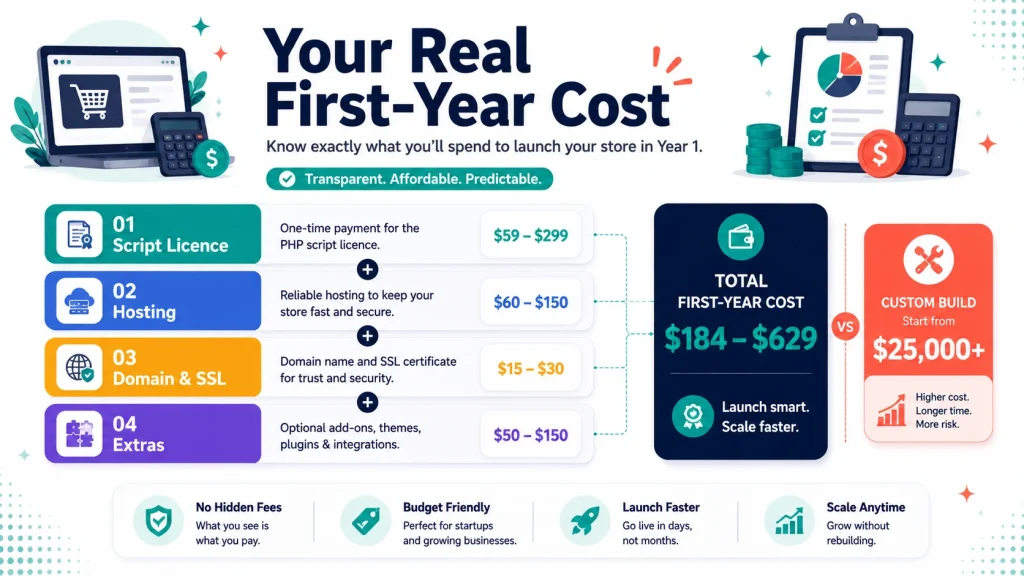
Mistakes to avoid when buying an eCommerce PHP script
- Buying on price alone. The cheapest script is no bargain if it lacks your payment gateways or the vendor has gone quiet.
- Skipping the demo. Always run a test product and a test checkout before you spend anything.
- Choosing the wrong model. Picking a single-vendor script when you plan a marketplace means rebuying within a year.
- Ignoring the review history. Read the recent one and two-star reviews to see how the vendor handles problems.
- Forgetting mobile. Most traffic is mobile now, so check the storefront on a real phone.
- Using nulled copies. Cracked scripts carry backdoors and get no security patches. On a site handling card payments, that is not a risk worth taking.
Final thoughts
An eCommerce PHP script is still the most practical way to launch a store or marketplace in 2026 without a five-figure budget. Decide your model first, then match it to the list: FleetCart or Zaika for your own store, Safecart or Active eCommerce CMS for a marketplace, Martfury if design leads, Yoori for mobile-first, Isshue if you have a physical shop.
Whichever eCommerce PHP script you choose, remember that the software is only the starting point. Your products, your pricing, and how well you market the store decide whether it earns money. A well-run shop on a modest eCommerce PHP script will beat a neglected one on the most expensive option here every time, so pick something you can actually operate and then put your energy into selling.
If your plan is to sell stores rather than products, explore Nazmart and launch a multi-tenancy platform you own outright, with no per-sale commission and no monthly platform fee.
Frequently Asked Questions (FAQ)
What is the best eCommerce PHP script overall?
There is no single winner, because it depends on your model. Martfury has the highest rating, Safecart is the best multi-vendor value, FleetCart is the cleanest single store, and Nazmart is the only true multi-tenancy SaaS option.
How much does an eCommerce PHP script cost?
Between 39 and 119 dollars for a one-time regular licence. Adding hosting, a domain, and SSL, your realistic first-year total is roughly 200 to 500 dollars.
Do I need coding skills to use an eCommerce PHP script?
Not for basic setup. Most scripts have installers and admin panels a non-developer can manage. You will want a developer for deeper customization or if something breaks.
Can I switch scripts later?
Yes, but it means exporting your products, customers, and orders and importing them into the new platform. It is easier to pick the right model up front than to migrate a live store.
Laravel or CodeIgniter, which is better?
Most modern scripts here use Laravel, which has a larger developer pool and a more active ecosystem, making customization and hiring easier. Isshue is the CodeIgniter exception on this list.
Is a script better than Shopify?
It depends on what you value. Shopify is easier and fully managed but costs monthly forever. An eCommerce PHP script is cheaper long-term and gives you full ownership, but you handle hosting and updates. Our platform comparison covers this in detail.