



A SaaS ecommerce platform lets you run an online store without owning servers, patching security, or hiring a dev team to keep the lights on. You pay a subscription, the provider handles the hosting and updates, and you focus on selling. The phrase means two different things, though, and getting them mixed up is how founders pick the wrong tool.
For some people, a SaaS ecommerce platform is where they sell: a hosted store like Shopify. Founders on a tight budget often start with a ready-made eCommerce PHP scripts comparison before committing to a full SaaS build. This guide covers both, plus the self-hosted platforms the big brands never mention, so you land on the right one.
I will compare 13 options for 2026 by price, features, and who they fit. Full disclosure: Nazmart, one of the tools below, is our own product, and I have scored it honestly and pointed out where a different platform is the better call.
Key takeaways
- A SaaS ecommerce platform can mean a hosted store you sell on, or a platform you launch to rent stores to other merchants.
- To sell your own products, Shopify, BigCommerce, and Wix lead the hosted SaaS ecommerce platform market.
- To build and own your platform, self-hosted options like Nazmart, WooCommerce, and Bagisto give you control the hosted giants cannot.
- Hosted platforms are the fastest to start but charge monthly fees and transaction cuts that grow with sales.
- Owning the platform means one cost and full control, which is why founders building a store business self-host.
Table of Contents
What is a SaaS ecommerce platform?
SaaS stands for software as a service. A SaaS ecommerce platform is ecommerce software you access online for a subscription, instead of installing and maintaining it yourself. The provider runs the servers, ships updates, and handles security, so you get a working store without touching infrastructure.
The confusion is that the same phrase covers two very different goals.
The first goal is selling. You want to open a store and sell your own products. Here a SaaS ecommerce platform like Shopify gives you a storefront, checkout, and payments in an afternoon. You are the merchant, the platform is your landlord.
The second goal is building a platform business, or simply owning your store outright. You want to be the landlord, launching your own Shopify-style service where many merchants each get their own store and pay you, or you want a self-hosted store you fully control. That needs software like Nazmart or WooCommerce, a different kind of product entirely.
Both are valid, and both get searched as “SaaS ecommerce platform.” The rest of this guide splits them so you compare the right tools for your goal.
The 13 platforms at a glance
Here is the full shortlist of every SaaS ecommerce platform in this guide before the detail. The first group is self-hosted, for owning your platform or store; the second is hosted, for selling fast. Confirm current pricing on each site before you commit.
| # | Platform | Type | Starting price | Best for |
|---|---|---|---|---|
| 1 | Nazmart | Self-hosted (multi-tenant) | One-time | Launching a store-rental SaaS business |
| 2 | WooCommerce | Self-hosted (WordPress) | Free plugin | WordPress stores you fully control |
| 3 | Bagisto | Self-hosted (Laravel) | Free, open source | Laravel developers building a store |
| 4 | Adobe Commerce (Magento) | Self-hosted / enterprise | Free (open source) | Large, complex catalogs |
| 5 | PrestaShop | Self-hosted (open source) | Free | Europe-focused, feature-rich stores |
| 6 | Shopify | Hosted | ~$39/mo | Fast, polished single stores |
| 7 | BigCommerce | Hosted | ~$39/mo | Growing stores, no transaction fees |
| 8 | Wix ecommerce | Hosted | ~$29/mo | Small stores and design control |
| 9 | Squarespace | Hosted | ~$27/mo | Brand and content-led stores |
| 10 | Ecwid | Hosted add-on | Free tier | Adding a store to an existing site |
| 11 | Square Online | Hosted | Free tier | In-person plus online retail |
| 12 | Shift4Shop | Hosted | Varies | Feature-heavy hosted stores |
| 13 | Volusion | Hosted | ~$35/mo | Simple catalog-based stores |
Self-hosted: own your platform or your store
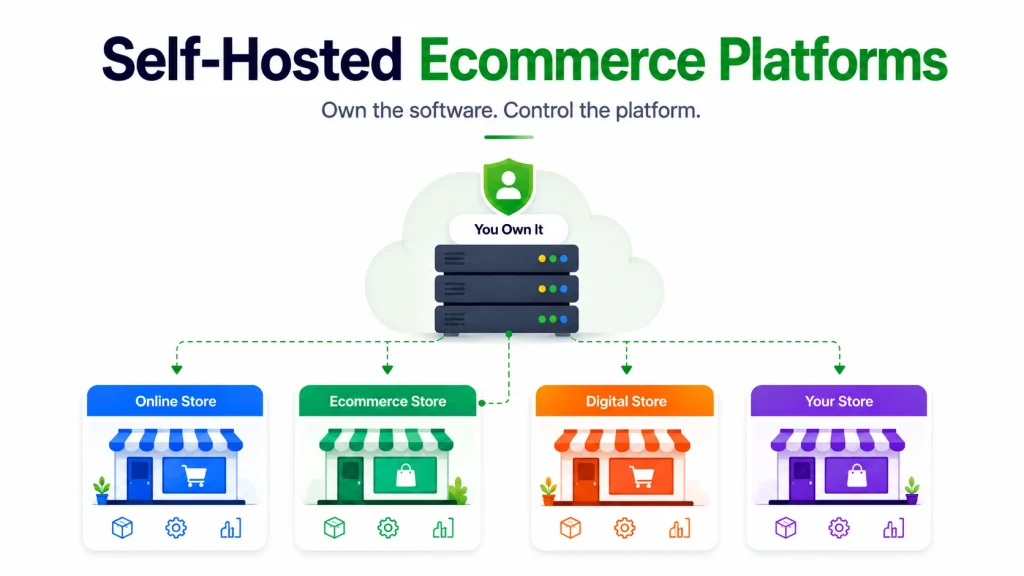
If you want to be the landlord (launch a platform others sell on) or simply own your store without a monthly platform fee, a self-hosted SaaS ecommerce platform is the answer. You host it, you control it, and no vendor takes a cut of every sale.
1. Nazmart (best for launching your own store-rental SaaS)
Type: self-hosted, multi-tenant. Disclosure: this is our own product.
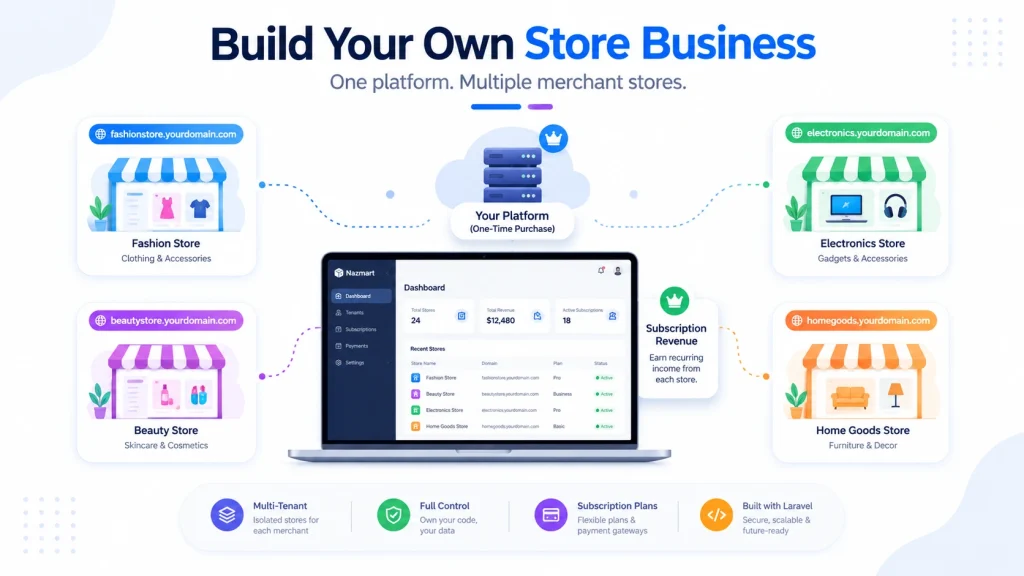
Nazmart is a multi-tenancy ecommerce platform that lets you run your own SaaS ecommerce platform business. Each merchant who signs up gets their own store with a subdomain or custom domain, their own products, themes, and settings, while you own the whole system and collect the subscription revenue. It is built on Laravel, self-hosted, and sold as a one-time product rather than a monthly fee.
Pros:
- Purpose-built to launch a multi-tenant SaaS ecommerce platform, not just one store
- Each tenant gets an isolated store with subdomains or custom domains
- One-time cost and self-hosted, so no per-store platform fees eating your margin
- Subscription plans, payment gateways, and an admin panel built in
- You own the code and data, so you control pricing and features
Cons:
- You host and maintain it, which is real work compared to a hosted tool
- Aimed at founders building a business, not someone who just wants to sell a few products
- Needs a server and basic technical setup to launch
Honest positioning: if you want to be the next Shopify for a niche or region, Nazmart is exactly the kind of SaaS ecommerce platform you build on. If you only want to sell your own products, a hosted platform below is the faster route.
2. WooCommerce
Type: self-hosted WordPress plugin. Free (plus hosting).
WooCommerce turns any WordPress site into a store, and it powers a huge share of the web’s online shops. It is the most popular self-hosted SaaS ecommerce platform by market share, free, open source, and endlessly extensible, so if you already run WordPress, it is the natural way to sell. You host it, so you own your data and avoid platform fees.
Pros: free and open source, massive plugin and theme ecosystem, full control, no transaction cut.
Cons: you manage hosting, security, and updates yourself, and costs come from plugins and hosting rather than a subscription.
Best for: anyone already on WordPress who wants to own their store fully.
3. Bagisto
Type: self-hosted, open source, Laravel. Free.
Bagisto is an open-source SaaS ecommerce platform built on Laravel, which makes it a strong pick if your team works in that stack. It gives you a modern, customizable store you host and own, and because it is Laravel-native, developers can extend it comfortably.
Pros: free and open source, built on Laravel, clean codebase, multi-store and multi-currency support.
Cons: you need Laravel and hosting skills, smaller ecosystem than WooCommerce.
Best for: Laravel teams that want a self-hosted store they can shape. If Laravel is your stack, see our guide to building with it in our Laravel ecommerce coverage.
4. Adobe Commerce / Magento
Type: self-hosted or enterprise. Open source available.
Adobe Commerce, still widely known as Magento, is a powerful SaaS ecommerce platform for large, complex stores. The open-source edition is free to self-host, and it handles big catalogs, multiple stores, and heavy customization. The trade-off is complexity: it is demanding to run.
Pros: extremely powerful and flexible, handles large catalogs, strong for enterprise.
Cons: heavy and complex to run, needs real developer resources.
Best for: large stores with the technical team to manage a serious platform.
5. PrestaShop
Type: self-hosted, open source. Free.
PrestaShop is a mature open-source ecommerce platform, popular in Europe, with a big module marketplace. It sits between WooCommerce and Magento: more of a dedicated store platform than a plugin, lighter than Magento. You host and own it.
Pros: free and open source, feature-rich out of the box, strong in Europe.
Cons: module quality varies, you manage hosting and updates.
Best for: merchants who want a dedicated open-source store platform without Magento’s weight.
6. Shopify
Type: hosted. Starting around $39 a month.
Shopify is the most popular SaaS ecommerce platform for running a single store. It is polished, reliable, and has a huge app ecosystem, so almost anything you need is a few clicks away. Setup is genuinely fast, and it scales from a first sale to enterprise volume.
Pros: fastest polished setup, massive app store, strong payments and checkout, great for beginners.
Cons: monthly fees plus extra transaction fees unless you use Shopify Payments, less control over the code.
Best for: merchants who want a proven, low-hassle store and will trade some control for speed.
7. BigCommerce
Type: hosted. Starting around $39 a month.
BigCommerce is a strong Shopify rival with more built-in features and, notably, no extra transaction fees on any plan. It suits stores that are scaling and want more out of the box without piling on paid apps.
Pros: no transaction fees, lots of native features, good for larger catalogs.
Cons: interface is less beginner-friendly than Shopify, some plans have annual sales thresholds.
Best for: growing stores that want built-in features and no per-sale platform cut.
8. Wix ecommerce
Type: hosted. Starting around $29 a month.
Wix pairs a well-known website builder with ecommerce, so you get strong design control and an easy drag-and-drop editor. It is a good SaaS ecommerce platform for small stores where the look matters and the catalog is modest.
Pros: excellent design freedom, easy editor, affordable entry plans.
Cons: less powerful for large catalogs, can slow down as the store grows.
Best for: small businesses and creators who want a beautiful store without complexity.
9. Squarespace
Type: hosted. Starting around $27 a month.
Squarespace is known for elegant templates, and its commerce features suit brand and content-driven stores. If your selling is tied to strong visuals, a blog, or a portfolio, it fits naturally.
Pros: beautiful templates, strong content and blogging, simple to run.
Cons: fewer ecommerce-specific features than Shopify or BigCommerce, smaller app ecosystem.
Best for: creators and brands who want a SaaS ecommerce platform where design and content lead the sale.
10. Ecwid
Type: hosted add-on. Free tier available.
Ecwid bolts a store onto a site you already have, whether that is WordPress, Wix, or plain HTML. If you do not want to rebuild, it is the easiest way to add selling to your current site.
Pros: free tier, works on top of an existing site, simple to set up.
Cons: less of a standalone platform, advanced features need paid plans.
Best for: businesses that already have a website and just want to add a store.
11. Square Online
Type: hosted. Free tier available.
Square Online connects tightly with Square’s point-of-sale, so it shines when you sell both in a shop and online. Inventory and payments sync across both, which is the whole appeal.
Pros: free tier, excellent in-person plus online sync, simple payments.
Cons: less flexible for large or complex online-only catalogs.
Best for: retailers and food businesses selling in person and online together.
12. Shift4Shop
Type: hosted. Pricing varies.
Shift4Shop packs a lot of built-in ecommerce features into a hosted platform, which appeals to stores that want depth without stacking apps. Availability and pricing vary by region and payment setup, so check current terms.
Pros: many native features, established platform.
Cons: dated in places, terms depend on payment processing.
Best for: stores that want feature depth in a hosted tool.
13. Volusion
Type: hosted. Starting around $35 a month.
Volusion is a long-running hosted platform aimed at straightforward, catalog-based stores. It covers products, payments, and inventory cleanly, though it is less flashy than newer rivals.
Pros: simple to run, solid inventory tools, established.
Cons: dated interface, fewer modern features and integrations.
Best for: small stores that want a no-frills hosted catalog.
Hosted vs self-hosted: which do you actually need?
This is the decision that everything hinges on, so make it first.
Choose a hosted SaaS ecommerce platform if you want to sell your own products with no maintenance. Shopify, BigCommerce, or Wix will have you selling within a day, and the monthly fee buys you zero upkeep. This is the right path for most shop owners. Founders on a tight budget often start with a ready-made eCommerce PHP script before committing to a full SaaS build.
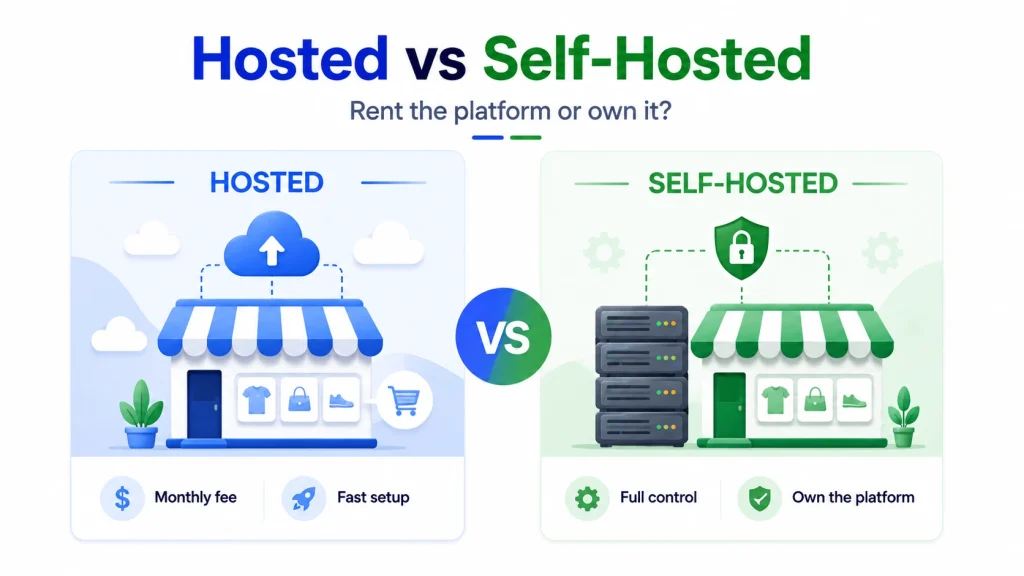
Choose a self-hosted platform if you want to own the whole thing. If you want a store you fully control (WooCommerce, Bagisto, PrestaShop) or, bigger, a platform that other merchants sell on and pay you for, you need to host it yourself, and Nazmart is built for exactly that. You take on hosting, but you keep control and, in the store-rental model, all the subscription revenue.
The quick test: do you want to rent, or own? Renters use hosted platforms. Owners self-host. If you are still deciding what to sell, our guide on how to launch an ecommerce website walks through the merchant path step by step.
What a SaaS ecommerce platform costs
Costs split along the same two lines, and the difference is bigger than it looks over time.
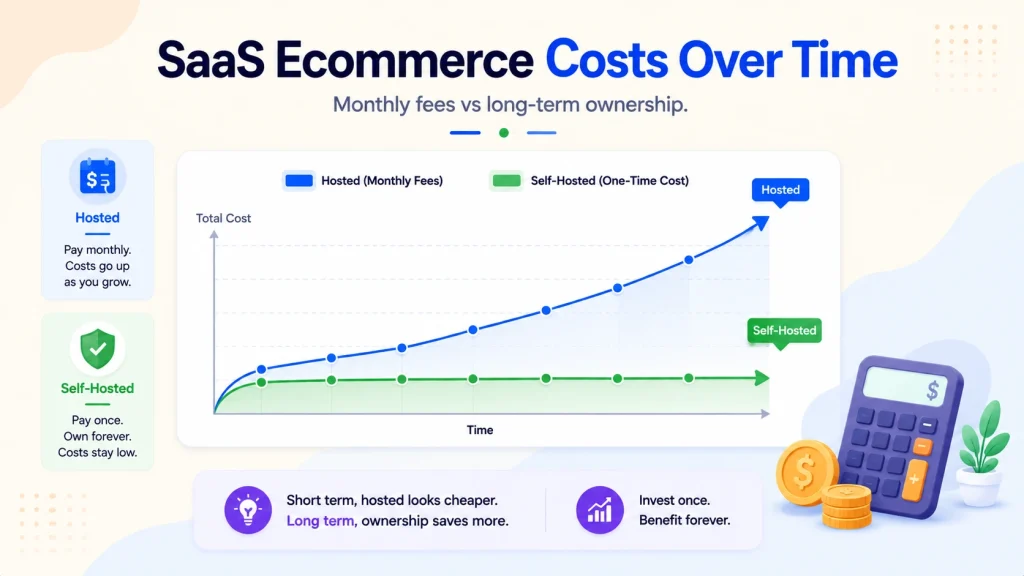
Hosted platforms charge monthly, usually $27 to $39 to start, climbing to hundreds on higher tiers, plus payment processing and often extra transaction fees and paid apps. It is cheap to begin and predictable, but the bill never stops and grows with your success.
A self-hosted SaaS ecommerce platform like Nazmart is typically a one-time cost (or free, for open-source options like WooCommerce and Bagisto) plus your own hosting. You pay more attention up front and you run the server, but there is no platform fee skimming every sale, and no per-store charge as you add merchants. For a platform business with many tenants, that math is the whole point: your costs stay flat while your subscription revenue grows.
If you are weighing a build, it also helps to understand the architecture, since a store-rental business is a multi-tenant system. Our explainer on multi-tenant SaaS architecture covers how tenant isolation works before you commit.
How to choose the right SaaS ecommerce platform
Run through these questions and the answer usually settles itself.
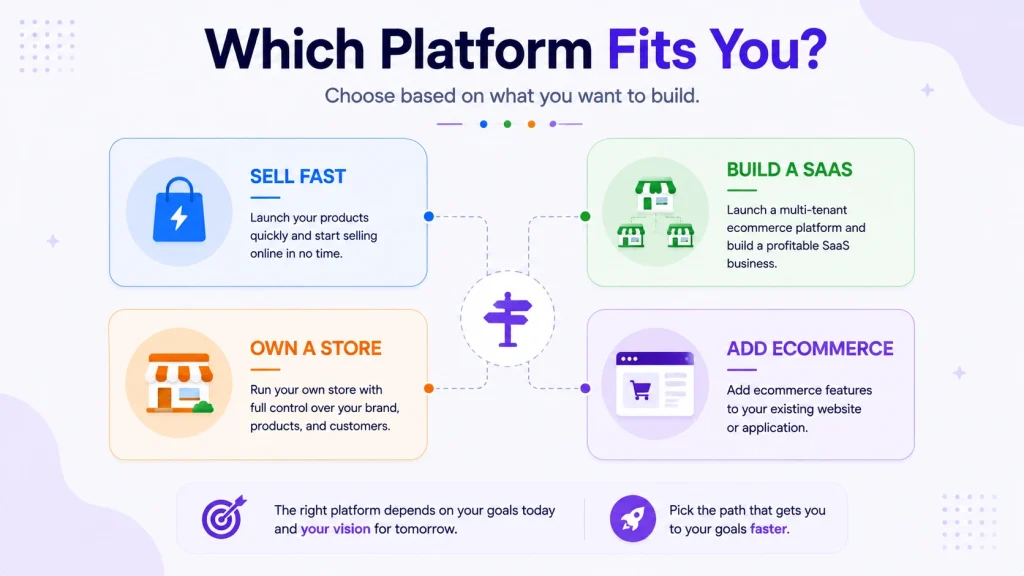
- Are you selling, owning a store, or building a platform? Selling fast points to hosted (Shopify, BigCommerce, Wix). Owning a store points to self-hosted (WooCommerce, Bagisto). Building a store-rental business points to Nazmart.
- How fast do you need to launch? A hosted store goes live in a day. A self-hosted platform takes setup but pays back in ownership.
- What is your budget shape? Prefer low upfront and steady monthly, go hosted. Prefer one cost and no ongoing platform cut, self-host.
- Do you have technical help? Hosted needs none. Self-hosted needs basic server skills or a developer.
- How much control do you want? Hosted limits you to the platform’s rules. Owning the code lets you change anything.
Match the SaaS ecommerce platform to your goal, not to whichever brand you have heard of most, and you will not outgrow it in six months. The right SaaS ecommerce platform is the one that fits how you want to run the business, not the loudest name.
The Bottom Line
A SaaS ecommerce platform is only the right choice once you are clear on which kind you need. If you want to sell your own products fast, pick a hosted platform: Shopify for polish, BigCommerce for built-in features, Wix for design. You will be live quickly and maintenance-free, and the monthly fee is the price of that convenience.
If you want to own the whole thing, whether that is a store you fully control or a platform that merchants sell on and pay you for, a hosted tool cannot get you there, because you would be renting instead of owning. That is the gap Nazmart fills: a self-hosted, multi-tenant SaaS ecommerce platform you buy once and own, so you can launch your own store-rental service and keep the revenue. Decide whether you want to rent or own, and the right platform is obvious. And if you would rather have a team build a custom platform for you, our custom SaaS development service can help.
Frequently asked questions
What is a SaaS ecommerce platform?
It is ecommerce software you use online for a subscription, where the provider handles hosting, updates, and security. The term also covers self-hosted software you use to own your store or launch your own store platform.
Which SaaS ecommerce platform is best for beginners?
For selling your own products, Shopify is the easiest to start with. It sets up fast and needs no technical skill.
How do I build my own SaaS ecommerce platform?
You need multi-tenant ecommerce software like Nazmart that gives each merchant their own store while you own the system. You host it, set your subscription plans, and merchants sign up and pay you.
Is a hosted or self-hosted SaaS ecommerce platform cheaper?
Hosted is cheaper to start but charges monthly forever and often takes a cut of sales. Self-hosted costs more up front (or is free and open source) but has no ongoing platform fee, which wins over time, especially for a platform with many stores.
What is the best self-hosted ecommerce platform?
For owning a single store, WooCommerce and Bagisto lead. For launching a multi-tenant store-rental business, Nazmart is purpose-built for it.
Do I need coding skills?
For hosted platforms, no. For self-hosted options like Nazmart, WooCommerce, or Bagisto, you need basic server setup or a developer to launch and maintain them.