

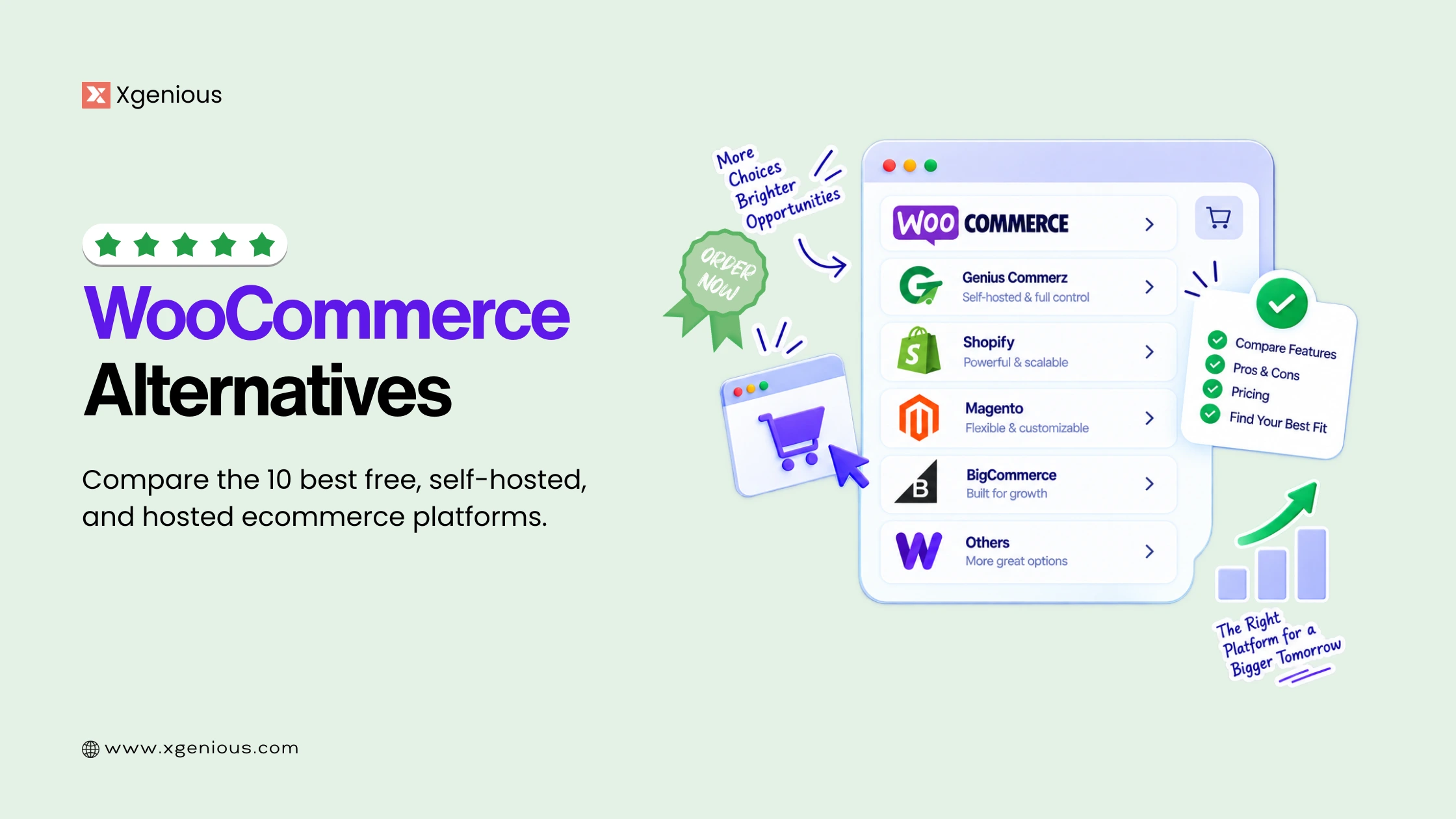


WooCommerce is free to install, and that is exactly why the real cost sneaks up on you. Every regional payment gateway, every courier, every tax setup, and most serious features come as separate paid extensions, and the bill for a working store adds up fast. Add plugin conflicts, updates, and performance tuning, and a lot of store owners start looking for WooCommerce alternatives that ship those pieces in the box.
This guide compares the 10 best WooCommerce alternatives for 2026, both self-hosted platforms you own and hosted ones you rent, by cost, built-in features, and who each fits. Full disclosure: Genius Commerz, the first tool on the list, is our own free product, and I have scored it honestly and pointed out exactly when staying on WooCommerce is the smarter call.
Key takeaways
- WooCommerce alternatives split into two camps: self-hosted platforms you own and hosted platforms you rent.
- The real reason people leave WooCommerce is extension cost and plugin sprawl, not the free core software.
- For a self-hosted, free WooCommerce alternative with payments, shipping, and tax built in, Genius Commerz ships 98 integrations with 0% commission.
- Hosted alternatives like Shopify and BigCommerce trade monthly fees for zero maintenance.
- Stay on WooCommerce if you need the largest plugin ecosystem and deep WordPress integration; leave it if the extension bill and upkeep outweigh that.
Table of Contents
Why look for a WooCommerce alternative?
WooCommerce powers a huge share of the web’s stores, and the core plugin genuinely is free. So why do so many owners search for WooCommerce alternatives? The reasons are consistent.
The first is extension cost.
WooCommerce keeps the core lean and pushes almost everything else into add-ons. Each regional payment gateway, each shipping carrier, each tax automation, and most advanced features is a separate paid plugin with its own annual renewal. A functioning cross-border store can end up paying for a dozen extensions, which quietly costs more than a hosted platform’s monthly fee.
The second is plugin sprawl and maintenance.
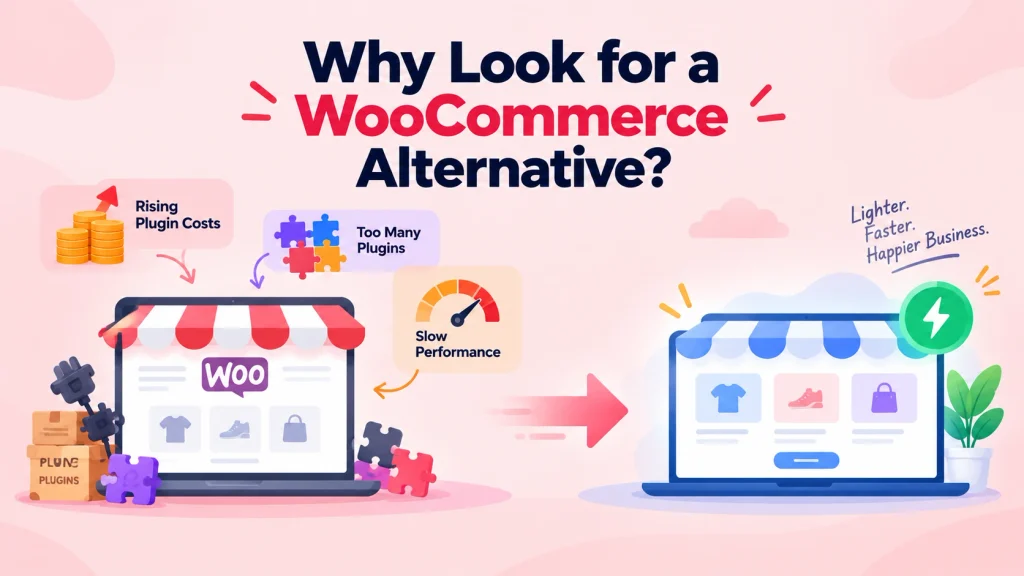
A WooCommerce store that leans on twenty plugins is twenty things that can conflict, break on an update, or slow the site down. Someone has to keep that stack healthy, and for a small team that is real, recurring work.
The third is performance and dependencies.
WooCommerce runs on top of WordPress, which is a content management system first and a store second. As the catalog grows, the WordPress dependency and plugin weight can drag on speed. Owners who want a platform built for commerce from the ground up start weighing WooCommerce alternatives that are purpose-built.
What to look for in a WooCommerce alternative
Not every WooCommerce alternative solves the problem you actually have. Run any option through this checklist before you switch.
- Built-in payments, not per-gateway plugins. The whole point of leaving WooCommerce is escaping the extension-per-feature model. A strong alternative ships payment gateways in the box.
- Shipping and tax included. Real carrier rates and destination-based tax should be native, not a $99 plugin each.
- Self-hosted or hosted. Decide whether you want to own the platform (self-hosted, more control) or rent it (hosted, zero maintenance). It changes everything else.
- Source access. If you self-host, full source code means you can customize and are not locked in.
- No per-sale commission. Some platforms take a cut of every order. Confirm the fee model before you commit.
- A real integration layer. Adding a new provider should be simple, not a fork of the checkout.
The 10 best WooCommerce alternatives
Here is the shortlist of WooCommerce alternatives before the detail. The first group is self-hosted, for owning your store; the second is hosted, for selling with zero maintenance. Confirm current pricing on each site before you commit.
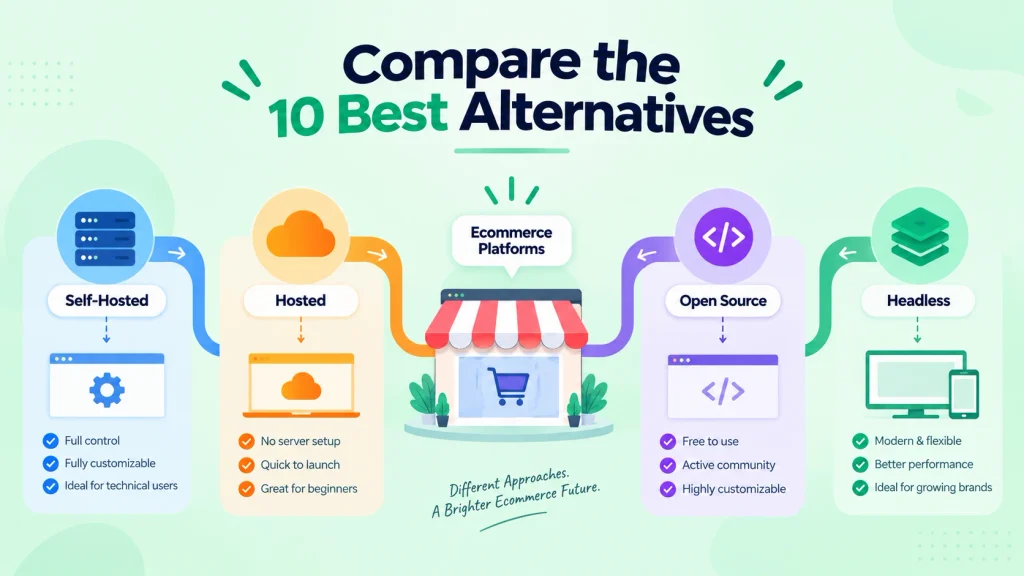
The 10 best WooCommerce alternatives compared at a glance
| # | Platform | Type | Cost | Payments/tax built in | Best for |
|---|---|---|---|---|---|
| 1 | Genius Commerz | Self-hosted, open source | Free (MIT) | Yes, 98 integrations | Free, no-commission, cross-border |
| 2 | Medusa.js | Self-hosted headless | Free | Via integrations | Developers, custom builds |
| 3 | Bagisto | Self-hosted (Laravel) | Free | Some built in | Laravel teams |
| 4 | PrestaShop | Self-hosted | Free | Some (paid modules) | Europe-focused stores |
| 5 | OpenCart | Self-hosted | Free | Some | Lightweight simple stores |
| 6 | Saleor | Self-hosted headless | Free | Via integrations | GraphQL and API-first teams |
| 7 | Shopify | Hosted | $29 to $299+/mo | Built-in | Fastest hosted switch |
| 8 | BigCommerce | Hosted | $39+/mo | Built-in | No transaction fees |
| 9 | Ecwid | Hosted add-on | Free tier | Built-in | Adding a store to a site |
| 10 | Wix ecommerce | Hosted | $29+/mo | Built-in | Small, design-led stores |
Self-hosted WooCommerce alternatives
If your issue with WooCommerce is cost and control, a self-hosted alternative keeps you in the same “you own it” model without the extension-per-feature tax.
1. Genius Commerz (best free, self-hosted alternative)
Type: self-hosted, open source, MIT licensed. Disclosure: this is our own product.
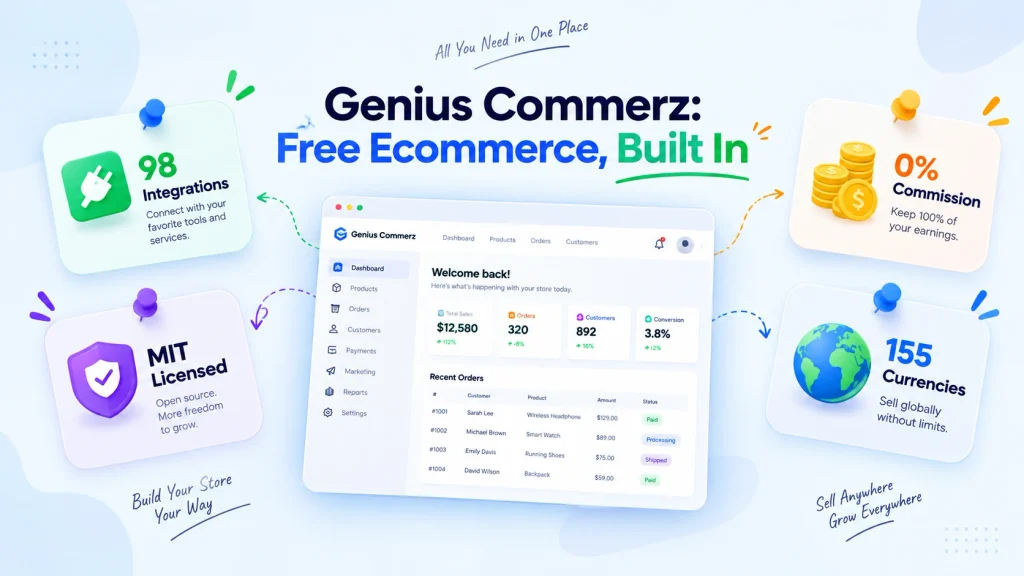
Genius Commerz is a free, self-hosted ecommerce platform built for merchants selling across borders. It ships 98 provider integrations in the box: 39 payment gateways, 19 shipping carriers, 20 SMS gateways, and 11 fraud checkers, across 213 countries and 155 currencies, with 0% commission on every order.
Where WooCommerce makes each gateway, courier, and tax setup a separate paid extension, Genius Commerz includes them all on one integration layer. It is built on Laravel 12 and React 19, so a new payment provider is two files, not a fork of the checkout.
Pros:
- 98 integrations built in, so no per-plugin fees for gateways, shipping, or fraud checks
- 0% commission and MIT licensed, so you keep 100% of revenue and can white-label it
- Country-aware checkout, multi-currency accounting, and destination-based tax out of the box
- Full Laravel and React source, easy to extend
- Genuinely free forever, not a limited tier of a paid product
Cons:
- Newer than WooCommerce, so a smaller community and plugin ecosystem
- Self-hosted, so you run the server (that is the point, but it is a step)
- No automated importer from WooCommerce yet, so migration is manual
Honest positioning: if you are leaving WooCommerce specifically to escape extension costs and want cross-border features built in, Genius Commerz is the closest like-for-like free alternative. If you rely on WooCommerce’s huge plugin library, that ecosystem is still larger.
2. Medusa.js
Type: self-hosted, open source, headless. Free.
Medusa is an open-source headless commerce engine built in Node.js. It gives developers a flexible backend with a modular architecture, so you build the storefront you want on top. It is a strong WooCommerce alternative for teams that want full control and a modern JavaScript stack, and one of the more flexible WooCommerce alternatives for a custom build.
Pros: modular and developer-friendly, headless flexibility, active community.
Cons: you build the storefront yourself, so it needs real development resources.
Best for: developer teams building a custom store rather than installing a ready-made one.
3. Bagisto
Type: self-hosted, open source, Laravel. Free.
Bagisto is an open-source ecommerce platform built on Laravel, with multi-store, multi-currency, and a clean codebase. If your team works in Laravel, it is comfortable to extend and a natural WooCommerce alternative for the PHP world.
Pros: free and open source, Laravel-native, multi-store support.
Cons: smaller ecosystem than WooCommerce, needs Laravel and hosting skills.
Best for: Laravel teams who want a self-hosted store they can shape.
4. PrestaShop
Type: self-hosted, open source. Free.
PrestaShop is a mature open-source platform, popular in Europe, with a large module marketplace. It is a dedicated store platform rather than a plugin, so it sits between WooCommerce and heavier systems.
Pros: feature-rich out of the box, strong in Europe, big module library.
Cons: module quality varies and some are paid, you manage hosting.
Best for: merchants who want a dedicated open-source store, especially in the EU.
5. OpenCart
Type: self-hosted, open source. Free.
OpenCart is a long-running, lightweight open-source WooCommerce alternative that is simple to run and covers the essentials cleanly. It is a good WooCommerce alternative for straightforward catalog stores that do not need heavy customization.
Pros: lightweight and simple, established, free.
Cons: dated in places, advanced features need extensions.
Best for: small, simple stores that want low overhead.
6. Saleor
Type: self-hosted, open source, headless GraphQL. Free.
Saleor is an open-source, GraphQL-first commerce platform for teams that want an API-driven backend and a custom frontend. Like Medusa, it is headless, so it suits modern development workflows.
Pros: modern GraphQL API, scalable, strong for custom frontends.
Cons: headless means you build the storefront, developer resources required.
Best for: API-first teams building bespoke commerce experiences.
Hosted WooCommerce alternatives
If your issue with WooCommerce is the upkeep rather than the cost, a hosted platform removes maintenance entirely. You pay monthly, they handle everything technical.
7. Shopify
Type: hosted. Starting around $29 to $39 a month.
Shopify is the most popular hosted platform and the most common destination for WooCommerce leavers who want zero maintenance. It sets up fast, has a huge app store, and scales well. The trade-off is monthly fees plus extra transaction fees unless you use Shopify Payments.
Pros: fastest polished setup, massive app store, no maintenance.
Cons: monthly fees, transaction fees without Shopify Payments, less control over code.
Best for: merchants who want a proven hosted store and will trade control for speed.
8. BigCommerce
Type: hosted. Starting around $39 a month.
BigCommerce is a strong hosted WooCommerce alternative with more built-in features and no extra transaction fees on any plan, which matters for growing stores.
Pros: no transaction fees, lots of native features, good for larger catalogs.
Cons: less beginner-friendly than Shopify, some plans have sales thresholds.
Best for: growing stores that want built-in features without a per-sale cut.
9. Ecwid
Type: hosted add-on. Free tier available.
Ecwid bolts a store onto a site you already have, including a WordPress site, which makes it an interesting WooCommerce alternative if you want to keep WordPress but drop the WooCommerce stack.
Pros: free tier, works on top of an existing site, simple.
Cons: less of a standalone platform, advanced features need paid plans.
Best for: businesses that want to add selling to a current site without a rebuild.

10. Wix ecommerce
Type: hosted. Starting around $29 a month.
Wix pairs an easy website builder with ecommerce and strong design control. It is a good hosted WooCommerce alternative for small stores where the look matters and the catalog is modest.
Pros: great design freedom, easy editor, affordable entry plans.
Cons: less powerful for large catalogs, can slow as the store grows.
Best for: small businesses and creators who want a beautiful store without complexity.
WooCommerce vs Genius Commerz: the head-to-head
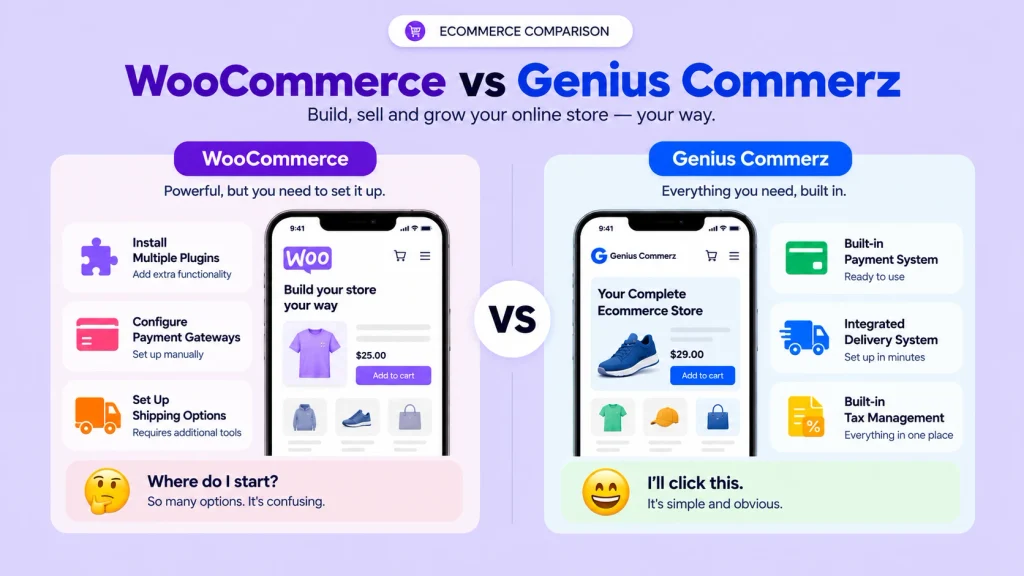
Since Genius Commerz is the closest free, self-hosted alternative, it deserves a direct comparison. Both are free and self-hosted, so on paper they look similar. The difference is what ships in the box versus what you pay extra for.
| Feature | WooCommerce | Genius Commerz |
|---|---|---|
| Core software | Free (WordPress plugin) | Free (MIT, standalone) |
| Payment gateways | Usually a paid extension per gateway | 39 built in |
| Shipping carriers | Usually a paid extension per carrier | 19 built in, plus fallback rates |
| Tax automation | Usually a separate paid extension | EU VAT, UK VAT, US, Canada templates built in |
| Multi-currency | Plugin-dependent | 155 currencies, audit-safe accounting |
| Commission on sales | 0% | 0% |
| Runs on | WordPress | Standalone Laravel + React |
| Plugin ecosystem | Largest of any platform | Growing |
| Source access | Full | Full |
The pattern is clear. WooCommerce is free at the core but charges you, in extensions, for the gateways, couriers, and tax logic that Genius Commerz ships free. If your extension stack is where your WooCommerce budget goes, that gap is the whole reason to switch.
When to stay on WooCommerce
Being honest here matters, because WooCommerce is not the wrong choice for everyone.
Stay on WooCommerce if you rely on its plugin ecosystem, which is the largest of any platform by a wide margin, so there is an extension for almost anything. Stay if your business lives in WordPress and you want your store and content tightly integrated. For teams that want to own the code outright, a self-hosted eCommerce PHP script is usually cheaper over three years than any hosted plan.
And stay if your current stack simply works and the extension cost is not actually a pain point for you. WooCommerce alternatives are worth the switch when the extension bill, plugin maintenance, or performance genuinely outweigh that ecosystem, not before.
How to choose the right WooCommerce alternative
For teams that want to own the code outright, a self-hosted eCommerce PHP script is usually cheaper over three years than any hosted plan. Run through these questions and the answer usually settles itself.
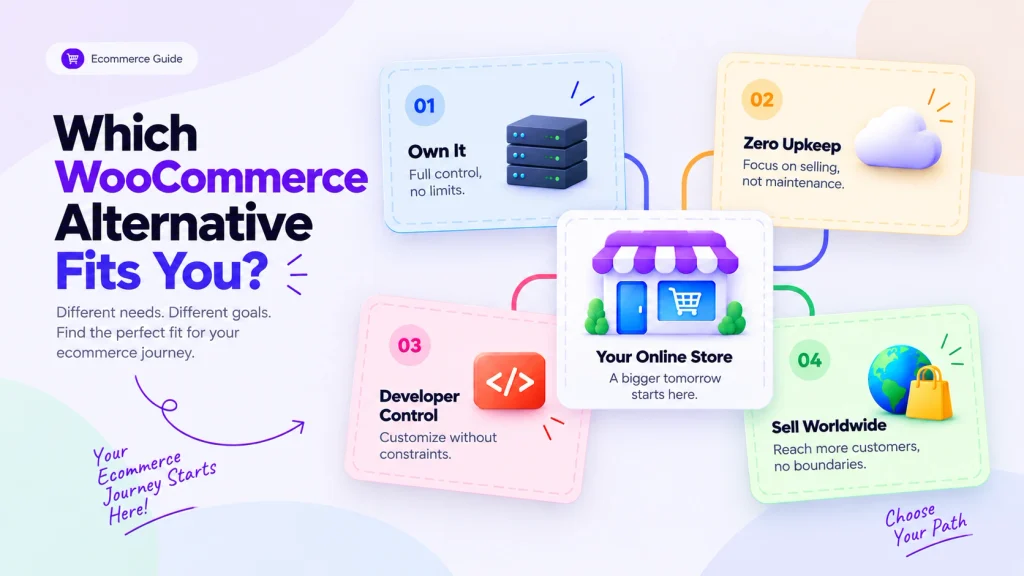
- Do you want to own the platform or rent it? Owning points to self-hosted (Genius Commerz, Bagisto, PrestaShop). Renting points to hosted (Shopify, BigCommerce).
- Is your problem cost or maintenance? Cost points to a free self-hosted alternative. Maintenance points to a hosted one.
- Do you have developers? Headless options (Medusa, Saleor) need real development. Ready-made ones (Genius Commerz, Shopify) do not.
- Do you sell across borders? If regional gateways and multi-currency matter, Genius Commerz ships them; most others need add-ons.
- How attached are you to WordPress? If very, Ecwid lets you keep WordPress. If not, a standalone platform is cleaner.
Match the WooCommerce alternative to your actual reason for leaving, and you will not end up switching twice. If you want a wider view, compare the 13 best SaaS ecommerce platforms, and if you are still planning your store, our guide on how to launch an ecommerce website walks through the steps.
Final thoughts
The best WooCommerce alternative depends on why you are leaving. If it is cost, a free self-hosted platform that ships payments, shipping, and tax in the box beats stacking paid extensions. If it is maintenance, a hosted platform like Shopify or BigCommerce removes the upkeep for a monthly fee. And if you genuinely rely on WooCommerce’s massive plugin ecosystem, staying is a defensible choice.
For store owners leaving specifically to escape extension costs, Genius Commerz is the closest free, self-hosted match: MIT licensed, 0% commission, with 98 payment, shipping, SMS, and fraud integrations across 213 countries built in. Download it, connect your gateways, and you own the whole store outright. And if you would rather have a team build or migrate your store for you, our custom SaaS development service can help.

Frequently asked questions
What is the best free WooCommerce alternative?
For a free, self-hosted alternative with payments, shipping, and tax built in, Genius Commerz is the closest like-for-like, since it ships 98 integrations with 0% commission. Bagisto, PrestaShop, and OpenCart are also fully free open-source options.
Is there a self-hosted WooCommerce alternative?
Yes. Genius Commerz, Medusa, Bagisto, PrestaShop, OpenCart, and Saleor are all self-hosted, so you run them on your own server and own the data, the same ownership model as WooCommerce without the WordPress dependency.
Which WooCommerce alternative has no transaction fees?
elf-hosted options like Genius Commerz take 0% commission. Among hosted platforms, BigCommerce charges no extra transaction fees on any plan, while Shopify adds them unless you use Shopify Payments.
Can I migrate from WooCommerce?
It depends on the platform. Most alternatives support CSV product import; some hosted platforms offer WooCommerce migration apps. Genius Commerz does not yet have an automated importer, so products and orders go in via CSV or database import.
Is WooCommerce or a hosted platform better for beginners?
A hosted platform like Shopify is easier for a true beginner, since there is no server to manage. WooCommerce and self-hosted alternatives give more control but need more technical comfort.
Why leave WooCommerce if the core is free?
Because the core being free is not the whole cost. The gateways, couriers, tax automation, and features you actually need are paid extensions, and maintaining a large plugin stack is ongoing work. Alternatives that ship those in the box can cost less overall.