



Most marketplace startups do not fail because the app was bad. They fail because one side of the market showed up and the other side did not.
I have watched this happen more times than I would like. A founder builds a clean booking flow, lists fifty cleaners or forty tutors or thirty handymen, runs some ads, and then waits. Customers arrive, search, find nobody available in their area at the time they want, and leave. The cleaners log in for a week, get no jobs, and stop opening the app. Six months later, the founder is asking why a product that “worked” has no transactions.
That is the whole problem with a two-sided marketplace business model in one paragraph. You are not building one product. You are running two businesses that only pay off when they meet in the middle, and the middle is harder to reach than almost anyone expects going in.
This article is about the five things that decide whether you get there. I call them the Liquidity Forces Map, partly because I needed a name for it and partly because, after a few years of building these platforms at Xgenious, these are the five numbers I look at before anything else. If you are planning an on-demand platform, you should read this alongside our guide to on-demand service marketplace development, which covers the build side. This one is about the economics underneath it.
What a Two-Sided Marketplace Business Model Really Is
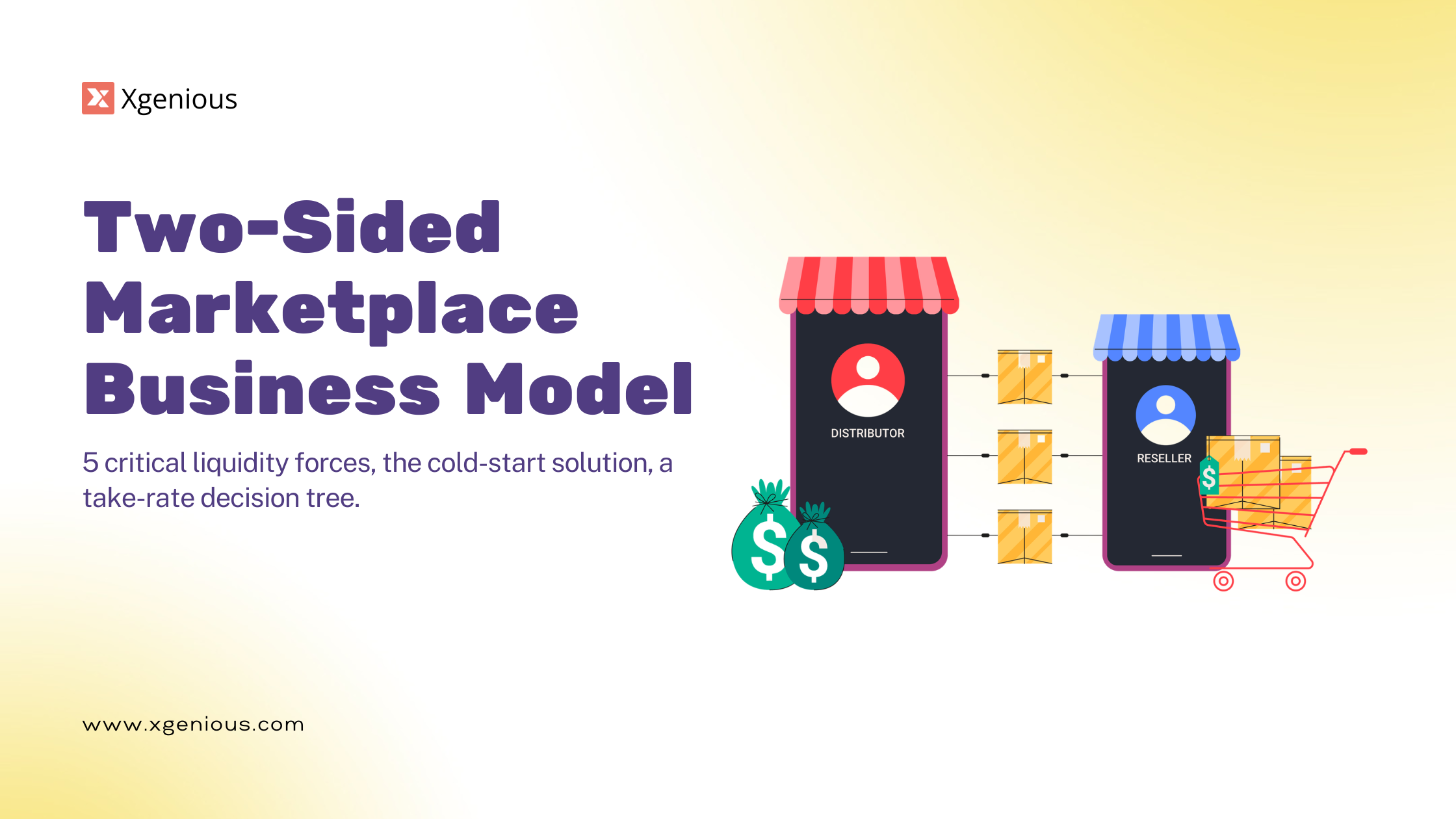
A two-sided marketplace business model connects two distinct groups who need each other but cannot easily find each other on their own, and it earns money by making that connection happen. One side has something to sell, usually time or a service or inventory. The other side wants to buy it. The platform sits between them, takes a cut, and ideally makes the whole transaction safer and faster than it would be otherwise.
1. The Two Sides
Every two-sided marketplace has a supply side and a demand side. In Airbnb, hosts are supply and guests are demand. In DoorDash, restaurants and drivers are supply and diners are demand (DoorDash is arguably three-sided). In Upwork, freelancers are supply and clients are demand. In a home service marketplace, providers are supply and homeowners are demand. The two sides have different needs, different acquisition channels, and different retention dynamics.
2. The Platform Creates Value by Reducing Friction
A two-sided marketplace business model creates value by making transactions between the two sides easier, safer, or cheaper than they would be otherwise. The platform provides discovery (helping demand find supply), trust (verification, reviews, payments protection), and transaction infrastructure (booking, payment, dispute resolution). The marketplace does not own the supply or perform the service; it makes the connection work.
3. What a Marketplace Is Not
A two-sided marketplace business model is not a saas business (saas sells software to one customer type). It is not e-commerce (e-commerce sells goods the company owns). It is not a service business (a service business employs the providers). Founders who confuse these models build the wrong thing: they hire providers when they should connect them, or they treat the marketplace like a single-customer saas and ignore one side.
4. Revenue Models
The two-sided marketplace business model earns revenue through one or more mechanisms: a take-rate (a percentage of each transaction, the most common), transaction fees (a fixed fee per transaction), subscription fees (charged to one or both sides), or listing fees. Take-rate is the dominant model because it aligns platform revenue with marketplace activity.
5. The Defining Property: Liquidity
The single defining property of a two-sided marketplace business model is liquidity: the probability that a participant on one side finds a satisfactory match on the other side quickly. A liquid marketplace delivers value reliably and grows through network effects. An illiquid marketplace, no matter how good its product, delivers no value and dies. Everything in this guide traces back to liquidity.
Why Most Two-Sided Marketplace Models Fail in Year One
Most attempts at a two-sided marketplace business model fail, and the failure follows a predictable pattern. Understanding why marketplaces fail is the first step to building one that does not.
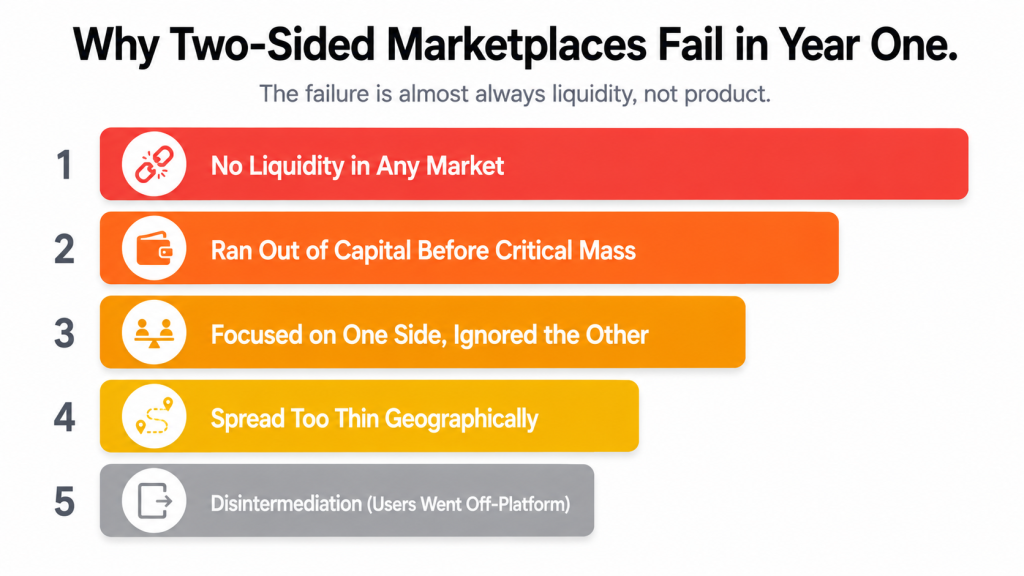
Failure 1: No Liquidity in Any Market
The most common failure of a two-sided marketplace business model is reaching the end of the runway with no market liquid enough to deliver reliable value. Supply is too thin, demand is too thin, or both. Users try the marketplace, fail to find a match, and do not return.
Failure 2: Capital Ran Out Before Critical Mass
Building liquidity takes capital: subsidies, marketing, operations. Many marketplaces fail because they underestimated how much capital reaching critical mass would require and ran out before the marketplace became self-sustaining.
Failure 3: Focused on One Side, Ignored the Other
A two-sided marketplace business model requires both sides. Founders often build for the side they understand and neglect the other. A marketplace with great demand and no supply, or great supply and no demand, delivers no value. The neglected side is what kills the marketplace.
Failure 4: Spread Too Thin Geographically
For location-based marketplaces, geographic concentration is essential. A marketplace with participants scattered across many cities has density in none. Spreading thin produces an illiquid marketplace everywhere instead of a liquid one somewhere.
Failure 5: Disintermediation
Once two sides meet through the marketplace, both may have incentive to transact off-platform to avoid the take-rate. A two-sided marketplace business model that adds no ongoing value beyond the initial introduction loses transactions to disintermediation.
The pattern across all five failures: the two-sided marketplace business model is uniquely fragile in its early life because it delivers no value until both sides reach density. The Liquidity Forces Map exists to diagnose and manage that fragility.
The Liquidity Forces Map Framework
The Liquidity Forces Map is the framework this guide is built around. It identifies the 5 critical forces that together determine whether a two-sided marketplace business model reaches and sustains liquidity.
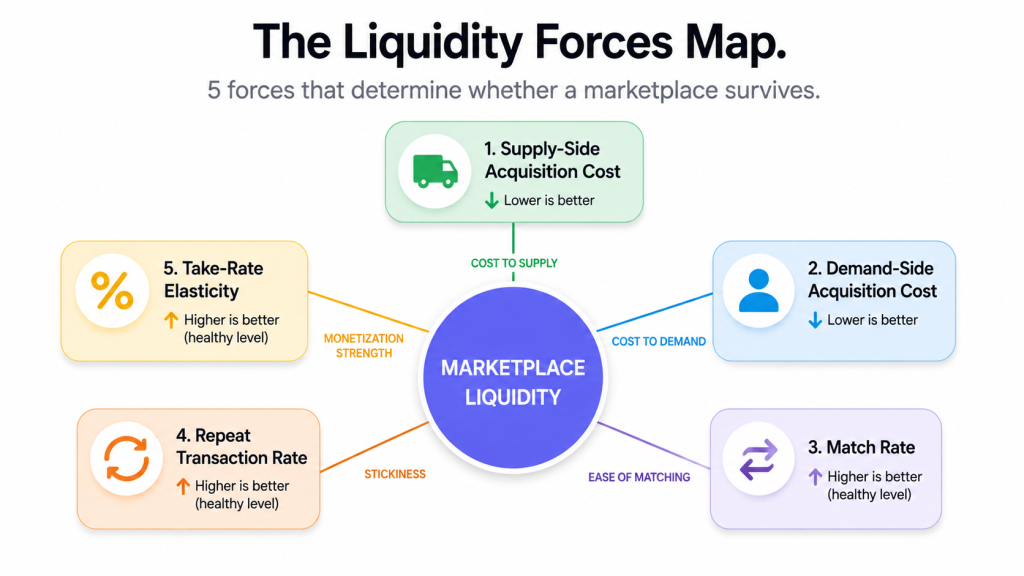
The 5 Forces
Force 1: Supply-Side Acquisition Cost. What it costs to bring one provider onto the marketplace. Lower is better.
Force 2: Demand-Side Acquisition Cost. What it costs to bring one customer onto the marketplace. Lower is better.
Force 3: Match Rate. How often a participant who comes to transact finds a satisfactory match. Higher is better; this is the direct measure of liquidity.
Force 4: Repeat Transaction Rate. How often participants come back and transact again. Higher is better; this is what amortizes acquisition cost.
Force 5: Take-Rate Elasticity. How much take-rate the marketplace can charge before supply or demand leaves. Wider elasticity is better.
How the Forces Interact
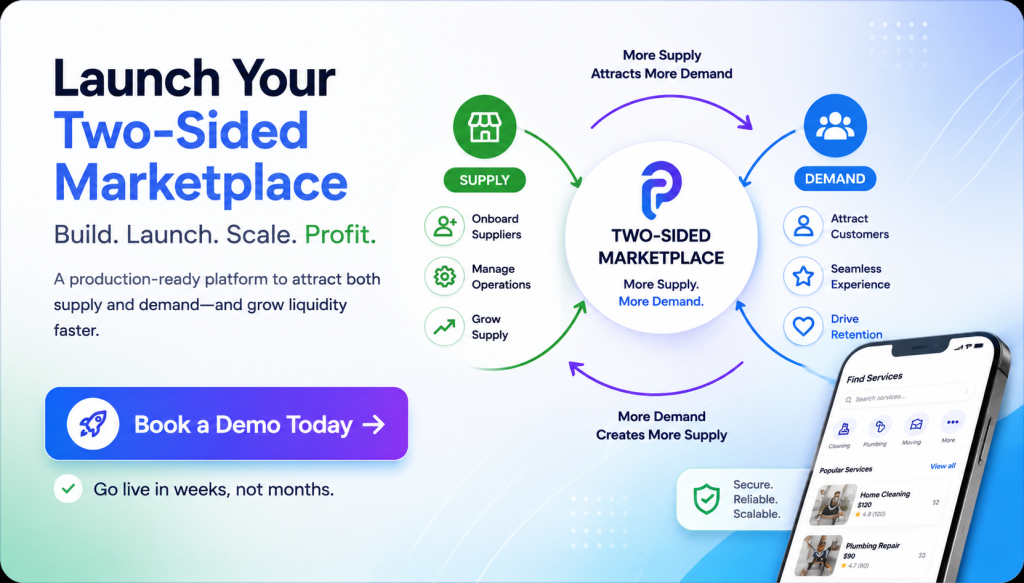
The 5 forces are not independent. A high match rate (Force 3) raises repeat transaction rate (Force 4), because participants who find good matches come back. A high repeat rate lowers effective acquisition cost (Forces 1 and 2), because each acquired participant generates more transactions. A marketplace with strong matches and high repeat rates can sustain a higher take-rate (Force 5), because participants get enough value to accept the fee. The forces compound: strength in one creates strength in others, and weakness in one drags down the rest.
Using the Map
The Liquidity Forces Map is a diagnostic tool. When a two-sided marketplace business model is struggling, the team measures each of the 5 forces and identifies the weakest. The weakest force is where effort should go. A marketplace with great match rate but brutal supply acquisition cost has a different problem, and a different fix, than a marketplace with cheap acquisition but a low repeat rate.
Force 1: Supply-Side Acquisition Cost
Force 1 of the two-sided marketplace business model is supply-side acquisition cost: what it costs to bring one provider, seller, host, or worker onto the platform.
Why Supply Acquisition Cost Matters
Every marketplace needs supply before it can serve demand. Supply-side acquisition cost determines how expensive it is to build the inventory of providers that makes the marketplace useful. A two-sided marketplace business model with high supply acquisition cost burns capital fast during the build-up phase.
What Drives Supply Acquisition Cost
Supply acquisition cost varies by how motivated the supply side is to join. Supply that is actively seeking demand (freelancers wanting clients, drivers wanting fares, providers wanting bookings) is cheap to acquire because the marketplace offers them something they want. Supply that is comfortable without the marketplace (established businesses, fully-booked providers) is expensive to acquire because the marketplace must overcome their inertia.
The Easier Side Is Usually Supply
In many marketplaces, supply is the easier and cheaper side to acquire because providers want demand. Freelancers will list on Upwork for free because they want clients. Hosts will list on Airbnb because they want bookings. This is why marketplace founders are often advised to seed supply first: it is usually the cheaper side, and demand will not come to an empty marketplace.
Tactics to Lower Supply Acquisition Cost
Supply acquisition cost drops with: targeting the most motivated supply segment first, making onboarding fast and frictionless, offering early providers visible benefits (featured placement, no fees during launch), partnering with organizations that aggregate supply (industry associations, existing provider networks), and word-of-mouth among providers once early adopters succeed.
Measuring Force 1
Track cost per acquired active provider, not just cost per signup. A provider who signs up and never completes a transaction did not actually join the marketplace. Active-provider acquisition cost is the real Force 1 metric.
Force 2: Demand-Side Acquisition Cost
Force 2 of the two-sided marketplace business model is demand-side acquisition cost: what it costs to bring one customer onto the platform.
Why Demand Acquisition Cost Matters
Supply without demand is a marketplace with nothing happening. Demand-side acquisition cost determines how expensive it is to build the customer base that gives providers a reason to stay. In a two-sided marketplace business model, demand acquisition cost is often the larger and harder cost.
What Drives Demand Acquisition Cost
Demand acquisition cost depends on how the marketplace reaches customers and how strong the customer’s need is. Customers with an urgent, frequent need (someone who needs a ride, a meal, a service) are easier to acquire. Customers with an occasional need are harder, because the marketplace must reach them at the rare moment the need exists.
Demand Is Often the Harder Side
In many marketplaces, demand is the harder and more expensive side because customers will not come to an empty or thin marketplace. Demand acquisition spending is wasted if those customers arrive and find no supply or a bad match. This is the chicken-and-egg dynamic at the heart of the cold-start problem covered later in this guide.
Tactics to Lower Demand Acquisition Cost
Demand acquisition cost drops with: launching demand acquisition only after supply density exists, geographic concentration so marketing spend hits a liquid market, content and SEO that capture customers searching for the service, referral mechanics that turn customers into acquirers, and a high match rate so acquired customers succeed and tell others.
The Acquisition Cost Balance
A healthy two-sided marketplace business model balances Force 1 and Force 2. If supply acquisition is cheap and demand acquisition is expensive, the marketplace should seed supply generously and spend demand acquisition only into liquid markets. The a16z Marketplace 100 research and NfX’s marketplace network effects work both document how the strongest marketplaces manage this balance.
Measuring Force 2
Track cost per acquired customer who completes a first transaction, and compare it to the customer’s projected lifetime value. Demand acquisition cost only makes sense in light of Force 4 (repeat transaction rate), because a customer who transacts once rarely justifies the acquisition spend.
Force 3: Match Rate
Force 3 of the two-sided marketplace business model is match rate: the probability that a participant who comes to transact finds a satisfactory match on the other side. Match rate is the most direct measure of liquidity.
Why Match Rate Is the Core Liquidity Metric
A marketplace exists to create matches. Match rate measures whether it actually does. A customer who searches and finds a good provider experiences a liquid marketplace. A customer who searches and finds nothing, or a bad fit, experiences an illiquid one and does not return. Match rate is the single number that best captures whether a two-sided marketplace business model is working.
What Match Rate Depends On
Match rate depends on three things: supply density (enough providers to cover demand), supply relevance (providers who match what demand actually wants), and matching quality (the platform’s ability to surface the right supply to the right demand). A marketplace can have plenty of supply and still have a low match rate if the supply does not match demand’s specific needs or if the matching system surfaces it poorly.
Geographic and Categorical Match Rate
For location-based marketplaces, match rate is geographic: a customer matches only with supply in their area. For categorical marketplaces, match rate is about specificity: a customer wanting a specific service, skill, or product matches only with supply that offers it. A two-sided marketplace business model must achieve match rate within each relevant geography and category, not just in aggregate.
Improving Match Rate
Match rate improves with: concentrating supply density in defined markets, recruiting supply that matches observed demand patterns, building a matching algorithm that surfaces relevant supply, and reducing the search effort demand must exert. The fastest way to raise match rate is usually to concentrate, not expand.
Measuring Force 3
Track the percentage of demand-side sessions or searches that result in a completed transaction, segmented by geography and category. A low match rate in a specific segment points exactly where supply or matching needs work.
Force 4: Repeat Transaction Rate
Force 4 of the two-sided marketplace business model is repeat transaction rate: how often participants return and transact again after their first transaction.
Why Repeat Rate Decides Marketplace Economics
Acquisition costs money. A participant who transacts once rarely generates enough revenue to justify their acquisition cost. The two-sided marketplace business model becomes economically viable only when participants transact repeatedly, amortizing the acquisition cost across many transactions. Repeat transaction rate is what turns an expensive acquisition into a profitable relationship.
Frequency Is Partly Structural
Some marketplace categories are naturally high-frequency: food delivery, ride-hailing, and recurring services generate frequent transactions. Others are naturally low-frequency: home sales, car purchases, and occasional services generate rare transactions. A two-sided marketplace business model in a low-frequency category must either accept lower repeat rates and find higher per-transaction value, or expand into adjacent higher-frequency services.
Repeat Rate and Match Rate Are Linked
Repeat transaction rate depends heavily on match rate. A participant who had a good match returns; a participant who had a bad match or no match does not. This is why Force 3 and Force 4 compound: improving match rate directly improves repeat rate, and the two together are what make a marketplace economically sustainable.
Improving Repeat Transaction Rate
Repeat rate improves with: a high match rate so first transactions succeed, retention features (saved preferences, preferred providers, recurring bookings, loyalty rewards), reducing repeat-transaction friction (one-tap rebooking), and staying in contact between transactions. The repeat-booking patterns covered in the vertical guides, such as pet care marketplace development and the recurring subscription patterns in cleaning, all serve Force 4.
Measuring Force 4
Track the percentage of participants who complete a second transaction, the average number of transactions per participant, and cohort retention curves. Flat retention curves indicate a healthy two-sided marketplace business model; declining curves indicate a leaky one.
Force 5: Take-Rate Elasticity
Force 5 of the two-sided marketplace business model is take-rate elasticity: how much the platform can charge as a take-rate before supply or demand starts leaving.
What Take-Rate Elasticity Means
Take-rate is the percentage of each transaction the marketplace keeps. Take-rate elasticity is the range within which the marketplace can set that percentage without driving participants away. A two-sided marketplace business model with wide elasticity can charge a healthy take-rate and fund growth; a model with narrow elasticity is squeezed between participants who resist any fee and a platform that needs revenue.
What Determines Elasticity
Take-rate elasticity depends on how much value the marketplace adds beyond the initial connection. A marketplace that provides ongoing value (trust, payment protection, dispute resolution, demand generation, convenience) can charge more because participants get more. A marketplace that only introduces the two sides and then adds nothing has narrow elasticity, because participants resent paying a fee for value they no longer receive.
Elasticity Differs by Side
The two sides of a two-sided marketplace business model have different take-rate tolerance. The side that benefits most from the marketplace tolerates a higher fee. In many service marketplaces, supply (providers wanting demand) tolerates the take-rate because the marketplace delivers customers. The platform usually charges the side that gets the most value, which is often, but not always, supply.
Elasticity Changes Over Time
Take-rate elasticity is not fixed. Early in a marketplace’s life, elasticity is narrow because the marketplace has not yet proven its value. As the marketplace builds liquidity and demonstrates value, elasticity widens and the platform can raise the take-rate. Many marketplaces launch with a low or zero take-rate to build liquidity, then raise it as the value becomes undeniable.
Why Elasticity Connects to the Other Forces
Take-rate elasticity is downstream of the other four forces. A marketplace with a high match rate (Force 3) and high repeat transaction rate (Force 4) delivers obvious ongoing value, which widens elasticity. A marketplace weak on those forces has narrow elasticity no matter what it wants to charge. This is why Force 5 sits last in the Liquidity Forces Map: it is largely earned by performance on the first four forces.
Measuring Force 5
Test take-rate elasticity by observing supply and demand behavior at different fee levels: does raising the take-rate cause providers to leave or list elsewhere, does it suppress demand. The right take-rate is the highest the marketplace can charge while keeping both sides healthy, which the decision tree below helps determine.
The Cold-Start Problem and How to Solve It
The cold-start problem is the defining early challenge of every two-sided marketplace business model: neither side wants to join until the other side is present, but the other side will not join either. Solving the cold-start problem is the difference between a marketplace that launches and one that never gets off the ground.
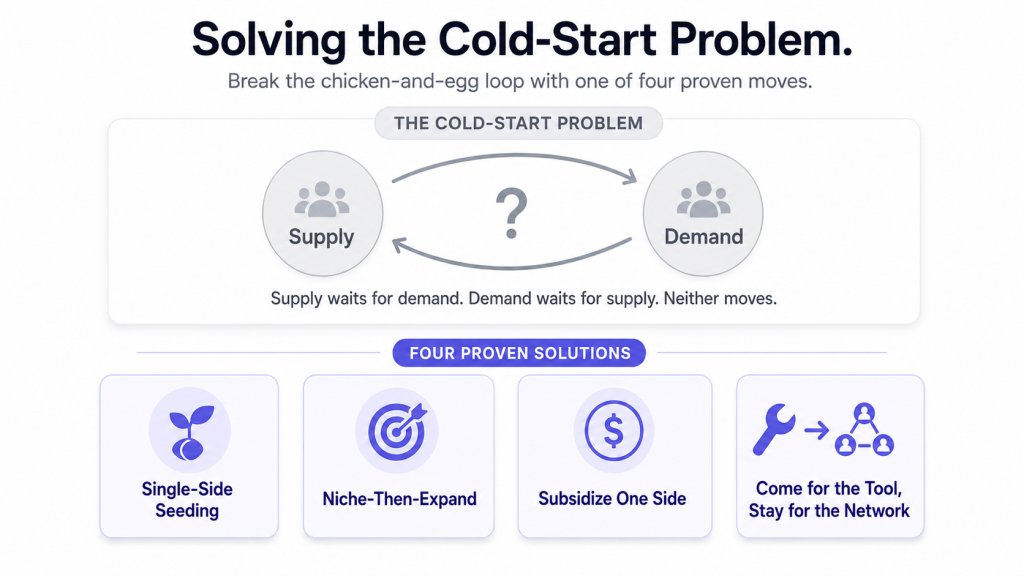
Why the Cold-Start Problem Exists
A two-sided marketplace business model delivers no value until both sides are present in density. A provider joining an empty marketplace finds no customers and leaves. A customer joining an empty marketplace finds no providers and leaves. The marketplace is stuck: it cannot attract either side without the other. This is the chicken-and-egg problem, and it is where most marketplaces die.
Solution 1: Single-Side Seeding
Pick the side that is easier to acquire (usually supply) and build it first, even before demand exists. Seed enough supply that when demand arrives, the marketplace already looks liquid. Many marketplaces manually recruit their first hundreds of providers one by one. Single-side seeding accepts that the marketplace will look lopsided early in exchange for solving the cold-start problem.
Solution 2: Niche-Then-Expand
Instead of launching a broad marketplace, launch in the narrowest viable niche, a single city, a single category, a single campus, where reaching liquidity requires far fewer participants. A narrow niche reaches density with hundreds of participants instead of tens of thousands. Once the niche is liquid, expand to adjacent niches one at a time. Airbnb’s early focus and Facebook’s campus-by-campus launch are the canonical examples.
Solution 3: Subsidize One Side
Use capital to make one side’s participation free or rewarded until the other side reaches density. Pay providers a bonus for early bookings, or give customers free or discounted first transactions. Subsidy buys liquidity with money. It works when the marketplace has enough capital and a clear path to a take-rate that recovers the subsidy later.
Solution 4: Come for the Tool, Stay for the Network
Launch as a single-player tool that delivers value to one side without needing the other side, then convert the tool’s users into a marketplace once enough have gathered. The classic pattern: offer providers a free scheduling or management tool, accumulate a base of providers, then open the marketplace to demand. The two-sided marketplace business model emerges from a single-player tool that already aggregated one side.
Choosing a Cold-Start Solution
Most successful marketplaces combine solutions: seed supply, focus on a niche, subsidize early activity, and provide standalone value. The right combination depends on capital, the category, and which side is harder. Sangeet Paul Choudary’s work on platform strategy and the NfX cold-start research document these solutions in depth.
Take-Rate Decision Tree (5% to 30% Range)
Setting the take-rate is one of the highest-stakes decisions in a two-sided marketplace business model. The viable range spans 5 to 30 percent, and the right number depends on a sequence of questions.
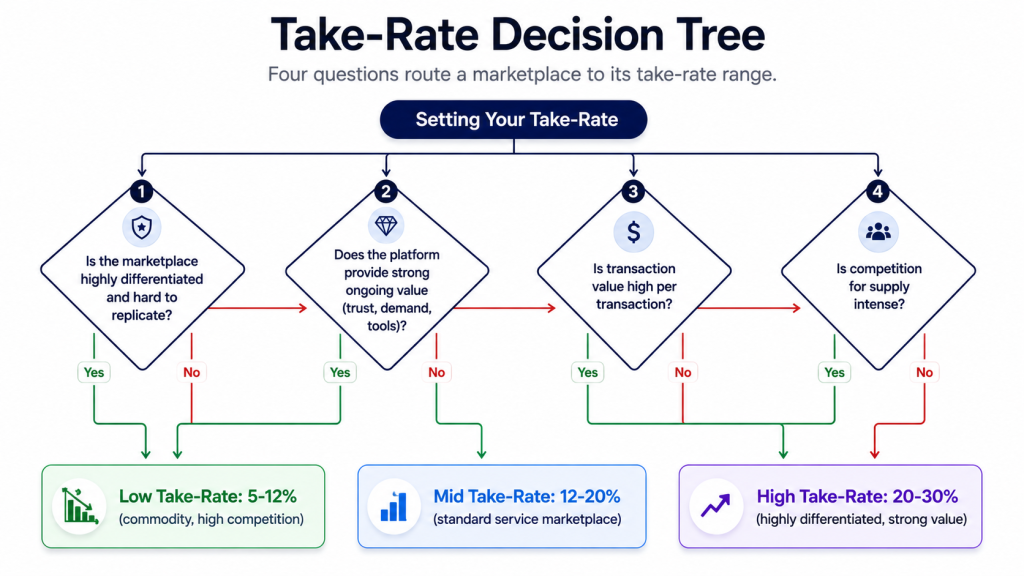
The Take-Rate Range
Two-sided marketplace business models charge take-rates from roughly 5 percent at the low end to 30 percent at the high end. PayPal-style payment-adjacent marketplaces sit near the low end. Standard service marketplaces sit in the middle. Highly differentiated marketplaces like Airbnb and DoorDash sit near the high end.
Question 1: Differentiation
Is the marketplace highly differentiated and hard to replicate? A marketplace with strong network effects, a unique supply base, or a hard-to-copy experience can charge a higher take-rate. A commodity marketplace where supply and demand could easily use a competitor must charge less.
Question 2: Ongoing Value
Does the platform provide strong ongoing value beyond the initial match? Trust infrastructure, demand generation, payment protection, dispute resolution, and provider tools all justify a higher take-rate. A marketplace that only introduces the two sides cannot charge much.
Question 3: Transaction Value
Is the value per transaction high? High-value transactions can sustain a higher percentage take-rate in absolute terms while still feeling reasonable. Low-value, high-frequency transactions often need a lower percentage or a fixed fee instead.
Question 4: Supply Competition
Is competition for supply intense? When multiple marketplaces compete for the same providers, take-rate becomes a recruiting lever, and the marketplace may need to charge less to attract and keep supply. When the marketplace has a strong supply position, it has more take-rate room.
The Take-Rate Is Not Permanent
A two-sided marketplace business model can and often should start with a low take-rate to solve the cold-start problem, then raise it as liquidity and value grow. The decision tree gives the target range; the timing of reaching that target depends on marketplace maturity.
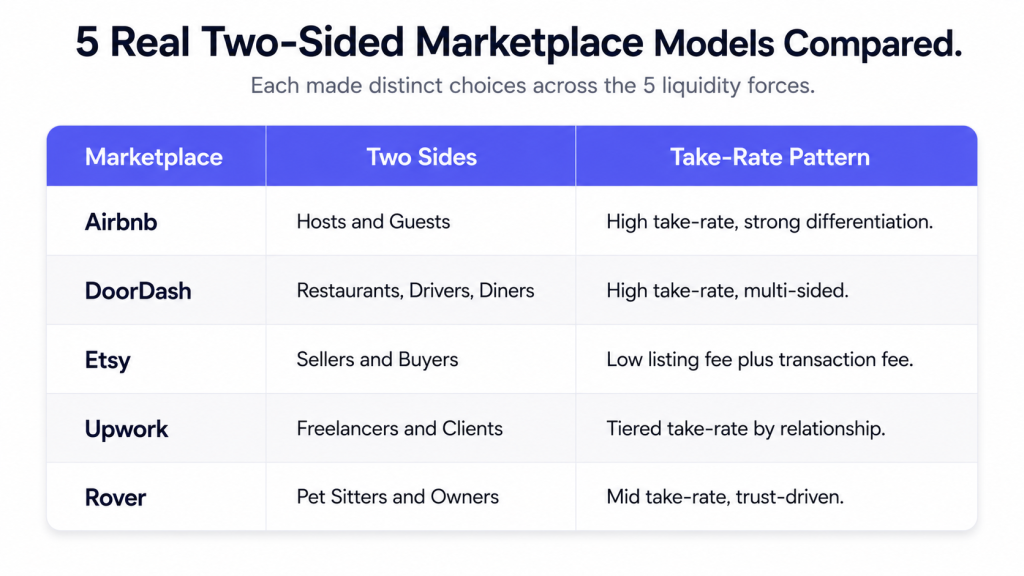
Five Real Two-Sided Marketplace Models
Five real marketplaces illustrate the two-sided marketplace business model in practice. Each made distinct strategic choices across the 5 forces.
Airbnb (Hosts and Guests)
Airbnb solved the cold-start problem with niche focus and single-side seeding, building host supply in target cities before scaling demand. What it teaches: a highly differentiated two-sided marketplace business model with strong network effects can sustain a high take-rate, because neither side can easily replicate the experience elsewhere.
DoorDash (Restaurants, Drivers, Diners)
DoorDash is arguably three-sided, coordinating restaurants, drivers, and diners. It solved cold-start through intense geographic concentration, launching market by market. What it teaches: high-frequency categories support strong repeat transaction rates, and geographic density is non-negotiable for location-based models.
Etsy (Sellers and Buyers)
Etsy uses a low listing fee plus a transaction fee rather than a high pure take-rate. What it teaches: the revenue model is a strategic choice. A low-friction fee structure attracts a large seller base, and the two-sided marketplace business model monetizes through volume and adjacent services.
Upwork (Freelancers and Clients)
Upwork uses a tiered take-rate that changes based on the relationship between freelancer and client. What it teaches: take-rate can be dynamic, and a marketplace can use take-rate structure to discourage disintermediation by lowering the fee as a relationship deepens.
Rover (Pet Sitters and Owners)
Rover built a trust-driven two-sided marketplace business model where verification and reviews are the core value. What it teaches: in trust-sensitive categories, the ongoing value the platform provides (trust, insurance, communication) widens take-rate elasticity, because participants will not abandon that trust infrastructure to save the fee.
The pattern across all five: a successful two-sided marketplace business model makes deliberate, coherent choices across the 5 forces, and the choices fit the category. For a related platform model where one operator manages many vendors, see multi-vendor marketplace development.
Two-Sided Marketplace Business Model Anti-Patterns
Beyond the year-one failure causes, several anti-patterns quietly weaken a two-sided marketplace business model even when it survives.
Anti-Pattern 1: Building Both Sides Equally
Treating supply and demand as equally important from day one spreads effort thin. Most marketplaces should sequence: solve one side first (usually supply), then the other. Building both equally produces two half-built sides and no liquidity.
Anti-Pattern 2: Ignoring Disintermediation
Once two sides meet, they may transact off-platform to avoid the fee. A two-sided marketplace business model that adds no ongoing value after the introduction loses transactions silently. The fix is continuous value: payment protection, trust, convenience, tools.
Anti-Pattern 3: National Launch Before Local Liquidity
For location-based marketplaces, launching nationally before any single market is liquid produces thin density everywhere. Concentrate, prove liquidity, then expand.
Anti-Pattern 4: Vanity Metrics Over Liquidity Metrics
Tracking total signups or total listings instead of match rate and repeat transaction rate hides the real health of the marketplace. A two-sided marketplace business model can have impressive signup numbers and zero liquidity.
Anti-Pattern 5: Raising Take-Rate Before Earning It
Setting a high take-rate before the marketplace has proven its value drives participants away and narrows elasticity permanently. Take-rate should rise with demonstrated value, not ahead of it.
Anti-Pattern 6: Mobile as an Afterthought
Most marketplace activity happens on mobile. A two-sided marketplace business model that treats mobile apps as a later addition loses to mobile-first competitors. The mobile architecture patterns are covered at on-demand service mobile app development.
A final word: Building a Two-Sided Marketplace Business Model That Reaches Liquidity
The two-sided marketplace business model is powerful when it works and fragile when it does not, and the difference is almost always liquidity. The 5 critical forces covered in this guide, organized through the Liquidity Forces Map (supply-side acquisition cost, demand-side acquisition cost, match rate, repeat transaction rate, and take-rate elasticity), are the framework for diagnosing and managing marketplace health. The forces compound: strength in match rate and repeat rate lowers effective acquisition cost and widens take-rate elasticity.
The dominant pattern across successful marketplaces: solve the cold-start problem deliberately through seeding, niche focus, subsidy, or a single-player tool; concentrate geographically before expanding; build the harder-to-acquire side first; set a take-rate that fits the category and raise it only as value is proven; and measure liquidity metrics rather than vanity metrics. A two-sided marketplace business model that respects these principles reaches the critical mass where network effects take over.
Two-Sided Marketplace Business Model FAQ
1. What is a two-sided marketplace business model?
A two-sided marketplace business model is a platform that connects two distinct participant groups, a supply side and a demand side, and earns revenue by facilitating transactions between them, usually through a take-rate. It differs from saas (which sells software to one customer type), e-commerce (which sells goods the company owns), and service businesses (which employ the providers). The defining property is liquidity: the marketplace delivers value only when both sides are present in density.
2. Why do most two-sided marketplaces fail?
Most fail on liquidity, not product. The common causes are reaching the end of the runway with no liquid market, running out of capital before critical mass, focusing on one side and neglecting the other, spreading too thin geographically, and losing transactions to disintermediation. The product is rarely the reason; the inability to get both sides transacting in density is.
3. What is the cold-start problem?
The cold-start problem is the chicken-and-egg challenge at the heart of every two-sided marketplace business model: neither side wants to join until the other is present, but the other will not join either. It is solved through single-side seeding (build supply first), niche-then-expand (launch in the narrowest viable market), subsidizing one side (use capital to buy early liquidity), or come-for-the-tool-stay-for-the-network (launch as a single-player tool, then convert to a marketplace).
4. What take-rate should a marketplace charge?
Take-rates range from 5 to 30 percent. The right number depends on differentiation, ongoing value provided, transaction value, and supply competition. Commodity marketplaces with intense competition charge 5 to 12 percent. Standard service marketplaces charge 12 to 20 percent. Highly differentiated marketplaces with strong ongoing value charge 20 to 30 percent. Many marketplaces start low to solve the cold-start problem and raise the take-rate as liquidity and value grow.
5. Which side of a marketplace should I build first?
Usually supply, because supply is often the cheaper side to acquire (providers want demand) and demand will not come to an empty marketplace. Seed supply first, ideally in a concentrated niche, then turn on demand acquisition once the marketplace looks liquid. The exception is marketplaces where demand is the constrained side; the principle is to build the harder-to-acquire side deliberately and not assume both will arrive together.
6. How do I measure if my marketplace is healthy?
Measure the 5 Liquidity Forces: supply-side acquisition cost, demand-side acquisition cost, match rate, repeat transaction rate, and take-rate elasticity. The most important is match rate (the percentage of demand-side searches that result in a completed transaction) and repeat transaction rate (the percentage of participants who transact again). Avoid vanity metrics like total signups; a two-sided marketplace business model can have large signup numbers and no liquidity.
7. How is a two-sided marketplace different from a multi-vendor marketplace?
They overlap but emphasize different things. A two-sided marketplace business model is the general structure of connecting supply and demand. A multi-vendor marketplace specifically refers to a platform where many independent vendors sell through one storefront, with the operational complexity of per-vendor management, unified checkout, and split payments. Many multi-vendor marketplaces are two-sided, but the multi-vendor framing focuses on the vendor-management mechanics covered at multi-vendor marketplace development.