



A bad cleaning is an inconvenience. A bad pet care experience can mean an injured, lost, or sick pet. The stakes of failure are emotionally and practically severe. Pet care marketplace development must build the safety mechanisms (GPS tracking, vet integration, insurance) that address the worst-case scenarios owners fear.
Trust Compounds Slowly and Breaks Fast
A pet owner extends trust cautiously, often booking a short trial walk before a longer engagement. That trust takes weeks to build and one bad incident to destroy. Pet care marketplace development that treats trust as the core product earns durable retention; platforms that treat trust as an afterthought lose owners permanently after a single scare.
These five characteristics mean pet care marketplace development cannot copy a generic template. The vertical requires a trust-first framework, covered next.
The Pet Care Market Opportunity: Rover, Wag, and the Rest
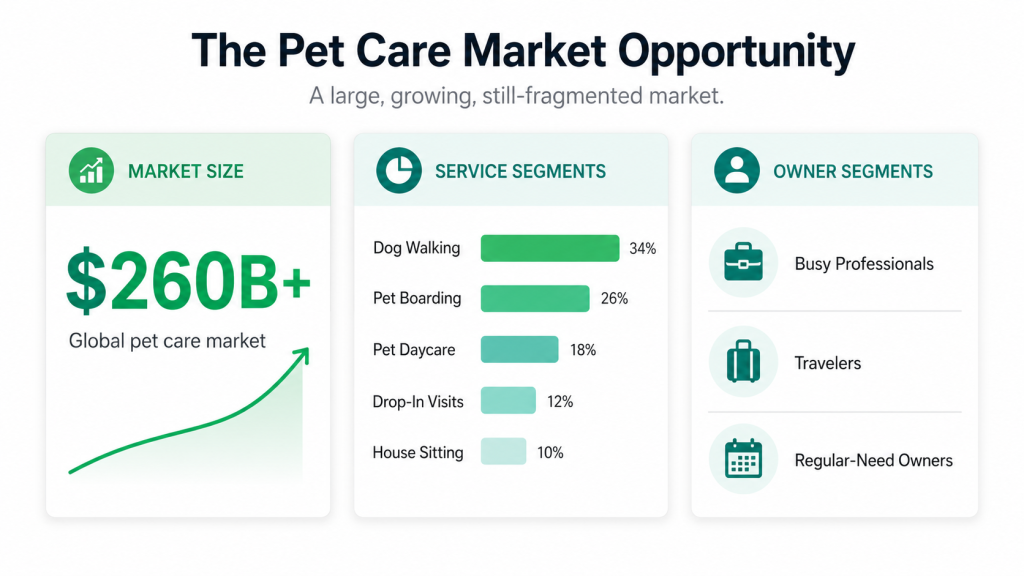
The pet care market is large, growing, and still fragmented, which makes it attractive for platform builders who understand the trust mechanics.
Market Size
The global pet care market exceeds $260 billion annually across food, products, veterinary care, and services. The services segment (walking, sitting, boarding, daycare, grooming) is a meaningful and fast-growing slice, with digital booking penetration still well below saturation. Offline pet care (neighbor referrals, local kennels, word-of-mouth sitters) still accounts for a large share, leaving room for a pet care marketplace to capture.
The Established Players
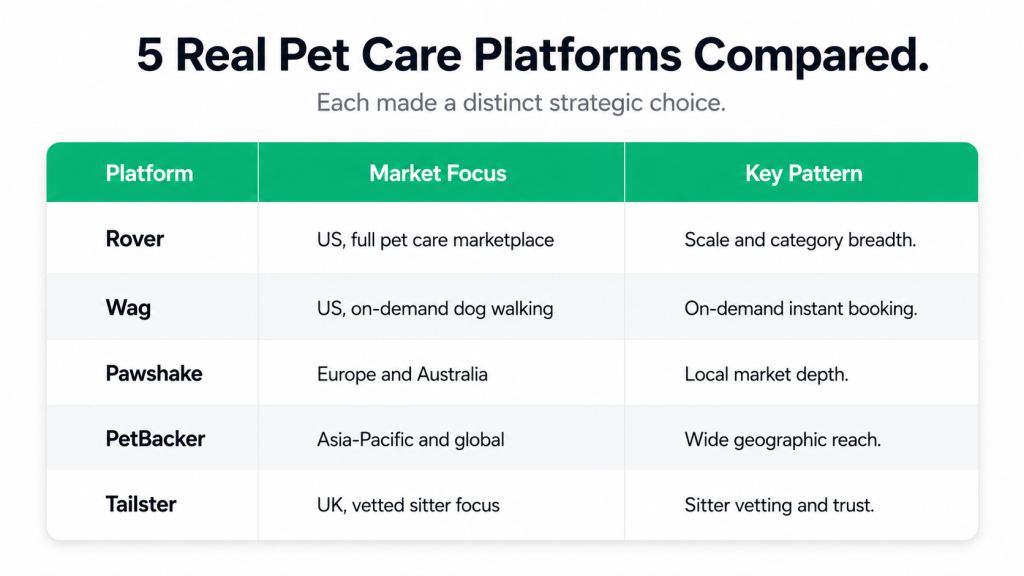
Rover dominates the US pet care marketplace, with Wag as the second major player focused more on on-demand walking. Pawshake, PetBacker, and Tailster hold positions in Europe, Asia-Pacific, and the UK respectively. The established players prove the model works, but their dominance is regional and segment-specific, not universal. A new pet care marketplace can win by going deep in a geography or a sub-segment the incumbents serve thinly.
Service Sub-Segments
Dog walking is high-frequency (daily or several times per week). Pet boarding is travel-driven and high-value per booking. Pet daycare is recurring for working owners. Drop-in visits suit cat owners and owners away for the day. House sitting combines pet care with home presence. Pet care marketplace development decisions vary by which sub-segments the platform targets.
Owner Segments
Busy professionals need regular weekday walking or daycare. Travelers need boarding or house sitting for trips. Regular-need owners (elderly owners, owners with mobility limits, owners with high-energy dogs) need ongoing support. Each segment has different booking patterns and different trust concerns.
Geographic Dynamics
Pet care is local. An owner books sitters in their neighborhood. Like other in-person service marketplaces, a pet care marketplace needs hyper-local liquidity and should launch city-by-city, building sitter density in one market before expanding.
The Pet Safety Triangle Framework
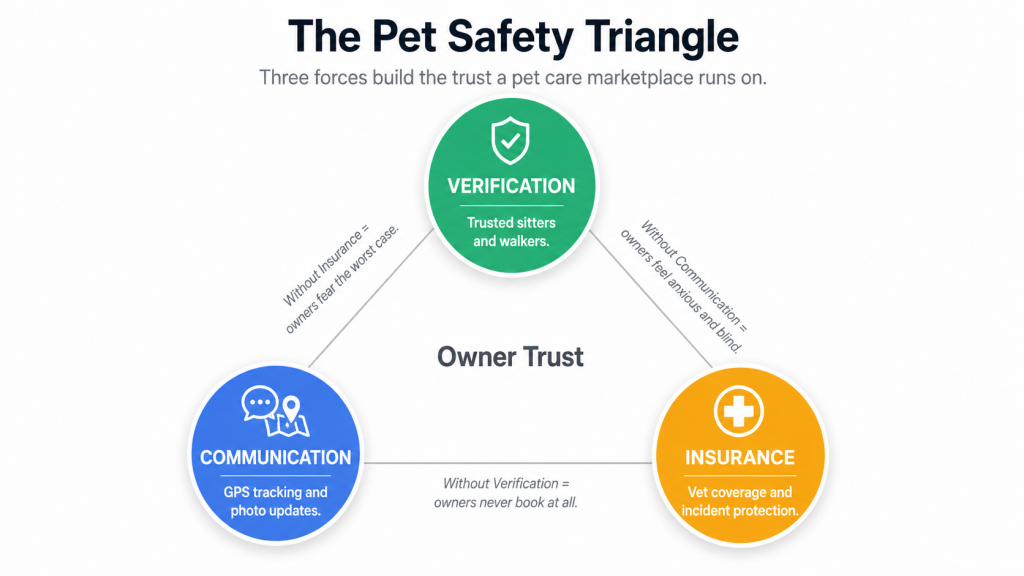
The Pet Safety Triangle is the framework this playbook is built around. It captures the three forces that build owner trust in a pet care marketplace. Strong on all three and owners book confidently; weak on any one and owners hesitate or churn.
Force 1: Verification
Verification is whether the sitter or walker can be trusted with a pet and, often, a home. It covers identity verification, background checks, and pet care experience assessment. Verification is what gets an owner to book in the first place. Without it, owners never reach the booking screen.
Force 2: Communication
Communication is whether the owner can see what is happening during unsupervised service. It covers real-time GPS tracking, photo and video updates, and in-platform messaging. Communication is what calms the anxious owner during the service. Without it, owners feel blind and book once, nervously, then stop.
Force 3: Insurance
Insurance is whether the worst case is covered. It covers emergency vet access, liability insurance, and incident response. Insurance is the safety net that converts a hesitant owner into a confident one. Without it, the owner’s imagination fills with worst-case scenarios and many never book.
Why All Three Are Required
A pet care marketplace needs all three forces. Verification without communication produces vetted sitters but anxious owners who cannot see the service happening. Verification and communication without insurance leave the worst-case fear unaddressed. Communication and insurance without verification means owners never trust the platform enough to book at all. The Pet Safety Triangle is the lens for every step in this playbook; each of the 7 steps strengthens one or more of the three forces.
Step 1: Sitter and Walker Verification
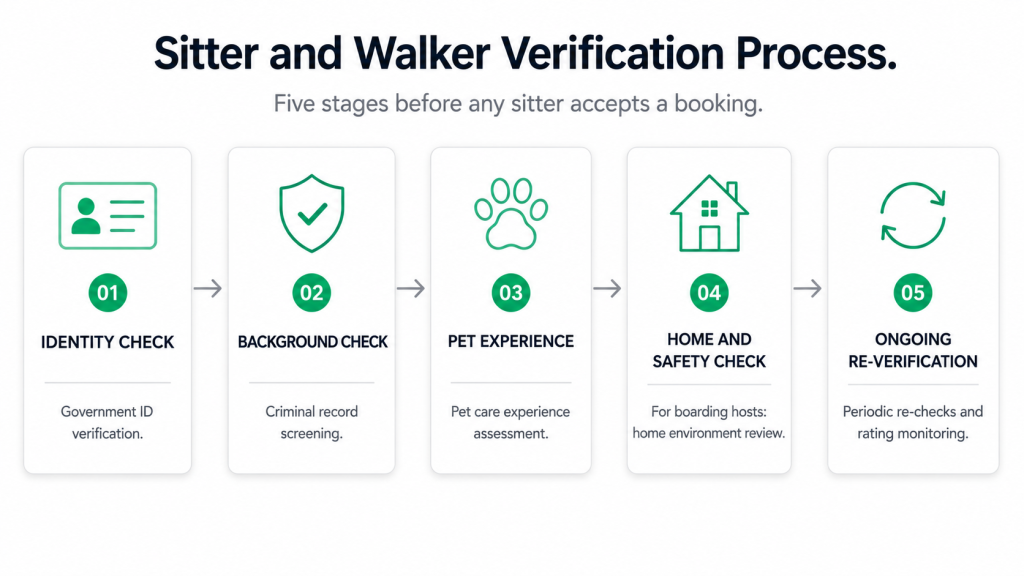
Step 1 of the pet care marketplace playbook is sitter and walker verification. This step builds the Verification force of the Pet Safety Triangle and is the foundation everything else rests on.
Identity Verification
Government ID verification through Onfido, Persona, Stripe Identity, or Veriff confirms every sitter is who they claim to be. Required before a sitter can list on the pet care marketplace. Identity verification produces an audit trail for incident response.
Background Checks
Criminal background checks screen sitters who will handle pets and, in many cases, enter homes. Services like Checkr, Sterling, or GoodHire handle US checks, with local equivalents elsewhere. Background checks for pet care typically cost $20 to $60 per sitter. The platform absorbs this cost during onboarding as an investment in the Verification force.
Pet Care Experience Assessment
Beyond identity and background, the pet care marketplace assesses actual pet care competence. This can include experience questionnaires, references from previous pet care work, a short knowledge assessment (recognizing signs of distress, basic first aid awareness), and a probationary period where early bookings are monitored closely. The ASPCA pet sitter guidance provides a useful reference for the competencies that matter in responsible pet care.
Home and Safety Check for Boarding Hosts
Sitters who board pets in their own homes need an additional check: the home environment must be safe for the pet (secure fencing, no escape routes, no hazards). Some pet care marketplace platforms conduct virtual or in-person home checks for boarding hosts. This addresses a trust concern specific to the boarding sub-segment.
Visible Verification Badges
Verification only builds trust if owners can see it. The sitter profile displays verified-identity badges, completed-background-check status, years of pet care experience, total bookings completed, and review history. A pet care marketplace that hides verification signals loses to platforms that surface them prominently on every sitter profile.
Ongoing Re-Verification
Verification is not a one-time event. The pet care marketplace re-runs background checks periodically, monitors rating trends to catch declining sitters, and suspends sitters who fall below quality thresholds or accumulate trust complaints.
Step 1 is roughly 15 to 20 percent of pet care marketplace build effort plus meaningful ongoing operational cost. It is the step that cannot be cut.
Step 2: Pet Profile Capture
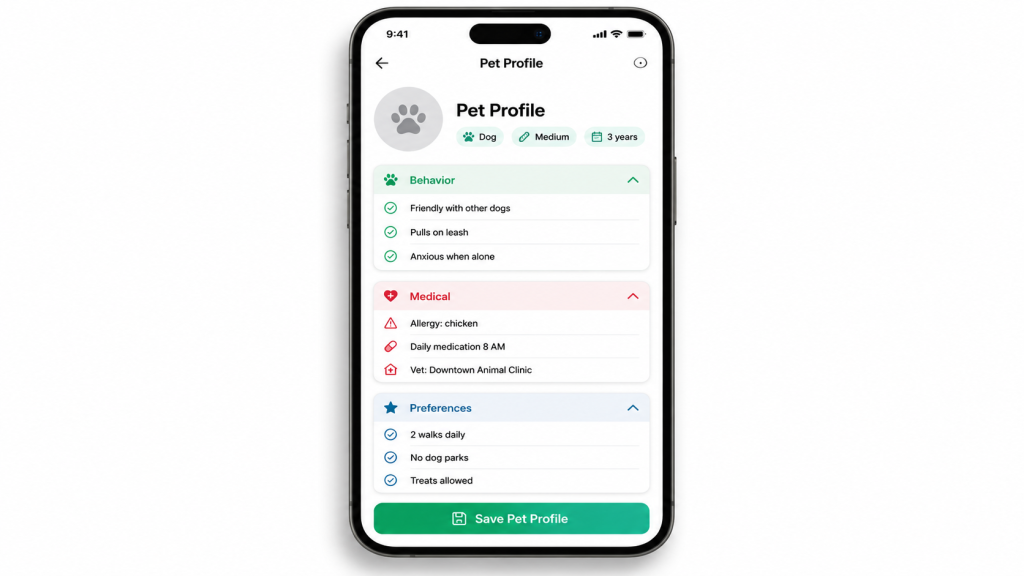
Step 2 of the pet care marketplace playbook is pet profile capture. A detailed pet profile is what lets sitters deliver safe, appropriate care and what lets the matching system pair the right pet with the right sitter.
Behavior Information
The profile captures how the pet behaves: friendly or reactive with other animals, leash behavior, separation anxiety, energy level, fears and triggers, and house-training status. Behavior information lets a sitter prepare correctly and lets the pet care marketplace flag pets that need experienced sitters.
Medical Information
The profile captures medical needs: allergies, medications and dosing schedules, chronic conditions, mobility limits, dietary restrictions, and the pet’s regular veterinarian. Medical information is safety-critical; a sitter who does not know about a medication schedule or an allergy can cause real harm.
Care Preferences
The profile captures owner preferences: feeding schedule and amounts, walk frequency and routes, whether dog parks are allowed, treat rules, crate preferences, and bedtime routines. Care preferences let the sitter replicate the pet’s normal routine, which reduces stress for the pet and complaints from the owner.
Emergency Contact and Vet Authorization
The profile captures the owner’s emergency contact, the pet’s veterinarian, and the owner’s authorization for emergency vet treatment up to a spending limit. This pre-authorization is what allows fast action in a medical emergency, covered fully in Step 6.
Why the Profile Compounds Value
A detailed pet profile makes every future booking better. The owner enters the information once; every subsequent sitter benefits from it. The profile also reduces the owner’s repeat-entry friction, which is one of the things that keeps owners booking through the pet care marketplace rather than going off-platform.
Step 2 is roughly 8 to 12 percent of build effort. The pet profile is low-cost to build and high-value for both safety and retention.
Step 3: Service Catalog
Step 3 of the pet care marketplace playbook is the service catalog. The catalog defines what services the platform offers and structures pricing, search, and sitter matching.
The Pet Care Service Types
Dog Walking
Short-duration, high-frequency service. Walks are typically 30 or 60 minutes, booked daily or several times per week. Walking is the entry service for many owners and the highest-frequency rebooking driver in a pet care marketplace.
Pet Boarding
The pet stays in the sitter’s home, typically for several days while the owner travels. Boarding is high-value per booking and travel-driven. It carries the highest trust requirement because the pet is in someone else’s home around the clock.
Pet Daycare
The pet spends the day at the sitter’s home or a daycare facility while the owner works, then returns home at night. Daycare is recurring for working owners and a strong retention driver.
Drop-In Visits
The sitter visits the owner’s home for a short period (30 to 60 minutes) to feed, walk, or check on the pet. Drop-in visits suit cat owners and owners away for the day. They involve home access.
House Sitting
The sitter stays in the owner’s home, providing pet care and home presence. House sitting combines pet care trust with home-access trust.
Catalog Structure and Pricing
Each service type has variants and pricing factors: pet size, pet count (multiple pets in one booking), service duration, add-ons (extra walks during boarding, medication administration, grooming). Most pet care marketplace platforms let sitters set their own prices within platform ranges, supporting the differentiation that lets experienced sitters charge more.
Service-Specific Trust Requirements
Different services need different trust depth. Walking needs GPS tracking. Boarding needs home checks and longer verification. Drop-in and house sitting need home-access trust. The catalog should connect each service type to its specific trust requirements so the pet care marketplace surfaces appropriately verified sitters for each service.
Step 3 is roughly 10 to 12 percent of build effort. A well-structured catalog connects pricing, matching, and trust requirements cleanly.
Step 4: Real-Time GPS Tracking During Service
Step 4 of the pet care marketplace playbook is real-time GPS tracking. This step builds the Communication force of the Pet Safety Triangle and is one of the features that most calms anxious owners.
Why GPS Tracking Matters
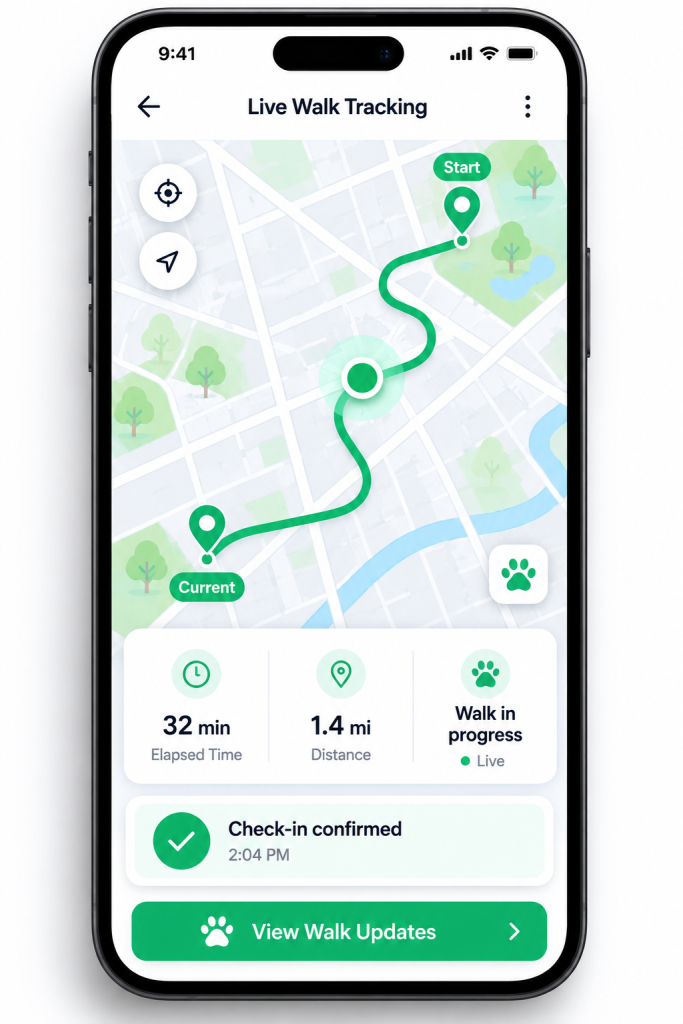
When a sitter walks a dog, the owner cannot see where the dog is going, how long the walk lasts, or whether the walk happened at all. GPS tracking turns an invisible service into a visible one. The owner watches the walk route on a map in real time, sees the distance covered, and gets confirmation the service actually happened. GPS tracking is a defining trust feature of a modern pet care marketplace.
GPS Tracking Components
Live Walk Map
During a walk, the sitter app shares location and the owner app displays the live route on a map. The owner sees the path, the current position, and the elapsed time. Mapbox or Google Maps Platform provide the mapping infrastructure.
Walk Summary
At the end of a walk, the platform generates a summary: route map, total distance, duration, and time stamps. The walk summary becomes part of the booking record and gives the owner concrete proof of service.
Check-In and Check-Out
For boarding, daycare, and drop-in visits, the sitter checks in and checks out through the app with location confirmation. Check-in and check-out give the owner confirmation the service started and ended as scheduled.
Geo-Verification
GPS tracking also verifies the service happened where it should. A drop-in visit logged at the owner’s address confirms the sitter actually went there. Geo-verification protects against the rare sitter who logs a service that did not happen.
Privacy and Battery Considerations
GPS tracking raises two practical concerns. Location data is sensitive and must be stored securely and shared only with the relevant owner. Continuous GPS tracking drains the sitter’s phone battery, so the tracking should be efficient (sampling intervals rather than constant polling) to avoid the sitter’s phone dying mid-walk.
Step 4 is roughly 12 to 15 percent of pet care marketplace build effort. GPS tracking is the single feature owners most associate with a trustworthy modern pet care platform.
Step 5: Photo and Video Updates to Owner
Step 5 of the pet care marketplace playbook is photo and video updates to the owner. This step strengthens the Communication force of the Pet Safety Triangle and is the feature that turns an anxious owner into a relaxed one.
Why Photo and Video Updates Matter
An owner who dropped their dog at boarding spends the trip wondering if the dog is happy, fed, and safe. A single photo of the dog playing in the yard answers all three questions instantly. Photo and video updates are the emotional payoff of a pet care marketplace; they convert worry into reassurance. Owners who receive regular updates rebook; owners who hear nothing during a service rarely return.
Update Components
Scheduled Photo Updates
The pet care marketplace prompts the sitter to send photo updates at intervals appropriate to the service: a photo mid-walk, photos twice daily during boarding, a photo at each drop-in visit. Scheduled prompts ensure updates happen consistently rather than depending on the sitter remembering.
Video Clips
Short video clips (10 to 30 seconds) are even more reassuring than photos. A clip of a dog wagging its tail or a cat eating dinner gives the owner a richer sense of the pet’s wellbeing. The sitter app makes capturing and sending clips a one-tap action.
Update Messages
Photo and video updates pair with short text notes: “Max had a great walk and made a friend at the corner,” “Bella ate all her dinner and is napping now.” The note adds context the image alone cannot.
The Update Timeline
All updates collect into a timeline the owner can scroll through during and after the service. The update timeline becomes a record of the booking and a memory the owner often keeps.
Updates as a Disintermediation Defense
Photo and video updates also keep owners on-platform. The update timeline lives inside the pet care marketplace app. An owner who values the updates has a reason to keep booking through the platform rather than arranging directly with the sitter. Updates are both a trust feature and a retention feature.
Privacy and Storage
Photos and videos of pets, often taken inside the owner’s home, are personal. The pet care marketplace stores them securely, shares them only with the relevant owner, and provides deletion on request. Updates should never be used for marketing without explicit owner consent.
Step 5 is roughly 8 to 12 percent of build effort. It is low-cost to build and produces the emotional reassurance that drives pet care marketplace retention.
Step 6: Emergency Vet Integration and Insurance
Step 6 of the pet care marketplace playbook is emergency vet integration and insurance. This step builds the Insurance force of the Pet Safety Triangle and addresses the worst-case fears that keep hesitant owners from booking.
Why the Safety Net Converts Owners
Every pet owner imagines the worst case before booking a stranger: the pet gets sick, gets injured, or goes missing. A pet care marketplace that has a clear, visible safety net for these scenarios converts owners who would otherwise never book. The safety net is not just risk management; it is a conversion feature.
Emergency Vet Integration
Pre-Authorized Vet Treatment
During pet profile capture (Step 2), the owner pre-authorizes emergency vet treatment up to a spending limit and names the pet’s regular veterinarian. Pre-authorization is what allows the sitter to act fast in an emergency without spending critical minutes trying to reach the owner.
Emergency Vet Locator
The pet care marketplace integrates an emergency vet locator so the sitter can find the nearest open emergency veterinary clinic from their current location. In a real emergency, minutes matter; a built-in locator removes the delay of searching.
Incident Protocol in the Sitter App
The sitter app includes a clear emergency protocol: assess the situation, contact emergency vet, notify the owner, notify the platform, document with photos. A documented protocol means sitters act correctly under stress rather than improvising.
Insurance and Liability Coverage
Platform Insurance
Leading pet care marketplace platforms provide insurance covering veterinary costs from incidents during a booking, liability for property damage, and in some cases coverage if a pet is injured by another animal during service. The platform either carries a policy or partners with a pet care insurance provider.
Visible Coverage on the Booking Screen
Insurance only converts hesitant owners if they can see it. The booking flow should clearly state what is covered, up to what limit, and how a claim works. A pet care marketplace that buries its insurance terms loses the conversion benefit.
Claims Process
When an incident occurs, the owner needs a clear, fast claims process: report the incident, submit documentation (vet bills, photos), receive a decision and reimbursement. A slow or opaque claims process damages trust as badly as having no insurance at all.
Incident Response Operations
Beyond automated systems, the pet care marketplace needs human incident response: a team that handles serious incidents promptly, communicates with the affected owner, supports the sitter, and documents resolution. Incident response is a permanent operational cost in this vertical, not a one-time setup. The ASPCA pet sitter guidance is a useful reference for the emergency preparedness standards responsible pet care should meet.
Step 6 is roughly 10 to 15 percent of build effort plus ongoing insurance and operations cost. It is the step that converts the worst-case fear into a manageable, covered scenario.
Step 7: Review and Repeat Booking Loop
Step 7 of the pet care marketplace playbook is the review and repeat booking loop. This step turns a nervous first booking into a recurring relationship, which is where the vertical’s economics live.
Why Repeat Booking Is the Goal
A first pet care booking is high-anxiety for the owner. A second booking with the same trusted sitter is low-anxiety. By the third or fourth booking, the owner has a trusted sitter and books almost reflexively. The pet care marketplace economics depend on getting owners past the anxious first booking and into the comfortable repeat-booking pattern.
The Review Component
Two-Way Reviews
After each booking, the owner reviews the sitter and the sitter reviews the owner. Owner-to-sitter reviews cover care quality, communication, and reliability. Sitter-to-owner reviews cover pet behavior accuracy and home condition. Two-way reviews protect both sides of the pet care marketplace.
Review Prompts at the Right Moment
The platform prompts for a review shortly after the service ends, when the experience and the relief of a safe return are fresh. A quick one-tap rating with optional detail maximizes completion.
Reviews as Trust Content
Sitter reviews are the trust content future owners rely on. A sitter with 50 positive reviews from real bookings is far more bookable than a new sitter. The review system feeds the discovery ranking and the owner’s confidence.
The Repeat Booking Loop
Preferred Sitter Rebooking
Once an owner has a sitter they trust, the pet care marketplace makes rebooking that same sitter a one-tap action. Preferred-sitter rebooking is the single strongest retention mechanic in the vertical.
Recurring Service Scheduling
For recurring needs (daily walks, weekly daycare), the platform supports recurring bookings with the preferred sitter, auto-scheduled and auto-billed. Recurring scheduling converts the high-frequency sub-segments into predictable revenue.
Rebooking Prompts
The platform prompts owners to rebook at natural moments: after a positive review, before an upcoming trip the owner mentioned, or at the regular interval for recurring services. Well-timed prompts catch owners at the rebooking moment.
Loyalty Rewards
Loyalty points or credits reward repeat bookings, giving owners a concrete reason to keep booking through the pet care marketplace rather than arranging directly with the sitter.
Step 7 is roughly 10 to 12 percent of build effort. The review and repeat booking loop is what converts the trust built in Steps 1 through 6 into durable, recurring revenue.
Five Real Pet Care Platforms
Five real platforms illustrate the patterns in pet care marketplace development. Each made distinct strategic choices.
Rover
The dominant US pet care marketplace, Rover offers the full range of services (walking, boarding, daycare, drop-in, house sitting). What it teaches: category breadth and scale create defensibility, but the breadth means a new entrant can win by going deeper in one sub-segment or one geography than Rover does.
Wag
A US platform focused heavily on on-demand dog walking with instant booking. What it teaches: on-demand instant booking is a distinct positioning from scheduled booking. Wag competes on immediacy, which appeals to owners with unpredictable schedules.
Pawshake
A platform with strong positions in Europe and Australia. What it teaches: local market depth beats shallow global coverage. Pawshake’s strength is being genuinely local in each market it serves.
PetBacker
A platform with wide geographic reach across Asia-Pacific and beyond. What it teaches: geographic reach can be a strategy, but it requires the platform to handle many local markets, each with its own liquidity challenge.
Tailster
A UK platform that emphasizes vetted, trusted sitters. What it teaches: leaning hard into the Verification force of the Pet Safety Triangle is a valid positioning. Tailster competes on trust depth rather than scale or price.
The pattern across all five: successful pet care marketplace development comes from a clear strategic choice (scale and breadth, on-demand immediacy, local depth, geographic reach, or vetting and trust) executed deeply. The Rover case study material documents how the category leader built its position. For related home-service verticals, see home cleaning service marketplace development and beauty service marketplace development.
Conclusion: Building a Pet Care Marketplace That Owners Trust
Pet care marketplace development is a trust-first build. Owners hand over a family member, often a house key, and almost always lose visibility during unsupervised service. The definitive 7-step playbook covered in this guide (sitter verification, pet profile capture, service catalog, GPS tracking, photo and video updates, emergency vet integration and insurance, and the review and repeat booking loop) builds the trust the vertical runs on. The Pet Safety Triangle framework (verification, communication, insurance) is the lens that connects every step to a trust force owners care about.
The dominant pattern across successful pet care marketplace platforms: a clear strategic choice executed deeply, verification as the foundation that gets owners to book, GPS tracking and photo updates as the communication that calms anxious owners during service, insurance as the safety net that addresses worst-case fears, and the review and repeat booking loop as the engine that converts a nervous first booking into a recurring relationship.
Pet Care Marketplace FAQ
1. How much does pet care marketplace development cost?
$50K to $180K depending on scope. A single-service MVP (dog walking only, one city) runs $50K to $80K. A standard multi-service pet care marketplace with the 7-step playbook features and full mobile apps runs $80K to $140K. A feature-rich platform with advanced GPS tracking, video updates, vet integration, and insurance tooling runs $140K to $180K. White-label customization of an existing on-demand service platform runs $30K to $70K. Add $30K to $90K for Year 1 operating costs including insurance.
2. How long does it take to build a pet care marketplace app?
10 to 16 weeks for most MVPs. 10 to 12 weeks for a single-service single-city build. 12 to 16 weeks for a standard multi-service marketplace with GPS tracking, photo updates, and full mobile apps. 4 to 8 weeks for white-label customization of an existing platform.
3. What verification do pet sitters need?
Identity verification, criminal background checks, and pet care experience assessment at minimum. Boarding hosts need an additional home and safety check. Background checks cost $20 to $60 per sitter through services like Checkr or Sterling. Verification should be re-run periodically, and verification badges should be visible on every sitter profile because visible verification is what converts hesitant owners.
4. Does a pet care marketplace need insurance?
Yes. Insurance covering veterinary costs from incidents, liability for property damage, and incident protection is a conversion feature, not just risk management. Owners imagine worst-case scenarios before booking; visible insurance coverage on the booking screen converts owners who would otherwise never book. The platform either carries a policy or partners with a pet care insurance provider.
5. How important is GPS tracking in a pet care marketplace?
Very important for dog walking. GPS tracking turns an invisible service into a visible one: the owner watches the walk route, sees the distance and duration, and gets proof the service happened. GPS tracking is one of the features owners most associate with a trustworthy modern pet care marketplace. For boarding and drop-in services, check-in and check-out with location confirmation serve a similar trust function.
6. Should a pet care marketplace start with one service or all services?
Start with one service in one city. Dog walking is a common entry service because it is high-frequency and builds rebooking habits quickly. Once the platform has sitter density and owner trust in one market with one service, expand to additional services (boarding, daycare, drop-in) and additional cities. Launching all services in all cities at once dilutes attention and produces thin liquidity everywhere.