




On-demand service marketplace development in 2026 is one of the most strategically valuable categories a saas founder can pursue. The global on-demand service economy exceeds $400 billion annually, driven by consumer expectations of convenience, the gig economy supply pool, and platforms like TaskRabbit, Handy, Rover, Booksy, and Uber that have normalized on-demand service consumption across categories. New entrants continue to find space in vertical niches (lawn care, pet sitting, beauty at home, fitness coaching) because horizontal platforms cannot serve every vertical with equal depth.
On-demand service marketplace development is meaningfully more complex than typical e-commerce or saas builds because of the two-sided nature of the marketplace: supply (service providers) and demand (consumers) must be acquired in parallel, retained simultaneously, and coordinated through real-time matching. Founders who copy a generic marketplace template into a service vertical underestimate the complexity and ship platforms that lose to better-engineered competitors.
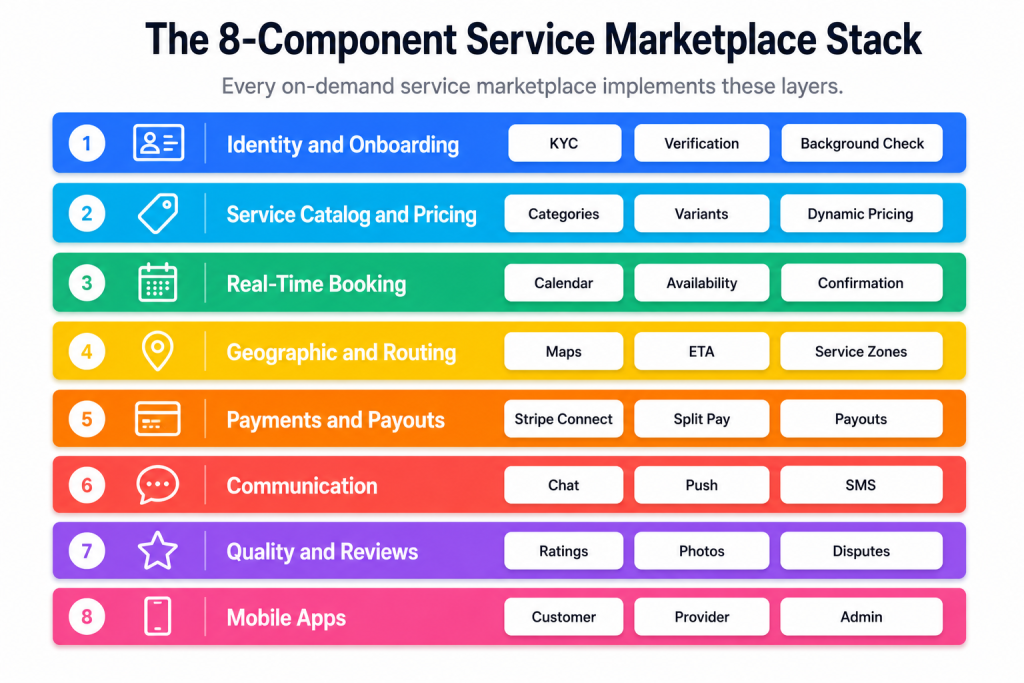
This guide walks through the 8 critical steps in on-demand service marketplace development through the 8-Component Service Marketplace Stack framework: identity and onboarding, service catalog and pricing engine, real-time booking and scheduling, geographic and routing infrastructure, payment splits and payouts through Stripe Connect, communication and notifications, quality assurance and reviews, and the mobile app architecture across customer, provider, and admin surfaces. It includes vertical examples across home service, beauty, pet care, and fitness, the realistic cost and timeline patterns, common mistakes that slip projects, and the agency vs in-house decision for service marketplace builds.
Five takeaways before reading on: on-demand service marketplace development is two-sided coordination work disguised as a saas build; the 8-Component Stack forces structured thinking about platform requirements; real-time booking and geographic routing are where most generic templates fall short; Stripe Connect is the dominant payment infrastructure in 2026; and mobile apps for both customers and providers are non-optional. For an example of an on-demand home service marketplace platform built around these patterns, see Prohandy. For a vertical-specific build using this framework, see car service marketplace development.
What On-Demand Service Marketplace Development Means?
On-demand service marketplace development is the engineering practice of building two-sided platforms where consumers book services from independent providers, the platform handles matching, payment, and trust, and the entire transaction completes within hours or days rather than weeks. The five-property definition matters because it separates true on-demand marketplaces from related categories: directories (no transaction), e-commerce (goods not services), traditional service businesses (employees not independent providers), and scheduled-only platforms (weeks not hours).
The Difference Between On-Demand and Scheduled Service Platforms
A scheduled service platform books appointments for next week or next month. An on-demand service platform books service within hours or same-day. The architectural difference is meaningful: on-demand platforms need real-time provider availability, geographic dispatch, instant payment confirmation, and live tracking, while scheduled platforms can rely on simpler calendar booking. Most modern service marketplaces support both modes (book now or book later), but the on-demand mode is where engineering complexity lives.
What Counts as a Service in This Framework
The on-demand service marketplace development framework in this guide applies to any service delivered to a specific location (home, office, gym, salon) or virtually by an independent provider. Examples: home cleaning, lawn care, handyman services, pet sitting, dog walking, beauty at home, mobile car service, fitness training, tutoring, massage therapy, photography, moving services. The framework does not apply to product-only marketplaces (Etsy, Faire) or pure information marketplaces (course platforms without provider interaction).
The dominant 2026 default for on-demand service marketplace development is a multi-tenant platform built on Next.js or Flutter for the customer-facing surface, Node.js or Laravel backend, Postgres database with PostGIS for geographic queries, Stripe Connect for payment splits, Twilio or similar for communications, and native mobile apps for both customer and provider sides. This is the pattern most fixed-price MVP packages assume.
The 8-Component Service Marketplace Stack Framework
The 8-Component Service Marketplace Stack is the framework this guide is built around. Every successful on-demand service marketplace development project implements these 8 components, ordered roughly by criticality and build sequence.
How Each Component Maps to the Build
The 8 components correspond to 8 sequential build phases. Phase 1 (identity) ships in weeks 1-2. Phase 2 (catalog and pricing) ships in weeks 2-3. Phase 3 (booking) ships in weeks 3-5. Phase 4 (geo-routing) ships in weeks 4-6. Phase 5 (payments) ships in weeks 5-7. Phase 6 (communication) ships in weeks 6-8. Phase 7 (quality and reviews) ships in weeks 7-9. Phase 8 (mobile apps) typically ships in parallel with the other phases because mobile is the primary surface for both customers and providers.
The 8-Component Stack is the structural spine of every successful on-demand service marketplace development project. Skipping any component produces a platform that fails its first real-world stress test. Reordering the sequence produces dependency conflicts that slip the build by weeks. The framework’s value is enforcing both completeness and correct sequencing.
Before You Build: On-Demand Service Marketplace Founder Readiness Check
Many on-demand service marketplace development projects fail not because of execution but because the founder was not ready to operate a two-sided marketplace business. Four readiness pillars separate teams that ship and scale from teams that burn capital.
Pillar 1: Supply-Side Acquisition Capability
Two-sided marketplaces require both supply (providers) and demand (consumers) to launch. The founder must know how to acquire 50 to 200 providers in the first geographic market before opening to consumers. Provider acquisition tactics vary by vertical: cold outreach for B2B-style services, social media recruitment for gig-style services, partnerships with industry associations for licensed trades. Founders who plan only the consumer side discover at launch they have no providers to fulfill demand.
Pillar 2: Geographic Concentration Discipline
On-demand service marketplace development succeeds with geographic concentration, not national-from-day-one expansion. A marketplace with 200 providers across 50 cities has 4 providers per city and zero density; the same 200 providers in one city is dense and functional. Founders who insist on national launch before validating one city consistently lose to focused competitors who dominated their local market first.
Pillar 3: Operational Capital Runway
On-demand service marketplace development costs $50K to $200K for MVP plus $30K to $100K per quarter for operations during the first year. Subsidies on either side (free trials for consumers, bonus payouts for providers) consume capital. Founders who underestimate operational capital run out of money at month 6, just when the marketplace is starting to find traction.
Pillar 4: Trust and Safety Operations
Service marketplaces face trust and safety incidents (provider no-shows, consumer disputes, occasional safety concerns) that require human operators handling each case promptly. Founders who treat trust and safety as optional discover at the first incident that ad-hoc response damages customer trust faster than the platform can rebuild it. Plan for trust and safety operations as a permanent operational cost, not a one-time setup.
Founders who score weak on two or more pillars should either pivot to a different category (a directory site or a single-provider saas) or partner with an agency that brings the missing operational capability. On-demand service marketplace development is not a part-time founder pursuit; the model demands full-time operational engagement to succeed.
Component 1: Two-Sided Identity and Onboarding
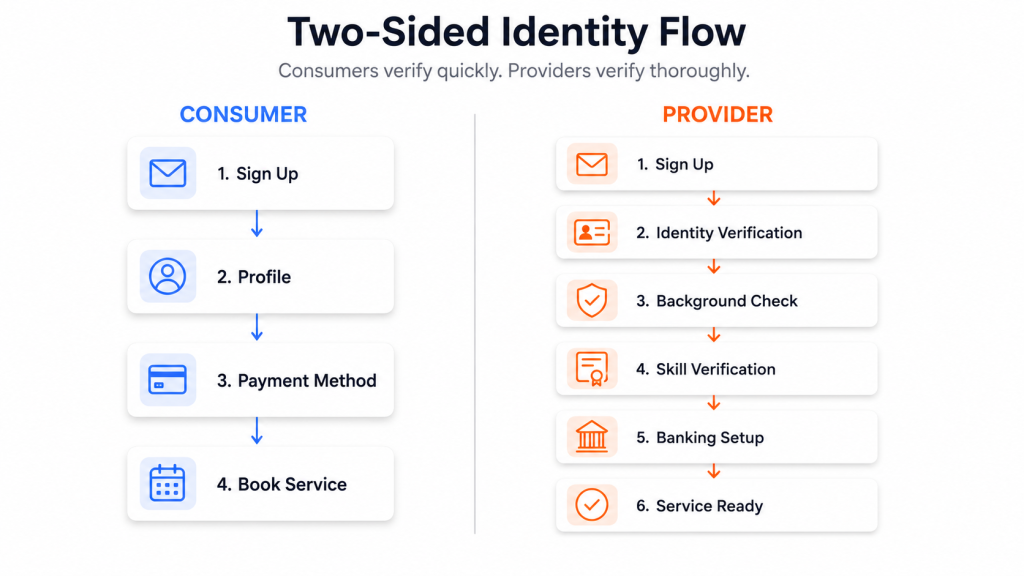
Component 1 of on-demand service marketplace development is two-sided identity. The platform must onboard, verify, and authenticate two distinct user types (consumers and providers) with meaningfully different identity requirements.
Consumer-Side Identity
Sign-Up Flow
Consumers want minimal friction. The sign-up flow asks for email or phone, password, and optional name. Social sign-in through Google or Apple reduces friction further. Address capture happens at first booking, not at sign-up, because requiring address upfront tanks conversion. Phone verification through SMS confirms the number is real but is not required at sign-up for low-friction consumer markets.
Payment Method Capture
Payment method capture happens before the first booking, through Stripe Elements or equivalent. The platform stores tokenized payment credentials (never raw card numbers) and validates the card through a small test charge. Consumers can add multiple payment methods (credit card, debit card, Apple Pay, Google Pay) and select a default.
Provider-Side Identity
Identity Verification
Providers face stricter onboarding because they will interact with consumers in person and handle payment. Government ID verification through Onfido, Persona, Stripe Identity, or Veriff is required before listing. Identity verification confirms the provider is who they claim and produces an audit trail for incident response.
Background Checks
Background checks are required for any service involving entry to consumer homes or interaction with vulnerable populations (children, elderly). Services like Checkr, Sterling, or GoodHire handle US checks; DBS Checks in UK; local equivalents elsewhere. Check costs run $20 to $80 per provider, typically absorbed by the platform during onboarding.
Skill Verification and Licenses
For licensed trades (electricians, plumbers, HVAC technicians), the platform verifies professional licenses through state licensing boards or equivalent national registries. For unlicensed services (cleaning, lawn care, pet sitting), the platform may use proficiency assessments or reference checks instead. The 5-Layer Trust Stack covered at the two-sided marketplace business model article details the verification depth tradeoffs.
Banking and Payout Setup
Providers must complete Stripe Connect account setup with banking details and tax information (W-9 in US, equivalent elsewhere) before receiving payouts. The platform cannot legally hold provider funds without proper KYC compliance, so banking setup is required before the provider can accept bookings.
The two-sided identity component is roughly 15 to 20 percent of MVP build time. Skipping provider verification depth produces platforms that fail at the first consumer-trust incident; skipping consumer-side friction reduction produces platforms with high signup-to-first-booking drop-off.
Component 2: Service Catalog and Pricing Engine
Component 2 of on-demand service marketplace development is the service catalog and pricing engine. The catalog defines what services exist on the platform; the pricing engine determines what each service costs.
Catalog Hierarchy
Categories and Sub-Categories
The catalog is hierarchical. Top-level categories represent broad service types (Home Cleaning, Handyman, Beauty, Pet Care). Sub-categories represent specific services (House Cleaning, Deep Cleaning, Move-Out Cleaning within the Home Cleaning category). Most platforms ship with 3 to 5 top-level categories and 10 to 30 sub-categories at launch, expanding as supply grows.
Service Variants
Each sub-category has variants based on attributes: home size for cleaning (1 bedroom, 2 bedroom, 3+ bedroom), service duration for handyman (1 hour, 2 hours, half-day, full-day), session length for beauty (haircut, full color, highlights). Variants drive pricing and provider matching.
Pricing Models
Fixed Pricing
Some services have fixed prices set by the platform: a standard 1-bedroom cleaning costs $89, a basic haircut costs $45. Fixed pricing simplifies the consumer experience but reduces provider flexibility. Best for commodity services where consumers compare on price.
Provider-Set Pricing
Other services let providers set their own prices within platform-defined ranges: a beauty stylist charges $80 to $250 for highlights depending on hair length and complexity. Provider-set pricing supports differentiation and premium positioning but complicates the consumer comparison experience.
Dynamic Pricing
Some platforms implement dynamic pricing where prices fluctuate based on demand, time of day, or provider availability. Uber-style surge pricing is the canonical example. Dynamic pricing maximizes revenue capture but creates consumer trust issues if not communicated transparently. Most on-demand service marketplace development projects in 2026 avoid heavy dynamic pricing for consumer trust reasons.
The Pricing Engine
The pricing engine combines base price, variants, modifiers (rush fees, after-hours fees, distance surcharges), discounts (first-time consumer, repeat consumer, package deals), and taxes to produce a final consumer-facing price. The platform’s take-rate (typically 15 to 30 percent of service value) is deducted from the provider payout, not added to the consumer price.
The catalog and pricing engine component is roughly 10 to 15 percent of MVP build time. The most common mistake: hardcoding pricing logic instead of building it as a configurable engine. Platforms with hardcoded pricing cannot run promotions, test pricing experiments, or expand to new verticals without engineering work.
Component 3: Real-Time Booking and Scheduling
Component 3 of on-demand service marketplace development is real-time booking and scheduling. This is where the platform converts consumer interest into confirmed bookings with available providers.
The On-Demand Booking Flow
Step 1: Service Selection and Quote
Consumer selects service from catalog, chooses variants, sees a quote in real time. The quote engine pulls from the pricing engine (Component 2) and applies promotions or modifiers. The consumer sees a clear breakdown: service price, platform fee, taxes, total.
Step 2: Time Window Selection
Consumer selects a time window: “Today between 2 PM and 4 PM,” “Tomorrow morning,” or a specific date and time. Time windows balance consumer convenience with provider efficiency. Wider windows (2 to 4 hour ranges) work better for on-demand services because they give the dispatch system flexibility.
Step 3: Location and Address Confirmation
Consumer confirms service address. The platform validates the address through Google Maps or Mapbox geocoding APIs, captures access instructions (gate code, parking notes, entry preferences), and confirms the address is within the platform’s service zone.
Step 4: Provider Match or Dispatch
The platform finds the best available provider for the requested service, time window, and location. Matching algorithms consider provider availability, distance from consumer, service rating, and historical match success. The match either offers the job to a single provider (Uber-style dispatch with accept/decline) or shows multiple providers to the consumer (Yelp-style provider selection).
Step 5: Confirmation and Payment Authorization
Consumer confirms the booking; the platform authorizes the payment method (Stripe places a hold, not a charge); both consumer and provider receive confirmation. The booking is now live and the provider commits to showing up at the agreed time.
Calendar and Availability Management
Providers manage their availability through a calendar interface in the provider app. The platform automatically blocks time when a booking is confirmed and reopens time when a booking is canceled. Providers can set recurring availability (every Tuesday and Thursday) or one-off availability windows. The calendar integrates with Google Calendar and Apple Calendar so providers do not double-book themselves.
The booking and scheduling component is roughly 15 to 20 percent of MVP build time. The most common mistake: building separate booking and scheduling systems that fall out of sync, producing double-bookings. Build them as a unified system from day one.
Component 4: Geographic and Routing Infrastructure
Component 4 of on-demand service marketplace development is geographic and routing infrastructure. The platform must understand where consumers are, where providers are, who is closest, who is available, and how long the travel will take. Without strong geographic infrastructure, the matching system produces bad matches and the user experience falls apart.
Geocoding and Address Validation
Every consumer address gets geocoded into latitude and longitude at booking. The platform uses Google Maps Platform, Mapbox, or HERE for geocoding. Mapbox tends to be the lowest cost for typical marketplace volumes. Address validation catches common errors (typos, incomplete addresses, addresses that do not exist) before the provider is dispatched to the wrong location.
Service Zones and Coverage Maps
The platform defines service zones (cities, neighborhoods, or custom polygons) where providers operate. Each provider sets their service radius (typically 5 to 30 miles for in-person services). The matching system only routes bookings to providers whose service zone includes the consumer’s address. Coverage maps inform the team where to focus supply-side acquisition.
Real-Time Provider Location and ETA
When a booking is dispatched, the provider’s location updates in real time so the consumer sees the provider en route on a map. ETA calculations use Google Distance Matrix API, Mapbox Directions API, or HERE Routing API. Real-time location and ETA are baseline expectations in 2026; platforms without them lose to competitors who have them.
Multi-Stop Route Optimization
Providers with 4 to 8 jobs per day need optimized routes to minimize drive time and maximize utilization. Multi-stop optimization through Mapbox Optimization API, Google Routes Optimization, or OptimoRoute improves provider productivity by 20 to 35 percent. The deeper treatment of mobile workforce routing lives at mobile workforce management software.
The geographic component is roughly 10 to 15 percent of on-demand service marketplace development effort and roughly 5 to 10 percent of ongoing infrastructure cost. Skipping geographic depth produces platforms that look like generic marketplaces; building it well produces platforms that feel like Uber for the chosen vertical.
Component 5: Payment Splits and Payouts with Stripe Connect
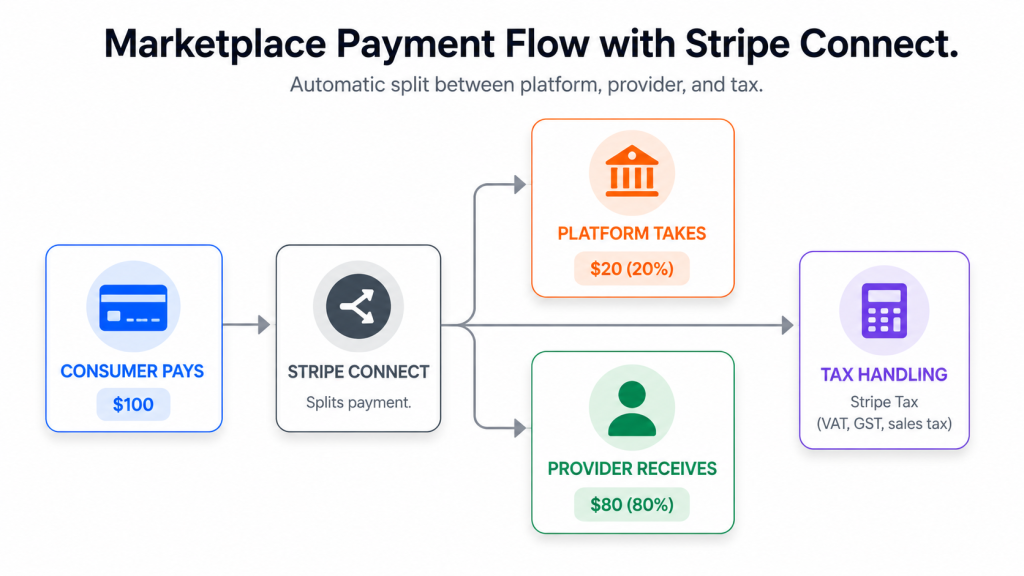
Component 5 of on-demand service marketplace development is payment infrastructure. Marketplace payments are meaningfully more complex than typical e-commerce because money flows from consumer to platform to provider, with the platform taking a cut and the provider receiving a payout. Stripe Connect dominates this category in 2026.
Stripe Connect Account Types
Standard Accounts
Providers connect their own Stripe accounts to the platform. Stripe handles all KYC, tax forms, and payout management. The platform has the least operational burden but also the least control over the provider experience. Best for platforms targeting providers who are comfortable with self-managed Stripe accounts.
Express Accounts
Stripe manages the underlying account but the platform controls the onboarding flow. Providers complete a streamlined onboarding (5 to 10 minutes), and the platform retains a branded experience. Express accounts are the dominant 2026 choice for on-demand service marketplace development.
Custom Accounts
The platform handles all UX and Stripe handles only the underlying payments infrastructure. Maximum control, maximum compliance burden. Best for large platforms with dedicated payments engineering teams.
Take-Rate Decision
The platform’s take-rate (percentage of transaction value retained) determines unit economics. Service marketplaces typically take 15 to 30 percent. Lower take-rates (10 to 15 percent) work for commodity services with high volume. Higher take-rates (25 to 30 percent) work for premium services where the platform provides meaningful trust and matching value. Take-rate decisions are difficult to change after launch; pick deliberately.
Tax Handling
Cross-border platforms handle VAT (EU), GST (Australia, India, Singapore), and US sales tax through Stripe Tax or specialized providers like Avalara. Skipping tax compliance produces audit risk down the line. The canonical reference for marketplace payments is the Stripe Connect documentation.
Payout Cadence
Weekly payouts are standard. Faster options (daily, instant) appeal to providers but carry additional fees. The payout cadence decision affects provider retention; providers who feel paid quickly stay on the platform longer.
The payment component is roughly 15 to 20 percent of MVP build time. The most common mistake is rolling custom billing instead of using Stripe Connect; custom billing is the second-fastest way to burn an MVP budget after building before validating.
Component 6: Communication and Notifications
Component 6 of on-demand service marketplace development is communication infrastructure. Consumers and providers need to coordinate before, during, and after service. Without strong communication, no-shows and disputes rise sharply.
In-Platform Messaging
Tutor-style in-platform messaging between consumer and provider is the dominant 2026 pattern. Messages route through the platform (not direct phone numbers or email) to prevent disintermediation, support moderation, and provide audit trails. Contact info redaction automatically masks phone numbers and email addresses shared in chat.
Push Notifications
Push notifications drive engagement on both sides of the marketplace. For consumers: booking confirmation, provider en route, provider arrived, service completed, rating request. For providers: new job request, schedule reminder, payment received, low-rating alert. Each notification is opt-in and respects user notification preferences.
SMS Fallback
SMS notifications fire for high-priority events (booking confirmation, provider arrival, urgent updates) even when push notifications are disabled. Twilio dominates as the SMS infrastructure provider. SMS costs $0.005 to $0.05 per message depending on geography; budget accordingly at scale.
Email Communication
Email handles longer-form communication (receipts, monthly summaries, marketing emails). Postmark, Resend, or SendGrid handle transactional email infrastructure. Email is the secondary channel; mobile push and SMS carry most operational communication in 2026 on-demand service marketplace development.
Voice and Video
Optional voice calling through Twilio or Sinch lets consumers and providers talk without exchanging phone numbers. Video calling is increasingly common for service categories like fitness training, beauty consultations, and remote tutoring. The voice and video components add 5 to 10 percent to MVP build cost but are essential for video-native verticals.
The communication component is roughly 8 to 12 percent of MVP build time. Most marketplace projects underinvest here, then add communication features after launch when the absence becomes painful for users.
Component 7: Quality Assurance and Reviews
Component 7 of on-demand service marketplace development is quality assurance. Service marketplaces compete on trust; trust is built through verified providers and visible review history.
Two-Way Rating System
Consumers rate providers after each service (typically 1 to 5 stars with optional written feedback). Providers rate consumers (no-shows, payment reliability, behavior). Two-way ratings filter bad actors on both sides over time and inform the matching algorithm.
Dimensional Ratings
Beyond a single star rating, platforms collect dimensional ratings: service quality, communication, timeliness, pricing fairness, cleanliness. Dimensional ratings give prospective consumers richer information and surface providers who excel in specific areas.
Photo Documentation
Before-and-after photos for services like cleaning, lawn care, and beauty create accountability and serve as portfolio content. Photo capture happens in the provider app at the start and end of service. Photos surface in the consumer’s service history and contribute to the provider’s profile.
Dispute Resolution
When service quality is contested, the platform mediates. Standard workflow: consumer reports issue within 24 to 48 hours of service, platform reviews evidence (photos, chat logs, ratings), platform decides on partial refund, full refund, or replacement service. Fast dispute resolution (under 72 hours) builds trust; slow resolution drives churn.
Trust and Safety Operations
Beyond ratings and disputes, the platform runs trust and safety operations: identity verification refresh, periodic background re-checks, incident response protocols, mandatory reporting where applicable. These operations are non-optional for any on-demand service marketplace development project.
The quality component is roughly 8 to 12 percent of MVP build time but ongoing operational cost is meaningful. Budget 5 to 10 percent of operational headcount for trust and safety at scale.
Component 8: Mobile App Architecture
Component 8 of on-demand service marketplace development is mobile app architecture. On-demand services live on smartphones. Platforms typically build three distinct apps (or app surfaces): the consumer app, the provider app, and the admin app.
The Consumer App
Customer-facing app for booking services, tracking provider arrival, communicating, paying, and reviewing. Built in Flutter or React Native for cross-platform efficiency. Distributed through App Store and Google Play. Key surfaces: home/discovery, service catalog, booking flow, active job tracking, account, history.
The Provider App
Field-service app used during active work. Built for offline-capable use because providers operate in places with weak signal. Key surfaces: incoming job queue, daily schedule, in-progress job management (photos, time tracking, status updates), customer communication, earnings dashboard, tax documents.
The Admin App (or Web Dashboard)
Operations team interface for managing the platform: viewing all bookings, monitoring flagged sessions, managing disputes, suspending bad-actor providers, processing payouts, supporting both sides. Most admin apps are web-based (not native mobile) because operators work from desks.
Cross-App Shared Infrastructure
The three apps share API endpoints, authentication, data models, and observability. Building them on a shared codebase (single React Native or Flutter project with three entry points, or a shared backend with three frontend apps) reduces development cost by 30 to 50 percent compared to fully separate apps. The deeper treatment of mobile app architecture lives at on-demand service mobile app development.
The mobile app component represents 25 to 35 percent of total MVP build cost. Mobile is not a v2 addition; it is the primary surface from day one.
On-Demand Service Marketplace Development Cost
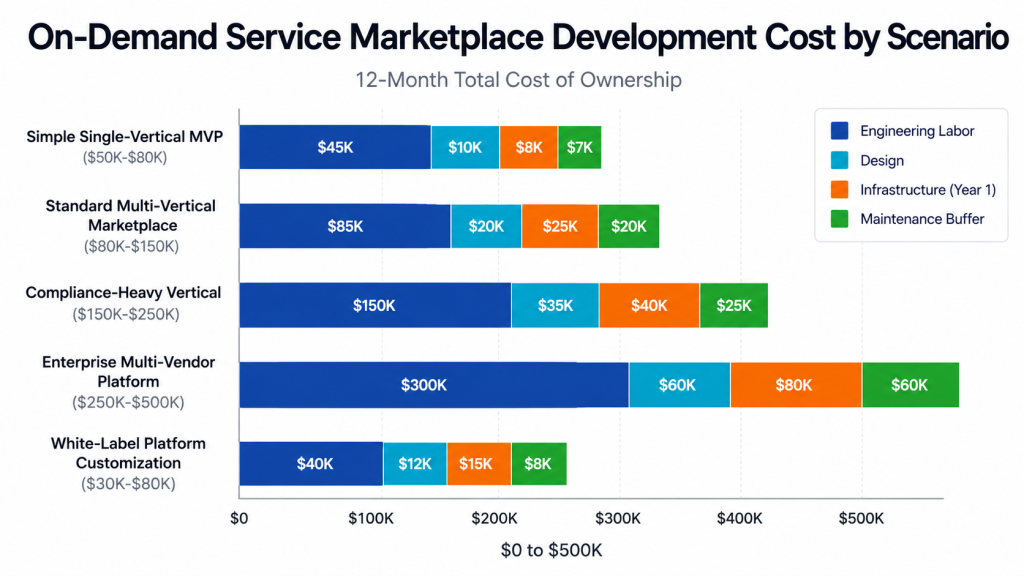
Cost varies dramatically by scope and team. Five scenarios cover most build paths.
The 5 Cost Scenarios
Scenario 1: Simple Single-Vertical MVP ($50K to $80K). Single vertical (one service category), single geography, 2 of 3 mobile apps (customer + provider, admin via web), 10 to 12 weeks build. For founders validating one specific vertical before expanding.
Scenario 2: Standard Multi-Vertical Marketplace ($80K to $150K). 3 to 5 verticals, multi-geography support, all 3 apps native, 12 to 16 weeks build. The dominant on-demand service marketplace development pattern in 2026.
Scenario 3: Compliance-Heavy Vertical ($150K to $250K). Healthcare, financial services, or other regulated verticals with HIPAA, SOC 2, or equivalent compliance requirements. Added 4 to 8 weeks for compliance architecture and certification work.
Scenario 4: Enterprise Multi-Vendor Platform ($250K to $500K+). Complex multi-vendor marketplace with sophisticated routing, advanced analytics, custom workflows, and enterprise integrations. 24 to 36 weeks build.
Scenario 5: White-Label Platform Customization ($30K to $80K). Customize an existing platform like Prohandy for your vertical. 4 to 8 weeks customization. Lowest cost, fastest time-to-market.
The 5th scenario is increasingly the right path for founders who want to focus on go-to-market rather than engineering. The cost includes scope-discipline savings (no greenfield architectural decisions) and time savings (3 to 6 month head start).
On-Demand Service Marketplace Development Timeline
Realistic timelines by scenario follow the cost patterns.
10 to 12 Weeks (Single-Vertical MVP)
Weeks 1-2: Discovery and design. Weeks 3-5: Core booking and provider features. Weeks 6-8: Payments and communication. Weeks 9-10: QA, testing, mobile app store submission. Weeks 11-12: Soft launch and stabilization.
12 to 16 Weeks (Standard Multi-Vertical)
Same phases extended by 2 to 4 weeks to accommodate multi-vertical catalog complexity, full mobile app suite, and broader QA coverage. The default on-demand service marketplace development timeline.
16 to 24 Weeks (Compliance-Heavy or Multi-Vendor)
Adds compliance review, security audits, multi-vendor onboarding flows, and additional integration work. Phased launch over multiple weeks rather than single soft launch.
4 to 8 Weeks (White-Label Customization)
Branding, vertical-specific configuration, custom features, deployment. The fastest path from idea to live marketplace.
Vertical Examples in On-Demand Service Marketplace Development
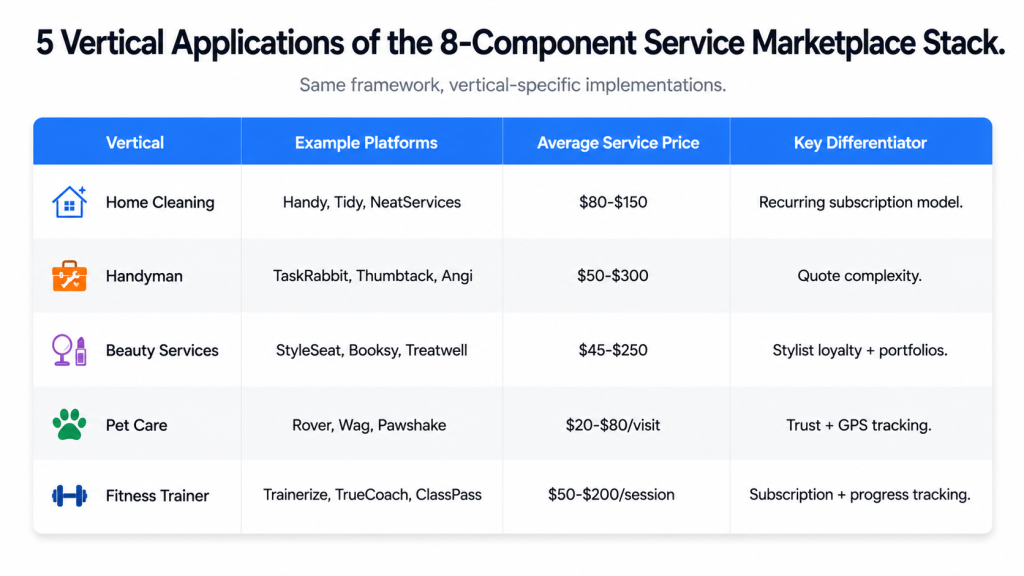
The 8-Component Stack applies across verticals with vertical-specific implementations of each component. Five vertical examples illustrate the patterns.
Home Cleaning Service Marketplace
Cleaning is the most-built vertical because demand is high and operational requirements are moderate. Recurring subscription is the dominant retention pattern. Deep coverage at home cleaning service marketplace.
Handyman Service Marketplace
Handyman services have quote complexity because scope varies job-to-job. Photo submission and pre-quote flows are central. Deep coverage at handyman app development.
Beauty Service Marketplace
Beauty platforms emphasize stylist loyalty, portfolios, and rebooking. Pre-appointment confirmation and post-appointment upsell drive economics. Deep coverage at beauty service marketplace.
Pet Care Service Marketplace
Pet care emphasizes trust (consumers leave pets with strangers) and real-time GPS tracking during walks or visits. Deep coverage at pet care marketplace.
Fitness Trainer Marketplace
Fitness trainer platforms emphasize subscriptions, progress tracking, and ongoing relationships rather than one-off bookings. Deep coverage at personal trainer app development.
Car Service Marketplace
For the automotive vertical specifically, including mobile mechanic services and shop-based marketplaces, see car service marketplace development.
The pattern across all verticals: the 8-Component Stack provides the structural foundation, but each vertical implements components differently. The two-sided marketplace business model framework explains why vertical-specific implementations outperform generic builds. The canonical reference for marketplace economics is a16z’s marketplace metrics framework.
Common On-Demand Service Marketplace Development Mistakes
Six recurring mistakes account for most slipped or failed marketplace builds.
Mistake 1: National launch before single-city liquidity. Marketplaces with 200 providers across 50 cities are liquid in zero cities. Concentrate first, expand later.
Mistake 2: Skipping provider verification depth. Background checks, identity verification, and skill verification take time but produce the trust that compounds. Skipping verification produces platforms that fail the first incident.
Mistake 3: Hardcoded pricing logic. Build the pricing engine as a configurable system. Hardcoded pricing blocks promotions, experiments, and vertical expansion.
Mistake 4: Treating mobile as a v2 feature. Mobile is the primary surface from day one. Web-only on-demand service marketplace development is a strategic mistake.
Mistake 5: Underestimating trust and safety operations. Budget human operators for incident response. Ad-hoc response damages trust faster than the platform can rebuild it.
Mistake 6: Custom billing instead of Stripe Connect. Rolling custom marketplace billing is the second-fastest way to burn capital. Use Stripe Connect.
The platform-vertical analysis at NfX’s marketplace network effects framework covers many of these patterns in marketplace economics terms.
Agency vs In-House for On-Demand Service Marketplace Development
The agency-vs-in-house decision follows familiar patterns for marketplace builds.
1. When Agency Wins
Specialized marketplace agencies bring pattern reuse (they have built dozens of marketplaces), compliance experience, and fixed-price predictability. The Xgenious agency model includes Prohandy as a productized starting point that white-labels for specific verticals, reducing build cost and timeline by 50 to 70 percent.
2. When In-House Wins
Post-PMF marketplaces with sustained development needs justify permanent engineering teams. In-house teams accumulate institutional knowledge and ship at higher velocity once ramped (typically 6 to 12 months post-hire).
3. The Hybrid Pattern
Most successful marketplaces hybridize: agency or productized platform builds the MVP and ships the first year, in-house team takes over for sustained development from month 12 to 18 onward. This pattern preserves agency velocity in the early stage while building in-house knowledge for scale.
Conclusion: Building Your On-Demand Service Marketplace That Scales
On-demand service marketplace development in 2026 has matured into a discipline with 8 critical components (identity, catalog, booking, geo-routing, payments, communication, quality, mobile apps) and a clear set of patterns proven across verticals. Teams that follow the 8-Component Stack ship working marketplaces in 10 to 16 weeks; teams that skip components produce platforms that fail their first stress test.
The dominant pattern across successful on-demand service marketplace development in 2026: single-city concentration before national expansion, vertical-specific implementation of each component, Stripe Connect for payments, native mobile from day one, and trust and safety as a permanent operational investment. None of this is exotic; all of it is what separates working marketplaces from broken ones.
On-Demand Service Marketplace Development FAQ
1. How much does on-demand service marketplace development cost?
$50K to $500K depending on scope. Simple single-vertical MVP at $50K to $80K. Standard multi-vertical at $80K to $150K. Compliance-heavy or multi-vendor at $150K to $500K. White-label customization of an existing platform like Prohandy at $30K to $80K. Add infrastructure and operations cost of $30K to $100K per year for Year 1.
2. How long does on-demand service marketplace development take?
10 to 16 weeks for most MVPs. 10 to 12 weeks for single-vertical builds. 12 to 16 weeks for standard multi-vertical builds. 16 to 24 weeks for compliance-heavy or multi-vendor builds. 4 to 8 weeks for white-label customization of an existing platform.
3. What is the right take-rate for an on-demand service marketplace?
15 to 30 percent of transaction value. Lower take-rates (10 to 15 percent) for commodity high-volume services. Higher take-rates (25 to 30 percent) for premium services where the platform provides strong trust and matching value. Take-rate decisions are difficult to change after launch; pick based on competitive landscape and value-added analysis.
4. Should I build mobile apps from day one?
Yes. Mobile is the primary surface for on-demand services. Web-only marketplaces lose to mobile-first competitors within 12 months. Build the customer app and provider app from day one; the admin app can stay web-based.
5. What is the minimum viable team for on-demand service marketplace development?
4 to 6 engineers (1 backend, 1 mobile, 1 frontend, 1 DevOps/full-stack, 1 to 2 product/design). Plus 1 product manager and 1 to 2 trust and safety operators starting in week 8 to 10. Solo builders take 6 to 12 months for equivalent scope and rarely ship competitive products.
6. Should I build a single-vertical or multi-vertical platform?
Start single-vertical, expand to multi-vertical after Year 1. Single-vertical focus produces faster initial liquidity in one market. Multi-vertical from day one dilutes attention and produces a marketplace that does many things poorly rather than one thing excellently. The Prohandy platform is multi-vertical by design but tenants typically launch focused on one vertical first.
7. What is the difference between an on-demand service marketplace and a directory site?
Directory sites list providers but do not handle bookings or payments. On-demand service marketplaces handle the entire transaction: discovery, booking, payment, dispute resolution. Directory sites have minimal engineering cost ($5K to $20K) but minimal monetization. On-demand marketplaces have meaningful engineering cost ($50K to $500K) but capture transaction value through take-rates.