



The automotive service market is in the middle of a digital shift that mirrors what happened to lodging in 2010 and food delivery in 2015. Car owners increasingly book maintenance, repairs, and inspections through digital platforms rather than calling shops directly. The market is large (over $800 billion globally in automotive aftermarket services), fragmented (millions of independent mechanics and shops), and underdigitized (less than 20 percent of service bookings happen through digital channels in most markets). Car service marketplace development sits at the center of this shift, and the platforms that nail the model capture a meaningful share over the next 5 to 10 years.
Car service marketplace development is meaningfully more complex than generic marketplace builds. The product requires vehicle data integration, location-based service routing, dynamic pricing for hundreds of service types, technician certification workflows, insurance and warranty handling, and two separate mobile apps (one for customers, one for providers in the field). Founders who copy a generic marketplace template into the automotive vertical underestimate this complexity and ship platforms that cannot handle real-world service scenarios.
This guide walks through the 7 bulletproof steps that every successful car service marketplace development project covers: market analysis, core platform features, vehicle information systems, location-based services, payment and pricing systems, quality control and certification, and mobile app development for both customer and provider audiences. It includes the Trust Triangle framework (Service Quality + Pricing Transparency + Booking Convenience) that explains why customers choose one platform over another, five real-world platform examples (YourMechanic, Wrench, Openbay, RepairPal, BookMyGarage), and what each teaches about the model, and a 6-question FAQ covering the build economics.
Five takeaways before reading on: car service marketplace development is a vertical-specific extension of two-sided marketplace patterns; the Trust Triangle determines customer loyalty; vehicle data integration is the hardest technical challenge unique to this vertical; provider-side apps are as important as customer apps; and platform economics depend heavily on take-rate vs subscription mix. For the broader marketplace framework that contextualizes this build, see saas vs marketplace, and for an example of an on-demand services marketplace in production, see Prohandy.
Why Car Service Marketplace Development Is Different from Generic Marketplace Builds
Car service marketplace development inherits the two-sided dynamics of any service marketplace (supply: mechanics, shops, mobile technicians; demand: vehicle owners) but adds vertical-specific requirements that generic marketplace patterns do not handle.
Vehicle-specific data complexity. Every service interaction is tied to a specific vehicle (year, make, model, trim, VIN). Service catalogs, pricing, parts compatibility, and provider qualifications all vary by vehicle. A generic marketplace handles “services” as opaque listings; car service marketplace development requires structured vehicle data flowing through every booking, quote, and service history record.

Technician certification asymmetry. Service quality varies dramatically by mechanic skill and certification level (ASE certifications in US, equivalent vocational certifications in EU). A platform that treats all providers as equal produces customer complaints; a platform that surfaces certifications, specialties, and ratings produces trust.
Service duration and on-site complexity. Most services take 30 minutes to 4 hours, sometimes longer for major repairs. Pricing depends on diagnostic findings that emerge during service. Mobile services require travel time and parking. Each of these variables complicates the booking, quoting, and payment flow beyond what generic on-demand marketplace patterns assume.
Regulatory and insurance overlap. Car service work often interacts with insurance claims (collision repair, warranty work, recalls), state inspection requirements, and consumer protection regulations specific to automotive repair. Car service marketplace development must accommodate these workflows; ignoring them limits the platform to non-insurance, non-warranty work, which is a fraction of the total market.
Trust and information asymmetry. Vehicle owners rarely know whether a quoted repair is necessary, fairly priced, or correctly diagnosed. The platform’s role in building trust (transparent pricing, certified providers, diagnostic explanations, before-and-after photos) is the difference between a thriving marketplace and a marketplace that bleeds liquidity to one-off direct relationships.
These five factors mean car service marketplace development cannot simply adopt the Airbnb or DoorDash playbook unchanged. The vertical requires its own framework.
Car Service Marketplace Development Market: Size, Demand, and Digital Adoption
The opportunity in car service marketplace development is large and accelerating, but it requires honest market analysis to target the right segment.
Market size. The global automotive aftermarket service market exceeds $800 billion annually, with the US share roughly $400 billion. Routine maintenance (oil changes, tire rotations, brake service) accounts for 30 to 40 percent; major repairs (engine, transmission, electrical) account for another 30 to 40 percent; collision and body work account for 15 to 20 percent; specialty services (detailing, performance, custom) account for the remainder.
Digital adoption gap. Despite the market size, digital booking penetration sits between 12 and 18 percent in most developed markets as of 2026. Comparable verticals (food delivery: 60 to 70 percent digital; ride-hailing: 80 to 90 percent; lodging: 75 to 85 percent) suggest car service has room for another 5 to 10 years of digital growth. The platforms that capture share now will be entrenched by 2030.
Customer segments. Three segments drive demand. Convenience-driven urban professionals who want mobile service at home or office (highest willingness to pay, smallest segment). Price-sensitive comparison shoppers who use platforms to get multiple quotes (largest segment, lowest margin per transaction). Fleet operators and small businesses managing multiple vehicles (B2B segment, highest LTV, requires dedicated tooling). Car service marketplace development decisions vary by which segment is primary.
Provider segments. Three provider types serve these segments. Independent mechanics and small shops (the long tail, 70 to 80 percent of providers, willing to join platforms for demand). Mid-size chains (Midas, Jiffy Lube, regional chains, more reluctant to join open platforms but interested in own-branded technology). Mobile technicians (rapidly growing segment, often platform-native). Provider acquisition asymmetry is real: independent shops are easy to acquire; chain partnerships are slow and high-touch.
Geographic dynamics. Hyper-local liquidity matters more than total market size. A car service marketplace with 1,000 providers spread across 50 cities is liquid in zero cities; the same 1,000 providers concentrated in one city is liquid. Most successful car service marketplace development projects start in one city, prove liquidity, then expand. National launches without geographic concentration consistently fail to build network effects.
The market analysis informs the platform’s positioning. Targeting convenience-driven urban professionals supports premium take-rates (15 to 25 percent); targeting price-sensitive comparison shoppers requires lower take-rates (5 to 10 percent) and higher volume. The right segment depends on the founder’s capital, geographic focus, and competitive landscape.
Core Features in Car Service Marketplace Development: Booking, Provider Management, and Inventory
Core platform features in car service marketplace development span four primary surfaces: customer-facing booking, provider-facing job management, admin dashboards, and shared data infrastructure.
Service booking flow. Customer enters vehicle (year/make/model or VIN), selects service type (from a structured catalog of 50 to 200 services), specifies location (drop-off shop or mobile service address), picks a time window, and receives a quote. The booking flow handles ambiguity: when the customer cannot describe the problem precisely, the platform offers diagnostic options that route to inspection-first appointments. Pricing is upfront where possible, range-based where diagnostic is required.
Provider profile management. Each provider lists business information, certifications (ASE specialties, manufacturer certifications), service capabilities (which vehicle makes, which service types), pricing tiers, availability calendar, location and service radius (for mobile providers), and historical ratings. Provider onboarding includes identity verification, business verification, insurance verification, and (where applicable) ASE certification verification through ASE’s verification API.
Job management for providers. Providers receive booking requests, accept or decline based on capacity, manage daily schedules, communicate with customers, mark jobs as in-progress and completed, upload before-and-after photos, capture parts used, and generate invoices. The provider workflow is mobile-first because most field technicians work from phones, not desks.
Service catalog management. A structured database of 50 to 200 standard automotive services, each with default time estimates, typical pricing ranges, required certifications, applicable vehicle types, and required parts. The catalog is the operational backbone of the marketplace; weak catalog structure produces inconsistent pricing and quality across providers.
Inventory and parts tracking. Service jobs require parts. The platform tracks parts requested per job, parts inventory at participating shops (for shops that share data), and parts ordering integrations with major suppliers (AutoZone, NAPA, O’Reilly for US; Euro Car Parts and similar in EU). Mobile technicians order parts per job; shops manage inventory at the location level.
Communication infrastructure. In-platform chat between customer and provider, push notifications for job status updates (accepted, en route, in progress, completed), photo and video sharing for diagnostic clarification, and SMS fallback for time-sensitive notifications. The platform owns customer-provider communication; allowing direct phone or text exchange leads to disintermediation, where customers and providers move off-platform after the first transaction.
Review and rating system. Two-way reviews (customer rates provider, provider rates customer) with structured rating dimensions (work quality, communication, timeliness, pricing fairness) and free-text reviews. Reviews are the primary trust signal for new customers selecting providers; weak review systems cripple liquidity. Reviews should be moderated for fairness (provider can respond, platform mediates disputes) but not censored.
Admin dashboard. Operations team views all bookings, manages disputes, suspends bad-actor providers, runs payouts, monitors platform metrics, and supports both sides through ticket management. Admin tools that lag behind operational complexity are a common failure mode in early-stage car service marketplace development.
The integration of these eight core surfaces into a coherent product is the central technical challenge. For the related question of multi-tenant architecture that supports separate provider businesses on a shared platform, see multi-tenant saas architecture.
The Trust Triangle: A Car Service Marketplace Development Framework
The Trust Triangle is the framework that explains why customers choose one car service platform over another, and why some platforms compound while others stall. Three forces shape every customer choice: Service Quality, Pricing Transparency, and Booking Convenience. Platforms strong on all three dominate; platforms weak on any one bleed customers to platforms that are strong on it.
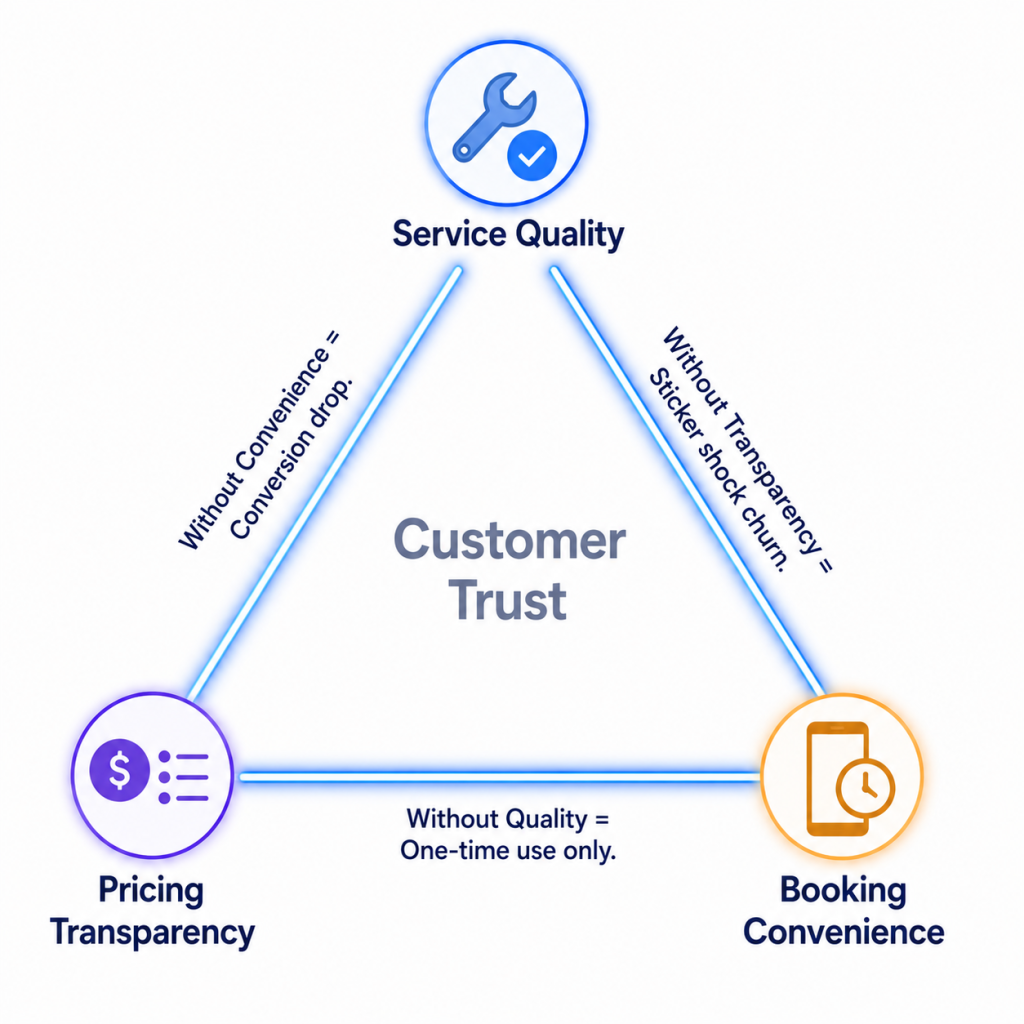
Force 1: Service Quality. Customers expect competent diagnoses, correctly-performed repairs, and durable outcomes. Platforms enforce quality through certification verification, structured ratings, dispute mediation, and warranty programs. Weak quality enforcement produces one-star reviews that scare new customers; strong quality enforcement compounds trust over time.
Force 2: Pricing Transparency. Vehicle owners chronically distrust automotive pricing because of decades of opaque shop quotes and surprise add-ons. Platforms win trust by displaying upfront pricing where possible, clearly explaining diagnostic-dependent ranges, requiring approval before scope changes, and breaking down labor vs parts vs platform fees. Sticker shock is the single biggest cause of customer churn in car service marketplace development.
Force 3: Booking Convenience. Customers want to book service in under 5 minutes from a phone, choose a time that fits their schedule, and receive clear status updates. Friction in booking (long forms, unclear availability, complicated checkout) drops conversion sharply. Convenience is the surface that compares directly against the alternative (calling local shops), and the platform’s convenience advantage is what motivates initial trial.
Pick two of three rarely works. Unlike some triangle frameworks where picking two of three is the realistic constraint, car service marketplace development requires all three forces to be strong for the platform to win meaningful share. Weakness on any one force creates an opening for a competitor that addresses it. The framework’s value is diagnostic: when growth stalls, identify which force the platform is weakest on, and direct effort there.
The Trust Triangle should be the framework the team revisits at every major product decision. Adding a new feature: does it strengthen Quality, Transparency, or Convenience? If none, the feature is decoration, not advantage.
Vehicle Information Systems in Car Service Marketplace Development: VIN, Profiles, History
Vehicle information systems are the technical layer unique to car service marketplace development. Generic marketplace patterns do not handle this complexity; building it correctly is the difference between a platform that can quote accurately and one that produces wrong prices for half its bookings.
VIN (Vehicle Identification Number) integration. Every vehicle has a 17-character VIN that uniquely identifies it. VIN decoding reveals year, make, model, trim, engine type, transmission, and dozens of other specifications. Platforms integrate with VIN decoder APIs (NHTSA’s free vPIC API, commercial APIs from Carfax, AutoCheck, or Edmunds) to instantly populate vehicle data when a customer enters a VIN. This eliminates manual data entry errors and produces accurate service quotes.
Vehicle profiles. Each customer’s saved vehicles store the VIN, current mileage, ownership duration, modifications, and notes. Profiles support multi-vehicle households (one customer with 3 vehicles), fleet accounts (one customer with 50 vehicles), and historical service records. Vehicle profiles transform one-time customers into repeat customers because the friction of re-entering vehicle data on subsequent bookings disappears.
Service history. Every completed service generates a record tied to the vehicle: date, mileage, services performed, parts replaced, provider, cost, photos, warranty terms. The service history is the customer’s automotive maintenance record and one of the strongest retention features in car service marketplace development. Customers who have history on the platform return for subsequent services rather than switching to a competing platform that requires starting over.
Maintenance schedule integration. OEM (original equipment manufacturer) recommended service schedules vary by vehicle. The platform should know that a 2022 Toyota Camry needs oil changes every 10,000 miles and transmission fluid every 60,000 miles, then proactively remind the customer when their vehicle approaches each milestone. Proactive maintenance reminders drive 20 to 30 percent of revenue for established car service marketplaces.
Parts compatibility. The right parts depend on the vehicle’s exact specifications. The platform integrates with parts catalogs (Mitchell1, AllData, Bosch ESI, or supplier-specific APIs) to confirm parts compatibility before quoting. Wrong-parts errors are operationally expensive (parts returned, jobs delayed, customer trust damaged); compatibility checks prevent them.
Recall and TSB integration. Manufacturers issue safety recalls and Technical Service Bulletins (TSBs) for known issues. Integration with NHTSA’s recall API surfaces active recalls during booking, which the platform can use to alert customers and route them to authorized providers for recall work (often paid by the manufacturer, not the customer).
Diagnostic data integration. For advanced platforms, OBD-II diagnostic data from the customer’s vehicle (via Bluetooth dongle or connected car APIs from Tesla, Ford, GM, Stellantis) flows into the platform to provide diagnostic context before booking. This is emerging in 2026 as connected cars become standard; platforms that build for OBD-II integration now will have an advantage in 5 years.
The vehicle information system is meaningful engineering work. Budget 15 to 25 percent of the MVP build for this layer alone. Skipping it produces a platform that cannot quote accurately, cannot retain customers through history, and cannot compete with platforms that built it correctly.
Location-Based Services in Car Service Marketplace Development: GPS, Mobile Service, Pickup
Location-based services are the second technical layer unique to car service marketplace development. Whether the platform supports mobile service (technician comes to customer), pickup-and-deliver (platform arranges pickup, services at shop, returns vehicle), or drop-off only (customer brings vehicle to shop), location accuracy determines customer experience and operational efficiency.
GPS integration for mobile service. Mobile technicians travel to customer locations. The platform needs accurate GPS routing for the technician to find the address, real-time location sharing so customers see the technician en route (the Uber pattern, applied to automotive service), and travel time calculations that account for traffic, vehicle accessibility, and service duration. Mapbox, Google Maps Platform, and HERE are the dominant routing API providers; Mapbox is typically the lowest cost for marketplace volumes.
Service radius and zone management. Mobile providers operate within service radii (5 to 30 miles typical). Shop-based providers serve customers within driving distance (typically 10 to 20 miles for non-emergency service). The platform routes bookings to providers whose service radius includes the customer address. Zone-based pricing handles geographic cost variance (urban Manhattan service costs more than suburban service).
Pickup and delivery logistics. Premium platforms offer vehicle pickup at customer location, service at shop, and delivery back to customer. This requires coordination of two trips per service (pickup + delivery), driver assignment (often gig workers from the platform’s network or partnerships with valet services like Switch or HopSkipDrive), and key handling protocols. Pickup-and-delivery doubles the operational complexity but commands 30 to 60 percent pricing premium.
Real-time arrival tracking. Customers waiting for mobile service (and customers waiting for pickup) expect Uber-style real-time tracking. The provider app shares location during transit; the customer app shows ETA, route, and updates. Without real-time tracking, customer service tickets multiply (“where is my technician?”).
Address validation and accessibility flags. Vehicle service has accessibility constraints generic services do not. Apartment complexes may not allow mobile service on premises. Underground parking lots are inaccessible for tow trucks. Some services require flat ground or weatherproof workspace. The platform captures these constraints at booking and routes to compatible providers.
Multi-stop optimization. Mobile technicians often have 4 to 8 jobs per day. The platform should optimize route order to minimize drive time, increasing technician utilization 20 to 35 percent. Route optimization APIs (Mapbox Optimization, Google Routes Optimization, OptimoRoute) handle this at production scale.
The location layer is roughly 10 to 15 percent of MVP build effort for mobile-service platforms, lower for shop-only platforms. Skipping it for mobile-service platforms produces a product that cannot actually deliver mobile service efficiently. For the related question of which technical stack supports this geo-heavy workload, see the 2026 saas tech stack.
Payment and Pricing in Car Service Marketplace Development: Dynamic, Insurance, Warranty
Payment and pricing systems in car service marketplace development are more complex than generic marketplace payments because of insurance involvement, warranty work, and the gap between quoted and final prices that emerges during service.
Two-sided payment via Stripe Connect. The platform takes payments from customers, holds funds, and pays providers minus the platform’s take-rate. Stripe Connect is the dominant infrastructure (Express accounts for streamlined provider onboarding, custom accounts for platforms wanting full UX control). Connect handles split payments, KYC for providers, 1099-K tax reporting (US), and payout scheduling. The full mechanics are covered at saas vs marketplace in the payment plumbing section.
Dynamic pricing tiers. Platforms typically offer three pricing approaches per service: flat-rate (oil change at $69), range (brake pad replacement $200 to $400 depending on parts), and diagnostic-first (check-engine-light requires $89 diagnostic, repair quoted after). The pricing engine handles all three patterns plus surge pricing during peak demand (winter, post-storm spikes), promotional discounts, and provider-specific pricing variations.
Take-rate strategy. Car service marketplace take-rates range from 10 to 25 percent depending on segment. Premium mobile services (YourMechanic-style) command 20 to 25 percent; comparison marketplaces (Openbay-style) take 10 to 15 percent; transaction-fee marketplaces (where the platform charges providers a flat per-lead fee rather than percentage) sit in between. Higher take-rates require higher differentiation; commodity competition compresses take-rates toward single digits.
Insurance integration. A meaningful share of car service work is paid by insurance (collision repair, comprehensive claims, warranty work). The platform integrates with insurance providers’ claims systems (or operates as an intermediary that handles claims paperwork on behalf of the customer). Insurance-integrated platforms unlock 20 to 40 percent of the total addressable market that pure cash-pay platforms cannot serve.
Warranty handling. Cars under manufacturer warranty have specific repair networks (dealership-only for certain repairs). Cars with extended warranties from third-party providers (CarShield, Endurance, etc.) require claim authorization before work begins. The platform should route warranty-eligible work to authorized providers and handle the documentation workflow.
Scope-change approvals. Service jobs often expand during work (“we found additional issues during the brake inspection”). The platform requires mandatory customer approval for scope changes above a threshold (typically $50 or $100), with photo documentation of the issue and a revised quote. Without scope-change protocols, customers experience the bait-and-switch pattern that fuels distrust in automotive service.
Refund and dispute handling. When work is unsatisfactory, the platform mediates refunds. Mediation rules (warranty period, evidence requirements, partial refund tiers) protect both customers and providers. Strong dispute handling is the trust signal that pulls customers from off-platform direct relationships.
Evaluation checklist for payment and pricing in car service marketplace development: does the platform support all three pricing patterns natively; is the take-rate competitive for the target segment; can insurance and warranty workflows be added without major refactor; are scope-change protocols enforced at the platform level. For founders ready to scope these capabilities into a fixed-price MVP, see the MVP packages.
Quality Control in Car Service Marketplace Development: Certification, Standards, Reviews
Quality control is the marketplace’s defense against the trust erosion that kills most service marketplaces. Strong quality controls compound trust; weak controls produce one-star reviews that scare new customers permanently.
Provider certification verification. ASE (Automotive Service Excellence) certifications signal mechanic competence in the US; comparable certifications exist in EU (e.g., Bosch Service in Germany, IMI accreditations in UK). The platform verifies certifications at provider onboarding through ASE’s verification API or manual document review. Certified providers display badges; unverified providers do not. Customers filter by certification level.
Service standards documentation. The platform publishes service standards (e.g., “all oil changes include filter replacement, fluid level checks, and tire pressure check”) that providers commit to. Providers who consistently fall short of standards face platform consequences (lower ranking, suspended status, removal). The standards turn variable provider quality into more consistent customer experience.
Two-way rating system. Customers rate providers on multiple dimensions (work quality, communication, timeliness, pricing fairness, cleanliness). Providers rate customers (no-shows, payment reliability, condition of vehicle). Both sides see each other’s ratings before accepting a booking. The two-way system filters bad actors on both sides over time.
Photo documentation. Mobile technicians and shops photograph the vehicle before service, problems identified during inspection, parts replaced, and work completed. Photos create accountability, support warranty claims, and provide marketing material (with customer permission). Photo requirements are operational discipline; platforms that enforce them get better data and fewer disputes.
Mystery shopping and sample audits. Established platforms periodically send mystery customers to providers to verify service quality. Random photo audits catch shortcuts. These programs are operationally expensive but produce the trust signal that scales the marketplace.
Warranty program. Platforms increasingly offer their own warranty on all work performed by network providers (typically 12 to 24 months or 12,000 to 24,000 miles). Platform warranties differentiate the marketplace from direct provider relationships and earn customer loyalty.
Dispute resolution workflow. When customer and provider disagree on quality or scope, the platform’s dispute team mediates with photo evidence, ratings history, and documented service standards. Fast, fair dispute resolution (typically 48 to 72 hour response) is what separates trusted platforms from forgotten ones.
Quality control is operational, not just technical. The team that operates a car service marketplace development project at scale typically includes 1 to 3 quality operations staff per 10,000 monthly transactions.
Mobile App Development for Car Service Marketplace Platforms
Mobile apps are not optional in car service marketplace development. They are the primary surface for both customers and providers, and the apps must be designed with distinct workflows for each audience.
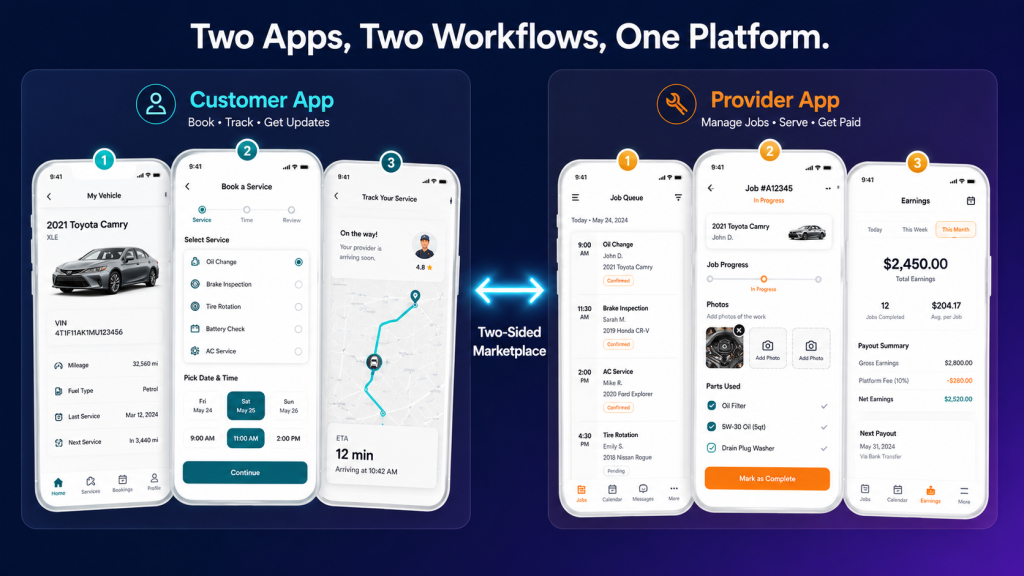
Customer app surface. The customer app is consumer-grade software competing against every other beautifully designed app on the user’s phone. Key surfaces: vehicle profile management, service booking, real-time provider tracking, in-app communication, payment and billing, service history, maintenance reminders, and review submission. The customer app drives initial conversion and ongoing retention; weak customer apps lose share to better-designed competitors quickly.
Provider app surface. The provider app is field-service software used during active work. Key surfaces: incoming job queue with accept/decline workflow, daily schedule with route optimization, in-progress job management (photos, parts capture, status updates), customer communication, time tracking, earnings dashboard, and tax document access. The provider app determines provider efficiency; weak provider apps cause technicians to disengage from the platform and revert to direct customer relationships.
Flutter vs React Native for the build. Both work for car service marketplace development. Flutter wins on visual consistency across iOS and Android (important for the customer app, which is brand-facing). React Native wins on web-mobile code reuse (useful if the platform shares logic with a web admin dashboard). Most 2026 builds use Flutter when mobile is the dominant surface, React Native when web is dominant and mobile is companion.
Native APIs and integrations. Both apps need native integrations: phone camera for photo capture, GPS for location, push notifications for status updates, payment SDKs for Apple Pay and Google Pay, and identity SDKs for ID verification (provider onboarding). Each integration adds 2 to 5 days of engineering and 1 to 2 weeks of testing across device types.
Offline functionality. Provider apps need offline functionality because field technicians work in basement garages, rural areas, and other low-signal locations. The app should accept jobs, capture photos, and queue status updates while offline, then sync when connectivity returns. Customer apps need less offline functionality but should at least preserve in-progress booking flows during temporary connectivity loss.
App Store and Google Play submission. Both apps require App Store and Google Play approval. Initial submission takes 1 to 2 weeks; subsequent updates take 1 to 7 days. Apple’s review process is meaningfully stricter; budget extra time for first submission and potential rejection on first attempt.
Ongoing app maintenance. Mobile apps require ongoing maintenance: OS updates (iOS and Android annual releases), device fragmentation testing, performance monitoring, crash reporting, and app store optimization. Budget 1 to 2 engineering days per month per app for steady-state maintenance after launch.
The two apps together represent 30 to 40 percent of total car service marketplace development effort. Founders who treat mobile as a “v2” item consistently lose to competitors who shipped mobile-first. For dedicated mobile build services, see our mobile app development services.
Five Real Examples of Car Service Marketplace Development
Five real platforms illustrate the patterns in car service marketplace development. Each made distinct strategic choices; each succeeded or struggled for different reasons.
1. YourMechanic (US, mobile service). Founded 2012, raised $40M+ in venture capital. Business model: mobile mechanics travel to customer locations for service. Take-rate: roughly 25 percent. Trust Triangle position: strong on Convenience (mobile service is inherently convenient), moderate on Quality (relies on contracted mechanics with verified certifications), strong on Transparency (upfront flat-rate pricing for most services). What it teaches: mobile-service marketplaces command premium take-rates but require careful provider quality management because customers cannot easily verify mechanic competence on-site.
2. Wrench (US, mobile service). Founded 2016. Similar mobile-service model to YourMechanic but tightly geographically focused (started in Pacific Northwest, expanded selectively). Business model and take-rate similar. What it teaches: hyper-local liquidity beats national expansion. Wrench’s slower geographic expansion produced more durable per-city economics than competitors who launched in 50 cities simultaneously.
3. Openbay (US, shop-based marketplace). Founded 2012. Business model: customer enters vehicle and service need, receives quotes from local shops, books with chosen shop. Take-rate: 8 to 12 percent (lower because shops bear cost of facility, not platform). What it teaches: shop-based marketplaces have larger TAM than mobile-only but lower trust differentiation (customers can comparison-shop directly with shops without the platform). Volume must be higher to compensate.
4. RepairPal (US, hybrid). Founded 2007. Business model: certified shop network with platform-managed quality standards, fair-price estimates, and warranty backing. Subscription model for shops plus consumer service. What it teaches: hybrid saas + marketplace models (subscription from providers, transaction value capture from consumers) reduce reliance on transaction take-rates and improve provider retention.
5. BookMyGarage (UK, marketplace). Founded 2015. UK-focused shop-based marketplace with strong MOT (UK vehicle inspection) integration. What it teaches: regional regulatory specialization (MOT in UK, TÜV in Germany, ITV in Spain) is a defensible moat. Global platforms with shallow per-country integration consistently lose to local platforms with deep regulatory integration.
The pattern across all five: the strongest car service marketplace development outcomes come from teams that pick a clear segment (mobile vs shop, premium vs comparison, geographic vs national), execute deeply within that segment, and resist the temptation to be everything to everyone. The full marketplace strategy discussion is at saas vs marketplace.
Conclusion: Building a Car Service Marketplace That Earns Trust and Compounds
Car service marketplace development is meaningfully more complex than generic marketplace builds because of vehicle data integration, location-based service routing, insurance and warranty workflows, technician certification verification, and the unique trust dynamics customers bring to automotive service. The 7 bulletproof steps covered in this guide (market analysis, core features, vehicle information systems, location-based services, payment and pricing, quality control, mobile app development) provide the structural foundation. The Trust Triangle framework (Service Quality + Pricing Transparency + Booking Convenience) explains why customers choose one platform over another and where successful platforms invest disproportionately.
The dominant pattern across the five real examples (YourMechanic, Wrench, Openbay, RepairPal, BookMyGarage): platforms that pick a clear segment, execute deeply within it, and resist over-expansion compound trust faster than platforms that chase national or category breadth before establishing per-market liquidity. Hyper-local liquidity beats national TAM. Deep regulatory integration beats shallow global coverage.
Car Service Marketplace Development FAQ
1. How much does car service marketplace development cost?
Fixed-price MVP packages from a specialized saas development agency typically run $40K to $120K for a multi-tenant car service marketplace MVP including customer app, provider app, web admin dashboard, basic VIN integration, payment plumbing, and 1 to 2 location-based service features. Custom enterprise builds run $200K to $1M+. In-house teams cost $400K+ in year 1 (4-engineer team). Budget realistically: a car service marketplace MVP that ships in 10 to 12 weeks lands in the $60K to $120K range.
2. How long does car service marketplace development take?
10 to 16 weeks for an MVP with the core feature set. The 10-week end assumes opinionated stack choices, a focused team, and strict scope discipline. The 16-week end accommodates compliance work (insurance integration, regulatory licensing), broader vehicle data integration, and dual-platform mobile apps with offline support. Geographic expansion adds 1 to 2 weeks per major new market.
3. What are the key compliance considerations in car service marketplace development?
Consumer protection regulations (clear pricing disclosures, scope-change consent, refund policies). Gig worker classification (mobile technicians are usually 1099 contractors, but classification rules tightened in California with AB5 and similar laws in other jurisdictions). Vehicle data privacy (VIN data is regulated as PII in some jurisdictions). Payment regulation (KYC/AML through Stripe Connect for marketplace payments). Insurance interaction (claims processing introduces regulated workflows). State-level licensing for some services (e.g., emissions testing).
4. What is the right take-rate for car service marketplace development?
Depends on the segment. Premium mobile service marketplaces: 20 to 25 percent. Mid-market shop-based marketplaces: 10 to 15 percent. Lead-generation marketplaces (flat per-lead fee instead of percentage): equivalent to 5 to 10 percent at typical conversion rates. Subscription-only models (providers pay monthly, platform takes nothing per transaction): 0 percent take-rate but $50 to $300/month per provider. The right rate balances provider acceptance and platform economics; under-priced rates leave money on the table, over-priced rates drive providers off-platform.
5. How complex is insurance integration in car service marketplace development?
Meaningfully complex. Direct integration with major insurance carriers (Geico, State Farm, Progressive, Allstate, plus regional insurers) requires API partnerships that take 6 to 12 months to negotiate. Most early-stage platforms instead handle insurance through manual claims paperwork (platform staff submit claims on behalf of customers) or through partnerships with claims-management intermediaries (CCC, Mitchell, Audatex). Plan to launch without direct insurance integration and add partnerships as the platform scales past 10,000 monthly transactions.
6. Should I build customer and provider apps with the same tech stack?
Yes for code reuse and team efficiency. Both apps should use the same framework (Flutter or React Native) because cross-app code (shared API client, authentication, push notifications) reuses cleanly. The two apps have distinct UX but share underlying data models, business logic, and infrastructure. Splitting the apps across different frameworks doubles maintenance cost and slows feature parity.