

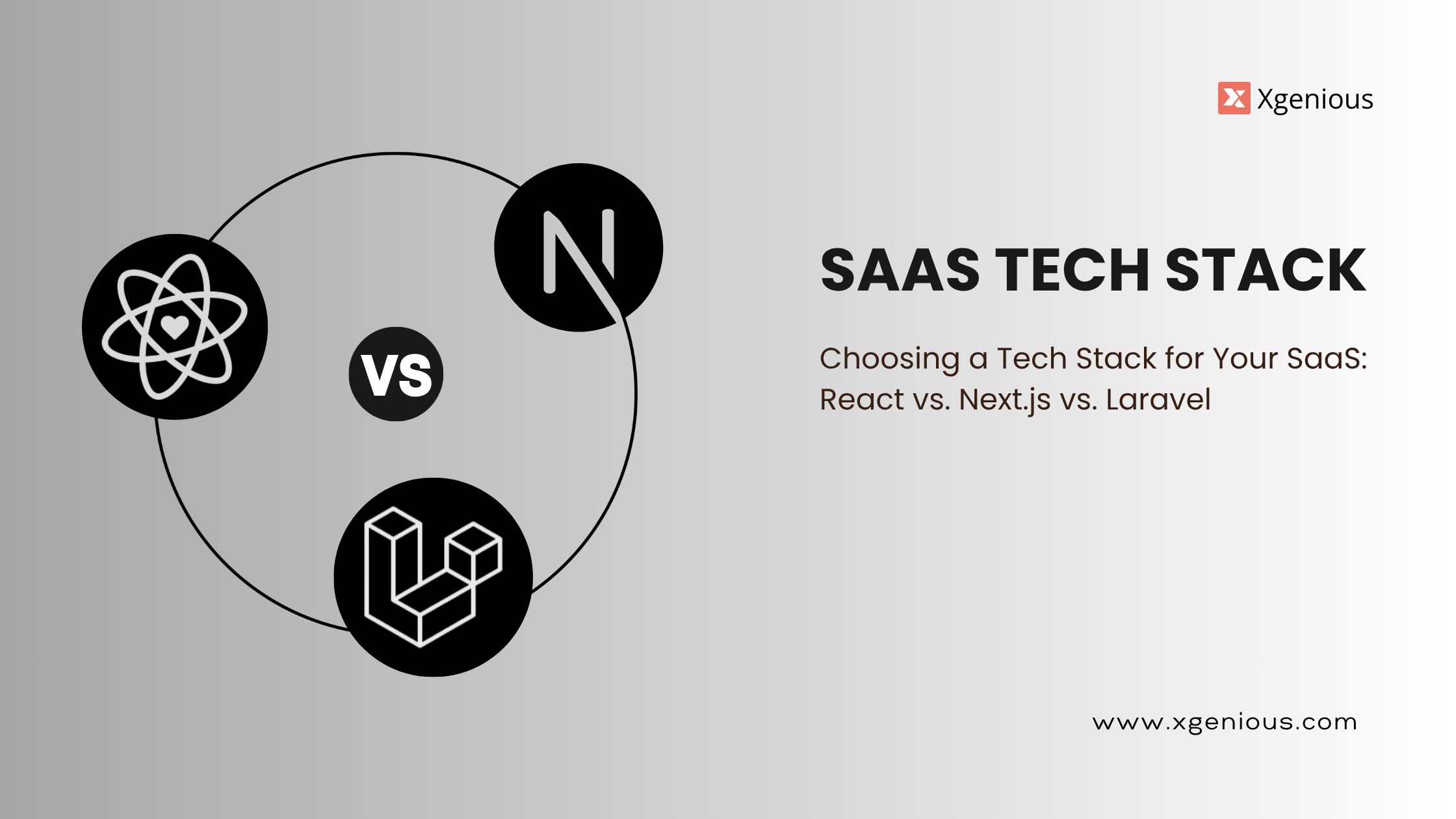


The saas tech stack debate burns weeks of founder time, generates bad LinkedIn arguments, and frequently produces the wrong answer because the wrong question is being asked. This guide gives founders a way to make the call in an afternoon: a six-criteria scoring framework, opinionated recommendations across frontend, backend, database, auth, AI, infrastructure, and mobile, plus three archetype stacks calibrated to the most common saas product types in 2026.
The premise is that most stack debates are misframed. “React or Vue?” is the wrong starting question. The right question is “what does the buyer need, what can the team hire and ship, and what carries an acceptable three-year total cost of ownership?” This article walks through that decision systematically, with the Stack Fitness Score framework as the structural backbone.
Five takeaways before reading on: the seven layers of a modern saas tech stack, the six-criteria fitness score, the three stack archetypes (B2B, PLG, AI-native), the honest trade-offs each choice imposes, and the hiring reality that quietly determines whether the stack ships. For the broader build framework that places this stack decision in context, see how to build a saas in 2026.
Why the 2026 Saas Tech Stack Conversation Is Different from 2020
Three forces have shifted the saas tech stack conversation since 2020. First, AI-native features moved from edge case to baseline expectation, which changed the stack from “web app plus optional ML pipeline” to “every layer needs to support tokens, embeddings, and inference budgets.” Second, compliance crept down-market: SOC 2 readiness used to be an enterprise concern, in 2026, it is a mid-market sales gate, which means infrastructure choices that did not matter in 2020 (data residency, audit trails, encryption keys) now decide whether the saas can sell to a 200-person company.
Third, the framework wars largely ended. By 2026, the dominant default for B2B saas is Next.js plus TypeScript on the frontend, Postgres plus Redis on the data layer, and either Node (with Hono or tRPC) or Laravel on the backend, with managed AWS or Vercel for hosting. This is not a contrarian take; it is what most fixed-price MVP packages and what most accelerator-backed teams ship. The interesting decisions in 2026 are not “which framework” but “which combination” and “what AI primitives.”
The saas tech stack discussion has shifted from a style debate (functional vs. object-oriented, monolithic vs. microservices) to an economics debate (what costs the least to ship, run, and replace over three years). Founders who treat the conversation as a religion in 2026 burn months on choices that no longer carry the cost differential they did in 2020.
The Stack Fitness Score: A Saas Tech Stack Framework
The Stack Fitness Score is the framework this article is built around. It rates candidate saas tech stack components on six criteria, scored 1 to 5, then weights and totals to produce a comparative number.
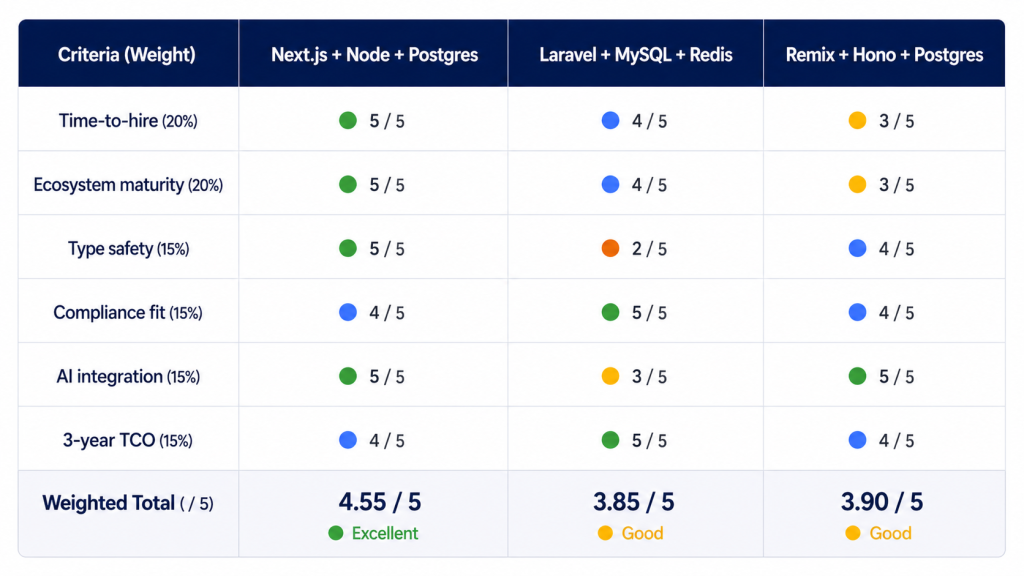
The six criteria:
- Time-to-hire. How fast can the team add a competent engineer to this stack? Lower hiring time means lower cost per ship.
- Ecosystem maturity. How well-served is the stack by libraries, integrations, hosting providers, and tutorials in 2026? Mature ecosystems reduce the surface area of unknown bugs.
- Type safety. How well does the stack catch errors at compile time versus runtime? Type-safe stacks ship fewer customer-visible bugs and onboard new engineers faster.
- Compliance fit. How easily does the stack support audit logs, encryption, tenant isolation, and SOC 2-ready architecture? Compliance-friendly stacks save weeks at vendor security review.
- AI integration. How natively does the stack support modern LLM patterns, vector databases, embedding pipelines, and inference budgeting? AI-friendly stacks shave months off shipping AI-native features.
- Three-year TCO. What is the total cost of ownership across three years (hosting, licensing, hiring, refactor risk, migration risk)? Low-TCO stacks compound savings as the saas scales.
Each criterion is weighted by founder priority. A B2B saas selling to enterprise weights compliance fit higher; a consumer-prosumer saas weights time-to-hire and ecosystem maturity higher; an AI-native saas weights AI integration as the dominant criterion. The matrix is included as a downloadable template at the end of this article.
The point of the Score is to depersonalize the decision. Stack choices made by gut frequently optimize for the founder’s preferences rather than the saas’s actual needs; a numerical score forces the conversation toward criteria that matter and exposes the cases where two stacks are tied (in which case team familiarity wins by default).
Frontend Saas Tech Stack: React, Next.js, Remix Compared
The frontend saas tech stack conversation in 2026 starts with React as the substrate, then asks which React framework to build on top of it.
Next.js is the dominant choice. Server-side rendering, edge functions, image optimization, file-based routing, and Vercel-native deployment make it the path of least resistance for B2B saas. The ecosystem is the largest of any React framework. Default for most fixed-price MVP packages. Trade-off: tight coupling to Vercel hosting can become expensive at scale; non-Vercel deployment requires careful configuration.
Remix is the credible alternative. Better data-loading model (loaders and actions), simpler mental model for forms, more agnostic about hosting. Smaller ecosystem in 2026 but maintained by Shopify with serious engineering investment. Right choice when the team values explicit data flow and is willing to trade some ecosystem breadth for clarity.
Plain React (Vite + React Router) still wins in two cases. First, for internal tools or admin panels where SSR and SEO are irrelevant. Second, for AI-native saas where the frontend is mostly an interactive surface over websocket streams (think Cursor, Claude.ai) and the SSR overhead of Next.js or Remix adds cost without benefit.
The framework choice impacts hiring directly. Next.js engineers are abundant; Remix engineers are competent but rarer; plain React with custom routing requires more senior judgment. For a team of two to four engineers shipping an MVP, Next.js is the safest default unless there is a specific reason to deviate. The full ecosystem reference is the Next.js documentation, which has matured significantly since 2023.
Backend Saas Tech Stack: Laravel vs. Node vs. tRPC Hybrids
The backend saas tech stack divides cleanly along team-language boundaries.
Laravel (PHP) remains a strong choice in 2026 despite cyclical predictions of its death. The ecosystem (Eloquent ORM, queues, broadcasting, Sanctum auth, Nova admin, Forge deployment, Vapor for serverless) is unmatched for shipping speed. Laravel is what gets a saas to MVP fastest if the team has any PHP experience. Trade-off: hiring outside major PHP markets (US East Coast, EU, parts of South Asia) is harder than hiring Node engineers in 2026, and Laravel is rare in venture-backed startup hiring pools. The Laravel documentation is the canonical reference.
Node (with Hono, Express, or Fastify) is the more conventional choice for venture-backed saas in 2026. JavaScript end-to-end (frontend and backend share types), abundant hiring pool, native fit with Vercel and AWS Lambda. The framework war within Node has largely settled around three options: Hono for edge-first deployment, Express for traditional API servers, Fastify for performance-critical workloads. Trade-off: ecosystem fragmentation means each Node project assembles its own stack, which costs the consistency that Laravel provides out of the box.
tRPC hybrids are the emerging pattern for full-stack TypeScript saas. tRPC provides end-to-end type safety from React client to Node server without the GraphQL overhead, which collapses the API design surface for small teams. The pattern: Next.js frontend, Node backend with tRPC, Postgres, Prisma ORM, deployed to Vercel. This is the highest-velocity pattern for a small team in 2026, at the cost of harder external integration (third-party services that expect REST or GraphQL).
The Stack Fitness Score for these choices in a typical B2B saas scenario: Laravel scores high on ecosystem and three-year TCO, low on AI integration and venture-stack hiring; Node + tRPC scores high on type safety and hiring, lower on ecosystem maturity for non-trivial features; pure Express Node scores middle on every criterion.
Type Safety in Your Saas Tech Stack: TypeScript + Prisma
Type safety used to be a developer-experience preference; in 2026 it is a saas tech stack hiring filter. Type-safe stacks ship fewer runtime bugs, onboard new engineers faster, and survive larger codebases without rewrites.
The dominant saas tech stack pattern for type safety in 2026: TypeScript end-to-end (React frontend, Node backend) plus Prisma as the ORM. Prisma generates TypeScript types directly from the database schema, which means changes to the schema produce compile-time errors anywhere in the codebase that depends on the changed field. This eliminates an entire category of runtime errors that historically broke saas applications during schema migrations.
Laravel teams achieve a partial equivalent through PHPStan and Larastan, but the ergonomics are worse than TypeScript plus Prisma. PHP type safety is improving in 2026 but still lags JavaScript for full-stack saas use cases.
The Stack Fitness Score for type safety: TypeScript plus Prisma scores 5 of 5; Laravel plus PHPStan scores 3 of 5; pure Node without TypeScript scores 1 of 5. A team building a saas tech stack in 2026 should default to TypeScript plus Prisma unless there is a specific Laravel ecosystem advantage that overrides the type-safety benefit.
The cost of type safety is a small initial learning curve and slightly slower prototyping. The benefit, measured at the 12-month mark, is fewer customer-visible bugs, faster onboarding, and the ability to refactor confidently. For early-stage saas, the benefit dominates the cost every time.
Database Layer of the Saas Tech Stack: Postgres, pgvector, Redis
The database layer of a modern saas tech stack converges on three components in 2026.
Postgres is the default. Mature, ACID, well-supported by every cloud provider, row-level security for multi-tenant architectures, JSON columns for semi-structured data, full-text search good enough to delay Elasticsearch for years. There is essentially no scenario in 2026 where a new B2B saas should pick MySQL over Postgres unless the team has overwhelming MySQL experience. For the deeper treatment of how Postgres maps to multi-tenant patterns, see multi-tenant saas architecture.
pgvector is the Postgres extension that handles vector embeddings for AI features. By 2026, pgvector has matured to the point that a separate vector database (Pinecone, Weaviate, Qdrant) is rarely justified for saas at the MVP stage. The pattern: store text and metadata in normal Postgres tables, embed text with an OpenAI or Voyage model, store the embeddings in a pgvector column, query with cosine similarity. This collapses the data infrastructure for AI features into one database. Separate vector databases become attractive only at scale (10M+ embeddings) or when the workload demands specialized indexing not yet available in pgvector.
Redis enters the saas tech stack within the first two weeks of any production build. Use cases: session storage (when sessions exceed what the database session tier can handle gracefully), rate limiting (every public API needs it), background job queues (Bull for Node, Horizon for Laravel), caching of expensive queries, real-time presence and counters. Managed Redis through AWS ElastiCache, Upstash, or Vercel KV is cheap (under $50 per month for MVP-scale) and saves significant rework when traffic grows.
The Stack Fitness Score for this database layer is uniformly high: Postgres plus pgvector plus Redis scores 5 of 5 on ecosystem, compliance fit, and AI integration. The TCO is low because all three are commodity managed services in 2026. Founders who deviate from this pattern at MVP stage usually have either a specific scaling problem they have already validated or a specific personal preference; either is fine, but the deviation should be deliberate.
Saas Tech Stack Authentication: Clerk vs. Supabase Auth vs. Cognito
The saas tech stack authentication decision in 2026 favors managed identity providers over DIY auth in almost all cases. Three providers dominate.
Clerk is the most polished. React-native components for sign-in, sign-up, profile management, and SSO. Generous free tier (10K MAUs), per-user pricing above that. Best fit for B2B saas with sub-100K MAUs. Pricing becomes expensive at scale.
Supabase Auth is the value choice. Bundled with Supabase Postgres hosting (the free tier covers most MVP needs), supports OAuth providers, magic links, MFA. Best fit for teams already using Supabase as their full backend.
AWS Cognito is the enterprise default. Cheapest at scale (50K free MAUs, then per-user pricing well below Clerk). Documentation and developer experience are weaker than Clerk. Best fit when AWS is already the infrastructure provider and the team has AWS engineering depth.
DIY auth is the wrong choice in 2026 for any saas planning to ship in under 12 weeks. The Stack Fitness Score for Clerk is 5 of 5 on time-to-ship, 3 of 5 on TCO at scale; Supabase is 5 of 5 on time-to-ship if Supabase is the rest of the stack; Cognito is 4 of 5 on TCO, 3 of 5 on DX. Default to Clerk unless cost constraints or AWS depth dictate otherwise.
The AI Layer in a Modern Saas Tech Stack: Claude, OpenAI, RAG
The AI layer is the part of the saas tech stack that has changed most aggressively since 2023. In 2026, no serious B2B saas ships without at least one AI-native feature, and the layer choices have practical TCO implications.
Model providers. Three categories in 2026. Premium models (Claude, GPT-5) for user-facing surfaces where reasoning quality matters and latency is acceptable. Cheap models (Haiku, GPT-5-mini) for background workloads (summarization, classification) where cost matters more than nuance. Open-source models (Llama, Mistral, Qwen) for data residency requirements or budget-bound bulk inference.
Retrieval-Augmented Generation (RAG). The pattern: embed customer data into a vector store, retrieve relevant chunks at query time, pass them to the LLM as context. For most B2B saas in 2026, RAG is the path to “AI that knows our customer’s data” without fine-tuning. Implementation in the saas tech stack: pgvector for storage, OpenAI or Voyage for embeddings, Claude or GPT-5 for generation. Total infrastructure cost for an MVP-scale RAG system: $50 to $500 per month.
Token budget management. Every active user generates LLM cost in 2026. The saas tech stack must include per-user token tracking (a counter table in Postgres), per-tier quotas (enforced at the application layer), and graceful degradation (fall back to a cheaper model when the user is approaching the cap). Saas products that ship without budget management discover negative-margin customers two months after launch.
Agentic patterns. The emerging 2026 pattern: small task-specific agents that route work to tools, summarize results, and loop until completion. This is more interesting than chatbots and produces meaningfully more user value. The saas tech stack needs background job infrastructure (Redis queues again), structured output validation, and observability tuned to multi-step LLM workflows.
The Stack Fitness Score for AI integration favors stacks already built on TypeScript plus Postgres plus Redis plus a managed cloud (AWS or Vercel). Adding the AI layer to that base is straightforward; retrofitting AI to a Laravel monolith is possible but slower.
Saas Tech Stack Infrastructure: AWS vs. Vercel vs. Fly.io
Three hosting options dominate the saas tech stack infrastructure layer in 2026.
AWS is the enterprise default. EC2, RDS, S3, ElastiCache, Lambda, ECS, the full enterprise menu. Strongest compliance posture (HIPAA BAAs, SOC 2 controls, data residency in 30+ regions). Steepest learning curve. Highest TCO at small scale, lowest TCO at large scale. The right choice for any saas selling into regulated industries or planning to raise institutional VC. The architectural reference is the AWS Well-Architected SaaS Lens, which covers tenant isolation, billing, identity, and compliance patterns.
Vercel is the Next.js-native choice. Zero-config deployments, edge functions, automatic CDN, serverless functions, preview environments per pull request. The fastest path from git push to production for a Next.js stack. Trade-off: pricing scales aggressively with traffic and serverless function invocations; teams that hit scale frequently migrate the API layer off Vercel while keeping the frontend on it.
Fly.io is the middle path. Container-based deployment with global edge presence, simpler than AWS, more flexible than Vercel. Good fit for non-Next.js stacks (Laravel, Hono, Rust APIs) that want edge deployment without AWS complexity. Smaller ecosystem than the other two but actively maintained.
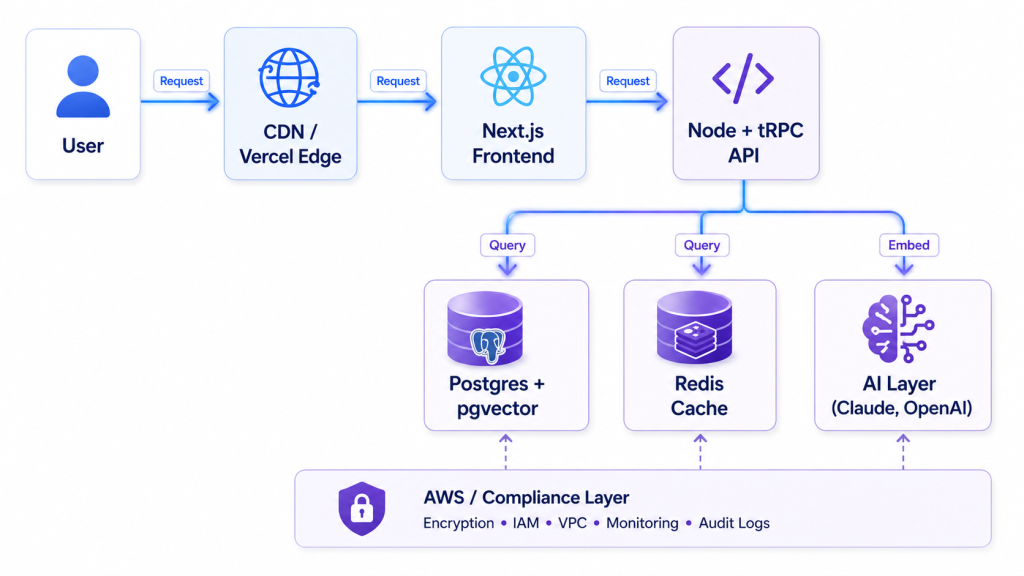
The Stack Fitness Score: AWS scores 5 of 5 on compliance fit and three-year TCO at scale, 2 of 5 on time-to-ship for non-AWS-experienced teams; Vercel scores 5 of 5 on time-to-ship for Next.js, 3 of 5 on TCO at scale; Fly.io scores 4 of 5 on most criteria, 3 of 5 on ecosystem.
Most saas tech stack builds in 2026 should start on Vercel or Fly.io for MVP velocity, then migrate compute to AWS once compliance gates appear in the sales cycle. This hybrid pattern is now the dominant production setup for venture-backed saas at the seed-to-Series-A stage.
Observability in Your Saas Tech Stack: Sentry, Datadog, Day-One Setup
The observability layer of the saas tech stack is treated as optional by most MVP teams and consistently regretted by month four. Three tools form the minimum day-one setup.
Sentry for error tracking. Captures unhandled exceptions, surfaces them with full stack traces and breadcrumbs, integrates natively with React, Node, and Laravel. Free tier covers MVP-scale traffic. The first tool any saas tech stack should add after the application boots.
Datadog or Better Stack for application performance monitoring. Tracks request latency, database query time, cache hit rate, third-party API response time. Datadog is the enterprise-grade choice but expensive; Better Stack and Highlight are credible cheaper alternatives for early-stage saas.
A logging pipeline for structured logs. Either Datadog Logs, Better Stack, or a self-hosted Loki + Grafana setup. Critical for debugging customer-reported issues and for compliance audit trails.
The Stack Fitness Score for this observability triad is high on every criterion. Total monthly cost at MVP scale: $0 to $200. Cost of skipping observability and adding it later: 1 to 2 weeks of refactor work plus the customer-trust damage from incidents that should have been caught in monitoring.
Mobile in the Saas Tech Stack: Flutter vs. React Native
Mobile is an increasingly common saas tech stack decision in 2026 as B2B buyers expect parity with their mobile workflows.
Flutter wins on visual consistency and performance. Single codebase produces native iOS and Android binaries with pixel-perfect UI control. Strong for products where the mobile experience is core (on-demand services, field-ops tools). Trade-off: Dart language adds a hiring dimension, and Flutter ships less code reuse with web than React Native does.
React Native wins on web-mobile code reuse for teams already on React. Roughly 60 to 70 percent of UI logic can share between web and mobile with proper architecture. Stronger venture-stack hiring pool. Trade-off: more platform-specific edge cases than Flutter, particularly on Android.
The Stack Fitness Score: Flutter scores 5 of 5 on visual consistency and performance, 3 of 5 on hiring outside major markets; React Native scores 5 of 5 on hiring and code reuse, 4 of 5 on visual consistency. Most B2B saas in 2026 should default to Flutter for a dedicated mobile companion app, React Native if mobile is a thin extension of an existing web React codebase.
Three Saas Tech Stack Archetypes: B2B, PLG, AI-Native
Most saas tech stack debates collapse cleanly when the saas type is named explicitly. Three archetypes cover the majority of 2026 saas builds.
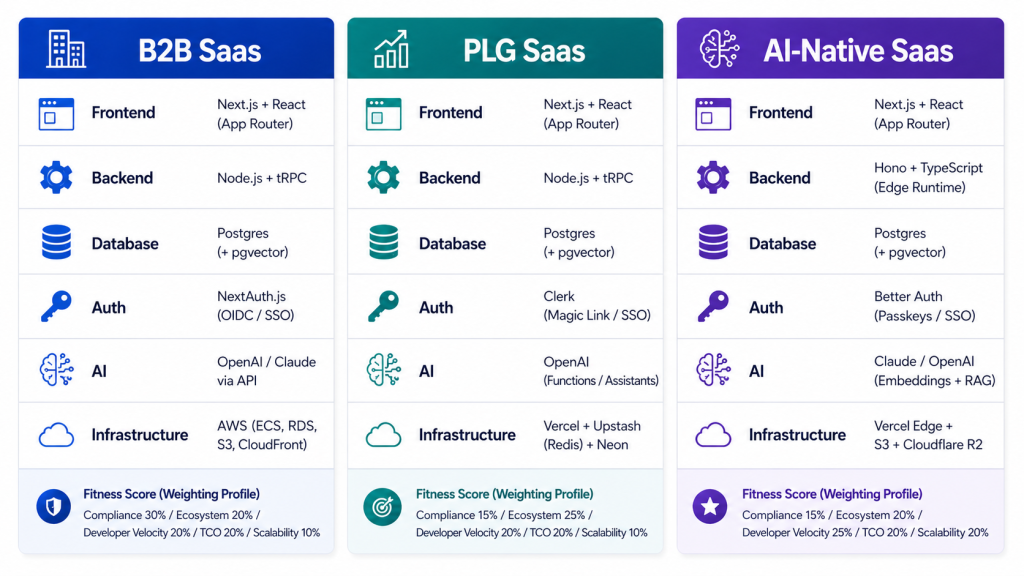
Archetype 1: B2B Saas (sales-led, enterprise-bound).
Frontend: Next.js + TypeScript + Tailwind CSS + shadcn/ui components. Backend: Node + Hono or Laravel, REST or tRPC API. Database: Postgres on AWS RDS, Redis on ElastiCache. Auth: Cognito (cost) or Clerk (DX), with SSO and SCIM ready for enterprise. AI: optional, RAG over customer data with pgvector. Infrastructure: AWS for compliance, Vercel for the marketing site. Mobile: optional, Flutter if mobile is central, none if web-only.
Stack Fitness Score weights: compliance 30%, ecosystem 20%, type safety 15%, TCO 15%, hiring 15%, AI 5%. The B2B archetype optimizes for enterprise sales cycles, vendor security questionnaires, and the ability to ship features that survive procurement review.
Archetype 2: PLG Saas (self-serve, product-led).
Frontend: Next.js + TypeScript + Tailwind, with a strong onboarding experience. Backend: Node + tRPC, end-to-end type safety, Prisma ORM. Database: Postgres on Supabase or Neon (serverless), Redis via Upstash. Auth: Clerk for fast self-serve onboarding. AI: in-product copilot or smart suggestions, light RAG, OpenAI or Claude. Infrastructure: Vercel for everything, no separate ops team needed at MVP scale. Mobile: rarely critical at MVP; defer to post-PMF.
Stack Fitness Score weights: time-to-ship 30%, ecosystem 20%, AI 15%, hiring 15%, TCO 10%, compliance 10%. The PLG archetype optimizes for self-serve velocity, in-product activation, and minimal infrastructure overhead.
Archetype 3: AI-Native Saas (AI is the product, not a feature).
Frontend: plain React + Vite, or Next.js with selective opt-in to SSR. Strong streaming UX, websocket connections, real-time token rendering. Backend: Node + Hono, optimized for streaming responses; some teams add a Python FastAPI service for ML pipelines. Database: Postgres + pgvector for embeddings, Redis for queue management of long-running inference jobs. Auth: Clerk or Supabase Auth, with per-user token tracking baked in from day one. AI: multi-model setup. Premium model for primary user surfaces, cheap model for background, open-source for residency-bound workloads. Infrastructure: Vercel + Fly.io hybrid for edge inference, AWS for compliance-bound deployments. Mobile: mobile companion if applicable; many AI-native saas products are web-first.
Stack Fitness Score weights: AI integration 35%, ecosystem 15%, type safety 15%, time-to-ship 15%, TCO 10%, compliance 10%. The AI-native archetype optimizes for streaming inference, token budget management, and the ability to swap models without rewriting the application.
The wrong archetype produces an awkward saas tech stack. A B2B saas built on the PLG archetype struggles with enterprise procurement; a PLG saas built on the B2B archetype ships too slowly to compete with self-serve incumbents; an AI-native saas built on the B2B archetype wastes infrastructure dollars on inference patterns the stack was never designed for.
Honest Saas Tech Stack Trade-Offs: Where Each Choice Hurts
Every saas tech stack choice has a hidden cost that emerges around month six. Naming the costs upfront prevents surprise.
Next.js trade-off. Tight Vercel coupling. Migrating away from Vercel hosting at scale costs 2 to 4 weeks of infrastructure work. Counter: most saas never need to migrate; the cost is theoretical.
Laravel trade-off. Hiring at scale outside of major PHP markets. Most early Laravel hires are mid-level; senior PHP engineers in venture markets are rare. Counter: Laravel productivity per engineer is high enough to compensate for fewer engineers.
TypeScript + Prisma trade-off. Build complexity at the start, schema migration ergonomics that confuse newcomers. Counter: payback within 4 to 6 months as the team grows.
Postgres + pgvector trade-off. Vector search performance ceiling around 10M embeddings on a single instance. Counter: most saas never hit this; pgvector continues to improve.
Clerk trade-off. Cost at 100K+ MAUs. Counter: by then the saas is generating enough revenue to absorb it or migrate to Cognito.
AWS trade-off. Steep learning curve, expensive surprises in unmonitored services. Counter: hire the cloud knowledge or start on Vercel and migrate later.
Vercel trade-off. Per-invocation pricing scales with success. Counter: Vercel’s enterprise tier negotiates this; teams hitting limits should talk to Vercel sales rather than migrate prematurely.
Flutter trade-off. Dart hiring is a real friction outside major markets. Counter: Flutter productivity per engineer matches or exceeds React Native, which compensates.
The pattern across all trade-offs: every saas tech stack choice carries a future cost. The right framing is which costs are acceptable, not which choices are perfect. Founders looking for a perfect saas tech stack burn months on the search and ship the same thing everyone else ships, six months late. For the broader build framework that places these trade-offs in context, see how to build a saas in 2026.
The Saas Tech Stack Hiring Reality: Staffing in 2026
The saas tech stack hiring conversation is the one most founders avoid until they need to staff it. By 2026 the hiring landscape has stratified along clear lines.
TypeScript + Next.js + Node is the largest hiring pool by a significant margin. LinkedIn job posts in this stack are filled in 4 to 8 weeks at $80K to $180K mid-level salaries (US) or $30K to $80K (offshore). Strong venture-stack alignment.
Laravel has a smaller but loyal hiring pool. Major markets (US East, EU, India, Bangladesh, Pakistan) have abundant senior talent. Outside those markets, hiring is harder. Salaries: $60K to $140K mid-level (US), $20K to $60K (offshore). Less venture-stack alignment.
AWS engineers are scarce and expensive. Senior AWS DevOps engineers command $150K to $250K (US). For early-stage saas, the right move is usually to start on Vercel or Fly.io and hire AWS expertise only when compliance forces it.
AI/ML engineers are the most expensive category in 2026. Salaries: $200K to $500K (US, big tech adjacent). The pragmatic move for early-stage saas: avoid hiring full-time ML engineers, use Claude and OpenAI APIs, and hire when the product reaches scale that justifies it.
Flutter and React Native hiring is a wash for venture-backed B2B saas. Both pools are sufficient at the mid-level; senior mobile is competitive in either.
The Stack Fitness Score weight on hiring should be highest for non-technical founders working with agencies, where the agency’s bench composition determines what is buildable on what timeline. For the broader question of when to use an agency versus build in-house, see when to hire a saas development agency. For the realistic week-by-week MVP timeline given a chosen stack, see the saas mvp timeline. And for when a simpler web app makes more sense than a full-stack saas, see our web app development services.
Final Words: Choosing a Saas Tech Stack That Ships
Choosing a saas tech stack in 2026 is less about picking the perfect technology and more about picking the right combination for a specific saas type, team, and runway. Seven layers (frontend, backend, type safety, database, auth, AI, infrastructure) and three optional layers (observability, mobile, hiring strategy) make up the modern saas tech stack. The Stack Fitness Score forces a numerical conversation that depersonalizes the choice. The three archetypes (B2B, PLG, AI-native) match the saas type to the right combination. The honest trade-offs name what each choice will cost in six months.
The most common 2026 saas tech stack default for B2B saas is Next.js + TypeScript + Node + Postgres + Redis + Clerk + AWS or Vercel, with Claude or OpenAI as the AI layer. This combination ships fastest, hires easiest, and survives the longest without rewrites. Founders who deviate from this default usually have specific reasons (Laravel familiarity, compliance constraints, AI-first architecture); deviation is fine when the reason is named.
Saas Tech Stack FAQ
1. Next.js or Laravel if I only know one?
Pick the one the team knows. The saas tech stack productivity gap from “stack we know well” to “stack we are learning” is roughly 3x at MVP stage. A Laravel-experienced founder shipping in Laravel beats a Laravel-experienced founder learning Next.js by 6 to 8 weeks of MVP velocity. The framework conversation is irrelevant if the team cannot ship in either. Pick what ships first.
2. Is Laravel still a good 2026 choice?
Yes, with caveats. Laravel is excellent for B2B saas where shipping speed matters more than venture-stack hiring alignment. It is suboptimal for AI-native saas where the AI ecosystem (Vercel AI SDK, LangChain JS, Hono streaming) is JavaScript-first. The Stack Fitness Score for Laravel is high on ecosystem and TCO, low on AI integration. Choose Laravel if the saas is information-management or workflow-automation; choose Node if AI is core.
3. Monolith-first then split?
Yes, almost always. Monolithic Next.js + Postgres ships an MVP in 8 to 12 weeks; microservices ship in 16 to 24 weeks. Operational complexity kills more early-stage saas than scaling problems do. Split the monolith only when a specific service hits a tenant-count, data-volume, or team-size threshold that the monolith cannot handle. Most saas never reach that threshold.
4. Best DB for multi-tenant saas?
Postgres with row-level security and a tenant_id column on every business-data table. Period. There is no scenario in 2026 where a new B2B saas should pick MongoDB or DynamoDB as the primary tenant data store unless the team has overwhelming experience with it. Postgres is the safest, most compliance-friendly, most ecosystem-rich choice in any saas tech stack.
5. Do I need a separate mobile app?
Usually, no, at the MVP stage. Most B2B saas users in 2026 use the product on desktop. Mobile becomes important post-PMF when on-the-go workflows emerge. The exceptions: field-ops tools, on-demand service marketplaces, consumer-facing prosumer apps. If unsure, ship web-first and add mobile in year two.
6. Should I use an ORM or write SQL?
Use an ORM for most queries, drop to SQL for the queries the ORM cannot express efficiently. Prisma (TypeScript) and Eloquent (Laravel) are excellent at 80 percent of saas queries. For complex aggregations, window functions, or performance-critical paths, raw SQL is faster and clearer. The hybrid pattern is the saas tech stack norm in 2026.
7. Is serverless worth it for saas?
For Next.js + Vercel, yes, the serverless model is the default and works well at MVP scale. For backend services with sustained traffic or long-running processes, serverless solutions are more expensive and harder to debug than container-based deployments on Fly.io or AWS ECS. The pragmatic mix in 2026: serverless for the frontend and lightweight API routes, container-based for the data-heavy backend.