



Most founders learning how to build a SaaS in 2026 waste six months and $80K on a build no one wants, because they skipped validation and let a generic dev shop choose the stack. The pattern is so common that the failure mode is now the default. This guide walks through how to build a SaaS without falling into it: ten building blocks that move a founder from problem to paying customers, an opinionated 2026 stack, compliance baked in from day one, honest budget ranges, and a clear answer on when to hire versus build.
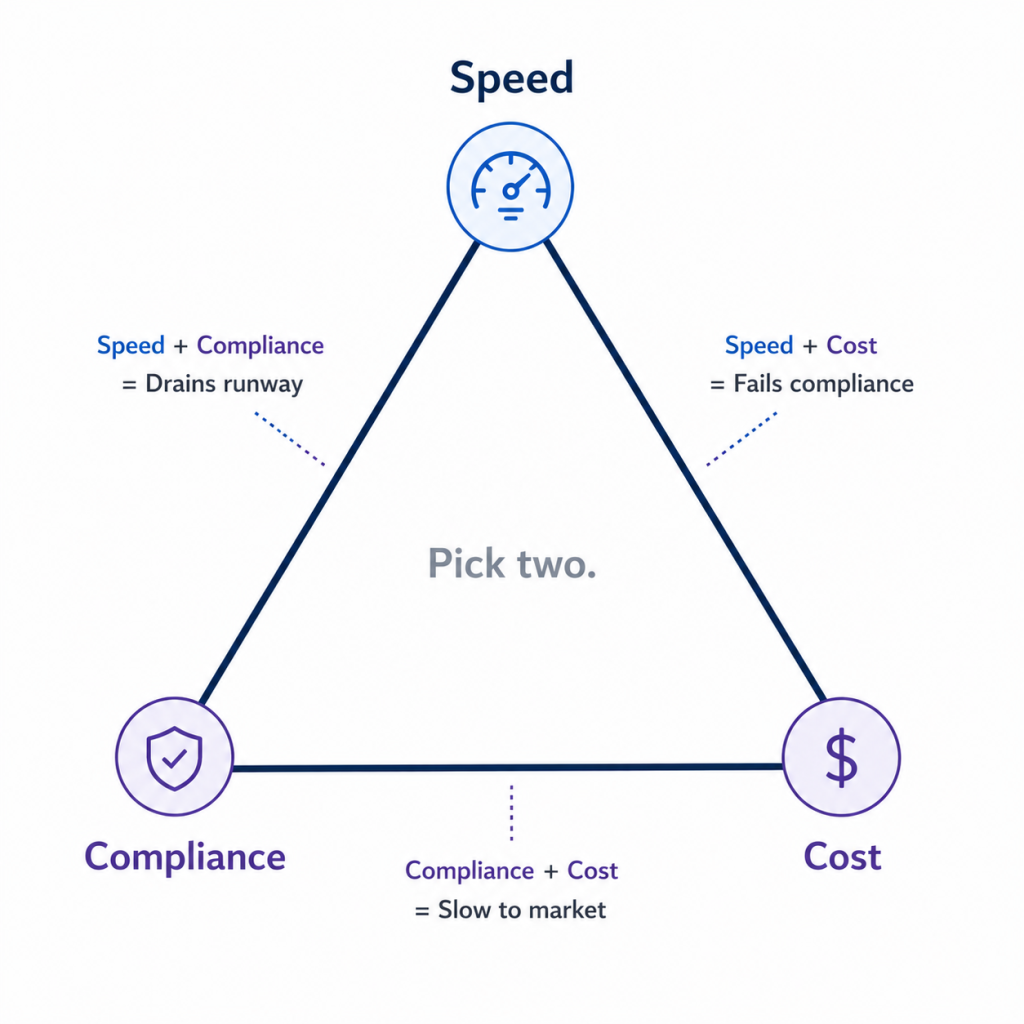
The article is structured around a single lens, the SaaS Build Triangle, that frames every meaningful decision in how to build a SaaS today. Three forces shape the work: Speed, Compliance, and Cost. Founders can pick two. Pretending all three are achievable at once is the most expensive mistake first-time SaaS builders make, and it shows up in every block that follows.
Five takeaways before reading on: the 10 building blocks, the 2026 stack that actually ships, compliance from day one, honest budgets, and when to hand the build to an agency. Whether the goal is a bootstrapped vertical SaaS or a venture-backed B2B platform, the same framework for building a SaaS applies.
How to Build a SaaS in 2026: What It Actually Means Now
Knowing how to build a SaaS in 2026 means more than putting a web app behind a login. The bar has shifted. A modern SaaS is multi-tenant by default, meaning it supports multiple customers with isolated data and shared infrastructure. It runs on subscription billing with proration, dunning, and tax handling. It carries a defensible compliance posture before the first enterprise sales call. And increasingly, it embeds AI as a primary product surface rather than a marketing afterthought.
These four properties separate a SaaS from a “web app with payments.” A founder who confuses the two ships software that cannot scale, cannot sell to mid-market, and cannot pass a vendor security review. The distinction matters at architecture, not just branding, and it is the first conceptual divide any founder learning how to build a SaaS has to internalize. SaaS vs. web app — what’s actually different covers the architectural delta.
The category also has a related-but-different cousin: the SaaS-marketplace hybrid. SaaS sells a tool. A marketplace connects two sides. The architectures, billing models, and growth loops diverge sharply, and many founders pick the wrong one. SaaS vs. marketplace covers when each model fits.
The running framework for the rest of this guide on how to build a SaaS: the SaaS Build Triangle. Three forces govern every meaningful build decision, Speed (how fast the MVP ships), Compliance (what regulatory and security posture it carries), and Cost (capital and operating spend). Pick two. Speed-and-Cost together produce a fast, cheap MVP that fails its first SOC 2 audit. Speed-and-Compliance together produce a polished product that drains the runway. Compliance-and-Cost together produce a 12-month build that ships after the market moves on. Every section that follows references the Triangle, sometimes explicitly, sometimes implicitly. The Triangle is the lens for how to build a SaaS that actually ships.
How to Build a SaaS: The 10 Building Blocks From Problem to Paying Customers
The full work of how to build a SaaS splits into ten building blocks. Eight are sequential, they happen in order, roughly. Two are cross-cutting: they shape multiple sequential blocks and don’t fit a strict timeline.
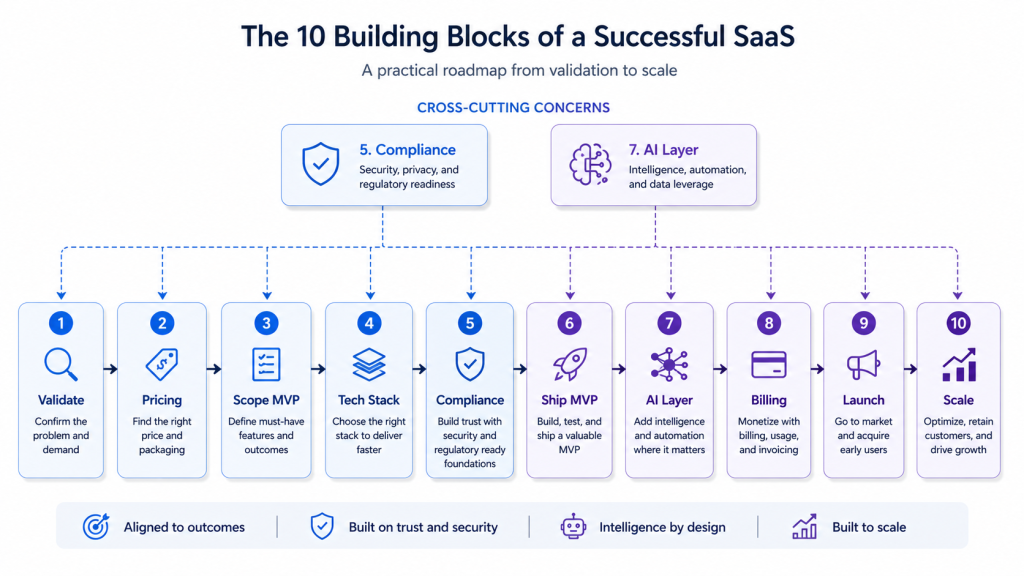
The ten blocks:
- Validate the problem. Twenty customer conversations and a six-signal traction tracker before any code.
- Choose the business model and pricing. Seat-based, usage-based, hybrid; pricing tier architecture.
- Scope the MVP. Must-have, nice-to-have, kill, the 80% Cut.
- Pick the tech stack. Front-end, back-end, database, hosting, mobile.
- Compliance-ready architecture (cross-cutting). GDPR, HIPAA, SOC 2, designed in, not retrofitted.
- Ship the MVP. Eight to twelve weeks, weekly cadence, named scope.
- The AI layer (cross-cutting). Where Claude, OpenAI, and open-source earn their keep, and where they don’t.
- Billing and subscriptions. Stripe, Paddle, Chargebee, proration, dunning, tax.
- Launch and the first 100 customers. Distribution channels, conversion benchmarks, paid acquisition test.
- Scale without rewriting. Tenant count, data volume, team size, and the three refactor triggers.
Blocks 5 and 7 are explicitly labeled cross-cutting because they don’t fit a strict sequence. Compliance shapes scope (Block 3), stack (Block 4), and the build itself (Block 6). The AI layer shapes scope (Block 3) and surfaces again at ship (Block 6). Treating them as numbered stages forces a false timeline; treating them as cross-cutting concerns matches how they actually behave when founders work through how to build a SaaS in practice.
Each block forces a Speed/Compliance/Cost trade-off. Validation can be done quickly and cheaply or slowly and rigorously. Compliance can be retrofitted (cheap upfront, expensive later) or designed in (expensive upfront, cheaper later). The Build Triangle is how this guide reasons about each block, the choice is rarely “which is best” but “which two of three matter most for this founder, this market, this runway.”
Before You Learn How to Build a SaaS: The Founder Readiness Check
Before block one, an honest check. Many SaaS builds fail not because of execution but because the founder was not the right person to start one. Four readiness pillars separate founders who ship from founders who burn, and the pillars decide whether someone is genuinely ready to learn how to build a SaaS or whether they should join an existing team first.
Technical literacy. A non-technical SaaS founder does not need to write production code. They do need to read code well enough to know when an engineer is bluffing. Skipping this leaves the founder dependent on whoever shows up, agency, contractor, or co-founder, and that dependency tends to corrupt every later decision in how to build a SaaS responsibly.
Commercial muscle. Can the founder sell the product? Not eventually, after marketing hires. Now, in the validation phase, with no product, into a list of strangers. The founders who ship are usually the ones who can pre-sell. Founders who plan to “figure out sales later” are the ones who run out of money first.
Capital runway. The honest number is not the bank balance. It is the bank balance minus 12 months of personal expenses, minus the $30K–$80K it actually costs to ship an MVP, minus the six-to-nine months of zero revenue that follows launch. Many founders underestimate what learning how to build a SaaS actually costs in personal capital.
Time commitment. Twelve months minimum, full-time, before the SaaS pays the founder a salary. Side-project SaaS exists, but it usually fails or stays small. The market does not respect part-time effort.
Honest counter-argument: many people who call themselves founders should be co-founders or first operators at someone else’s SaaS. The world has too few good co-founders and too many under-resourced solo founders. Joining a stronger team in year one often produces a better outcome than founding alone.
Block 1 — How to Build a SaaS That Solves a Real Problem
The decision in this block: validate the problem before writing production code. The recommendation: twenty structured customer conversations plus the 90-Day Traction Ledger. The trade-off: validation feels slow, but the alternative is a six-month build to zero customers and a destroyed runway. There is no version of how to build a SaaS that skips this step and lands on paying customers reliably.
Twenty conversations is the rough threshold where pattern repetition becomes statistically meaningful. Below that, founders hear what they want to hear. At twenty, the actual problem shape emerges, and frequently, it is not the problem the founder imagined.
The 90-Day Traction Ledger is a six-signal weekly tracker that turns validation from a vibe into a number. Six signals, each scored weekly:
- Problem-mention rate. How often does the target buyer raise the problem unprompted in conversation?
- Paid waitlist conversions. Of the people who hear the pitch, how many will pay a small deposit to hold a spot?
- Prototype signups. When shown a clickable prototype, how many sign up versus walk away?
- Sales-call book-rate. How many cold outbound messages convert into a 30-minute conversation?
- Deposit conversions. Of the prospects who book a call, how many will commit a non-trivial deposit before the product exists?
- Referral velocity. How fast do early prospects refer other prospects without being asked?
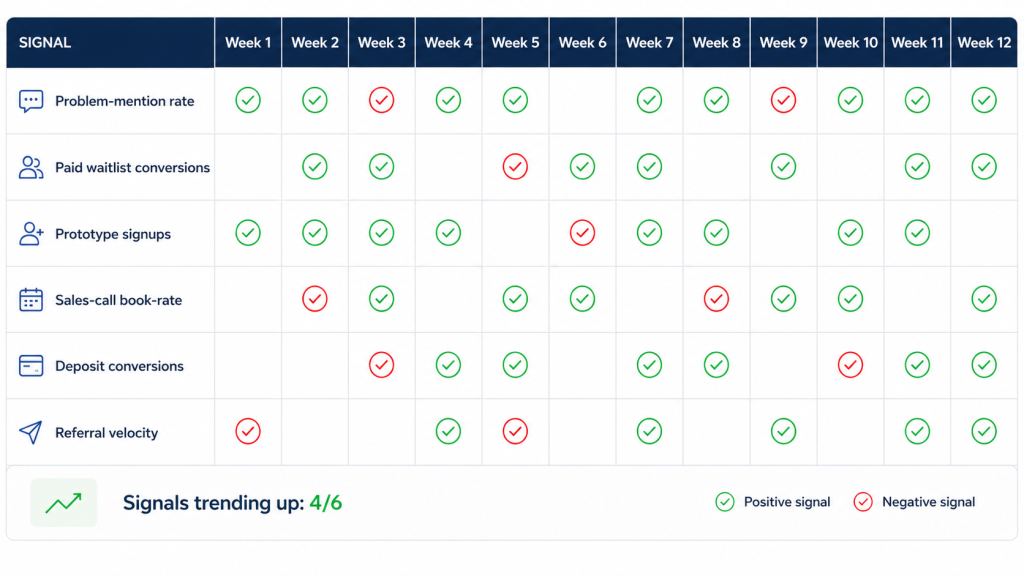
Tracked weekly across a 90-day pre-build window, the Ledger surfaces whether the problem is real, whether the founder can sell it, and whether the market will pay. Founders who can move four of six signals in the right direction across 90 days tend to ship products that find paying customers. Founders who cannot move any of them rarely do.
The full conversation script, the Ledger template, and the disqualification criteria, when to kill the idea rather than push through, live in the validation deep-dive on how to validate a SaaS idea.
Block 2 — How to Build a SaaS Pricing Model That Actually Converts
Three pricing archetypes dominate B2B SaaS in 2026 and define how to build a SaaS pricing model that does not leave revenue on the table: seat-based (charge per user), usage-based (charge per unit of value delivered), and hybrid (a base seat fee plus usage tiers above it).
Seat-based pricing is predictable and easy to forecast. It rewards customers for adding users, which is sometimes aligned with value and sometimes not. Usage-based pricing scales revenue with the value the customer extracts, a stronger alignment, but kills predictability for early-stage forecasting and complicates the buying conversation in regulated industries. Hybrid pricing, which is the dominant pattern for vertical SaaS in 2026, combines a predictable seat floor with usage-based ceiling capture.
Tier architecture matters as much as the model. The middle tier, when priced and packaged correctly, captures the largest share of paid conversion. Public benchmarks from OpenView and ProfitWell consistently show three-tier structures outperforming two-tier and four-tier structures by meaningful margins, and they show middle tiers converting at 2–4× the rate of bracketing tiers when the feature gating is right. Concrete tier numbers depend on industry, a horizontal analytics tool, a vertical practice-management SaaS, and a developer tool will price differently, but the structural pattern is consistent.
Founders who skip the pricing question early in how to build a SaaS often end up retrofitting their model after launch, which is expensive in churn and brand damage. The Build Triangle reappears here in a subtle form: the pricing model interacts with compliance. Usage-based billing in jurisdictions with consumption-based VAT and GST creates significant tax-handling complexity. Founders who pick usage-based pricing buy faster revenue scaling at the cost of slower compliance work — a Speed-vs-Compliance trade.
Worked examples, conversion benchmarks by tier, and the model decision tree by industry live in the pricing deep-dive at SaaS pricing models — seat, usage, hybrid.
Block 3 — How to Build a SaaS MVP Without Lying to Yourself About Scope
The decision: which features ship in the MVP, which wait for v2, and which die in the backlog. The recommendation: the 80% Cut exercise. The trade-off and the honest counter-argument is that shipping an MVP that embarrasses the founder costs more in trust than it saves in weeks. “Minimum” is not “broken.” This is the block where founders most often lose the plot on how to build a SaaS that actually launches.
The 80% Cut runs in three passes. Pass one: list every feature the product could conceivably have. Pass two: cut to the smallest set that delivers the core promise to a single named user persona, not “users” generally, a specific role at a specific company size in a specific industry. Pass three: cut another 20% from the result of pass two. Most MVPs that ship on time were scoped through some version of this exercise, even if the founders did not name it.
The exercise sounds simple. It is not. Founders consistently overrate the importance of features they personally find interesting and underrate the importance of features that are unglamorous but load-bearing, such as onboarding, billing, password reset, error states, and empty states. The features that founders are most tempted to cut are the features that determine whether early users come back on day two.
Three sub-pillars carry the depth this section deliberately skips. The decision between SaaS-grade architecture and a simpler web app, including the multi-tenant trade-off, lives at SaaS MVP vs. web app. The seven scoping mistakes that cost founders three to six months apiece live at SaaS MVP mistakes. The realistic week-by-week build cadence that puts numbers on the eight-to-twelve-week MVP timeline lives at the SaaS MVP timeline.
Block 4 — How to Build a SaaS Tech Stack That Actually Ships
The decision: an opinionated stack picked once, or à-la-carte choices made per-component. The recommendation, in one sentence, on how to build a SaaS stack that ships: Next.js with TypeScript on the front end, Node or Laravel on the back end (depending on team and ecosystem), Postgres with Redis for cache and queues, AWS for hosting, Flutter when mobile is a first-class surface. The trade-off, in one sentence and as the framing this section commits to:
Monolith-first beats microservices for an MVP. Operational complexity kills more early-stage SaaS than scaling problems do.
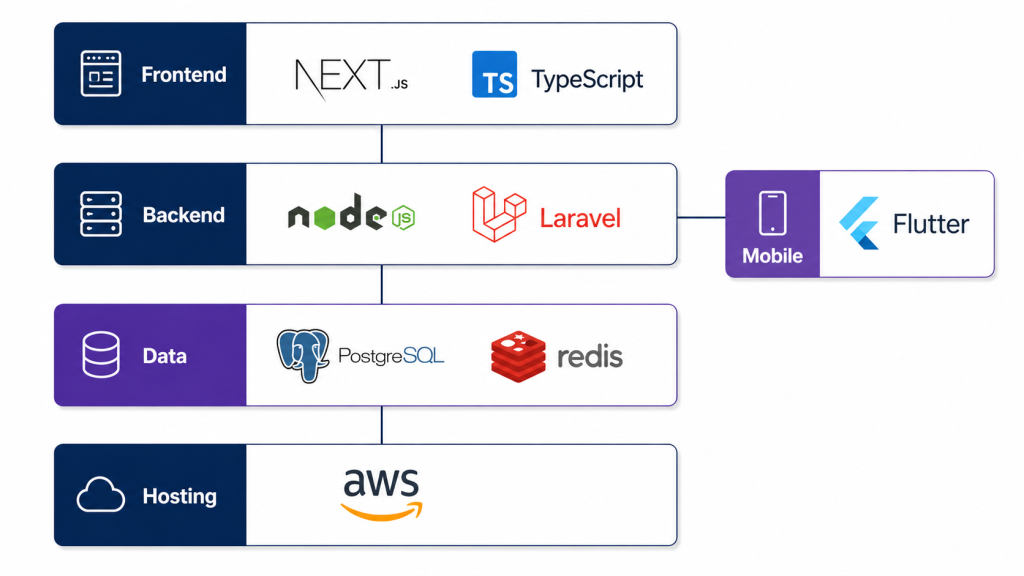
This is not a contrarian take in 2026, but it is still the take that gets ignored most often when teams are figuring out how to build a SaaS architecture. A small team running a well-structured monolithic Postgres-backed Next.js app, deployed to a single region on a managed hosting platform, will out-ship a small team running seven microservices in Kubernetes by months. The “scaling” problems that microservices supposedly solve do not exist for SaaS products with under 10,000 users on a properly indexed Postgres database.
The stack choices interact with the Build Triangle. Next.js plus TypeScript optimizes Speed by collapsing front-end and back-end-for-front-end into one framework. Postgres optimizes Compliance by giving auditors and security reviewers a database they recognize. AWS optimizes Compliance through built-in HIPAA/SOC 2 BAA pathways, but raises Cost relative to lighter-weight platforms. Flutter optimizes Cost by sharing roughly 90% of mobile code across iOS and Android, at a Speed cost on the first ramp-up.
The full stack comparison, Node vs. Laravel by team profile, Postgres vs. MongoDB by data shape, the AWS vs. Vercel hosting decision matrix, and the thresholds at which monolith-first should break into services, lives at the 2026 SaaS tech stack.
The pragmatic guidance on how to build a SaaS stack: most founders should pick the stack above as a default, ship the MVP, and revisit only when a specific block (data volume, tenant count, team size) hits a named threshold.
Block 5 — How to Build a SaaS With Compliance-Ready Architecture from Day One
This is the first cross-cutting block. Compliance is not a sequential stage that happens between Block 4 (stack) and Block 6 (ship). It shapes scope, stack, and build simultaneously, and it gets its own section because retrofitting compliance into a non-compliant architecture costs roughly four times what designing for it from day one costs. Anyone serious about how to build a SaaS for mid-market or enterprise treats compliance as a foundational concern, not an end-stage one.
The decision: which compliance frameworks apply to the SaaS, and which apply now versus later. The recommendation, in one sentence: assume GDPR baseline for any product with European users (which is almost all of them), add HIPAA only if the product processes Protected Health Information, treat SOC 2 Type II as a sales-cycle unlock for enterprise contracts above $50K ARR rather than a day-one requirement.
The architectural primitives are consistent across frameworks. Tenant isolation, strict separation between customer data, usually via row-level security in Postgres or per-tenant schemas. Audit logs are immutable, queryable records of every data-modifying action, attributable to a user and a tenant. Encryption, at rest (database, backups, file storage) and in transit (TLS 1.3 minimum). Data residency, the ability to keep EU customer data in EU regions, US in the US, GCC in DMCC-acceptable jurisdictions. Each primitive is cheap to design in and expensive to retrofit.
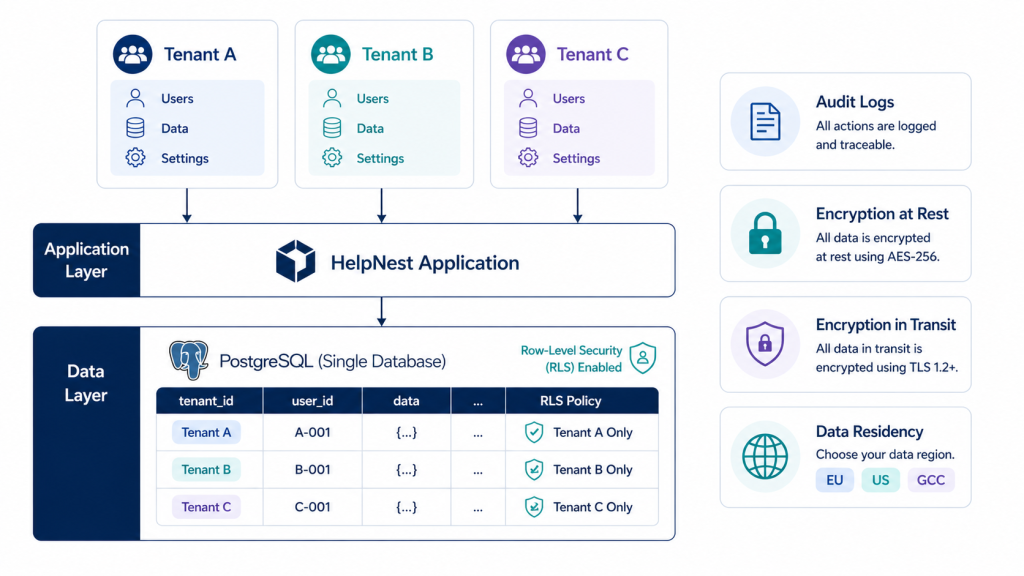
The Build Triangle reasoning is sharp here. Compliance is the C in the Triangle, and buying it costs Speed or Cost, usually both. Founders who insist on Speed-and-Cost without compliance ship products that cannot sell to mid-market and cannot pass a vendor security questionnaire. Founders who insist on day-one SOC 2 Type II for a five-customer beta have misallocated runway. The right answer to how to build a SaaS that holds up under enterprise diligence is almost always: design the primitives in from day one (cheap), defer the audits and certifications until the sales pipeline justifies them (expensive only when triggered).
The tenant isolation patterns and the day-one compliance checklist live at the multi-tenant SaaS architecture and the compliance-ready SaaS guide. For the underlying architectural reference, the AWS Well-Architected SaaS Lens is the canonical source.
How to Build a SaaS Across Borders: Delaware, UK Ltd, or UAE DMCC
The contracting entity matters more than first-time founders think. The wrong choice closes off fundraising, blocks enterprise deals in regulated jurisdictions, or generates unnecessary tax drag. The right choice is rarely a single jurisdiction; it is usually a hybrid. For founders working out how to build a SaaS that sells across borders, the incorporation decision is one of the highest-leverage structural calls of year one.
Delaware C-Corp remains the standard for any SaaS that intends to raise institutional venture capital. US investors fund Delaware C-Corps. They will sometimes fund foreign entities, but the friction is real, and many term sheets either require redomiciliation or price it in.
UK Ltd is strong for SaaS founders selling primarily into UK and EU markets, contracting with EU enterprise buyers, or working under IR35-friendly contracting arrangements. UK Ltd is cheap to incorporate, has a mature contracting law tradition, and gives EU customers a familiar entity type to sign with.
UAE DMCC (Dubai Multi Commodities Centre) is the emerging choice for SaaS founders selling into GCC markets — Saudi Arabia, UAE, Qatar, Kuwait. DMCC offers 0% corporate tax for qualifying activities, full foreign ownership, and a contracting reputation that GCC enterprise buyers recognize. For SaaS targeting Gulf banking, energy, or government-adjacent markets, DMCC is often the single highest-ROI structural decision a founder makes when learning how to build a SaaS for the region.
The hybrid setup most cross-border founders converge on is a holding entity in one jurisdiction (often Delaware for fundraising) with operating subsidiaries in the others (UK Ltd for EU contracting, UAE DMCC for GCC contracting). The cost of getting the structure wrong, discovering it during a Series A diligence or a $500K enterprise contract, is six-figure in legal fees and lost deal velocity.
When to incorporate: as soon as customer contracts or investor conversations begin, not before. Pre-revenue founders incorporate too early and burn cash on annual filings; pre-investor founders incorporate too late and lose deals.
This is not legal or tax advice. Incorporation decisions should be made with a qualified advisor in the relevant jurisdiction.
Block 6 — How to Build a SaaS MVP in 8 to 12 Weeks
Eight to twelve weeks is the realistic range for an MVP scoped through the 80% Cut, built on the recommended stack, by a focused team. The cadence that defines how to build a SaaS MVP on time breaks into four phases.
Weeks 1–2: Setup. Repository structure, CI/CD, hosting environment, design system foundations, authentication scaffold, base data model, the first compliance primitives (audit log table, tenant isolation pattern). Most teams either over-invest here (building a beautiful design system before the first feature) or under-invest (skipping CI/CD and paying for it in week eight).
Weeks 3–6: Core features. The features that deliver the primary product promise. This is the phase where scope creep does the most damage; the 80% Cut from Block 3 has to hold. Features that “just take a day” routinely take three.
Weeks 7–10: Hardening. Edge cases, error states, empty states, performance, security review, and the second compliance primitives (encryption, residency configuration, audit trail completeness). The phase that distinguishes a shipped product from a demo.
Weeks 11–12: Onboarding and billing. First-run experience, account setup flow, billing integration, dunning configuration, and the conversion-critical surfaces that determine whether trial signups become paying customers.
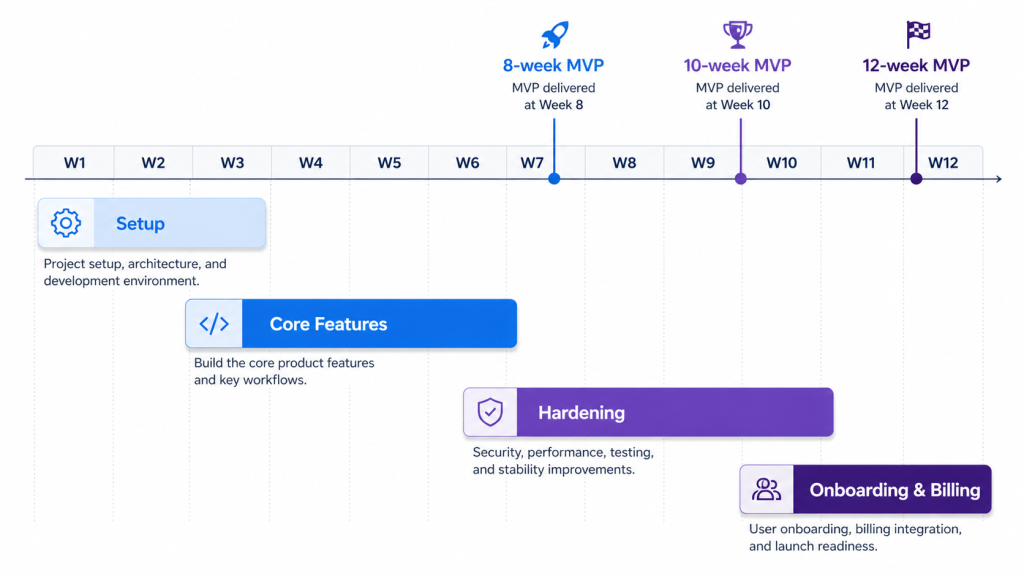
Where teams lose time when working through how to build a SaaS MVP: design rounds (two rounds is the right number, founders frequently insist on six), scope creep (every “small addition” pushes a week), hosting decisions made mid-build, building authentication from scratch instead of using a managed identity provider, and treating billing as a week-eleven problem when it should be wired up by week three.
A productized example anchors the cadence. Fixed-price MVP packages in the $15K–$40K range, Starter (8 weeks, narrow scope), Pro (10 weeks, fuller feature surface), Launch (12 weeks, billing and compliance hardened) — map directly onto this four-phase rhythm and exist as a category in the market. The full week-by-week breakdown of how to build a SaaS MVP in this window lives at the SaaS MVP timeline.
Block 7 — How to Build a SaaS With an AI Layer That Earns Its Cost
The second cross-cutting block. AI scoping decisions live inside Block 3 (scope), what AI features ship in the MVP, and surface again at Block 6 (ship), where the unit economics become real. The AI layer gets its own section because the cost model only stops being theoretical when the product is in production. Founders thinking carefully about how to build a SaaS with AI in 2026 plan the AI surface at scope time and budget for it at price time, not the other way around.
The first thing to drop is the assumption that “adding AI” means bolting on a chatbot. The patterns that earn their keep are different. Semantic search — turning unstructured customer data into searchable embeddings, converts existing data into a product surface. Workflow summarization — collapsing multi-step processes (call notes, ticket histories, document trails) into structured summaries, saves user time at the action layer rather than the input layer. Document extraction — pulling structured data out of invoices, contracts, and forms, replaces an entire category of manual work. Agentic routing — using a model to decide which downstream tool or workflow to invoke, is the highest-leverage pattern emerging in 2026 vertical SaaS.
The cost model is tokens per user per month. A B2B SaaS with moderate AI surface (semantic search plus one summarization workflow per active user per day) lands roughly in the $0.50–$3.00 per user per month range, depending on model choice. Heavier-AI products (document extraction at scale, agentic workflows running in the background) reach $5–$25 per user per month. Pricing tiers need to absorb this; founders who priced before measuring AI cost have negative-margin paying customers, and that is a costly lesson in how to build a SaaS that does not silently lose money on every customer.
Model choice trades off latency, cost, hallucination rate, and data residency. Claude tends to lead on summarization and structured-output reliability. OpenAI tends to lead in raw speed and ecosystem maturity. Open-source models (Llama, Mistral, Qwen) lead on cost when self-hosted and on data residency in regulated industries. The right answer for most SaaS in 2026 is a mix of premium models for user-facing surfaces and smaller open-source models for background workloads. The productized example of an AI-native product surface lives at HelpNest.
Block 8 — How to Build a SaaS Billing System That Won’t Break Under Load
Three billing platforms dominate SaaS in 2026 and frame how to build a SaaS billing stack that survives the first 100 customers without rework: Stripe, Paddle, and Chargebee.
Stripe is the default for most founders. Native subscription support, mature API, best-in-class developer experience, and the broadest ecosystem of third-party integrations. The trade-off is that Stripe leaves tax handling, VAT, GST, and sales tax to the merchant. For SaaS selling cross-border, Stripe Tax is an add-on that solves this, but it is a separate decision and a separate cost.
Paddle acts as Merchant of Record, meaning Paddle handles VAT/GST/sales tax compliance globally, and the SaaS founder sees a single net payout. The trade-off is a higher take-rate (typically 5% versus Stripe’s 2.9% plus add-ons) and less flexibility on pricing experimentation. For early-stage SaaS selling internationally, Paddle is often the right choice despite the higher rate, because it removes a category of compliance work that would otherwise eat weeks.
Chargebee is the right choice when subscription complexity is the constraint, multi-product bundling, complex proration scenarios, hybrid usage-and-seat billing, and deep enterprise contract terms. Chargebee sits on top of Stripe or another payment processor and adds the subscription logic that Stripe alone does not handle gracefully.
The three categories of work most founders underestimate when working out how to build a SaaS billing layer: proration (what happens when a customer upgrades mid-cycle), dunning (what happens when a payment fails, and roughly 6–8% of recurring charges fail every month), and tax (the cross-border compliance surface that grows with every new market entered). Rolling a custom billing system instead of using one of the three platforms is the second-fastest way to burn a seed round; the fastest is building before validating.
The canonical reference for subscription mechanics, proration math, dunning flows, and tax handling is the Stripe Billing documentation.
Block 9 — How to Build a SaaS Launch That Lands the First 100 Customers
The first 100 paying customers come from one or two distribution channels run with discipline, not five run halfheartedly. Most SaaS founders pick the wrong channel for their target buyer profile, and the channel mismatch is the single most expensive mistake in building a SaaS launch motion.
Product Hunt works for developer tools, designer tools, and consumer-prosumer SaaS. It does not work for B2B vertical SaaS sold to the mid-market. LinkedIn outbound works for B2B SaaS where the buyer profile maps to a clean LinkedIn search filter, director-level and above, specific industries, and specific company sizes. Cold email works when the founder has a tight ICP definition and a defensible reason to reach out. Content SEO works on a 6–12 month delay and is rarely the right channel for first-100 acquisition.
The relevant conversion benchmarks: pricing-page conversion runs 2–4% for B2B SaaS with sales-led motion and 0.5–1.5% for product-led growth. Trial-to-paid conversion runs 15–25% for B2B sales-led, 3–8% for PLG. Founders comparing themselves to public top-decile benchmarks (10%+ pricing-page conversion) usually find the comparison demoralizing and not actionable.
The $2,000 per month paid acquisition test rule: before scaling paid spend, run $2K/month for two months on the channel that looks most promising. If unit economics work at that scale, scale. If they don’t, the channel is wrong, or the product positioning is wrong, and scaling spend will not fix either.
The 90-Day Traction Ledger from Block 1 reappears here. The same six signals, problem-mention rate, paid waitlist conversions, prototype signups, sales-call book-rate, deposit conversions, referral velocity, translate directly into post-launch growth signals. The Ledger is the thread that ties pre-build validation to first-100 acquisition and is one of the most underused instruments in building a SaaS that finds product-market fit fast. The full pre-launch checklist lives at SaaS pre-launch checklist, and for the broader metrics framework, a16z’s “16 Startup Metrics” remains the canonical reference.
Block 10 — How to Build a SaaS That Scales Without Rewriting Everything
Three refactor triggers separate “we should think about scaling” from “we need to refactor now.” Crossing one is normal; crossing two is concerning; crossing three forces action. Knowing how to build a SaaS that scales without a rewrite means recognizing which signals matter and which are noise.
Tenant count. A well-built monolithic SaaS handles 50–500 tenants without architectural change. Above 500, multi-region routing, tenant-aware caching, and sharding decisions enter the picture. Below 500, the architecture rarely needs work.
Data volume. Postgres handles tens of terabytes per tenant on appropriately sized hardware. Most “we have a database problem” conversations at SaaS under 50 tenants are missing-index problems, not data-volume problems. The first response to slow queries should be the query plan, not the rewrite proposal.
Team size. Single-team monolithic codebases stop being efficient at roughly 10–15 engineers. Above that, module ownership and conditional service extraction become real concerns. Below that, the monolith is almost always the right answer.
Observability and on-call become non-optional at roughly 50 paying customers, regardless of which trigger fires first. Below 50, they can be on the on-call rotation. Above 50, that pattern starts producing customer-visible incidents during family dinners, vacations, and the founder’s first illness. Tracing, structured logging, error monitoring, and a real on-call rotation are infrastructure decisions, not engineering preferences.
Most “we need to rewrite this in Rust” conversations inside SaaS are not architecture problems. They are missing-index problems, N+1 query problems, or premature-optimization problems wearing architecture clothing. The right first move is profiling, the right second move is indexing, and the right third move is caching. Rewrites are the fourth move and are rarely necessary when teams understand how to build a SaaS that scales incrementally.
The deeper signal that triggers the right kind of refactor is product-market fit. See finding SaaS product-market fit for the metrics that indicate a product is ready to scale rather than ready to rewrite. The productized SaaS portfolio at Nazmart demonstrates the patterns described here in production.
How to Build a SaaS in 2026: The Real Cost Breakdown
The decision: which build path matches the founder’s profile and runway. Five paths cover almost all SaaS builds in 2026 and frame the honest economics of how to build a SaaS without surprises.
DIY ($5K–$20K plus 12+ months of founder time). Right for technical solo founders who can ship production-grade code unaided. The dollar number is hosting, tools, and contractor support; the time number is the real cost. Trade-off: cheapest in cash, most expensive in opportunity cost.
Freelance ($20K–$60K). Right for founders with a tight scope, an existing PM muscle, and the bandwidth to manage 1–3 contractors. Trade-off: low cost, high coordination overhead, variable quality.
Offshore agency ($30K–$80K). Right for cost-sensitive non-technical founders willing to manage timezone friction and accept slower iteration cycles. Trade-off: cheaper than specialized agencies, but specification-heavy — vague briefs produce vague products.
Specialized agency ($40K–$120K). Right for compliance-heavy verticals, time-to-market pressure, or founders who need fixed-price predictability. Trade-off: more expensive in cash, faster in delivery, lower technical risk.
In-house team ($400K+ per year). Right only post-PMF, when ongoing product velocity is the primary constraint and the SaaS has revenue to support a permanent team. Trade-off: highest cash burn pre-PMF, highest velocity post-PMF.
| Path | Range | Best for |
|---|---|---|
| DIY | $5K–$20K + time | Technical solo founders |
| Freelance | $20K–$60K | Tight scope, existing PM muscle |
| Offshore | $30K–$80K | Cost-sensitive non-technical |
| Specialized agency | $40K–$120K | Compliance-heavy, time pressure |
| In-house | $400K+/yr | Post-PMF only |
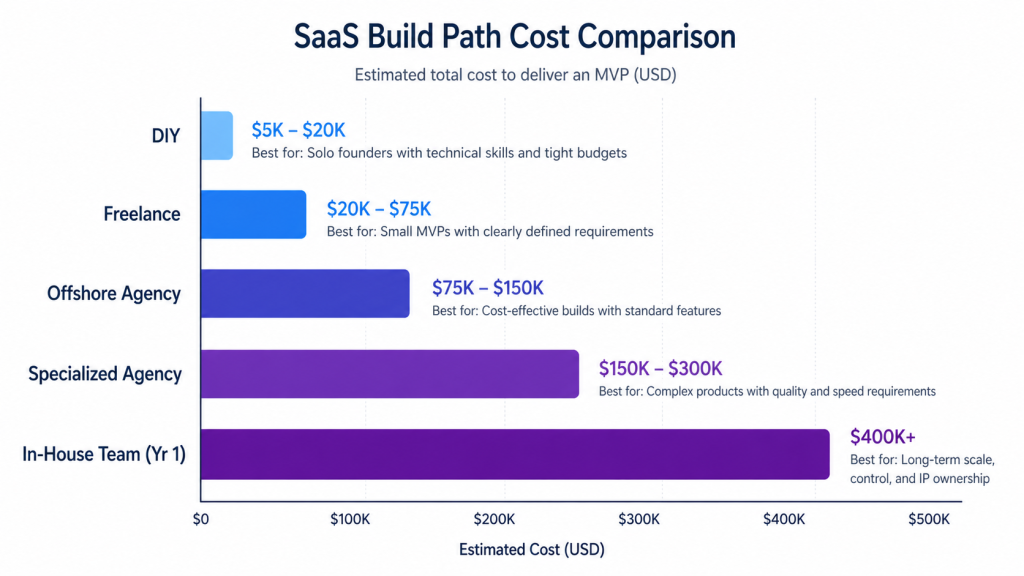
The cross-cutting trade-off in how to build a SaaS at any budget, in one sentence: cheaper paths cost more in founder time and rework; more expensive paths cost more in cash but compress timelines and reduce technical risk. Specialized fixed-price MVP packages in the $15K–$40K range exist as a category and combine specialized-agency quality with budget predictability.
The full ROI math, hidden cost breakdowns by path, and the build-vs-buy decision tree live at the SaaS development cost breakdown.
How to Build a SaaS Without Raising: Bootstrap vs. Pre-Seed Capital Strategy
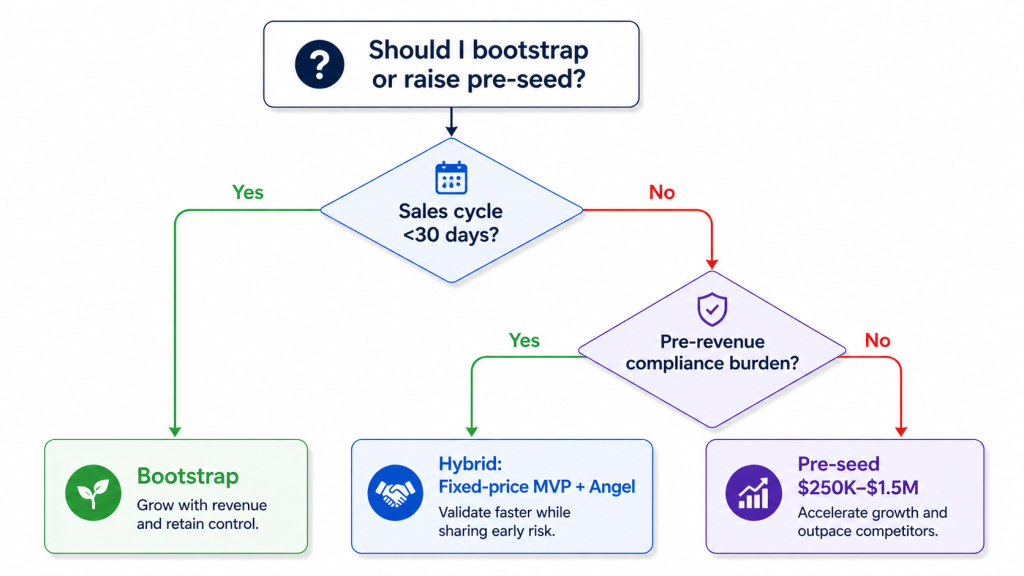
The capital path decides what can be built. Two clean paths and a hybrid frame how to build a SaaS in year one without running out of money.
Bootstrap runs on revenue, savings, and sweat. Bootstrap math is honest: the founder needs personal runway covering 12–18 months, MVP build budget of $15K–$80K depending on path, and revenue starting in months 6–9 to extend the runway. Bootstrap works best for SaaS with short sales cycles, fast time-to-revenue, and pricing tiers that early customers can self-serve. It does not work for SaaS with long enterprise sales cycles, heavy compliance burden before first revenue, or large fixed infrastructure costs.
Pre-seed raises $250K–$1.5M in 2026, with the upper end of that range — $500K to $2M — increasingly common for technical founders building in compliance-heavy or AI-heavy categories. The math: 18 months of runway, including 2–3 engineers (or one founder plus an agency build), product launch in months 4–6, ten paying customers by month 9, $20K MRR by month 18 to support seed-round metrics. Pre-seed investors expect MVP shipped, paying customers, and category clarity by the seed conversation.
Raising too early kills more SaaS than it saves. A pre-seed round at the wrong valuation, with the wrong investors, before product-market signal, locks in dilution and expectations that frequently make seed-round mechanics worse, not better. Many founders who raised pre-seed in months 1–3 would have been better served by 6 months of validation, a fixed-price MVP build, and 6 months of revenue before the conversation. That sequence is the most overlooked path in how to build a SaaS without giving away too much equity too early.
The hybrid path, fixed-price MVP build plus revenue plus a smaller angel round at month 9–12, lets some founders skip pre-seed entirely and walk into a seed round with revenue, customers, and meaningfully less dilution.
This is not financial advice. Capital decisions should be made with a qualified advisor.
How to Build a SaaS: When to Hire an Agency vs. Build In-House
The framework: time-to-market, capital efficiency, technical risk, and founder skills, scored against the SaaS Build Triangle. Few questions in how to build a SaaS shape year-one outcomes more than the team-structure decision.
By this point in the article, the Triangle has appeared in the intro, the definition section, the roadmap overview, and several middle sections. The team-structure mapping is where it earns the framing. Three team archetypes, each picking two of the three Triangle forces:
Agency: Speed + Compliance, sacrifice Cost. Specialized agencies ship fast and ship compliance-aware because that is the productized capability they sell. The cost is cash — the engagement is a fixed expense, not a salary, and the engagement ends when the contract ends. Right when the founder needs a compliance-ready MVP in 8–12 weeks and has the cash to pay for compression.
In-house team: Compliance + Cost over time, sacrifice Speed. A 4-engineer in-house team at $400K/year is more expensive in year one than an agency MVP, but cheaper across years 2–4 because the team compounds knowledge of the product. Compliance posture grows with the team. Speed-to-first-MVP suffers because hiring takes 3–6 months before the team is productive. Right post-PMF, when product velocity is the primary constraint and ongoing compliance work is steady-state.
Freelance bench: Speed + Cost, sacrifice Compliance. A small founder + 1–2 freelancers can ship fast and ship cheap. Compliance suffers because freelance contracts rarely include security review, audit-log discipline, or HIPAA-aware data handling by default. Right for non-regulated B2C or prosumer SaaS where compliance posture is not a sales gate.
Honest counter-argument: agencies are the wrong choice when the SaaS is the IP the founder intends to defend for ten years. If the core product is a defensible technical moat — proprietary algorithms, novel architectures, hard-earned domain expertise expressed in code — that capability needs to live inside the company, in people the company employs. Outsourcing the core moat is the most expensive cost-cutting decision a SaaS founder can make.
Most founders are best served by a hybrid in how to build a SaaS team for year one and beyond: agency for the MVP, in-house team starting at month 6–9 post-launch. The full agency-selection framework lives at when to hire a SaaS development agency.
Common Mistakes to Avoid When You Build a SaaS Product
Seven mistakes account for most SaaS failures observed across the agency and accelerator literature. Each is paired with a one-line fix. Together they form the negative checklist for how to build a SaaS that does not implode in year one.
- Building before selling. Twenty conversations and the 90-Day Traction Ledger before code.
- Perfect design before a functional product. Two design rounds maximum before features ship.
- No billing on day one. Wire Stripe by week three, even if the first customer pays manually.
- Ignoring compliance until the first enterprise deal. Tenant isolation and audit logs from week one; certifications can wait.
- Over-hiring before the product-market signal. One engineer plus the founder until ten paying customers exist.
- Picking the wrong co-founder. A bad co-founder is more expensive than a delayed launch — many founders ignore the warning signs because the alternative feels worse.
- Optimizing too early. Profile before refactoring; index before sharding; cache before rewriting.
The pattern across all seven is the same: founders consistently optimize for the wrong constraint at the wrong stage. Pre-validation, they build. Pre-PMF, they hire. Pre-scale, they refactor. Each decision feels productive in the moment and costs months in hindsight.
The single most common version is the first: building before selling. It is the most rationalizable mistake, the most flattering one to make (“we’re moving fast and shipping product”), and the most consistently fatal. A founder who has not pre-sold the product to ten people for real money should not be writing production code; they should be selling. The full taxonomy lives at SaaS MVP mistakes.
Conclusion: How to Build a SaaS That Ships and Sells in 2026
Ten building blocks define how to build a SaaS that moves from problem to paying customers: validate the problem, choose business model and pricing, scope the MVP, pick the tech stack, design compliance in (cross-cutting), ship in 8–12 weeks, decide the AI layer (cross-cutting), wire billing properly, launch and acquire the first 100 customers, and scale without rewriting. Three foundational decisions before block one, the founder readiness check, the jurisdiction decision, and the capital strategy, shape what is actually possible to build at all.
The lens through it all is the SaaS Build Triangle. Speed, Compliance, Cost pick two. Every block forces a version of the same choice, and the founders who ship are the ones who decide consciously rather than pretending they can have all three. Speed-and-Compliance trades runway. Speed-and-Cost trades enterprise eligibility. Compliance-and-Cost trades market timing. The right two depend on the founder, the market, and the runway, but two it is. Anyone serious about how to build a SaaS in 2026 makes that choice deliberately and revisits it at every block.
How to Build a SaaS in 2026: Frequently Asked Questions
1. How long does it realistically take to build a SaaS MVP?
Eight to twelve weeks for a properly scoped MVP built on a recommended stack by a focused team. The range depends on three factors: scope discipline, team experience, and compliance burden. A founder who runs the 80% Cut exercise rigorously, hires either an experienced specialized agency or a small senior team, and operates in a non-regulated market can ship at the eight-week end. A founder building HIPAA or SOC 2-aware infrastructure into the MVP, or scoping for a more complex feature surface, lands at the twelve-week end. Builds that exceed twelve weeks have almost always failed scope discipline somewhere in Block 3 — usually because “one more feature” felt smaller than it actually was. The honest sign that an MVP is over-scoped: if the timeline projection extends past sixteen weeks, the scope is the problem, not the team. Cut, then cut again.
2. How much does it cost to build a SaaS from scratch in 2026?
Five paths cover most SaaS builds, each with its own range. A technical solo founder going DIY spends $5,000–$20,000 in tools and hosting plus 12+ months of full-time work — cheap in cash, expensive in opportunity cost. Freelance contractors run $20,000–$60,000 with high coordination overhead. Offshore agencies run $30,000–$80,000 with timezone friction and specification-heavy delivery. Specialized agencies — including the productized fixed-price MVP category — run $40,000–$120,000 with compressed timelines and lower technical risk. In-house teams run $400,000+ per year and only make sense post-product-market-fit. Add ongoing infrastructure cost ($500–$3,000/month for early-stage SaaS), billing platform fees (2.9–5% of revenue), and AI inference costs ($0.50–$25 per user per month depending on AI surface). Most first-time founders working out how to build a SaaS for the first time underestimate ongoing costs by 30–50%; budget for them from day one.
3. Should my SaaS be GDPR or HIPAA compliant from day one?
GDPR is functionally non-optional for any SaaS with European users — which is almost all SaaS. The architectural primitives (data residency, deletion-on-request, processing records, consent capture) are cheap to design in and expensive to retrofit. HIPAA applies only if the product processes Protected Health Information; if it does not, HIPAA is not relevant. SOC 2 Type II is a sales-cycle unlock for enterprise contracts above roughly $50K ARR. Founders who attempt SOC 2 Type II for a five-customer beta have misallocated runway; founders who skip the day-one architectural primitives and try to retrofit at the first enterprise deal pay roughly 4× the cost. The right answer is: design the primitives in from day one (cheap), defer the audits and certifications until pipeline justifies them (expensive only when triggered).
4. Do I need a technical co-founder to build a SaaS?
No, but the alternative requires more capital. Non-technical founders without a technical co-founder fund the build through agency or freelance contracting, which costs $20K–$120K depending on path. Founders with a technical co-founder trade equity (typically 30–50%) for the in-house build capability and the longer-term technical leadership. The wrong answer is finding a “technical co-founder” who is actually a junior contractor with equity — this is the worst of both paths. Either find a true peer-level technical co-founder, or fund the build commercially and keep equity. The middle path tends to fail.
5. What’s the biggest mistake first-time SaaS founders make?
Building before selling. The mistake is consistent across geographies, verticals, and founder profiles. It feels productive — code accumulates, screenshots look impressive, the project has visible momentum. But the underlying signal (whether anyone will pay) is exactly zero stronger after three months of building than it was on day one. Founders who run twenty validation conversations and the 90-Day Traction Ledger before writing production code ship products that find paying customers at meaningfully higher rates than founders who skip validation. The unglamorous fix is also the right one in any framework for how to build a SaaS responsibly: validate first, build second.
6. Should I incorporate before or after I start building?
Incorporate when contracts or investor conversations begin, not before. Pre-revenue, pre-investor founders incorporate too early and burn cash on annual filings, accountant fees, and structure that the business does not yet need. Pre-investor, pre-customer founders who delay incorporation past the first contract or term sheet lose deal velocity at the worst possible moment. The right trigger is concrete: the first customer ready to sign, or the first investor ready to fund. Jurisdiction choice depends on customer geography (UK Ltd for EU, UAE DMCC for GCC, Delaware C-Corp for US institutional VC) and is often a hybrid setup; that decision belongs with a qualified advisor in each relevant jurisdiction.
7. Bootstrap or raise pre-seed for an MVP?
Depends on time-to-revenue and capital intensity. SaaS with short sales cycles, fast time-to-revenue, and self-serve pricing tiers can usually bootstrap. SaaS with long enterprise sales cycles, heavy pre-revenue compliance work, or large fixed infrastructure costs typically needs pre-seed. The hybrid path — fixed-price MVP build plus revenue plus a smaller angel round at month 9–12 — lets many founders skip pre-seed entirely and walk into a seed round with revenue and meaningfully less dilution. Founders who raise pre-seed before validation almost always over-dilute; founders who refuse to raise when the build genuinely requires capital starve the product. The decision is rarely binary.