



The hardest thing about multi-vendor marketplace development is not the code. It is the order you build the pieces in. Almost every failed marketplace I have looked at picked the wrong starting point, spent six months on something that should have been built last, and ran out of money before the parts that earn revenue were even live.
I have seen founders begin with a beautiful storefront and only realise three months later that nothing in the back end handles split payments. I have watched a team in Lisbon ship a complete vendor app before they had a single buyer-side flow tested, then discover the buyer side took longer than the vendor side and burned the runway. Multi-vendor marketplace development punishes the wrong sequence more than any other software category I work in.
This piece is about the right sequence. I call it the 6-Step Multi-Vendor Build Sequence, and it is what we use at Xgenious when a founder asks us to scope a marketplace from scratch. If you are working through the broader product, read this with our on-demand service marketplace development guide open in another tab. The two pieces are designed to fit together.
Table of Contents
What multi-vendor marketplace development actually requires
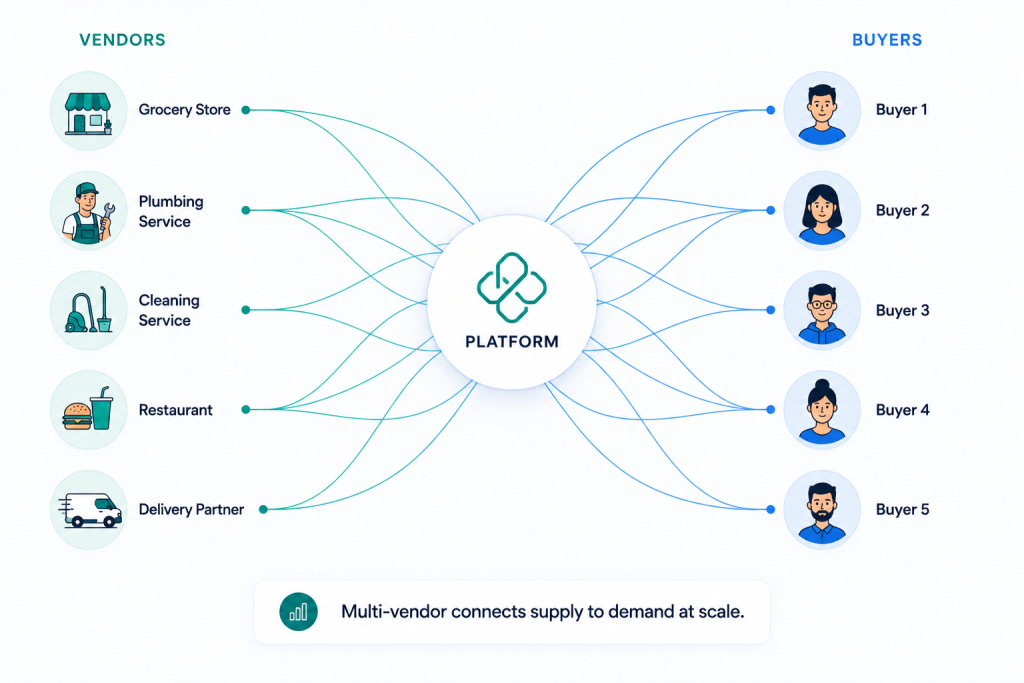
Multi-vendor marketplace development means building a platform where many independent sellers list their own products or services on the same site, the buyer can purchase from one or several of them in a single transaction, and the platform handles payment, routing, and trust on top.
That is a longer list than a normal store and a much longer list than most founders expect. A regular ecommerce site has one seller (you), one inventory, one fulfilment flow. A multi-vendor marketplace has hundreds or thousands of sellers, each with their own inventory, their own pricing rules, their own payout details, and their own opinions about how the platform should work for them. You are not building a store. You are building infrastructure for stores.
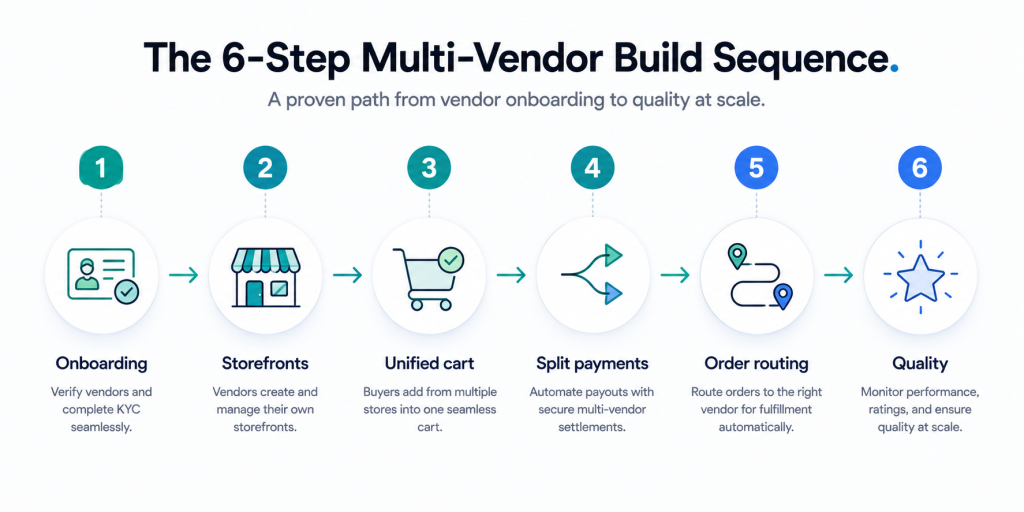
The pieces that have to exist before a marketplace can transact are: vendor onboarding with identity verification, per-vendor storefronts and product management, a buyer-side catalogue that pulls from every vendor, a unified cart that can split across vendors, split payments that route money to the right accounts, order routing that tells each vendor what they need to fulfil, and quality management to keep the bad vendors off the platform. Skip any one of these and the marketplace either does not work or does not stay legal.
That is why multi-vendor marketplace development is one of the most expensive software categories to build well. According to Andreessen Horowitz’s Marketplace 100, the biggest consumer marketplaces have all built and rebuilt these systems multiple times as they scaled, and each rebuild was a multi-month project. You do not want to discover that at the wrong moment.
The 6-Step Multi-Vendor Build Sequence framework
The framework is six steps in a specific order. Onboarding first, storefronts second, cart third, payments fourth, order routing fifth, and quality management sixth. Each step depends on the one before it working, which is why the order matters more than the features.
The trap most founders fall into is treating these as parallel tracks. They split the team and try to build the buyer side, the seller side, and the payments side at the same time. The buyer side gets bottlenecked because the seller side has no listings to show. The seller side has no payments to test against. The payments side cannot be finished because routing rules depend on listings that do not exist yet. Three teams, six months, no working platform.
Building in sequence is slower on paper and faster in practice. A real vendor with a real listing using a real payment flow exposes problems that no amount of parallel work catches. Build it in this order, prove each step with one vendor before moving to the next, and you ship something that actually works. The 6-Step Multi-Vendor Build Sequence is a discipline more than a checklist. Hold the discipline and multi-vendor marketplace development becomes a normal engineering project. Skip the discipline and it becomes a death march.
Step 1: Vendor onboarding and KYC pipeline
Multi-vendor marketplace development starts with onboarding because nothing else can be tested without at least one real vendor inside the system. A vendor needs to register, verify their identity, complete a business profile, agree to platform terms, set up their payout method, and clear whatever review the platform requires before they can list. If any of that is missing, the marketplace cannot legally pay them, which means it cannot legally take money on their behalf, which means it cannot transact.
KYC, or “know your customer,” is the regulated piece. Payment processors like Stripe Connect, Adyen, and Mangopay require the platform to collect identity documents, beneficial ownership information, and tax IDs before a vendor can receive payouts. The exact requirements vary by jurisdiction and by vendor type (individual versus business), but the rule of thumb is that every vendor who handles money on your platform needs a verified record before their first payout.
What a good onboarding pipeline looks like:
- A signup flow that takes less than ten minutes for a clean case
- Real-time document verification with a fallback to human review for edge cases
- Clear status states so the vendor knows what is pending and why
- Tax form collection (W-9, W-8BEN, equivalents in other jurisdictions)
- Payout method setup that ties directly into the payments processor
- A holding state where a vendor can prepare listings but not yet sell
The mistake here is building onboarding as a manual back-office process that engineering will “automate later.” Later never comes. The team ends up spending hours per vendor doing what software should do, and at fifty vendors the back office breaks. Build the pipeline properly the first time, and multi-vendor marketplace development gets meaningfully cheaper from step two onward.
Step 2: Per-vendor storefront and product management
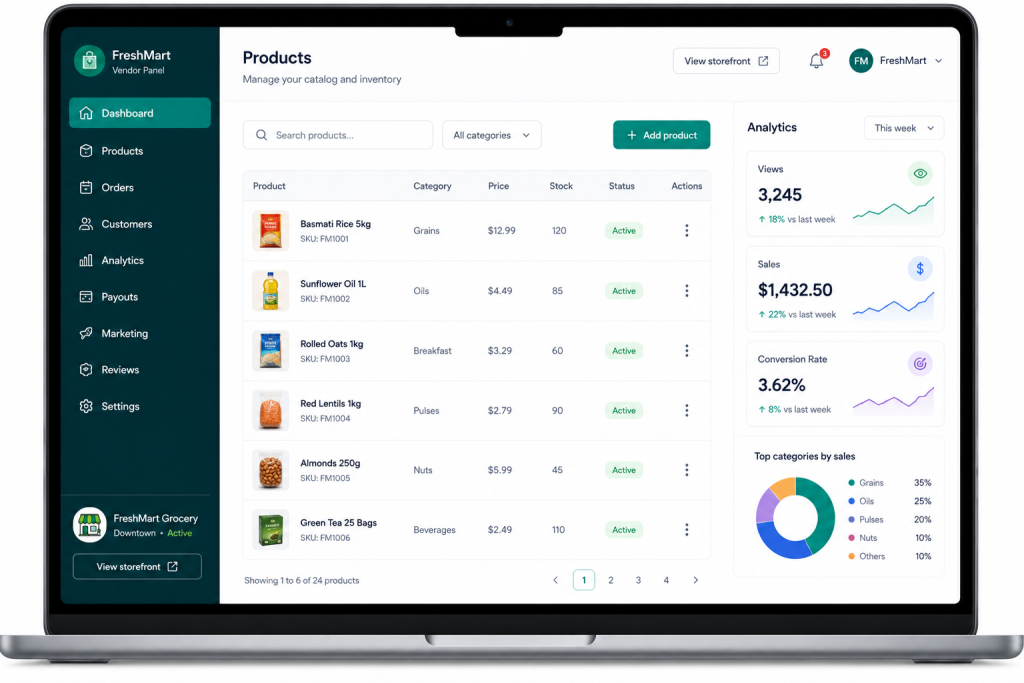
Once a vendor exists, they need a place to list products or services and a tool to manage them. This is the seller-facing surface area of the platform, and it is where vendor satisfaction is won or lost. A vendor with twenty products spends real hours every week inside your product management tools. If those tools are slow, confusing, or missing features they need, the vendor will leave for a competitor that respects their time.
Per-vendor storefront means each seller has a branded surface where buyers can see all of their offerings, their ratings, their policies, and their story. This is what makes the platform feel like a marketplace rather than a catalogue. Etsy’s seller-side architecture, which it has published bits of in investor materials, shows just how much surface area a healthy marketplace gives to vendors and how much that surface area is responsible for retention.
What product management has to handle in multi-vendor marketplace development:
- Bulk upload (CSV, XLSX) for vendors with large catalogues
- Variant management (size, colour, material, service tier)
- Inventory tracking per variant with low-stock alerts
- Pricing rules including discounts, bulk pricing, and currency
- Media library with image compression and alt text
- Vendor-side analytics on listing performance
The trade-off here is between flexibility and consistency. Give vendors too much control and the catalogue looks chaotic. Give them too little and they feel boxed in. The marketplaces that get this right tend to lock the shape of a listing (the layout, the data fields, the required photos) and let the vendor own the content inside that shape. That keeps the buyer experience predictable while keeping vendors happy. Multi-vendor marketplace development on this step is mostly about finding that line.
Step 3: Unified cart with multi-vendor checkout
Step three is where multi-vendor marketplace development starts to look different from a regular ecommerce build. The buyer needs to add items from multiple vendors to a single cart, check out once, pay once, and trigger separate fulfilment from each vendor on the back end. That sounds simple. It is not.
The cart has to handle different shipping rules per vendor (or per region per vendor), different return policies, different tax treatment, different lead times, and sometimes different currencies. The buyer should never see most of this complexity. They should see one cart, one total, and one confirmation. Everything else has to be hidden inside the platform.
What a working unified cart needs to do:
- Group line items by vendor so shipping can be calculated per vendor
- Apply vendor-specific shipping rules and combine them into one total
- Handle taxes correctly across vendors in different jurisdictions
- Lock pricing at the moment of add-to-cart, not at checkout
- Handle partial inventory failures gracefully (one vendor sold out)
- Send the right line items to the right vendors after payment confirms
The mistake here is trying to copy the single-vendor cart and bolt vendor splitting on top. That works until the first vendor ships from a different country, or the first buyer needs to return only one item from a multi-vendor order, and then the bolt-on starts breaking. Build the cart as multi-vendor from the start, even if you only have two vendors live. The cost is the same, and refactoring this later is one of the most expensive things in multi-vendor marketplace development.
Step 4: Split payments and payout automation
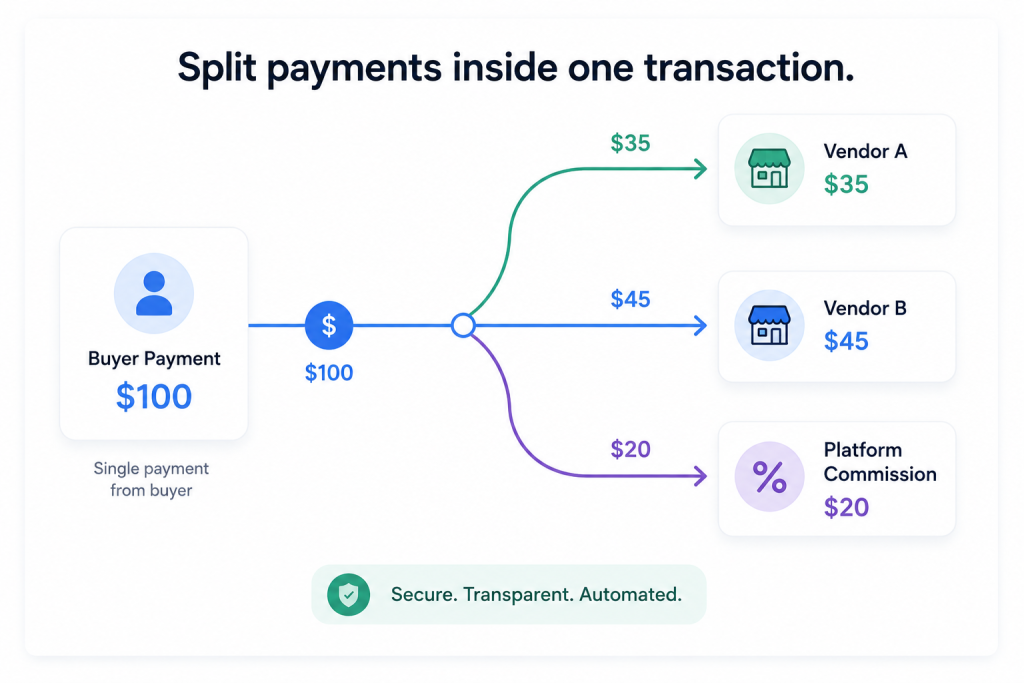
Step four is the legally regulated heart of multi-vendor marketplace development. The buyer pays one amount. That amount has to be split between (sometimes many) vendors and the platform’s commission, with the right tax handling, the right hold periods for refunds, and a clean audit trail for every cent.
Almost every modern multi-vendor build uses one of three payment processors for this: Stripe Connect, Adyen for Platforms, or Mangopay. Stripe is the most common because the developer experience is best and the documentation is thorough. Their Stripe Connect docs are worth reading even if you choose another processor, because they describe the patterns every marketplace eventually has to handle.
What split payments and payout automation cover:
- Charging the buyer once, splitting between vendors and platform commission
- Holding funds in escrow until a defined event (delivery, dispute window close)
- Automated payout schedules per vendor (daily, weekly, on-demand)
- Refund handling that pulls money back from the right account
- Chargeback handling with vendor liability rules
- Tax form generation at year end (1099-K equivalents)
The most common mistake here is underestimating the regulatory surface. A marketplace that processes payments on behalf of vendors is operating as a payment facilitator in most jurisdictions, which carries specific obligations. Using a processor that handles those obligations for you (the Stripe Connect “Custom” or “Standard” models, for example) takes that risk off your plate. Building your own payment routing without that protection is one of the fastest ways to attract regulatory trouble in multi-vendor marketplace development, and almost never the right call early.
Step 5: Order routing to multiple vendors
After payment confirms, the platform has to tell each vendor what they need to do. This is order routing, and it is where multi-vendor marketplace development meets operations. A vendor needs to see their portion of the order, accept it, prepare it, ship it (or service it), and mark it complete. The buyer needs to see the status of each portion separately, because one vendor might ship in two days and another in two weeks.
Routing logic depends on the category. For physical goods, it usually splits the order by vendor and sends each vendor a notification with their line items. For services, it might route based on location, availability, or skills, similar to how a two-sided marketplace business model matches supply to demand in real time. For mixed marketplaces, both patterns coexist.
What good order routing handles:
- Per-vendor order views with only their line items visible
- Accept and reject flows with reasons and automatic refunds on reject
- Status updates per line item that aggregate to a buyer-facing order status
- Vendor notifications across email, SMS, push, and dashboard
- Cut-off times and SLA tracking per vendor
- Cancellation flows that handle one cancelled item without breaking the rest
The mistake here is letting vendors see the whole order. They should only see their portion, their buyer’s shipping address, and the data they need to fulfil. Showing them anything else creates a disintermediation risk (the vendor reaches out to the buyer directly to bypass the platform on the next sale) and a privacy problem. Multi-vendor marketplace development requires careful data minimisation at this step, and the platforms that get it right define what a vendor can see explicitly rather than implicitly.
Step 6: Vendor performance and quality management
Step six is the one most marketplaces leave for “later” and most marketplaces regret leaving for later. Quality management is what keeps bad vendors off the platform and good vendors on it. Without it, the platform degrades over time as the worst vendors generate the most complaints, the best vendors leave because they feel undervalued, and the buyer experience drifts toward the lowest common denominator.
What quality management means in practice:
- Ratings and reviews tied to verified purchases, not anonymous accounts
- Performance dashboards per vendor with cancellation rate, dispute rate, on-time rate
- Automated warnings when a vendor crosses defined thresholds
- Tiering or badge systems that reward high-performing vendors with visibility
- A clear, documented suspension and removal process
- Feedback loops back to vendors so they can fix issues before suspension
The mistake here is starting with no policy and writing one only when the first crisis hits. By then the rules look reactive and the affected vendors feel singled out. Better to define the quality standards in the vendor terms during step one, build the tracking in step six, and let vendors see exactly where they stand from day one. Done well, vendor performance management becomes the single biggest driver of buyer retention, which is the metric that ultimately decides whether the marketplace economics work. Multi-vendor marketplace development that ignores this step ships fast and dies slow.
Multi-vendor marketplace development cost breakdown
Costs in multi-vendor marketplace development vary wildly because the same brief can mean three very different builds. The cheapest realistic price for a usable platform is around $20,000, and that is for a white-labelled solution like Nazmart configured by a small team. A genuinely custom multi-vendor build with the six steps above engineered properly is closer to $80,000 to $200,000 for a mid-complexity case, and large enterprise marketplaces run into the millions.
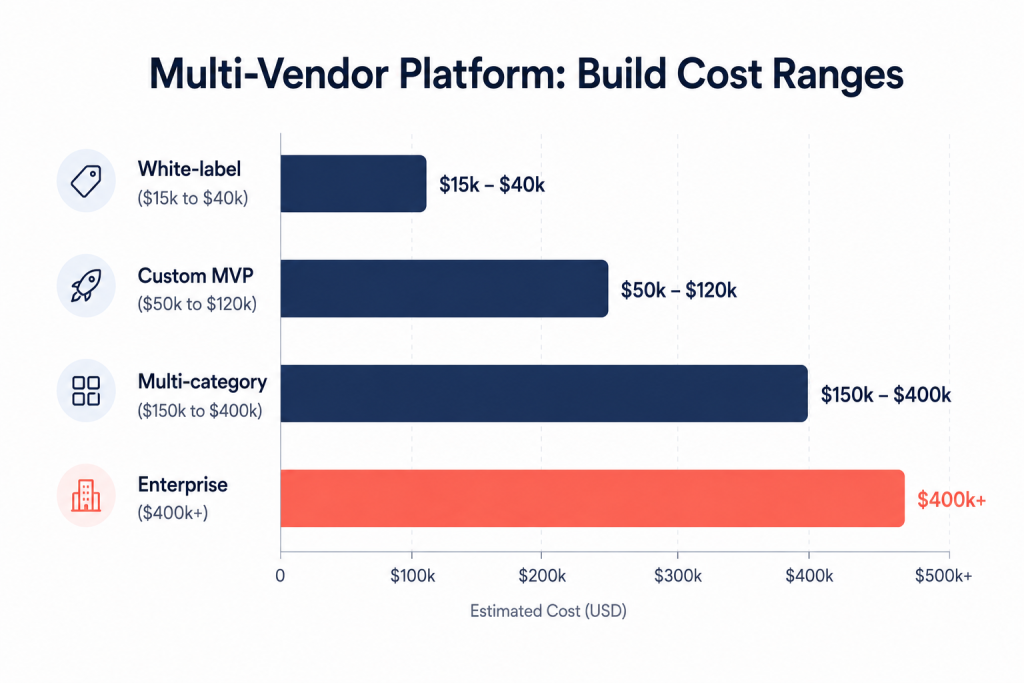
Rough ranges by build type:
- White-label or SaaS multi-vendor platform with light customisation: $15,000 to $40,000
- Custom MVP with the six steps and a single category: $50,000 to $120,000
- Multi-category custom marketplace with mobile apps: $150,000 to $400,000
- Enterprise marketplace with custom payments and logistics: $400,000+
The single biggest cost driver, more than category or feature count, is the payments and onboarding surface. A marketplace that operates in one country with one payment processor and one tax jurisdiction is meaningfully cheaper than one that has to handle five countries and three tax regimes from day one. Plan the geographic footprint deliberately because the difference in multi-vendor marketplace development cost between “one country” and “global” is often the entire project budget.
The second-biggest cost driver is whether the platform has native mobile apps. A web-only marketplace ships faster and cheaper. iOS and Android apps add three to four months and a meaningful chunk of budget, and they only earn their keep once liquidity is proven.
Multi-vendor marketplace development timeline (12 to 24 weeks)
Most realistic mid-complexity multi-vendor marketplace development projects ship a usable MVP in 12 to 24 weeks. Anything faster is either a configured SaaS platform (which can launch in days) or a marketing claim that the team will quietly miss. Anything slower usually means scope creep, not engineering difficulty.
A typical 16-week timeline breaks down roughly:
- Weeks 1 to 3: Discovery, requirements, and architecture
- Weeks 3 to 5: Design system, vendor and buyer flow wireframes
- Weeks 4 to 8: Step 1 (onboarding) and Step 2 (storefronts) in parallel
- Weeks 8 to 12: Step 3 (cart) and Step 4 (payments) with continuous integration testing
- Weeks 12 to 14: Step 5 (order routing) and Step 6 (quality scaffolding)
- Weeks 14 to 16: QA, beta vendors, payment processor go-live checks, soft launch
A 24-week timeline buys you native mobile apps, deeper analytics, multi-currency, and a more polished design system. A 12-week timeline forces hard scope cuts and usually means the marketplace launches without features that should be there. The right timeline depends on whether you are chasing a specific season (Q4 retail) or whether you can ship when ready.
The most common timeline mistake is committing to a launch date before the payments processor has approved the platform. Stripe Connect, in particular, has a review process for marketplaces in regulated categories that can take two to six weeks, and it cannot be parallelised. Multi-vendor marketplace development has to plan around that review window from day one or the launch date slips at the worst possible moment.
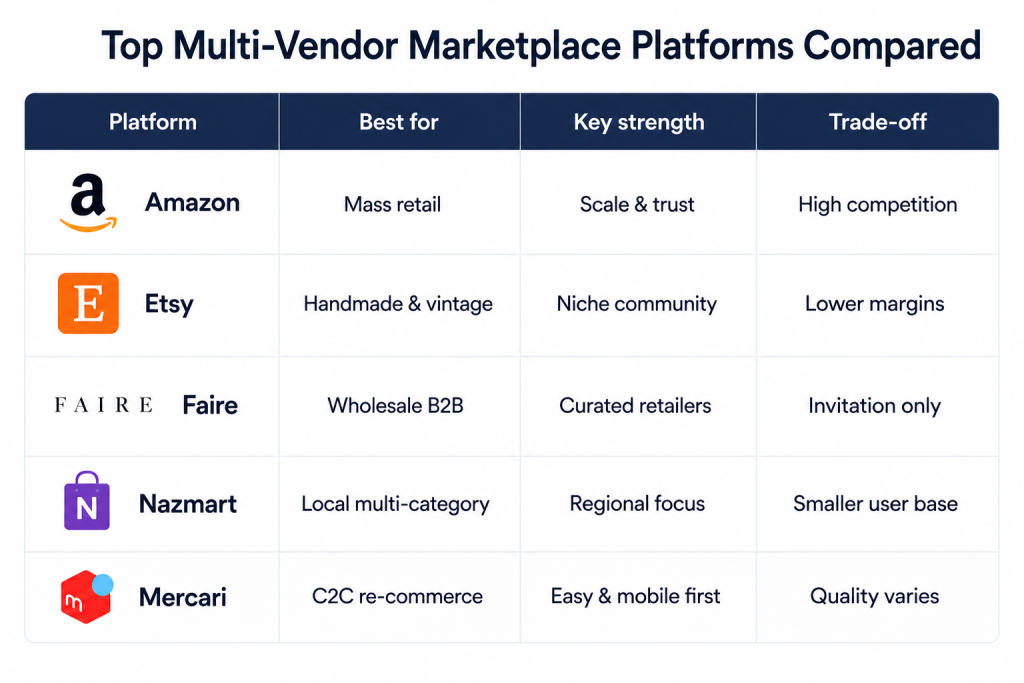
Five real multi-vendor platforms
Looking at real platforms is the best way to understand multi-vendor marketplace development trade-offs.
Amazon is the extreme end. Millions of third-party sellers, complex fulfilment options (FBA, FBM, SFP), elaborate dispute and performance systems, and decades of refinement on every piece. Nobody is building “an Amazon,” but Amazon is a useful reference for how the six steps look at full scale.
Etsy is the most studied small-marketplace case. Handmade and vintage focus, simpler vendor onboarding than Amazon, strong vendor storefronts, and a quality regime built around their handmade standards. Etsy’s public investor materials are unusually transparent about the metrics that matter in multi-vendor marketplace development: active sellers, gross merchandise sales, take rate, and seller services revenue.
Faire is the B2B angle. Wholesale marketplace connecting retailers to independent makers. Different cart logic (large basket sizes, payment terms, reorder flows), different KYC (business verification rather than consumer), and a take rate model tied to repeat orders rather than first-time sales.
Nazmart is our white-label multi-vendor solution at Xgenious, built for founders who want to launch a marketplace quickly without engineering the six steps from scratch. It handles vendor onboarding, storefronts, unified cart, split payments, and order routing out of the box, with customisation available for category-specific rules. It is the right choice when the goal is to prove the marketplace thesis before committing to a fully custom build. You can see Nazmart’s product page for what comes configured and what is customisable.
Mercari is the peer-to-peer case. Individuals selling to individuals (mostly second-hand goods), very light KYC, automated shipping label generation, and a buyer-protection model that handles the trust gap that comes with individual sellers. Different from a vendor marketplace, but useful as a reference for low-friction onboarding.
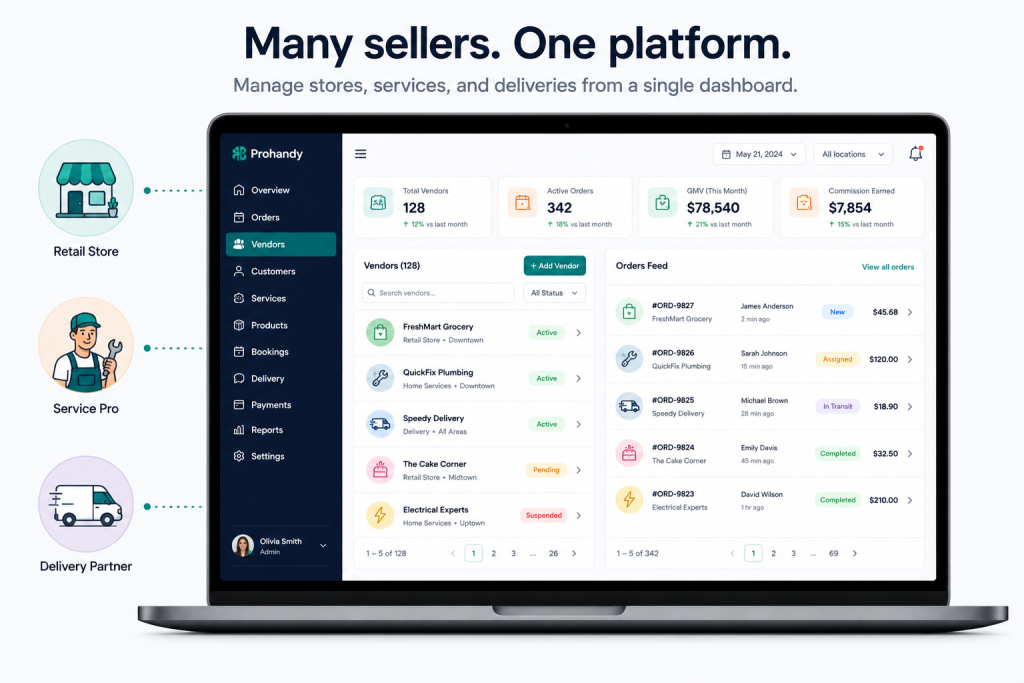
If your build is closer to Prohandy’s on-demand services pattern than to a goods marketplace, look at Prohandy instead. The six steps still apply, but service marketplaces have different routing and inventory shapes than goods marketplaces.
Common multi-vendor marketplace development mistakes
A few patterns show up so often in multi-vendor marketplace development that they are worth calling out explicitly.
The first is launching with the wrong number of vendors. Too few and the marketplace looks empty. Too many and quality control breaks before the systems can keep up. The sweet spot for soft launch is usually 20 to 50 carefully chosen vendors, enough to test the routing and payments under real conditions without overwhelming the manual processes still in place.
The second is treating the buyer side and the seller side as separate products with separate priorities. They are one product with two surfaces. A buyer-side decision (like adding a return window) creates a seller-side obligation (handling returns). A seller-side decision (like allowing custom shipping rules) creates a buyer-side complexity (showing combined shipping accurately). Multi-vendor marketplace development that does not hold both sides in mind at every decision ends up with mismatched experiences.
The third is underestimating fraud and abuse. Open marketplaces attract fraudulent vendors, fake reviews, return fraud, and chargeback fraud. None of this destroys a small platform. All of it scales faster than the platform does once volume picks up. Build the abuse-detection scaffolding in step six even when there is nothing to detect yet, because retrofitting it under attack is much harder than building it during a quiet period.
The fourth is custom-building the payments stack when a processor would have handled it. I have lost track of how many founders set out to build their own payout routing because they thought Stripe Connect’s take was too high, then discovered six months in that the regulatory and operational overhead they took on was worth far more than the saving. Use the processor unless you genuinely have a reason not to. Multi-vendor marketplace development is hard enough without inventing a payments business inside it.
The fifth is delaying mobile too long, or building mobile too early. Web-first is correct for most categories because it lets you test the model cheaply. But once liquidity is real, a mobile-first vendor experience and a mobile-first buyer experience both lift activity, and delaying that move past the eighteen-month mark is usually a mistake.
A final word
Multi-vendor marketplace development is one of the most rewarding software categories to ship and one of the easiest to get wrong. The six steps in the Multi-Vendor Build Sequence (vendor onboarding and KYC, per-vendor storefronts, unified cart, split payments, order routing, and quality management) are the order that survives contact with real vendors and real buyers. Build them in any other order and the project usually finds a way to fail expensively.
At Xgenious we have built marketplaces across goods, services, and B2B wholesale. The common pattern is that the founders who succeed treat multi-vendor marketplace development as infrastructure rather than as a product. They invest in the boring pieces (onboarding, payments, routing) first, leave the flashy pieces (recommendation engines, AI matching, loyalty programs) for after liquidity is proven, and accept that the first year is mostly about removing friction for both sides.
If you want a fast path to a working platform, Nazmart has the six steps configured out of the box and is the cheapest realistic way to test a multi-vendor thesis. If you want a fully custom build with workflows the SaaS platforms cannot handle, the on-demand service marketplace development approach is what we use. Either way, start with the sequence. The sequence is what saves the project from itself.
Frequently asked questions about multi-vendor marketplace development
What is multi-vendor marketplace development, in one sentence?
Multi-vendor marketplace development is the work of building a platform where many independent sellers list their own products or services on the same site, buyers can purchase from one or several in a single transaction, and the platform handles payment routing, order coordination, and trust on top.
How long does multi-vendor marketplace development take?
Realistic mid-complexity multi-vendor marketplace development takes 12 to 24 weeks for a usable MVP, depending on category, geographic footprint, and whether native mobile apps are in scope. White-label solutions can launch in days. Enterprise marketplaces with custom payments and logistics can take a year or more.
How much does multi-vendor marketplace development cost?
A configured white-label platform sits around $15,000 to $40,000. A custom MVP runs $50,000 to $120,000. A multi-category custom marketplace with mobile apps usually lands in the $150,000 to $400,000 range, and enterprise-level builds run higher. The biggest cost drivers are payment complexity and geographic footprint, not feature count.
What is the easiest way to handle split payments?
Use Stripe Connect, Adyen for Platforms, or Mangopay. These processors handle the regulated piece of multi-vendor marketplace development (taking money on behalf of vendors and paying them out) and protect the platform from operating as an unlicensed payment facilitator. Stripe Connect is the most common starting point because the developer experience and documentation are the strongest.
Should I build a custom multi-vendor marketplace or use a SaaS platform?
Use SaaS if your model is close to a standard pattern (products with vendors, light customisation) and you want to prove the marketplace thesis quickly. Build custom if your model has unusual routing, regulated workflows, or category-specific features that no SaaS will support well. Many founders start with SaaS, validate, and migrate to custom once the economics justify it. Both routes are valid.
Which legal structures matter most for multi-vendor marketplace development?
The big ones are terms of service for both sides, vendor agreements, privacy policy that handles vendor and buyer data separately, payment-facilitator registration where required, and tax-collection logic per jurisdiction. Get a lawyer who has worked on marketplaces specifically, not a general commercial lawyer. The patterns are unusual enough that experience matters.
How do I attract the first vendors to a new marketplace?
The first vendors are almost always recruited directly, not acquired through marketing. Reach out personally, offer a launch deal (reduced commission for the first six or twelve months), and pick vendors whose existing customer base you can plausibly bring some of onto the platform. Multi-vendor marketplace development is easier than vendor acquisition. Plan the cold-start strategy before you plan the build.