




Portfolio management systems freelancer platforms use to showcase work are the single most important conversion layer in any marketplace. When a client visits your platform, they scan portfolios first, not bios. Within three seconds, a hiring decision begins to form based on the visual quality, context, and credibility signals embedded in a freelancer’s work showcase. For platform operators and marketplace developers, this single behavioral truth carries a critical implication: the quality of your portfolio management systems for freelancer platforms is inseparable from the commercial success of your marketplace.
So what exactly are portfolio management systems for freelancer platforms? They are the integrated set of tools, architecture layers, and UX workflows that allow freelancers to upload, organize, present, verify, and optimize their work samples, while giving clients the structured view they need to make confident hiring decisions. They go far beyond a simple file upload gallery to encompass media processing, intelligent categorization, work authentication, social proof automation, SEO optimization, and performance analytics.
The global freelance economy is accelerating sharply. Platforms that invest in comprehensive portfolio management systems for freelancer platforms consistently outperform competitors across every meaningful metric, including freelancer retention, client conversion rate, average contract value, and gross marketplace volume. Yet most competitor articles on this topic cover only surface-level advice: “curate your best work,” “add testimonials,” “use analytics.” What is almost universally missing is the technical blueprint and strategic layer that platform builders actually need.
This guide fills that gap. Informed by a structured audit of the top-ranking competitor content, we cover ten topic areas that no competitor addresses, including AI-powered portfolio intelligence, mobile-first creation UX, third-party API integrations, legal compliance frameworks, collaborative agency portfolios, and portfolio monetization as a direct platform revenue strategy. For the foundational context of how portfolio systems integrate into marketplace architecture, explore our complete guide on freelancer hiring marketplace development.
This guide covers every feature that the best portfolio management systems freelancer platforms rely on to convert visitors into paying clients.
Table of Contents
Chapter 1: AI-Powered Portfolio Management Systems for Freelancer Platforms
Choosing the right portfolio management systems freelancer platforms use directly impacts your freelancer retention rate and client conversion speed.
Why AI Transforms Portfolio Management Systems on Freelancer Platforms
When a platform hosts ten thousand freelancers, manually curating or moderating portfolio quality is operationally impossible. AI-powered portfolio management systems for freelancer platforms automate what would otherwise require an army of content moderators, and they do so with greater consistency, speed, and commercial benefit for everyone involved.
The creative portfolio system of 2026 is no longer a passive gallery. It is an active, AI-driven engine that learns what converts and continuously optimizes each freelancer’s showcase to maximize client inquiries. Here is how leading platforms should implement each AI layer within their portfolio management systems:
| AI Feature | What It Does | Measurable Platform Benefit |
|---|---|---|
| Auto-Skill Tagging | NLP model reads project descriptions and auto-suggests relevant skill tags | Reduces tag errors by 70%; improves search precision |
| Portfolio Quality Score | Composite score: completeness + verification rate + recency + engagement metrics | Drives freelancer improvement behavior; powers search ranking |
| Image Quality Detection | Vision model flags low-resolution, blurry, or watermarked uploads automatically | Maintains platform quality bar without manual review team |
| Personalized Gap Prompts | AI compares profile against top earners in same category and highlights missing elements | Increases portfolio completeness rate by 35–50% |
| Client-Intent Matching | Matches portfolio content to active job post keywords in real-time | Increases organic proposal acceptance rate significantly |
| Duplicate Detection (pHash) | Perceptual hashing identifies visually similar images across multiple accounts | Eliminates portfolio plagiarism; protects original creators |
Every AI layer discussed above is now standard in leading portfolio management systems freelancer platforms depend on to maintain quality at scale.
The portfolio quality score deserves special attention as a design pattern for any portfolio management system on a freelancer platform. Rather than a simple completion percentage, a well-engineered quality score weights factors dynamically: a verified client testimonial carries more weight than a self-added skill tag; a project with high client engagement, long view time, and hire button clicks should outweigh a project with many views but zero conversion actions.
Implementation Note: Train the auto-tagging NLP model on your platform’s own job post data, not generic web data. Job posts reveal exactly which skill terms your client base uses to search — aligning portfolio tags to client search vocabulary directly increases discoverability within your freelancer showcase.
Chapter 2: Mobile-First Portfolio Management for Freelancer Platforms
Mobile-first design is no longer optional, the best portfolio management systems freelancer platforms offer today are built for smartphone creation, not just viewing.
Mobile-First Portfolio Systems Are Critical for Global Freelancer Platforms
In global freelance markets, particularly across Southeast Asia, Sub-Saharan Africa, Latin America, and the Middle East, the majority of freelancers access and manage their platforms exclusively via smartphone. A portfolio management system on a freelancer platform that treats mobile as a responsive version of desktop is not a genuine mobile strategy. Genuine mobile-first freelancer portfolio management requires purpose-built UX patterns for creation, not just consumption.
- Camera-Direct Upload: Allow freelancers to photograph and upload physical work (hand-drawn illustrations, print design, architectural models) directly from their device camera with automatic EXIF-strip and background removal preprocessing.
- Voice-to-Text Project Descriptions: Integrate speech-to-text transcription for project descriptions. Freelancers who struggle to type long descriptions on mobile keyboards dramatically increase portfolio completeness when they can speak their project context.
- Touch-Native Drag-and-Drop Reordering: Implement drag-and-drop portfolio item reordering using the Web Drag and Drop API with fallback to long-press gesture detection for iOS compatibility across all devices.
- Offline Draft Support: Allow freelancers to draft portfolio entries offline using IndexedDB or Service Worker caching, then auto-sync when connectivity returns. Critical for users in emerging markets on intermittent mobile data connections.
- Progressive Image Upload: Show progressive loading previews during upload so freelancers on slow connections can confirm the correct image was selected before the full upload completes — preventing repeated failed uploads.

Chapter 3: Third-Party API Integrations for Freelancer Portfolio Systems
Connecting Your Portfolio Management System to the Creative Ecosystem
Freelancers already maintain work across multiple platforms before joining your marketplace. Requiring them to re-upload everything manually creates a significant onboarding friction point that directly reduces portfolio completion rates. A sophisticated portfolio management system for freelancer platforms integrates with the ecosystems where creative work already lives, pulling verified work samples automatically.
| Platform | API Integration Type | Data Imported | Trust Signal Generated |
|---|---|---|---|
| Behance | OAuth 2.0 + Behance API v2 | Projects, images, descriptions, appreciations count | Imported from Behance — verified |
| Dribbble | OAuth 2.0 + Dribbble API | Shots, project links, like counts, followers | Imported from Dribbble — community-verified |
| GitHub | GitHub OAuth App + REST API | Repos, commit history, stars, language statistics | Code Verified — commit history visible |
| LinkedIn Sign In + Profile API | Work history, skills, recommendations | LinkedIn-verified experience | |
| YouTube / Vimeo | oEmbed API (no auth required) | Video embed, title, thumbnail, view count | Live embedded portfolio video |
| Figma | Figma REST API + file embed | Design files rendered as interactive previews | Live Figma design — interactive preview |
API integrations are what separate basic upload tools from powerful portfolio management systems freelancer platforms trust to reduce onboarding drop-off by up to 50%.
When implementing API imports in your freelancer platform portfolio system, display a clear data permission dialog before connecting any third-party account. Specify exactly what data will be imported and what will remain private. Platforms with one-click import from established portfolio platforms report 35–50% higher onboarding completion rates at the portfolio step compared to manual upload-only flows. For a complete technical checklist covering API integration planning, see our freelancer hiring marketplace development checklist.
Chapter 4: Legal Compliance in Portfolio Management Systems for Freelancer Platforms
Legal compliance is the most overlooked layer in portfolio management systems freelancer platforms build, yet it is the one that carries the highest financial risk if ignored.
NDA, GDPR & Copyright Controls Every Portfolio Management System Needs
Portfolio management systems for freelancer platforms carry significant legal obligations that are entirely absent from competitor coverage. Platform operators who ignore the legal compliance layer expose themselves to GDPR enforcement action, copyright infringement claims, and breach-of-contract disputes between freelancers and their past clients. Here is the full compliance framework every platform must implement.
NDA & Confidentiality Controls in Your Freelancer Portfolio System
Many freelancers — particularly those who have worked for agencies, enterprise brands, or government clients — operate under non-disclosure agreements that restrict public display of certain work. The portfolio management system must provide granular confidentiality controls at the individual project level:
- Full Confidential Mode: Project hidden from client search and portfolio views. Freelancer can reference it in private proposals with a “Private Work Sample” notation.
- Anonymous Client Display: Work is visible but client name replaced with “Confidential Client in [Industry]” — allows showcasing work without identifying the specific client.
- Time-Delayed Visibility: Work initially confidential but automatically becomes publicly visible after a user-defined expiry date when the NDA period ends.
- NDA Acknowledgment Log: When a freelancer marks work as involving an NDA, log the declaration with a timestamp — a defensible audit trail if a past client disputes public display.
GDPR Compliance for Freelancer Platform Portfolio Data
| GDPR Requirement | Portfolio System Implementation | Risk if Not Implemented |
|---|---|---|
| Right to Erasure | Full portfolio data deletion within 30 days of account closure request | Up to 4% global annual turnover fine |
| Data Portability | Export all portfolio items as ZIP archive (images + JSON metadata) | Regulatory non-compliance flag |
| Consent for Client Data | Client email collected for verification must have explicit consent checkbox | Unauthorized data processing violation |
| Cookieless Analytics | Portfolio view analytics must use server-side cookieless tracking events | ePrivacy Directive violation across EU |
For comprehensive regional compliance requirements, see our guides on European freelancer marketplace EU regulations and American freelancer marketplace state regulations.
Chapter 5: Collaborative Agency Portfolio Features on Freelancer Platforms
Agency & Team Portfolios — The Missing Feature in Most Freelancer Platform Portfolio Systems
A significant and growing segment of every freelancer marketplace is not individual sole traders but small agencies, creative studios, and freelancer collectives who want to pitch as a team. Standard talent portfolio management systems are built entirely for the individual, leaving a profitable segment unserved. Platforms that implement collaborative portfolio features unlock a higher average contract value tier and differentiate from single-user-only competitors.
- Team Portfolio Accounts: Allow two or more platform-registered freelancers to link accounts into a “Studio” entity with a shared portfolio page, combined work history, and unified profile — while preserving individual profile pages as well.
- Per-Project Contributor Attribution: Each portfolio item supports multiple contributor tags. On the project detail page, each contributor’s name links to their individual profile — giving studios full transparency while rewarding all participants.
- Role-Based Portfolio Editing: Studio owners can add, edit, or archive portfolio items. Team members can contribute their own work but cannot delete others’ contributions without owner approval — preventing accidental data loss.
- Agency Credentialing Badge: Verified studios with three or more active members and a combined completion rate above 90% earn an “Agency Verified” badge displayed on the studio portfolio.
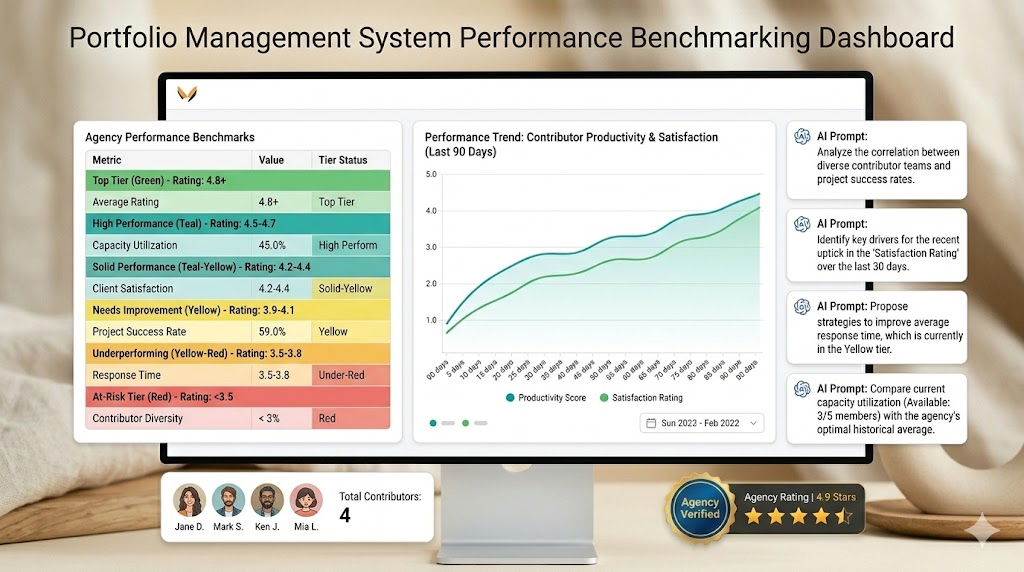
- Capacity Display: Agency portfolios display a current availability indicator — e.g., “3 of 5 team members available” — to help enterprise clients assess bandwidth before reaching out for project scoping.

Chapter 6: Portfolio Version Control in Freelancer Platform Systems
How Version Control Strengthens Freelancer Portfolio Management
A senior developer’s portfolio from two years ago might show React 16 projects. Today they specialize in Next.js and TypeScript. A graphic designer’s aesthetic may have evolved from flat illustration to 3D rendering. Portfolios change constantly, but most portfolio management systems for freelancer platforms treat them as static collections with no memory of what came before. Version control changes this entirely.
Portfolio version control allows freelancers and platforms to track work showcase evolution over time — benefiting the freelancer who can demonstrate professional growth, the client who can verify how recent the skills are, and the platform which gains longitudinal data for its portfolio quality algorithm.
- Snapshot Archive: Each time a freelancer publishes a significant portfolio update — adding 2 or more items or changing featured projects — the system creates a dated snapshot accessible via “Portfolio History” in the dashboard.
- Project Evolution Timeline: Within each portfolio project card, allow freelancers to attach dated “Update Notes” entries such as “Redesigned UI in Q2 2024 based on client feedback.” This demonstrates iterative growth to evaluating clients.
- Skill Progression Graph: Generate an automatically computed graph showing how a freelancer’s skill composition has shifted over 12–24 months based on project tags. Display this as a “Professional Evolution” section on the public portfolio.
- Rollback Capability: If a portfolio update reduces engagement metrics significantly over a 14-day window, alert the freelancer with a one-click option to restore the previous version — protecting conversion rates during experimentation.
Chapter 7: Portfolio Monetization Strategy for Freelancer Platform Operators
Turning Freelancer Portfolio Management Systems Into Revenue Streams
Most platforms treat their portfolio management system as a cost center — a feature that must be built to attract freelancers but generates no direct revenue. This is a strategic error. A well-designed creative work management system can generate meaningful incremental revenue through tiered feature access, portfolio promotion products, and data-driven upsell triggers timed to peak-intent moments in the freelancer journey.
The revenue models below are proven across portfolio management systems freelancer platforms have scaled to 100,000+ users successfully.
| Revenue Model | Feature Gated | Price Signal | Conversion Trigger |
|---|---|---|---|
| Portfolio Pro Plan | Custom domain, branded portfolio URL, unlimited portfolio items | $9–15/month | Free tier storage quota warning at 80% |
| Spotlight Promotion | Portfolio featured in category search top-3 for 7 days | $19–29 per boost | Triggered when portfolio views drop 20%+ week-over-week |
| Verification Rush | Priority client verification processing within 24 hours | $5 per item | Shown when client verification request is first submitted |
| Agency Portfolio Tier | Studio accounts with team collaboration and agency badge | $29–49/month | Offered when a second team member joins the platform |
| Analytics Pro | Visitor heatmaps, conversion funnels, competitor benchmarking | Bundled with Pro | Shown after freelancer reaches 500 total portfolio views |
The key to effective monetization of your freelancer platform portfolio system is timing upsell triggers precisely. A freelancer who just received their first client inquiry is in the highest-intent state to upgrade. A freelancer who has received no inquiry in 30 days and sees a “3× more inquiries with Portfolio Pro” message is primed for the “solve my problem” conversion moment. Use portfolio analytics data to trigger the right offer at the right time for each user state.
For how monetization layers connect to payment infrastructure, see our guide on escrow payment systems for freelancer platforms.
Chapter 8: Multilingual Portfolio Support for Global Freelancer Platforms
Building Portfolio Management Systems for a Global Freelance Workforce
A freelancer platform portfolio system operating in the Middle East, Southeast Asia, or Europe cannot treat English as the only language for portfolio content. Talent portfolio management for global platforms requires a multilingual architecture that serves both the freelancer — who wants to present work in their native language — and the client, who wants to evaluate talent in their own language context.
- Parallel Language Portfolio Entries: Allow freelancers to add the same portfolio project in multiple languages. A French designer can maintain English and French versions of the same project description — served automatically based on the viewing client’s platform language preference.
- RTL Layout Support: Portfolio templates must render correctly in Arabic, Hebrew, and Farsi. Use CSS logical properties such as margin-inline-start instead of margin-left to handle right-to-left text without duplicate template files.
- Auto-Translation with Freelancer Editing: Integrate a machine translation layer (Google Translate API or DeepL API) that auto-translates portfolio descriptions as a starting draft, then allows the freelancer to edit before publishing.
- Currency-Aware Project Value Display: When freelancers display project budget in their portfolio, convert amounts to the viewing client’s local currency using a real-time exchange rate API — reducing cognitive friction for international clients.
For regional business and cultural considerations affecting portfolio norms, see our guide on Middle East freelancer marketplace cultural considerations.
Chapter 9: Client Portal Integration With Freelancer Portfolio Management Systems
Connecting the Portfolio System to the Client Hiring Journey
Most platforms treat the portfolio as a freelancer-side feature only. The client experience ends when they view the portfolio and click “Contact.” A deeply integrated client portal that extends portfolio management system data into the client’s hiring workflow creates a seamless path from portfolio discovery to project initiation — dramatically reducing time-to-hire across the platform.
- Portfolio Shortlist Tool: Clients can “Save to Shortlist” directly from any portfolio view. Their shortlist dashboard shows saved freelancers side-by-side with portfolio highlights, ratings, and availability status — eliminating the need to manage separate browser tabs during candidate comparison.
- Proposal-Attached Portfolio Sharing: When a freelancer submits a proposal, they can pin specific portfolio items relevant to that brief rather than linking their full portfolio — ensuring the most relevant work samples are always front and center.
- Client View Analytics for Freelancers: Notify freelancers when an identified logged-in client views their portfolio for more than 60 seconds: “A client from [Industry] spent 4 minutes on your portfolio today.” This high-intent signal enables proactive follow-up.
- Portfolio-Linked Contract Initiation: The “Hire Me” button on a portfolio pre-populates a contract draft with the freelancer’s displayed rates, availability, and skill tags — reducing the friction between portfolio impression and contract signed to minutes.
To understand how time-tracking data complements the client portal workflow, see our guide on time tracking for freelancers marketplace.
Chapter 10: Performance Benchmarks for Portfolio Management Systems on Freelancer Platforms
What Good Performance Looks Like in a Freelancer Platform Portfolio System
Analytics without context are merely numbers. Platform operators running portfolio management systems for freelancer platforms need industry benchmarks to understand whether their system is performing at market standard, and freelancers need category-specific benchmarks to compare themselves against top earners in their segment.
| Portfolio Metric | Underperforming | Average | Strong | Top 10% |
|---|---|---|---|---|
| Portfolio Items (count) | 1–3 | 4–7 | 8–14 | 15+ |
| Verified Items (%) | <20% | 20–50% | 51–75% | >75% |
| Testimonials (count) | 0–1 | 2–4 | 5–9 | 10+ |
| Portfolio CTR (hire/contact) | <1% | 1–3% | 3–6% | >6% |
| Avg. Time on Portfolio | <45 sec | 45–120 sec | 2–4 min | >4 min |
| Days Since Last Update | >180 days | 90–180 days | 30–90 days | <30 days |
Share these benchmarks with your freelancers inside the portfolio management system analytics dashboard. When a freelancer sees their “Verified Items: 18%” highlighted alongside the benchmark of “>75% for Top 10%”, the motivation to seek more verifications is immediate and data-backed. Benchmark transparency transforms your analytics from a passive observation tool into an active growth coaching engine for every freelancer on the platform.
At the platform operator level, aggregate these metrics monthly and segment by freelancer category, geographic region, and account tier. If your top-earning freelancer segment has a portfolio CTR of 7.2% but your mid-tier has 1.4%, the gap reveals exactly where to focus your next freelancer portfolio feature investment, whether a testimonial nudge campaign, a verification drive, or a featured content refresh program.

Conclusion: Building Portfolio Management Systems That Outperform on Freelancer Platforms
Portfolio management systems freelancer platforms invest in are not a cost center, they are the primary trust layer that drives every hire, every contract, and every dollar of marketplace revenue. Competitors cover the fundamentals, upload your work, add testimonials, check analytics. What this guide delivers, and what no competitor has yet published, is the complete system picture: from AI-powered quality scoring and mobile-first creation UX to legal compliance frameworks, collaborative agency portfolios, third-party API integrations, and portfolio monetization built directly into the platform revenue model.
The ten content gaps filled in this guide represent ten competitive advantages for any platform operator willing to implement them. Each feature addressed, multilingual support, version control, client portal integration, performance benchmarking, and AI scoring, is something your freelancers need, your clients expect, and your competitors have not yet built. Every well-designed portfolio management system on a freelancer platform creates a compounding advantage: better portfolios attract better freelancers, who attract higher-value clients, who generate larger contracts, which increase platform commission revenue.
The commercial logic is clear. A better portfolio management system for your freelancer platform is not a feature expense; it is a revenue investment. Build it accordingly, and build it to the standard this guide defines. Accelerate your complete marketplace build using the freelancer hiring marketplace development checklist a comprehensive framework covering every platform component from portfolio to payments.
Frequently Asked Questions About Portfolio Management Systems for Freelancer Platforms
Q1: What makes portfolio management systems for freelancer platforms different from a basic file gallery?
A basic file gallery stores and displays files. Portfolio management systems for freelancer platforms are integrated platform layers combining media storage, intelligent categorization, responsive presentation templates, AI-powered quality scoring, work verification workflows, social proof collection, SEO optimization per portfolio page, client-side integration, and performance analytics. A well-engineered portfolio management system can increase client inquiry rates by 40–60% over a basic upload gallery with identical underlying work quality.
Q2: How should platforms implement AI-powered portfolio quality scoring in their portfolio management system?
A portfolio quality score within your portfolio management system for freelancer platforms should be a composite metric weighted across completeness (number of portfolio items), authenticity (percentage verified), recency (date of last upload), social proof (testimonial count and sentiment), conversion data (time spent and hire button clicks), and discoverability (skill tag diversity). Weight these dynamically — verified testimonials should carry more weight than self-added skill tags. Train the model on your specific platform’s outcome data: which portfolio characteristics correlate with actual successful client hires on your marketplace.
Q3: What legal compliance requirements must portfolio management systems for freelancer platforms include?
The three critical compliance domains for any portfolio management system on a freelancer platform are: NDA and confidentiality controls (per-project visibility toggles, anonymous client display, time-delayed visibility), GDPR and data privacy compliance (right to erasure within 30 days, data portability via ZIP export, explicit consent for client email collection, cookieless analytics), and copyright attribution controls allowing freelancers to tag work as collaborative, client-owned, or open-source. Platforms serving European users must additionally implement ePrivacy Directive compliance for portfolio page tracking.
Q4: How do third-party API integrations improve portfolio management systems on freelancer platforms?
Third-party API integrations in portfolio management systems for freelancer platforms directly address the most common freelancer onboarding drop-off point: the portfolio upload step. Freelancers who already have substantial Behance, Dribbble, or GitHub presence frequently abandon onboarding flows requiring manual re-uploading. Platforms with one-click import report 35–50% higher onboarding completion rates at the portfolio step. Imported content also triggers the platform’s verification system automatically when linked to a live, publicly accessible external source.
Q5: What portfolio features should be gated behind paid plans to monetize portfolio management systems on freelancer platforms?
Effective monetization of portfolio management systems for freelancer platforms uses a freemium model. The free tier provides strong core functionality — 10 to 15 portfolio items, standard templates, platform URL. Premium tiers unlock: custom branded portfolio domain, unlimited portfolio items, agency and team collaboration accounts, spotlight search promotion, priority verification processing, advanced analytics with heatmaps and conversion funnels, and version history with rollback capability. Price tiers $9–49/month and trigger upsell prompts using behavioral signals such as storage quota warnings, engagement drops, or the moment after a freelancer’s first successful client inquiry.
Q6: How should multilingual support be implemented in portfolio management systems for global freelancer platforms?
Store portfolio content in a language-keyed data structure where each portfolio item record contains a translations object with language codes as keys (en, fr, ar, de, etc.) and localized content as values. The API of your portfolio management system for freelancer platforms returns content in the requesting user’s platform language preference, falling back to the creator’s primary language if no translation exists. Implement RTL layout support using CSS logical properties (margin-inline-start instead of margin-left) to ensure Arabic, Hebrew, and Farsi content renders correctly without duplicate template files.
Q7: What performance benchmarks should operators track in their freelancer platform portfolio management system?
Key platform-level health metrics for portfolio management systems for freelancer platforms include: average portfolio completion rate across all active freelancers (target above 70% with 5+ items), percentage of portfolio items with at least one verification signal (target above 50%), average portfolio-to-hire conversion rate by category (3–6% CTR is a strong target), portfolio update frequency (target: above 60% of top-performing freelancers update within 90 days), and testimonial collection conversion rate from post-project prompts (target: above 25% of completed projects generating a testimonial). Track monthly and segment by freelancer tier, category, and geography.
Q8: How do portfolio management systems on freelancer platforms contribute to organic SEO at scale?
At scale, every portfolio project page in your portfolio management system for freelancer platforms becomes an independently indexable web page. With unique title tags, descriptive meta descriptions, skill-based keywords, and JSON-LD CreativeWork schema markup, portfolio management systems for freelancer platforms generate portfolio pages that rank in Google for long-tail searches such as “freelance motion designer Dubai portfolio” or “Python developer open source GitHub portfolio.” A platform with 100,000 active freelancers averaging 8 portfolio items possesses 800,000 potential indexed pages. This organic SEO footprint dramatically reduces paid client acquisition costs and compounds as the platform grows.