



By Sharifur Rahman, Founder & CEO, Xgenious. Updated 25 November 2026.
Multi-vendor and multi-tenant ecommerce sound alike, and buyers mix them up all the time, but they are different businesses. A multi-vendor marketplace is one store with many sellers, like Amazon or Etsy, and it earns commission on each sale. A multi-tenant platform is many separate stores on one system, like Shopify, and it earns a subscription from each store. Choose the model first. The software follows from it.
The difference in one table
| Multi-vendor marketplace | Multi-tenant ecommerce platform | Multi-store | |
|---|---|---|---|
| What the shopper sees | One website, one cart, products from many sellers | Many independent websites, each with its own brand and domain | Several storefronts from one business |
| Who owns the customer | The marketplace | Each store owner | The business |
| How you earn | Commission per order, listing fees, seller plans | Monthly or yearly plans per store, setup fees, add-ons | Product sales |
| Checkout | Shared cart, split payments to vendors | Each store has its own checkout and gateways | Shared or separate |
| Data | One database, vendor ID on records | Usually separated per store (separate database or tenant ID) | One database |
| Your hardest job | Getting buyers and sellers at the same time | Getting store owners to sign up and stay | Running inventory across channels |
| Examples | Amazon, Etsy, Daraz | Shopify, BigCommerce, Wix stores | A brand with country stores |
| Xgenious script | SafeCart | Nazmart | A single-store script |
What a multi-vendor marketplace is
In a multi-vendor marketplace, independent sellers list products in your catalogue. Shoppers browse one site, add items from several sellers to one cart and pay once. You split the payment, keep a commission and route each order line to the right seller. Shopify’s own guide to multi-vendor ecommerce platforms describes the same model.
The hard part is not software. It is liquidity: buyers come only when there are enough sellers, and sellers come only when there are buyers. Our guide to multi-vendor marketplace development walks through vendor onboarding, split payments and order routing, and the two-sided marketplace business model post covers the chicken-and-egg problem.
What a multi-tenant ecommerce platform is
In a multi-tenant platform, each customer gets their own complete store: products, orders, customers, theme, domain and payment gateways. Shoppers on one store never see another. You sell the software, not the products, and charge each store a plan. The term comes from software architecture: one application serves many tenants whose data is kept apart, as described in Microsoft’s tenancy model guidance.
You do not need buyers and sellers at the same time. You need store owners, one at a time, which is why many agencies and local tech firms start here. Shopify is the proof that the model scales: in 2025 it earned $2.75 billion in subscription revenue and $8.80 billion from merchant solutions such as payments (Shopify 10-K).
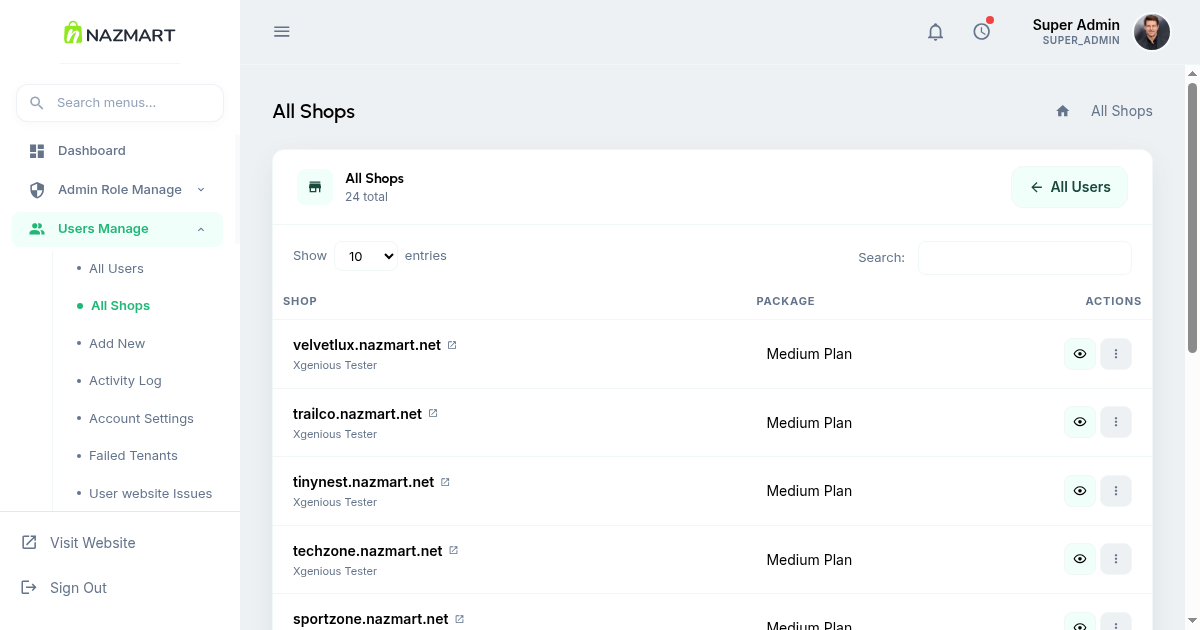
Examples of multi-tenant platforms built on Nazmart: Shopyzee (Saudi Arabia and the Gulf), Obikol (Bangladesh) and Flippinex (Italian-language). Each one sells complete stores to merchants on subscription plans.
And multi-store?
Multi-store means one business running several storefronts, for example one per country or brand, from one admin. There is one owner and one set of customers. It is a feature of a store, not a business model. If that is what you need, a single-store ecommerce PHP script with multi-store support is enough.
Revenue model: commission vs subscription
A marketplace earns a percentage of gross sales, so revenue tracks how much your sellers sell. It can grow fast once liquidity arrives, but it is close to zero until then. A multi-tenant platform earns a fixed fee per store, so revenue is predictable from month one and grows with the number of stores, not their sales. Many platforms add a second line later: payment processing, apps, themes, domains or a small transaction fee, the way Shopify does.
A simple illustration (example numbers, not a forecast): 200 stores on a $20 plan bring $4,000 a month in recurring revenue regardless of their sales. A marketplace taking 10% would need $40,000 of monthly sales across all sellers to match it. You can model your own numbers with the ecommerce SaaS revenue calculator.
Architecture and cost differences
- Data: a marketplace keeps everything in one database with a vendor ID on products and orders. A multi-tenant platform separates each store, either with its own database (Nazmart does this) or with a tenant ID on every table. Our multi-tenant SaaS architecture guide compares the options.
- Payments: marketplaces need split payments and vendor payouts, which brings KYC and, in many countries, money-transmission rules. Multi-tenant stores each connect their own gateway, so the money never passes through you.
- Domains: marketplaces run on one domain. Multi-tenant platforms need wildcard subdomains, custom domains and SSL for every store.
- Support: marketplace support is about disputes between buyers and sellers. Platform support is about store setup, themes and domains.
Which model fits your business?
- You want to own a destination where shoppers come to buy from many sellers in a niche: multi-vendor marketplace.
- You want to sell online stores to businesses, for example as an agency, a hosting company or a local Shopify alternative: multi-tenant platform.
- You run one business with several storefronts: multi-store.
If you are torn, ask who owns the customer. If you want the shopper relationship, build a marketplace. If you want the store owner relationship, build a multi-tenant platform. Our SaaS vs marketplace comparison goes further into the economics.
Can one platform do both?
Yes, but it is usually a later step. Some multi-tenant platforms let a store host its own sellers, and some marketplaces sell storefronts to big vendors. Start with the model that matches your first 50 customers and add the other later. Picking a script that does both on day one usually means paying for complexity you do not use.
Next steps
For a marketplace, compare the multi-vendor options in our best ecommerce scripts roundup or start with SafeCart. For a Shopify-style platform, read the best multi-tenant ecommerce SaaS scripts list and our step-by-step guide on how to start an ecommerce SaaS business.
Frequently asked questions
What is the difference between multi-vendor and multi-tenant ecommerce?
Multi-vendor is one store with many sellers sharing a cart, and you earn commission. Multi-tenant is many separate stores on one platform, each paying you a subscription.
Is Shopify multi-vendor or multi-tenant?
Shopify is multi-tenant. Each merchant runs an independent store on Shopify’s shared platform. Amazon and Etsy are multi-vendor marketplaces.
Which is more profitable, a marketplace or a multi-tenant platform?
It depends on scale. A multi-tenant platform earns predictable subscription revenue from the first store. A marketplace can earn more per customer once it has enough buyers and sellers, but earns little before that.
Is multi-store the same as multi-tenant?
No. Multi-store is one business running several storefronts. Multi-tenant is many different businesses, each with its own store, on one platform.
Which Xgenious script should I use?
SafeCart for a multi-vendor marketplace and Nazmart for a multi-tenant, Shopify-style platform.