

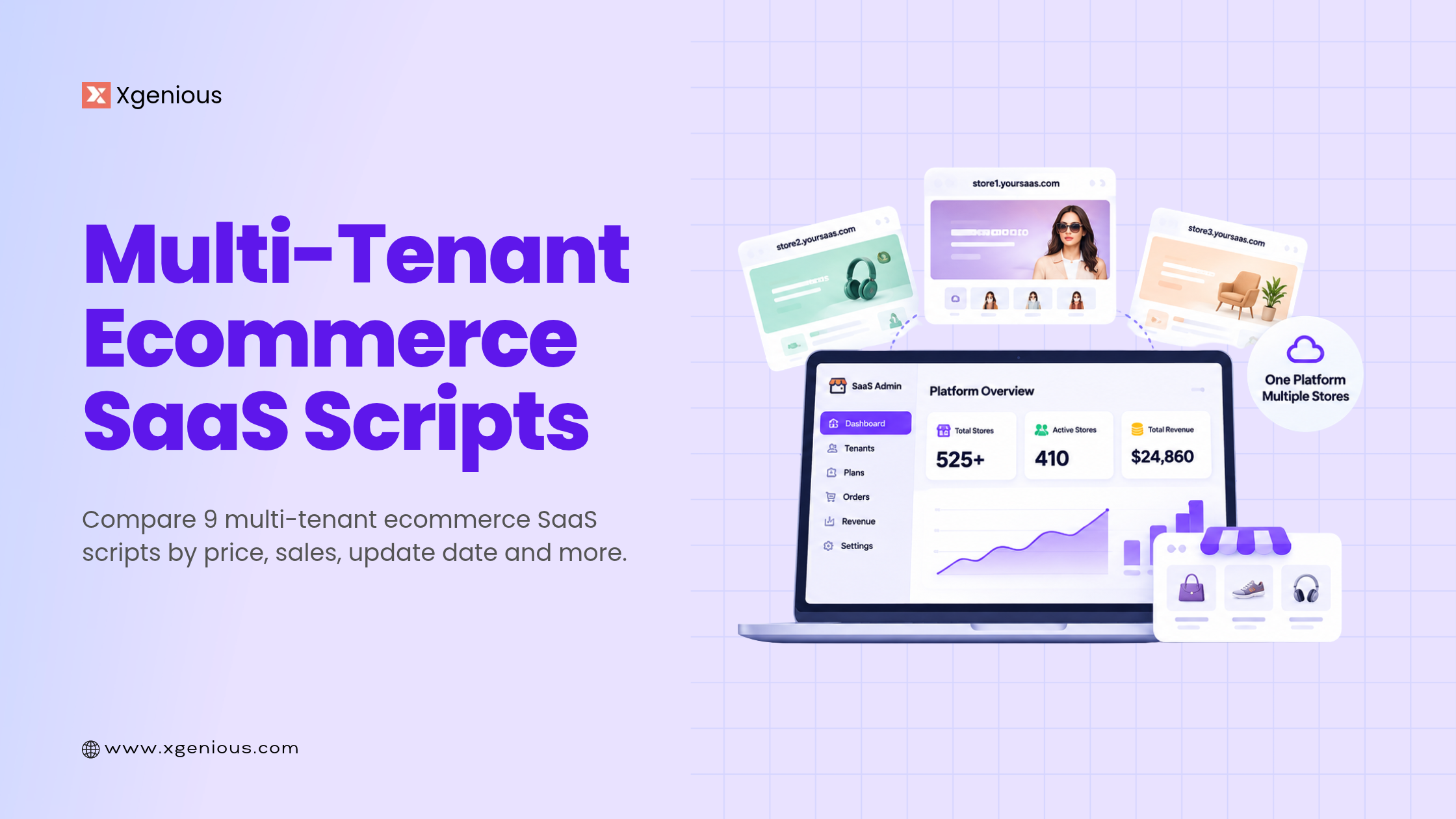


A multi-tenant ecommerce SaaS script lets you run your own Shopify-style business: one installation, many separate stores, each paying you a monthly plan. The script you pick determines how your tenants’ data stays separate, what you can legally charge for, and how much you will have to build yourself.
This list compares the nine options a buyer realistically finds in 2026, from $14 CodeCanyon items to enterprise modules.
Quick answer
For most founders who want to sell stores on subscription and launch this month, Nazmart is the most complete ready-made option: a separate database per store, subdomains and custom domains, subscription plans, and a $99 Everything Bundle (the entry licence for charging tenants) that adds POS, a Flutter mobile app and 17 premium plugins. If you need a REST API to plug the platform into other software, look at Botble Ecommerce SaaS. If you have a development team and want open source, start from Bagisto’s multi-tenant module.
At a glance: 9 multi-tenant ecommerce options compared
| Product | Type | Price | CodeCanyon sales | Last update | Tenant data | Best for |
|---|---|---|---|---|---|---|
| Nazmart | Ready-made script (Laravel) | $99 Everything Bundle to charge tenants ($69 core only) | 534 | 8 Oct 2026 | Database per store | Selling stores on subscription, fast |
| Botble Ecommerce SaaS | Ready-made script (Laravel) | $69 launch, then $99–$179 | 11 | 15 Nov 2026 | Database per store | API-first operators |
| eCommerce CMS SaaS (WorkDo) | Ready-made script (Laravel) | $89 | 632 | 5 Nov 2026 | Multi-store SaaS | Theme-heavy store builders |
| TLCommerce SaaS | Ready-made script (Laravel + Vue) | $99 | 53 | 29 May 2025 | Database per store | Shared hosting budgets |
| DOKANS | Ready-made script (Laravel) | $69 | 1.2K | 1 Mar 2023 | Multi-tenant | Not recommended (no updates since 2023) |
| MightyEcom | Ready-made script (PHP + Flutter) | $14 | 7 | 15 Apr 2026 | Multi-tenant | Low-budget experiments |
| Bagisto Multi-Tenant | Paid module on open-source Laravel | Quote | n/a | Active | Single or multiple databases | Dev teams who want open source |
| Spree Enterprise (multi-tenant) | Enterprise edition (Ruby on Rails) | Contact sales | n/a | Active | Per-store scoping | Funded B2B and white-label programs |
| Shopify (for reference) | Hosted SaaS you rent | $29–$299/month per store | n/a | n/a | Shopify’s | Merchants, not platform owners |
Prices are the listing price for a Regular License unless stated. A Regular License usually does not allow charging tenants, so check each vendor’s licence before comparing prices. Shopify prices are the annual-billing figures shown on shopify.com/pricing.
What multi-tenant ecommerce actually means
Multi-tenant ecommerce is one software installation that serves many independent stores. Each store, the tenant, has its own products, orders, customers, theme and domain. You, the platform owner, control the plans, billing and updates for all of them from one admin panel. Shopify is the best-known example. A multi-tenant script lets you run the same model on your own server, under your own brand.
It is easy to confuse with two other models. A multi-vendor marketplace (Amazon, Etsy) is one store with many sellers sharing one cart, and you earn commission. A multi-store setup is one business running several storefronts it owns. If you are unsure which one you are building, read our multi-vendor vs multi-tenant ecommerce explainer first, because picking the wrong model is the costliest mistake in this category.
How to evaluate a multi-tenant ecommerce script
I have watched hundreds of buyers set up Nazmart since 2022. These are the seven things that decide whether a launch works.
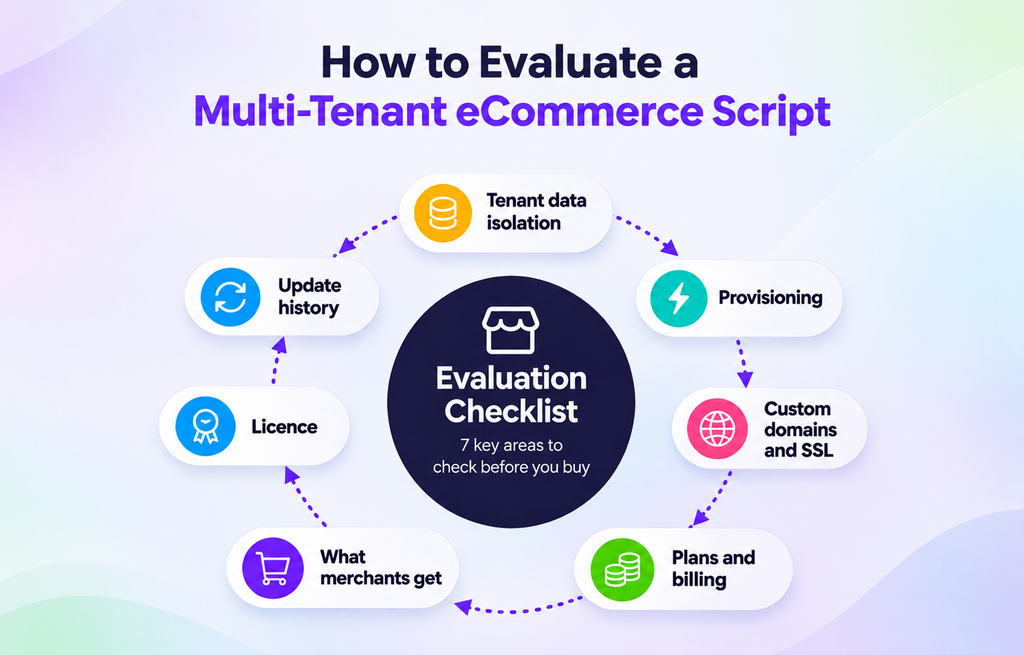
- Tenant data isolation. A separate database per store is the safest default for a script: one store’s bug or data export cannot touch another’s. Shared tables with a tenant ID column scale further on one server but put isolation in your code. Microsoft’s tenancy model guidance explains the trade-off well. Our multi-tenant SaaS architecture guide goes deeper.
- Provisioning. A new store should be created automatically after signup and payment, with a subdomain, a starter theme and demo content. Manual setup per tenant does not scale past a few dozen stores.
- Custom domains and SSL. Merchants will ask for their own domain in week one. Check how the script verifies domains and issues certificates.
- Plans and billing. You need trials, renewals, reminders, upgrades and limits per plan (products, staff, themes, modules). Check which payment gateways can collect your subscription fees, not only the stores’ checkout fees.
- What merchants get. Themes, a page builder, coupons, inventory, digital products, POS and a mobile app are what your tenants compare against Shopify. Every missing feature becomes a support ticket or a churned store.
- Licence. Envato’s rule is plain: if your users pay to use a SaaS built on an Envato item, you need an Extended License (Envato Help). Price your purchase with that in mind, or buy from the vendor’s own site if it sells a licence that covers charging tenants. For Nazmart, that is the Everything Bundle or the Exclusive licence; the $69 Regular licence does not cover it.
- Update history. A script that has not shipped an update in a year will fall behind on PHP, Laravel and payment-gateway changes. Check the changelog date before anything else.
The 9 best multi-tenant ecommerce SaaS scripts and platforms with full feature comparison
| Feature | Nazmart | Botble SaaS | TLCommerce SaaS | WorkDo SaaS |
|---|---|---|---|---|
| Database per store | Yes | Yes | Yes | Check listing |
| Subdomain + custom domain | Yes | Yes | Yes | Check listing |
| Licence needed to charge tenants | $99 Everything Bundle or $299 Exclusive | Extended License | Extended License | Check listing |
| Subscription plans | Yes, with trials | Yes | Yes (SaaS payments need Extended License) | Yes |
| Drag-and-drop page builder | Yes | No | Yes | Check listing |
| POS | Bundle | No (planned add-on) | No | Yes |
| Mobile app | Flutter (bundle) | No | No | Check listing |
| Platform REST API + webhooks | Webhooks | 38 endpoints, 27 events | No | Check listing |
| Shared hosting | Supported via tutorial; VPS recommended | No | Yes | Check listing |
| Last update | 8 Oct 2026 | 15 Nov 2026 | 29 May 2025 | 5 Nov 2026 |
1. Nazmart: the most complete ready-made platform
Nazmart is a Laravel multi-tenancy ecommerce platform we have built and sold since 2022. On CodeCanyon it has 534 sales and 43 ratings, and version 4.3.0 shipped on 8 October 2026 on Laravel 12 and PHP 8.3.
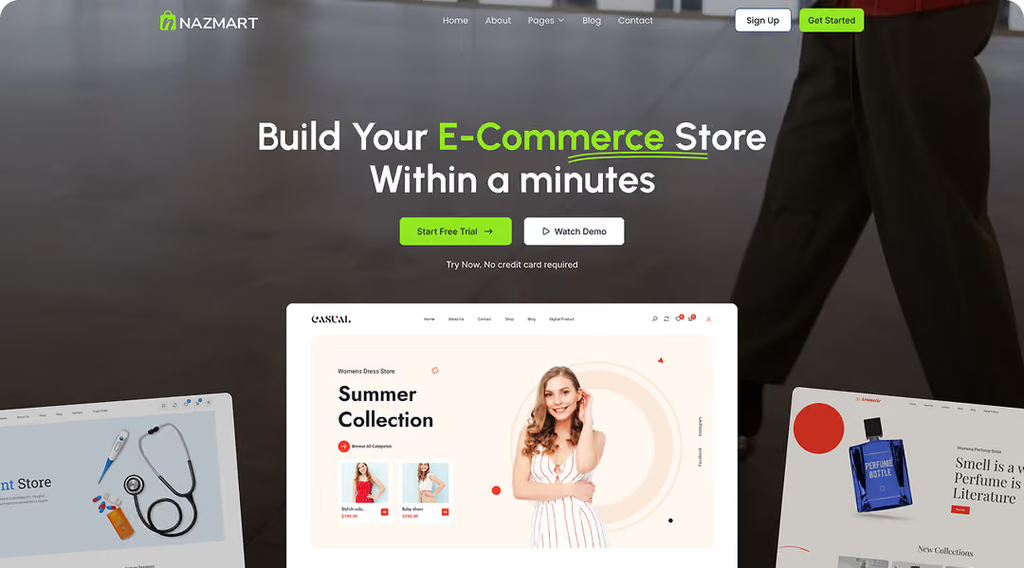
Each store gets its own database, an automatic subdomain and an optional custom domain. You build subscription plans that decide which themes, payment gateways and modules each store can use, with trials and renewal reminders. Store owners get a drag-and-drop page builder, inventory with variants and attributes, campaigns, coupons, tax rules, digital products and a wallet. The Everything Bundle adds a POS, a Flutter mobile app, a domain reseller and 17 premium plugins, including abandoned-cart recovery, affiliate, loyalty points, multi-currency, SMS and WhatsApp, Google Merchant feeds and WooCommerce import. Stores choose from 23+ themes. The landlord can set a commission from the admin panel; there is no automatic commission or payout feature.
- Price: $69 Regular (core web panel only; it does not let you charge tenants), $99 Everything Bundle (lets you charge tenants), $299 Exclusive (also lets you charge tenants, plus branding removal), on xgenious.com.
- Hosting: a VPS is recommended (wildcard subdomain, wildcard SSL, cron, MySQL user that can create databases). It installs on a root domain, not a subdomain.
- Watch out for: there is no public REST API for the platform layer, and database-per-store means backups and migrations run per store.
- Demo: nazmart.net (platform) and furniture.nazmart.net (a tenant store).
Nazmart already runs real store-builder businesses in several countries. A few platforms running on Nazmart today:
- Shopyzee: an Arabic and English store builder for Saudi Arabia and the Gulf, with Arabic themes, cash on delivery and bank transfer.
- Obikol: a Bangladeshi store builder with monthly plans in taka and a Play Store-ready Android app.
- Flippinex: an Italian-language platform that sets up and manages online stores for its customers, with plans in euros.
- Shopibuzz: an English-language store builder with plans priced in Indian rupees.
- GetMy.Shop: an English-language store builder for launching an online store in minutes, with 23+ themes, 20+ payment gateways and custom domains.
2. Botble Ecommerce SaaS: best for API-first operators
Botble’s Ecommerce SaaS launched in September 2026 and reached version 1.0.3 on 15 November 2026. It also runs a separate database per store, and it has the cleanest operator tooling in this list: a 38-endpoint REST API for the platform, 27 webhook events, and 43 languages. It ships one storefront theme with 20 presets.
Botble is honest about what is missing: no POS, no mobile app, no drag-and-drop page builder, no wallets, loyalty points, affiliate, SMS or WhatsApp, and no shared hosting. The price starts at $69 for the first 20 sales and steps up to $179. It has 11 sales so far, so expect early-version rough edges. We compare the two in detail in Nazmart vs Botble Ecommerce SaaS.
3. eCommerce CMS SaaS by WorkDo: best for theme variety
Formerly sold as eCommerceGo, this $89 Laravel script has the most sales in the category at 632, and was updated on 5 November 2026. It focuses on many ready-made store themes, white-label branding, POS and AI-written product content using your own OpenAI key. Its theme catalog is broad, so it suits founders targeting merchants who pick a look first.
4. TLCommerce SaaS: best for shared hosting
TLCommerce SaaS (Laravel with a Vue admin) costs $99 and has 53 sales. Its strengths are a page builder, plugin and theme systems, built-in backups, a one-click updater and support for shared hosting. Two warnings: the listing says the SaaS payment system and uncompiled Vue source are only available with the Extended License, and the last update was 29 May 2025. See Nazmart vs TLCommerce SaaS.
5. DOKANS: popular, but no longer maintained
DOKANS sold 1.2K copies at $69, which tells you how strong demand for this category is. Its last update was 1 March 2023. That is more than two and a half years without PHP, Laravel or gateway updates, so I would not start a new platform on it in 2026.
6. MightyEcom: cheapest entry ticket
At $14, MightyEcom combines a PHP panel with Flutter apps, a POS and inventory. It has 7 sales, so there is little public feedback yet. Treat it as a low-cost way to explore the model, not a platform to put paying customers on without testing.
7. Bagisto Multi-Tenant SaaS: best open-source base
Bagisto is an open-source Laravel ecommerce framework, and its paid multi-tenant module adds a super-admin panel, merchant panels and a choice of single or multiple databases. Bagisto lists case studies such as Ucraft (150+ registered stores) and Vyaparify (200+). You will need developers: it is a framework you extend, not a business in a box. Pricing is by quote.
8. Spree Commerce Enterprise: best for funded white-label programs
Spree is open-source Ruby on Rails commerce with a paid Enterprise edition whose multi-tenant module covers tenant provisioning, white-label theming and billing models. It is a strong fit for B2B networks and franchise programs with an engineering budget. Tenancy is handled by scoping stores inside the application rather than one database per store.
9. Shopify: the benchmark you are competing with

Shopify is not something you can install, but every merchant you pitch will compare you with it. Its plans run from $29 to $299 a month (annual billing), with an extra 2% to 0.6% fee if a merchant uses an outside payment gateway. In 2025 Shopify earned $2.75 billion from subscriptions and $8.80 billion from merchant solutions such as payments (Shopify 10-K). The gap you can fill is local: currencies, gateways, languages and support that Shopify serves poorly in your market.
Which one should you choose?
- You want to sell stores on subscription within weeks: Nazmart, on the Everything Bundle or Exclusive licence (the Regular licence does not let you charge tenants).
- Your platform must talk to other software through an API: Botble Ecommerce SaaS.
- Your merchants care most about choosing from many themes: WorkDo’s eCommerce CMS SaaS.
- You can only afford shared hosting: TLCommerce SaaS, accepting its slower update pace. Nazmart also offers a shared hosting tutorial.
- You have a dev team and want open source: Bagisto with its multi-tenant module.
- You are building for an enterprise or franchise network: Spree Enterprise.
Before you buy, estimate whether the business works. Our ecommerce SaaS revenue calculator models stores, plan prices, churn and hosting cost, and our guide to starting an ecommerce SaaS business covers niche, pricing and the first 50 stores. If you only need a single store, a regular ecommerce PHP script is cheaper and simpler.
Frequently asked questions
What is a multi-tenant ecommerce SaaS script?
It is software you install once on your server to host many independent online stores. Each store has its own products, orders, domain and design, and pays you a subscription. It is how you build a Shopify-style business without writing the platform yourself.
Does multi-tenancy require a separate database for each store?
No. Some platforms keep all stores in shared tables with a store ID. A separate database per store, used by Nazmart, Botble and TLCommerce, gives stronger isolation and simpler per-store exports, at the cost of running migrations and backups per store.
Which license do I need to charge stores a subscription?
Envato says an Extended License is required if users pay to use a SaaS built on an Envato Market item. For Nazmart, the $69 Regular licence does not let you charge tenants; you need the $99 Everything Bundle or the $299 Exclusive licence.
Can I run a multi-tenant ecommerce script on shared hosting?
Some can. TLCommerce supports shared hosting and Nazmart has a shared hosting tutorial, but wildcard subdomains, wildcard SSL and cron jobs are much easier on a VPS. Botble does not support shared hosting.
How much does it cost to launch an ecommerce SaaS platform with a script?
The script costs $14 to $299 depending on product and licence; for Nazmart, the cheapest licence that lets you charge tenants is the $99 Everything Bundle. Add a VPS, a domain with wildcard SSL, and payment gateway setup. Plan for marketing too, since the software is the cheapest part of the business.
Is Nazmart a Shopify clone?
Nazmart follows the Shopify business model: you host many stores and charge them plans. It is not a copy of Shopify’s code or design. Our Shopify clone script page explains what is and is not included.