




By Sharifur Rahman, Founder & CEO, Xgenious. Updated 25 November 2026.
Disclosure: we make ProHandy, a handyman marketplace script, and use it as the example platform in step 6. Third-party figures are linked to their sources, read on 25 November 2026. Worked examples are illustrations, not forecasts.
A handyman marketplace connects people who need small jobs done (mounting a TV, fixing a tap, assembling furniture) with vetted local handymen, and takes a fee on each booking. You don’t employ the handymen and you don’t need a van. You need enough good providers in one area, a booking platform, and a way to get the first customers. Here is how to start one in nine steps.
1. Pick one city and a short list of jobs
Start where you can reach both sides in person: your own city or a few postcodes. Pick 5 to 10 job types that are common, easy to price and usually don’t need a trade licence where you are, such as furniture assembly, TV and shelf mounting, minor plumbing fixes, door and lock repairs, painting touch-ups and gutter cleaning. Leave electrical and gas work until you understand the licensing rules.
Need ideas for a vertical? Our list of on-demand service business ideas covers cleaning, beauty, pet care and more.
2. Check the legal basics
- Business registration and terms. Terms of service for customers, a provider agreement that makes clear providers are independent, and a refund and cancellation policy.
- Licences. Find out which jobs need a licensed tradesperson in your city, and block those categories or require proof.
- Insurance. Decide whether providers must carry their own liability insurance, and whether you offer any guarantee.
- Payments and tax. If you collect money and pay providers, check what your payment gateway and local tax rules require.
This is not legal advice; a local lawyer or accountant should review your terms before launch.
3. Choose your business model and fees
Most handyman marketplaces use one of these, or a mix:
| Model | How you earn | Real example |
|---|---|---|
| Commission on bookings | A percentage of each job | Urban Company’s commissions and fees were 28.3% of professionals’ average gross earnings in 9M FY26 (Inc42) |
| Customer fees | A service or booking fee added to the customer’s bill | TaskRabbit charges clients a Service Fee and a Trust & Support fee (TaskRabbit) |
| Provider joining fee | A one-off fee to join | TaskRabbit Taskers pay $25 once (TaskRabbit) |
| Margin on fixed prices | You set the customer price and pay the provider less | Handy keeps a booking fee: the difference between the customer price and the pro’s service fee (Handy pro agreement) |
A simple start is one commission rate on every booking. More options are in monetization models for home service marketplaces.
4. Decide how customers book
Fixed-price jobs (assemble one wardrobe, mount one TV) work best with instant booking: pick a service, a time and pay. Jobs that vary (renovate a bathroom, fix “a leak somewhere”) work better with job posting: the customer describes the job and handymen send offers. Most handyman marketplaces need both. We compare them in job posting vs instant booking.
5. Recruit and vet handymen before you market
Supply comes first. A customer who books and gets no one loses trust in the brand. RaftLabs advises starting to recruit and vet 20 to 30 credentialed pros per category from day one of the build (RaftLabs). Where to find them: local trade groups, hardware stores, Facebook groups, and handymen already advertising on classifieds.
Vet every provider: ID check, skills or references, insurance if you require it, and a short call. Our provider onboarding guide has a full checklist.
6. Set up your platform
You need a customer app or website, a provider app, and an admin panel for approvals, payments and disputes. A custom build is commonly quoted at $40K–$90K for an MVP (RaftLabs). A ready-made script is far cheaper to start.
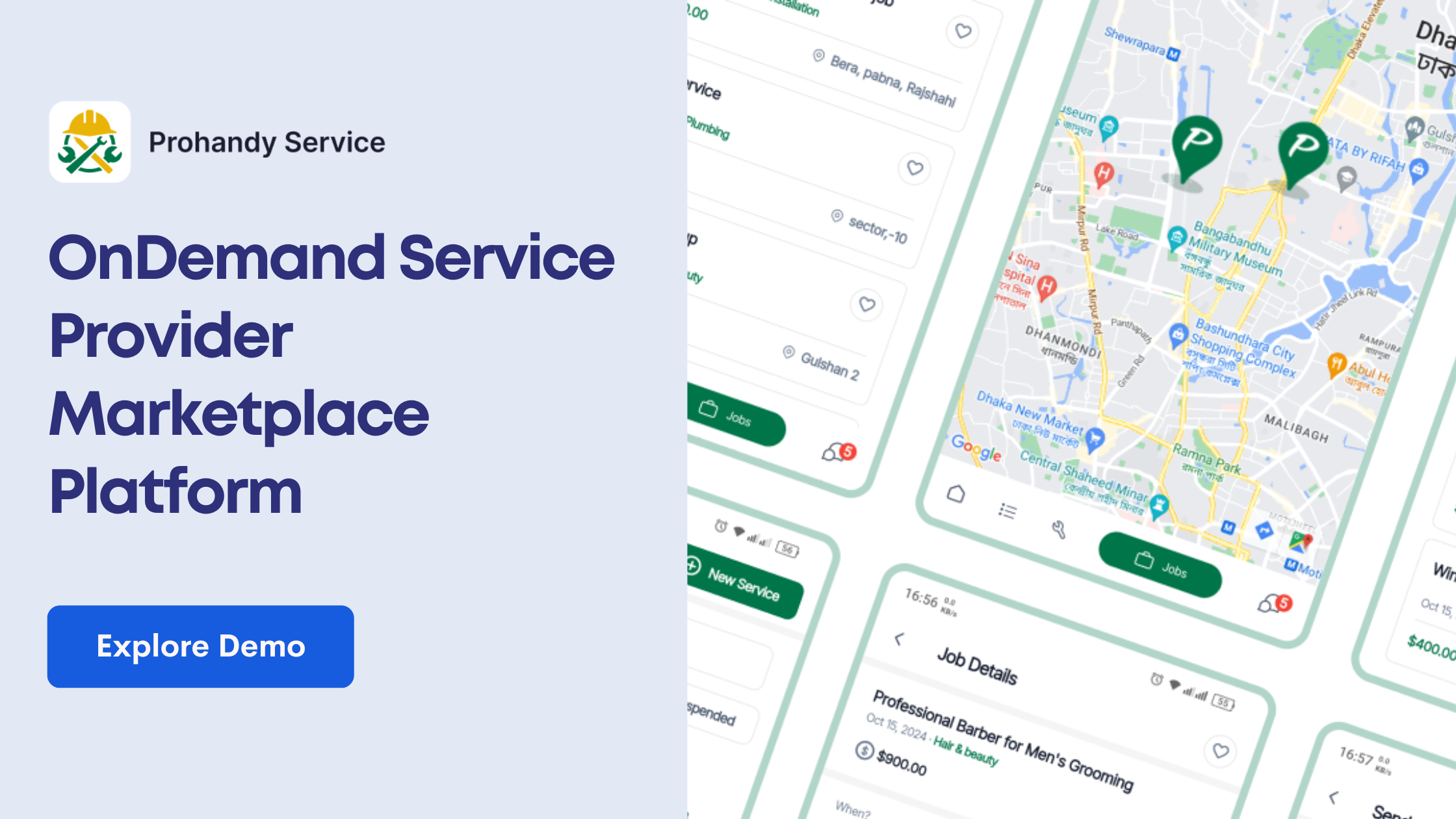
With ProHandy, the setup looks like this:
- Buy the $69 Everything Bundle (web platform and admin, plus the Flutter customer and provider apps and the premium WhatsApp plugin). The $39 Regular licence is the core web platform only.
- Install on PHP 8.0+ and MySQL hosting (cPanel works); installation is free.
- Add your city, areas and categories, then your services with prices, add-ons and time slots.
- Set the platform-wide commission rate, taxes and coupons, and connect one of the 19 payment gateways.
- Turn on provider identity verification and approve your first handymen.
- Set up and publish the customer and provider apps (built with the latest Flutter). You can try the ProHandy demo apps on Google Play first. Full white-label rights come with the $149 Exclusive licence.
Want to see the trade-offs of other scripts first? See the best on-demand service marketplace scripts.
7. Price your services
Look at what local handymen already charge, then set a fixed price per job where you can and an hourly rate where you can’t. Make sure the provider still earns a fair amount after your commission.
Illustration: if a TV-mounting job is priced at $100 and your commission is 15%, you keep $15 and the handyman gets $85 before any payment fees. At 300 such jobs a month, that is $4,500 in platform revenue. Change the numbers to match your market.
8. Get your first customers
- Create a Google Business Profile and a page for each service and area you cover.
- Ask your first providers to bring their existing customers onto the platform.
- Offer a first-booking coupon and a referral reward.
- Partner with estate agents, property managers and furniture stores.
More tactics are in marketing strategies for on-demand businesses.
9. Measure, then expand
Track the share of requests that get a provider, time to first response, repeat bookings, cancellations and review scores. Fix quality problems before adding a new area. Our article on quality control and rating systems explains how to keep standards as you grow. When one area works, copy the playbook to the next.
Frequently asked questions
How much does it cost to start a handyman marketplace?
The platform can cost $69 with a script such as ProHandy (web, admin and both apps), or $40K–$90K for a custom MVP. Add hosting, payment fees, app store accounts, legal review and marketing.
How do handyman marketplaces make money?
Usually through a commission on each booking, customer service fees, provider joining fees, or a margin on fixed prices.
How many handymen do I need to launch?
Enough to answer every request in your launch area. RaftLabs suggests recruiting and vetting 20 to 30 credentialed pros per category from the start.
Do I need a licence to run a handyman marketplace?
Rules differ by country and city. The platform usually needs a registered business, and certain jobs need licensed tradespeople. Check locally before launch.
Can I start a handyman marketplace without coding?
Yes. A ready-made script like ProHandy installs on cPanel hosting with free installation, and you configure services, areas and commission from the admin panel.
