



Lawn care app development is one of the most seasonally driven categories in the on-demand service marketplace space. Unlike cleaning or pet care, where demand is roughly steady year-round, lawn care demand swings dramatically with the seasons: a flood of bookings in spring, peak volume through summer, a cleanup surge in fall, and a deep trough in winter. This seasonal swing shapes every product, operational, and economic decision in lawn care app development.
Lawn care app development is meaningfully different from generic marketplace builds because the seasonal demand cycle means the platform must handle a 5x to 10x volume swing across the year, retain providers through a winter trough when there is little work, and convert one-time spring customers into recurring subscribers before summer ends. Founders who copy a generic booking template into the lawn care vertical underestimate the seasonality and ship platforms that cannot smooth the demand swing or survive the off-season.
This guide walks through lawn care app development in 4 powerful build phases, organized around the Seasonal Lawn Care Cycle framework: spring onboarding and service setup, summer peak service delivery, fall cleanup and recurring plan renewal, and winter maintenance and off-season retention. It includes five real platform examples, realistic cost and timeline figures, and a FAQ.
Five takeaways before reading on: lawn care is a seasonally driven vertical where demand swings 5x to 10x across the year; the Seasonal Lawn Care Cycle framework maps the build to the demand pattern; recurring subscriptions are what smooth the seasonal swing into predictable revenue; provider retention through winter is the hardest operational challenge; and the spring onboarding rush is the conversion moment that defines the whole year. For the broader marketplace framework, see on-demand service marketplace development. For a productized on-demand service platform, see Prohandy.
Why Lawn Care App Development Has a Seasonal Twist
Every lawn care app development decision traces back to seasonality. The vertical’s defining characteristic is a demand cycle that no other on-demand service category experiences with the same intensity.
Demand Swings 5x to 10x Across the Year
In most climates, lawn care demand peaks in late spring and summer, when grass grows fast and needs frequent mowing, and collapses in winter, when grass is dormant or snow-covered. The volume difference between a peak summer week and a deep winter week can be 5x to 10x. Lawn care app development must build a platform that functions at both extremes: a system that handles the summer flood without breaking and survives the winter trough without going dark.
The Spring Onboarding Rush
Spring is when homeowners suddenly remember their lawns. The booking surge in early spring is the single biggest customer acquisition window of the year. A lawn care platform that handles the spring rush well captures a year of customers; a platform that stumbles in spring loses customers to competitors and waits a full year for the next chance.
Provider Retention Through Winter
Lawn care providers need income year-round, but lawn care work nearly disappears in winter. A platform that offers providers nothing in the off-season loses them to other gig work, then has to re-recruit supply every spring. Lawn care app development must address provider retention through the winter trough, often by offering winter-adjacent services (snow removal, leaf cleanup, gutter clearing).
Recurring Subscriptions Smooth the Swing
The economic answer to seasonality is recurring subscriptions. A customer on a recurring mowing plan generates predictable bookings through the growing season, and a platform with many recurring customers has a smoother, more forecastable revenue curve. Converting one-time spring customers into recurring subscribers is the central economic task of lawn care app development.
Weather Dependency
Lawn care is weather-dependent at the daily level too. Rain delays mowing; heat waves change scheduling; storms create sudden cleanup demand. The platform must handle weather-driven rescheduling gracefully, which generic booking templates do not.
These five characteristics mean lawn care app development cannot copy a generic template. The vertical requires a season-aware framework, covered next.
The Lawn Care Marketplace Landscape
The lawn care market is large, fragmented, and still heavily offline, which makes it attractive for platform builders who understand the seasonality.
Market Size
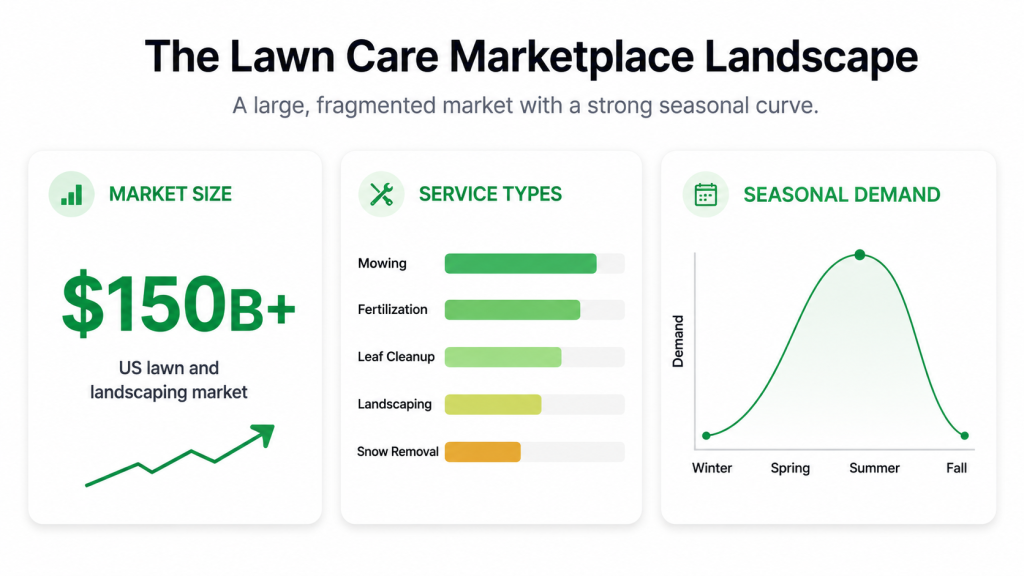
The US lawn and landscaping services market exceeds $150 billion annually, spanning residential mowing, fertilization, landscaping, and seasonal services. Digital booking penetration remains low; a large share of lawn care is still arranged through local providers, neighborhood referrals, and word of mouth. The low digital penetration is the opportunity for lawn care app development.
Service Types
Mowing is the highest-frequency service (weekly or biweekly through the growing season). Fertilization and weed control are scheduled treatments. Leaf cleanup is a fall surge service. Landscaping is project-based and higher value. Snow removal is the winter-adjacent service that keeps providers earning in the off-season. Lawn care app development decisions vary by which services the platform offers.
Customer and Provider Segments
Customers range from convenience-driven homeowners who want hands-off recurring service to price-sensitive customers who book one-off mows. Providers range from solo operators with a mower and a truck to small landscaping crews to larger lawn care companies. Lawn care app development that understands its target segments builds the right features for them.
Geographic and Climate Dynamics
Lawn care is intensely local and climate-dependent. The seasonal curve is steep in northern climates with real winters and flatter in southern climates with longer growing seasons. A lawn care platform should launch in geographically concentrated markets and account for the local climate’s specific seasonal shape.
The Seasonal Lawn Care Cycle Framework
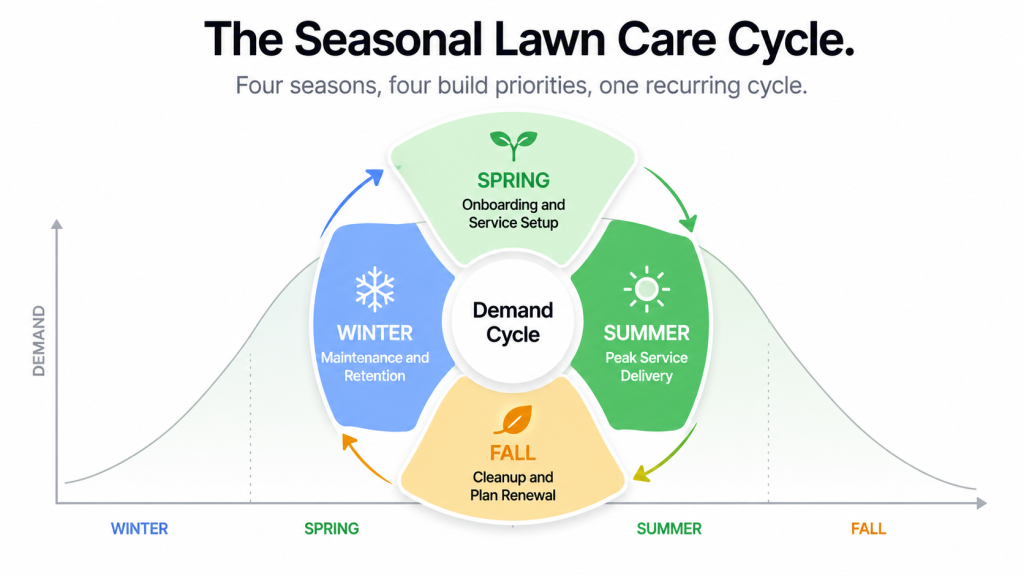
The Seasonal Lawn Care Cycle is the framework this guide is built around. It maps lawn care app development to the four-quarter demand pattern, and each of the 4 build phases corresponds to one season.
The Four Quarters
Spring: Onboarding and Service Setup. Demand surges as homeowners return to their lawns. The platform’s job is to capture the acquisition rush and set up service relationships. Build Phase 1 serves this quarter.
Summer: Peak Service Delivery. Demand is at maximum. The platform’s job is to deliver high volume reliably without breaking. Build Phase 2 serves this quarter.
Fall: Cleanup and Plan Renewal. Demand shifts from mowing to leaf cleanup, and the platform must renew recurring plans before the season ends. Build Phase 3 serves this quarter.
Winter: Maintenance and Off-Season Retention. Demand troughs. The platform’s job is to retain customers and providers through the lean months. Build Phase 4 serves this quarter.
Why the Cycle Matters
The Seasonal Lawn Care Cycle reframes lawn care app development from “build a booking app” to “build a platform that thrives across a demand cycle.” Each build phase is not a generic feature set; it is a response to a specific seasonal challenge. A platform built without the cycle lens handles spring and summer adequately and then goes dark in winter; a platform built with the cycle handles all four quarters and smooths the swing into a sustainable business.
Phase 1: Spring Onboarding and Service Setup
Phase 1 of lawn care app development serves the spring quarter, when demand surges and the platform must capture the year’s biggest acquisition window.
Capturing the Spring Rush
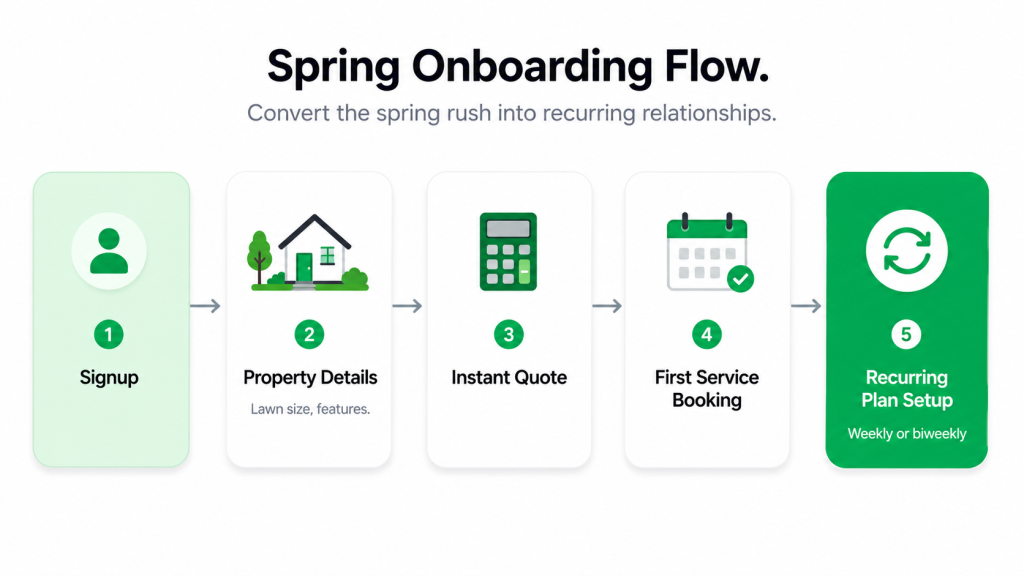
The spring booking surge is the year’s defining acquisition window. Lawn care app development must make spring onboarding fast and frictionless: a homeowner who wants their lawn handled should go from signup to booked service in minutes, not days. A slow or confusing spring onboarding loses customers to competitors at the exact moment they are ready to buy.
Property Details Capture
Lawn care quotes depend on the property. The onboarding flow captures lawn size (square footage or lot size), property features (slopes, trees, fencing, obstacles), and the services the customer wants. Property details feed the quote engine and the provider matching.
Instant Quoting
Homeowners booking in the spring rush want a price now. The quote engine produces an instant estimate from the property details. Some lawn care platforms use satellite or map-based lot measurement to estimate lawn size automatically, removing a friction point. Accurate instant quotes convert; quote delays lose customers.
First Service to Recurring Conversion
The most important Phase 1 task is converting the first spring booking into a recurring plan. A customer who books a one-time mow is a transaction; a customer on a recurring weekly or biweekly plan is a season of revenue. The onboarding flow should present the recurring plan as the default option, with the one-time mow as the alternative, and incentivize recurring with a small discount. The one-time-to-recurring conversion rate during spring largely determines the platform’s revenue for the year.
Phase 1 is the highest-leverage phase in lawn care app development. The spring quarter is short, the acquisition window is concentrated, and the conversion decisions made here echo through the whole year.
Phase 2: Summer Peak Service Delivery
Phase 2 of lawn care app development serves the summer quarter, when demand is at maximum and the platform must deliver high volume reliably.
Handling Peak Volume
Summer is when the platform processes the most bookings, dispatches the most providers, and runs the most concurrent services. Lawn care app development must ensure the booking system, dispatch system, and payment system all handle peak volume without degrading. A platform that slows down or breaks during the summer peak damages its reputation at the worst possible time.
Recurring Service Scheduling
By summer, most revenue should flow from recurring plans set up in spring. The platform auto-schedules recurring mows, assigns the customer’s preferred provider, and bills automatically. Recurring scheduling reduces the per-booking operational load, which is what makes peak volume manageable.
Route Density and Provider Efficiency
Summer is when route optimization matters most. A provider mowing 8 to 15 lawns per day needs an efficient route to fit them all in. The platform should cluster recurring customers geographically and optimize provider routes to maximize the lawns each provider can serve. Route density is the difference between a provider earning well and a provider quitting. The deeper treatment of routing across service marketplaces is in the pillar at on-demand service marketplace development.
Weather-Driven Rescheduling
Summer storms and heat waves disrupt schedules. The platform needs graceful weather rescheduling: when rain cancels a day of mowing, the system reschedules affected jobs, notifies customers and providers, and rebalances the following days. Weather rescheduling that works smoothly keeps both sides calm; weather rescheduling that breaks produces a flood of complaints.
Service Quality at Volume
The risk in the summer peak is quality slipping under volume pressure. The platform should maintain quality through photo documentation (before and after each mow), customer ratings, and quick response to quality complaints. Maintaining quality at peak volume is what carries customer trust into the fall renewal season.
Phase 2 is about reliability at scale. The summer quarter tests whether the platform built in Phase 1 can actually deliver.
Phase 3: Fall Cleanup and Recurring Plan Renewal
Phase 3 of lawn care app development serves the fall quarter, when demand shifts from mowing to cleanup and the platform must renew recurring plans before winter.
The Service Shift to Cleanup
As the growing season ends, demand shifts from regular mowing to fall-specific services: leaf removal, final mows, aeration, fall fertilization, and yard cleanup. Lawn care app development must support this seasonal service shift in the catalog, surfacing fall services prominently as the season changes. A platform that only knows mowing misses the fall cleanup revenue.
The Leaf Cleanup Surge
Leaf cleanup creates a secondary demand surge in fall, smaller than the spring rush but meaningful. The platform should make fall cleanup easy to book for both existing customers (a prompt offering cleanup as an add-on) and new customers who did not need mowing but do need leaf removal.
Recurring Plan Renewal
The most important Phase 3 task is renewing recurring plans for next year. A customer whose recurring mowing plan simply ends in fall may not return in spring; a customer whose plan is explicitly renewed for next season is locked in. The platform should prompt recurring customers to renew before the season closes, ideally with an early-renewal incentive. Fall renewal converts this year’s customers into next year’s guaranteed revenue.
Capturing Off-Season Contact Permission
Fall is when the platform should secure permission to contact customers through the winter and into next spring. A customer who opts into off-season communication can be re-engaged with a spring reminder; a customer the platform cannot contact may forget the platform exists by the time spring arrives. Off-season contact permission, captured in fall, is what makes spring re-acquisition cheap.
Provider Transition Planning
Fall is also when the platform plans the provider transition into winter. Providers who will offer winter services (snow removal, leaf cleanup) need to be set up; providers who will be inactive through winter need a retention plan so they return in spring. Phase 3 sets up the winter retention covered in Phase 4.
Phase 3 is the bridge phase. It captures fall revenue and, more importantly, locks in the recurring relationships and contact permissions that make the next spring cheaper and stronger.
Phase 4: Winter Maintenance and Off-Season Retention
Phase 4 of lawn care app development serves the winter quarter, when demand troughs and the platform must retain both customers and providers through the lean months. Winter is the phase most lawn care platforms neglect, and neglecting it is why many fail to survive their second year.
The Winter Trough Problem
In winter, lawn care demand nearly disappears in most climates. A platform built only for spring through fall goes effectively dark for three to four months. The danger of the winter trough is twofold: customers forget the platform exists, and providers drift to other gig work. Lawn care app development must build for the winter trough deliberately, not treat it as a gap to ignore.
Winter-Adjacent Services
The strongest winter strategy is offering winter-adjacent services that keep the marketplace transacting. Snow removal is the obvious one in northern climates: the same providers with trucks and equipment can plow driveways and clear walkways. Other winter-adjacent services include gutter cleaning, holiday light installation, and final leaf cleanup. Lawn care app development that adds winter services converts the trough into a smaller, manageable dip rather than a dead zone.
Provider Retention Through Winter
Providers need income year-round. A platform that offers nothing in winter loses providers to competing gig work and has to re-recruit supply every spring, which is expensive and slow. Retention tactics include: routing winter-adjacent service work to providers, keeping providers informed with off-season communication, offering early-bird incentives for committing to the next spring season, and maintaining the provider relationship so returning in spring is the default.
Customer Off-Season Retention
Customers on recurring plans renewed in fall are largely retained automatically. For other customers, winter retention means staying in contact: occasional helpful off-season communication (winter lawn tips, spring preparation reminders), and a strong spring re-engagement prompt timed to the start of the next season. The off-season contact permission captured in Phase 3 is what makes this possible.
Building for the Next Spring
Phase 4 is also when the platform prepares for the next spring rush. Winter is the natural time to ship product improvements, refine the onboarding flow, expand the service catalog, and recruit additional providers ahead of the spring surge. A platform that uses winter to prepare enters spring stronger than a platform that simply waits.
The Cycle Repeats
Phase 4 ends where Phase 1 begins. The customers retained through winter and the providers kept engaged become the foundation of the next spring’s onboarding rush. Lawn care app development that handles all four phases turns the seasonal cycle from a threat into a repeating, compounding business rhythm.
Phase 4 is the phase that separates lawn care platforms that survive from platforms that fade. Winter retention is unglamorous but decisive.
Five Real Lawn Care Platforms
Five real platforms illustrate the patterns in lawn care app development. Each made distinct strategic choices.
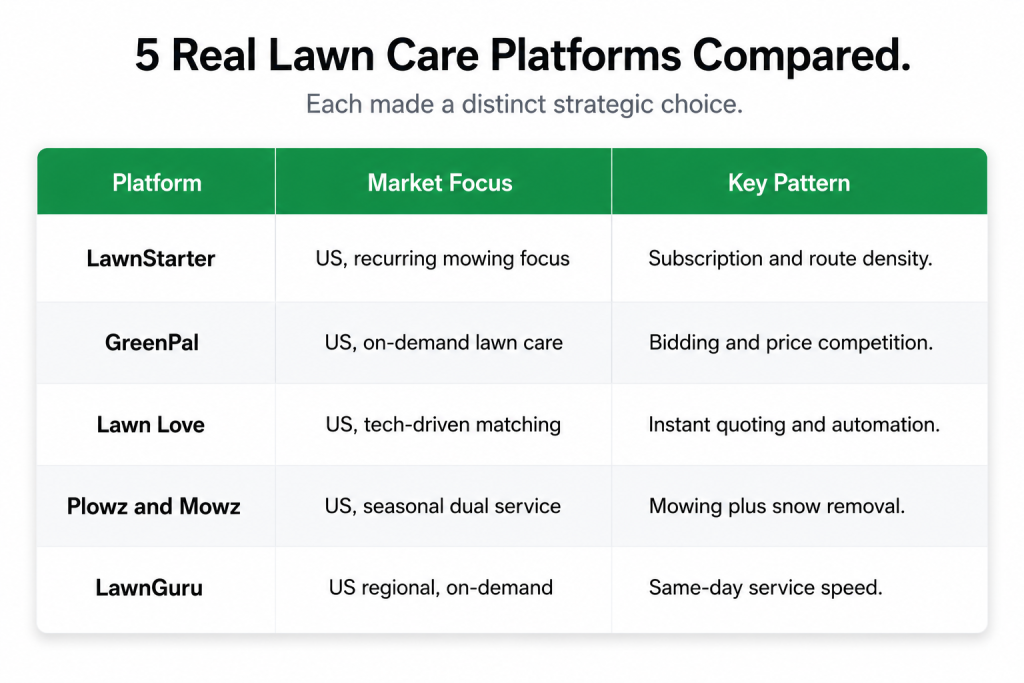
LawnStarter
A US platform focused on recurring mowing subscriptions with strong route density. What it teaches: recurring subscriptions are the economic answer to lawn care seasonality, and clustering recurring customers geographically makes providers efficient. LawnStarter’s subscription-first model is the clearest example of smoothing the seasonal swing.
GreenPal
A US platform often described as the on-demand lawn care marketplace, with provider bidding and price competition. What it teaches: a bidding model creates price competition that appeals to cost-sensitive customers, though it can compress provider margins. GreenPal shows a different monetization and matching approach from the subscription model.
Lawn Love
A US platform that leaned into technology-driven matching, instant quoting, and operational automation. What it teaches: automation and instant quoting reduce friction in the spring onboarding rush, which is the highest-leverage moment in lawn care app development.
Plowz and Mowz
A US platform that explicitly built for the seasonal dual: lawn mowing in the growing season and snow removal in winter. What it teaches: the winter-adjacent service strategy works. Building snow removal alongside mowing addresses the Phase 4 winter trough directly and keeps the platform transacting year-round.
LawnGuru
A US regional platform emphasizing on-demand, same-day service speed. What it teaches: service speed is a viable differentiator. Customers who want their lawn handled today, not next week, are an underserved segment that a speed-focused platform can capture.
The pattern across all five: successful lawn care app development comes from a clear strategic choice (recurring subscriptions, bidding competition, automation, seasonal dual service, or speed) executed deeply. The LawnStarter case study material documents the subscription-and-route-density approach in depth. For a related home-service vertical with different seasonal dynamics, see pet care marketplace development. For platforms that aggregate many providers, see multi-vendor marketplace development.
Lawn Care App Development Cost and Build Timeline
Realistic cost and timeline figures for lawn care app development depend on scope and how much seasonal infrastructure the platform builds.
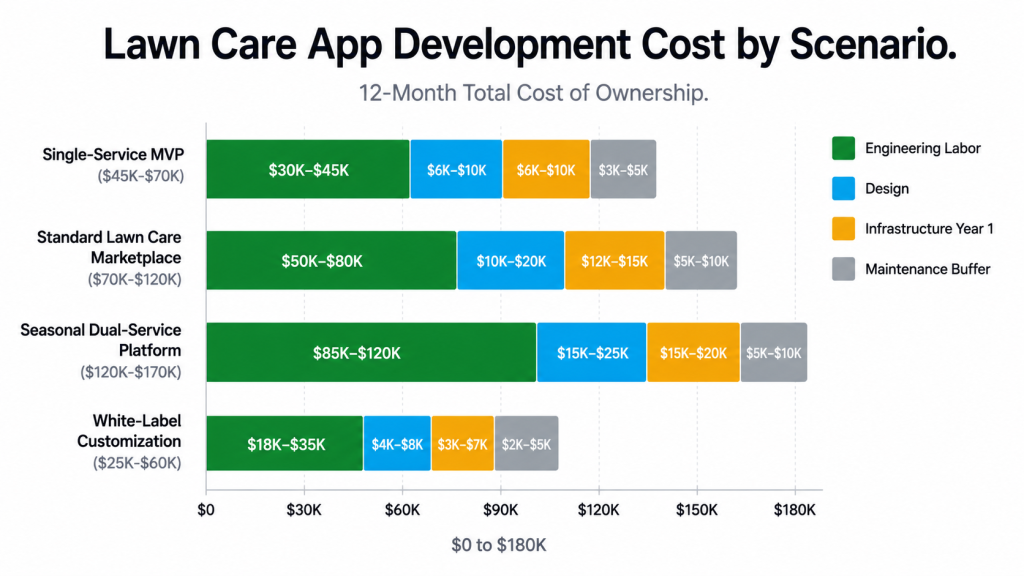
Cost Ranges
Single-service MVP ($45K to $70K). Mowing-only platform, single metro area, customer app and provider app plus web admin, 8 to 12 weeks. For founders validating the lawn care vertical in one market.
Standard lawn care marketplace ($70K to $120K). Multiple lawn services (mowing, fertilization, cleanup), recurring subscriptions, route optimization, full mobile apps, 12 to 16 weeks. The common lawn care app development pattern.
Seasonal dual-service platform ($120K to $170K). Lawn services plus winter-adjacent services (snow removal), advanced seasonal scheduling, off-season retention tooling, 16 to 20 weeks. Built to handle all four seasonal phases.
White-label customization ($25K to $60K). Customize an existing on-demand service platform for the lawn care vertical, 4 to 8 weeks. The fastest and lowest-cost path to market.
Build Timeline
Most lawn care app development MVPs ship in 8 to 16 weeks. The phases: discovery and design (weeks 1 to 2), booking and provider features (weeks 3 to 6), recurring subscriptions and route optimization (weeks 6 to 9), quoting and seasonal catalog (weeks 9 to 11), QA and mobile app store submission (weeks 11 to 13), soft launch and stabilization (weeks 13 to 16).
The Seasonal Launch Timing Decision
Lawn care app development has a timing consideration no other vertical has: when to launch. The ideal launch window is late winter or very early spring, so the platform is live and ready when the spring onboarding rush arrives. A platform that finishes building in mid-summer has missed the year’s biggest acquisition window and waits months for traction. Plan the build backward from the spring launch date.
Ongoing Operating Cost
Beyond the build, budget for infrastructure and hosting ($150 to $1,500 per month, scaling with the seasonal volume swing), background check costs for providers, payment processing fees, and seasonal operations staffing that flexes up for summer and down for winter. Year 1 operating cost typically runs $25K to $80K depending on scale and how aggressively the platform subsidizes early growth.
Conclusion: Building a Lawn Care App That Thrives Across Every Season
Lawn care app development succeeds when the build reflects the vertical’s defining characteristic: a demand cycle that swings 5x to 10x across the year. The 4 powerful build phases covered in this guide (spring onboarding and service setup, summer peak service delivery, fall cleanup and recurring plan renewal, and winter maintenance and off-season retention) map the build to the Seasonal Lawn Care Cycle framework. Each phase answers a specific seasonal challenge.
The dominant pattern across successful lawn care platforms: recurring subscriptions to smooth the seasonal swing, a fast spring onboarding flow to capture the year’s biggest acquisition window, route density to keep providers efficient through the summer peak, fall plan renewal to lock in next year’s revenue, and winter-adjacent services to survive the off-season trough. Platforms that build for all four phases turn seasonality from a threat into a repeating business rhythm; platforms that build only for spring and summer go dark in winter and struggle to survive their second year.
Lawn Care App Development FAQ
1. How much does lawn care app development cost?
$45K to $170K depending on scope. A single-service mowing MVP runs $45K to $70K. A standard multi-service lawn care marketplace runs $70K to $120K. A seasonal dual-service platform with snow removal runs $120K to $170K. White-label customization of an existing on-demand service platform runs $25K to $60K and is the fastest path. Add $25K to $80K for Year 1 operating costs.
2. How long does it take to build a lawn care app?
8 to 16 weeks for most MVPs. 8 to 12 weeks for a single-service single-city build. 12 to 16 weeks for a standard multi-service marketplace with recurring subscriptions and route optimization. 4 to 8 weeks for white-label customization. Plan the build to finish in late winter so the platform is ready for the spring onboarding rush.
3. How does a lawn care platform handle the winter off-season?
Three tactics. Offer winter-adjacent services like snow removal so the marketplace keeps transacting. Retain providers through off-season communication and early-bird incentives for next spring. Retain customers through fall plan renewal and a strong spring re-engagement prompt. Lawn care app development that ignores winter loses customers and providers and has to rebuild supply every spring.
4. Should a lawn care app focus on one-time or recurring bookings?
Recurring, strongly. Recurring mowing subscriptions are the economic answer to lawn care seasonality. They produce predictable bookings through the growing season and smooth the demand curve. Lawn care app development should present recurring plans as the default at onboarding and optimize the one-time-to-recurring conversion rate, because that conversion during spring largely determines the year’s revenue.
5. What is the most important moment in the lawn care seasonal cycle?
The spring onboarding rush. Spring is the year’s biggest customer acquisition window, concentrated into a few weeks. A platform that handles spring onboarding well, with fast signup, instant quoting, and strong one-time-to-recurring conversion, captures a year of customers. A platform that stumbles in spring waits a full year for the next chance.
6. Does a lawn care app need route optimization?
Yes, especially through summer. A provider mowing 8 to 15 lawns per day needs an efficient route to fit them all in. Clustering recurring customers geographically and optimizing provider routes is the difference between a provider earning well and a provider quitting. Route optimization is a core lawn care app development feature, not an optional extra.