




Launching a marketplace is a blast, right up until the first scammer shows up. And one will, usually way sooner than you would like. Marketplace fraud prevention is the unglamorous work that decides whether your new platform builds trust or slowly wears it away, and most founders only start caring about it after they have already been burned once.
So this one is for that founder, the one standing up a two-sided marketplace with a small team and a to-do list that is already a mile long. We will show you what fraud actually looks like on a young platform and 9 things that genuinely work, plus the mistakes that cripple new owners. No scare tactics, just what works.
Quick-answer
Marketplace fraud prevention is the set of checks, controls, and monitoring a platform uses to stop fake accounts, scam sellers, and fraudulent transactions before they cost real money. New platforms are hit hardest because fraudsters assume the defenses are not built yet.
- The three fraud types to plan for first: fake account and signup fraud, seller or listing scams, and payment and chargeback fraud.
- The strongest early moves: verify identity at signup, vet sellers before they list, match the depth of your checks to the risk of each transaction, and hold funds in escrow until delivery is confirmed.
- Keep every conversation and payment on the platform. The moment a deal moves to outside chat or a direct transfer, you lose both the evidence and the ability to protect the user.
- The mistakes that sink new platforms: trusting users by default, bolting on fraud tools only after the first big loss, and making fraud reporting so clunky that victims stay silent.
What Marketplace Fraud Prevention Looks Like on a Brand-New Platform
Before you fix anything, you need to know what you are up against. Online marketplaces are fraud magnets for one dead-simple reason: they move money between total strangers.
That online marketplace fraud sorts into a handful of types of marketplace fraud, some aimed at your buyers and sellers, some straight at your platform. Everyone from a two-person app to Facebook Marketplace fights the exact same stuff, almost always for plain financial gain.
Table of Contents
The Three Kinds of Fraud That Hit a New Marketplace First
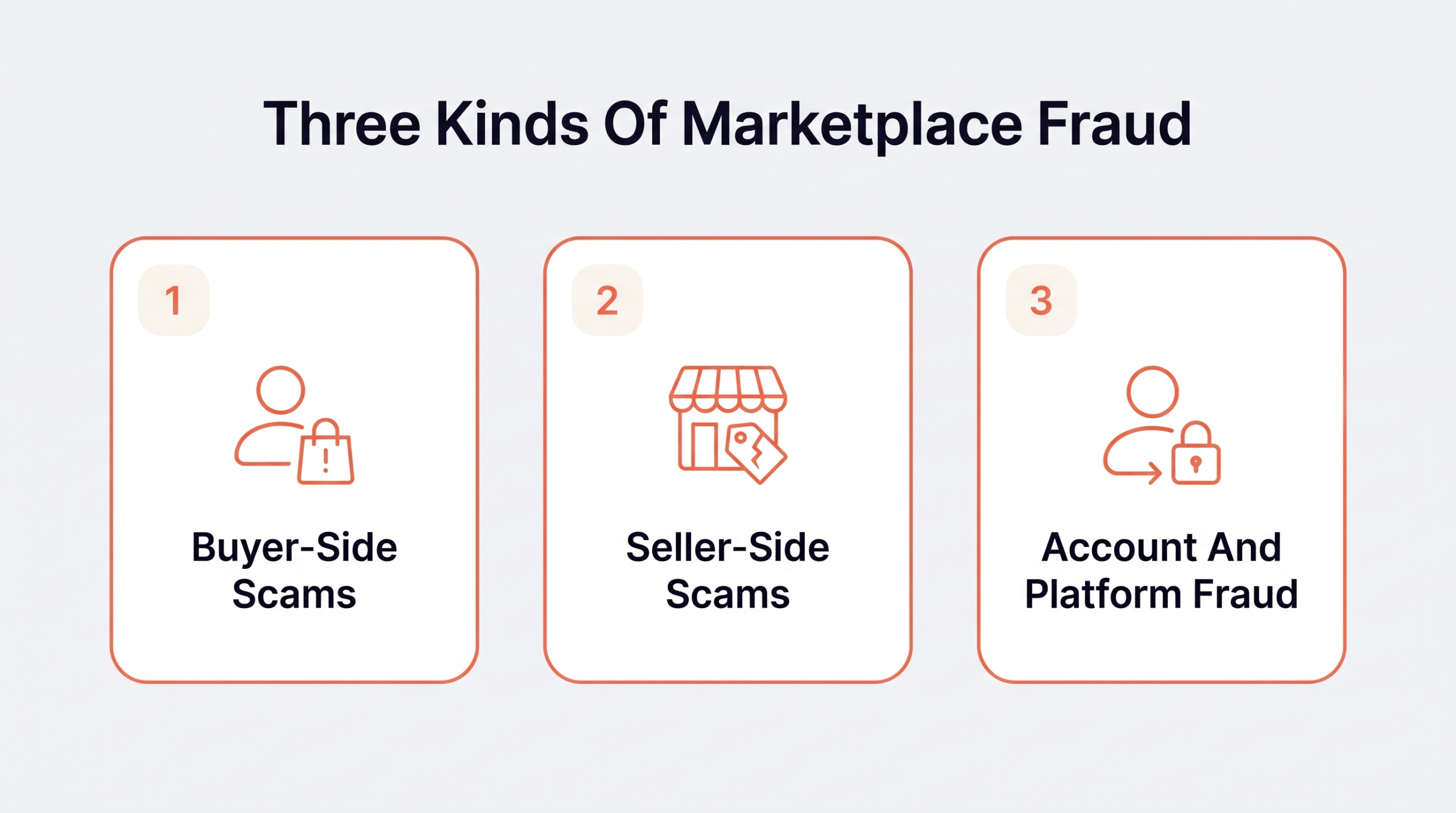
1. Buyer-Side Scams That Hit Your Sellers
On the buyer side, buyer fraud usually looks like an eager customer who isn’t one. Two old favorites: overpayment scams, where fraudulent buyers “accidentally” pay too much and sweetly ask for the change back, and orders paid with a stolen credit card.
Then the real cardholder notices and the chargeback hits, which leaves your honest seller out both the money and the goods they already shipped.
2. Seller-Side Scams That Hit Your Buyers
On the seller side, it changes. Seller fraud runs on fake listings – a fraudulent seller posts high-value items at a price that is a bit too good, takes the cash, and vanishes. Triangulation fraud is the really clever one, where a fake shop fills your buyer’s order using somebody else’s stolen card. So everyone ends up cheated except the crook.
3. Account and Platform Fraud That Targets Everyone
The third type goes after your architecture. Account takeover hijacks a legitimate seller’s profile and runs scams under a trusted name. Fraud rings create multiple accounts for money laundering or to drain promotional codes. None of it raises an alarm straight away. But it weakens your marketplace integrity from the inside.
Why Fraudsters Target Young Platforms Before Anyone Else
1. Thin Moderation and Too Few Eyes
A new platform is usually two or three people doing nine jobs each. No dedicated safety teams, nobody watching overnight, barely enough time to clear the support inbox. Bad actors notice that in about five minutes, and they treat an understaffed marketplace like an unlocked door nobody is guarding.
2. Growth Pressure That Rewards Looking Away
Every single signup is like a small victory in the first months of a new on-demand or services marketplace. So it is tempting to let people through and skip the annoying identity checks at account creation. Fraudsters love that land-grab energy. They come in droves while the welcome mat is still out and nobody is really looking.
3. Defenses Nobody Has Stress-Tested Yet
Your defenses are brand new, which means nobody has really tried to break them yet, except the people about to. Fraudster lists and shady forums happily swap notes on which fresh platforms are soft. So emerging threats reach you by word of mouth. Rules that have never been stress-tested tend to stop working in ways you only spot mid-attack.
What One Early Fraud Wave Actually Costs You
1. The Money You Lose to Chargebacks and Penalties
The price tag on the screen is never the real price. Chargeback fees, lost goods, the hours your team burns, processor penalties – they all add up fast. US retailers lose about $4.61 for every $1 of eCommerce fraud. So a few fraudulent transactions can take a major toll on your runway.
2. The Trust You Lose With Honest Users
Money you can usually claw back. Trust, not so much. Legitimate buyers who get scammed on your watch rarely give you a second shot, and a burned seller will tell everyone in their corner of the internet. On a two-sided market, that reputation is basically your whole growth engine, and fraud goes straight for it.
3. The Clean-Up That Eats Your Team’s Time
Every fraud case takes your small team off building and into firefighting. Investigations and refunds, furious messages and payment disputes – all of it wastes the exact hours you needed to grow. That stolen focus costs a young company more than the fraud itself ever did.
9 Marketplace Fraud Prevention Strategies Every New Platform Owner Needs
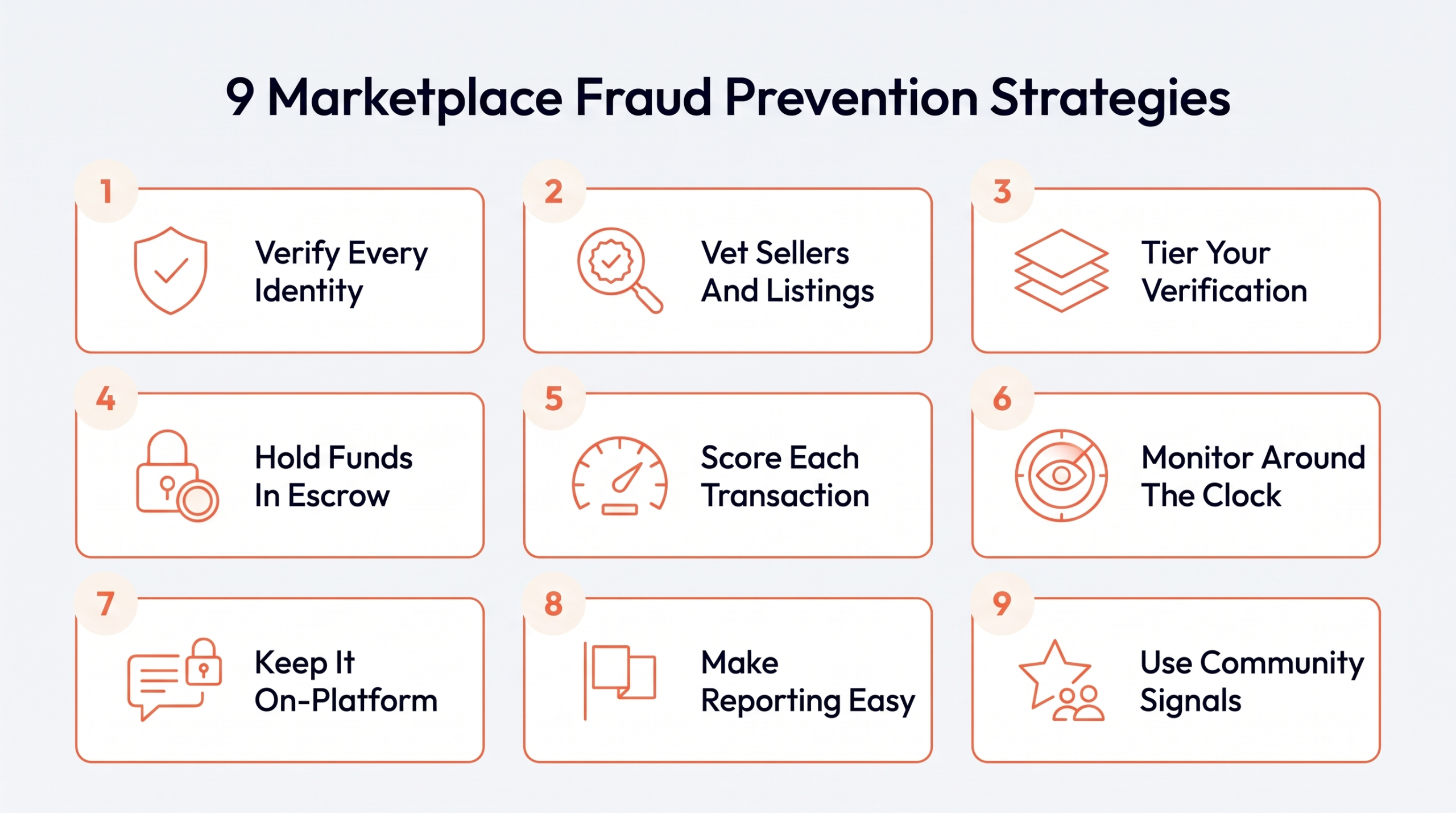
Alright, the actual game plan. Nine strategies that cover the whole board, from who gets through the front door to how you clean up when something gets by your defenses. They build on each other, so you don’t need all nine cranked to eleven on day one. Start at the top, then work your way down.
1. Verify Who Every Buyer and Seller Really Is at Sign-Up
Almost every marketplace scam starts with an account pretending to be something it is not, and account creation is when a fraudster is at their boldest. Let anyone sign up in ten seconds with a throwaway email, and you have basically given them free ammo. Verifying who people are at the door is the biggest-bang-for-buck move you have.
And the heat is rising. Marketplace account takeover is at 3.8%, above the cross-industry average, so stolen identities and flat-out identity theft are often move one, followed by a rash of suspicious login attempts on accounts that were never theirs.
The thing is, a fresh account only ever shows you what the user wants you to see, and a good fraudster hands you a tidy, believable story. Which is why device intelligence plus the old investigator’s trick of reading what someone leaves out both do their part; the gaps and a suspiciously thin digital footprint usually give the game away.
- Make verified email and phone details a hard requirement before any account transacts
- Ask higher-risk sellers for document verification that matches their stated legal identity
- Use device and behavior signals to spot one person running multiple accounts
- Add multi-factor authentication to every login attempt and each payout request
2. Vet Your Sellers and Screen Listings for Counterfeits
A verified ID tells you who someone is. It tells you nothing about whether the stuff they are selling is real. Totally different problem. A clean seller account can still push a wave of fake listings and counterfeit goods onto your platform. And that is the whole scam in some categories.
Write your seller onboarding down as a repeatable vetting flow before this gets big. Otherwise, the standard drifts every time you are slammed, and “we’ll check them later” slowly becomes “we never checked them at all.”
Some categories are just counterfeit heaven, and it is worst wherever the buyer can’t actually see what they are buying. Supplements are the poster child. A capsule looks exactly the same whether it is packed with the real active ingredient at the label dose or some cheap, mislabeled filler.
So the shopper is basically asked to take it all on faith, which is a gift to counterfeit products and the sellers pushing them.
The sellers who actually earn that trust do it by making the invisible checkable. Take this seller with a proper lab-tested memory supplement lineup. Every batch gets third-party tested at accredited labs, with the certificate of analysis published right there on the product page.
You can confirm the identity and purity of what is in the bottle. Better yet, they standardize to the actual active compound that matters, not some easy-to-fake surface marker.
For you running a marketplace, that is the bar. Make sellers in any high-trust category back up their claims with independent test documents, and screen the listings against those documents before anything goes live.
- Hold new sellers in a review queue before their very first listing goes live
- Demand proof of authenticity or sourcing for every brand-sensitive, high-risk category
- Flag listing photos and descriptions that match known counterfeit or duplicate patterns
- Re-verify sellers whose volume or category suddenly jumps without any clear reason
3. Match How Hard You Verify to What Each Category Can Cost Someone
Every check you include is adding friction a real person has to go through, and friction is never free. So the smart approach in risk management isn’t to interrogate everyone to death. It is to size your checks to how much damage a bad actor in that specific category could actually cause.
Because not every category can hurt you the same way. A fake $9 phone case just means someone is annoyed and you hand over a refund. But the downside gets a lot darker the moment your marketplace lists people who give advice or do hands-on work.
A fraudulent or just plain unqualified provider there doesn’t earn a one-star review. They can leave someone genuinely hurt. Those are your higher risk users.
Honestly? The cleanest example of this we found isn’t even a marketplace. It is this medical malpractice attorney, and it proves the point real hard. The firm spends its days on exactly one thing: what happens when a trusted professional gets it badly wrong. Think a misread scan or a surgical instrument left inside a patient after the stitches go in.
These cases drag on for years, and they depend on a single question of whether this person was ever truly competent to do the job they claimed.
Now picture that same failure, except the “professional” found their client through your platform and you never really checked them. The harm there is permanent. And it isn’t a chargeback. It is a lawsuit and a ruined life, with your marketplace’s name somewhere in the paperwork.
That is the whole case for tiering your checks to the stakes. A guy flipping cheap gadgets can clear a light identity step and move on. A listed professional in a high-consequence field needs real license and credential verification before they ever take a booking.
Get it wrong with gadgets, and you are out a few dollars. Get it wrong here, and the cost gets measured in people.
One more thing while we are at it. A provider’s own profile is marketing, not proof. A slick and confident bio can be written by AI in a couple of minutes now. So the shine tells you nothing about whether the license behind it is real. Trust the independent registry, never the applicant’s own words.
- Set verification tiers so low-stakes sellers clear far lighter checks than professionals
- Verify licenses and credentials directly with the issuing body, not the seller
- Reserve your heaviest checks for the highest-consequence fields like health and legal
- Re-run professional credential checks on a schedule, since licenses lapse or get revoked
4. Hold the Money in Escrow Until Both Sides Deliver
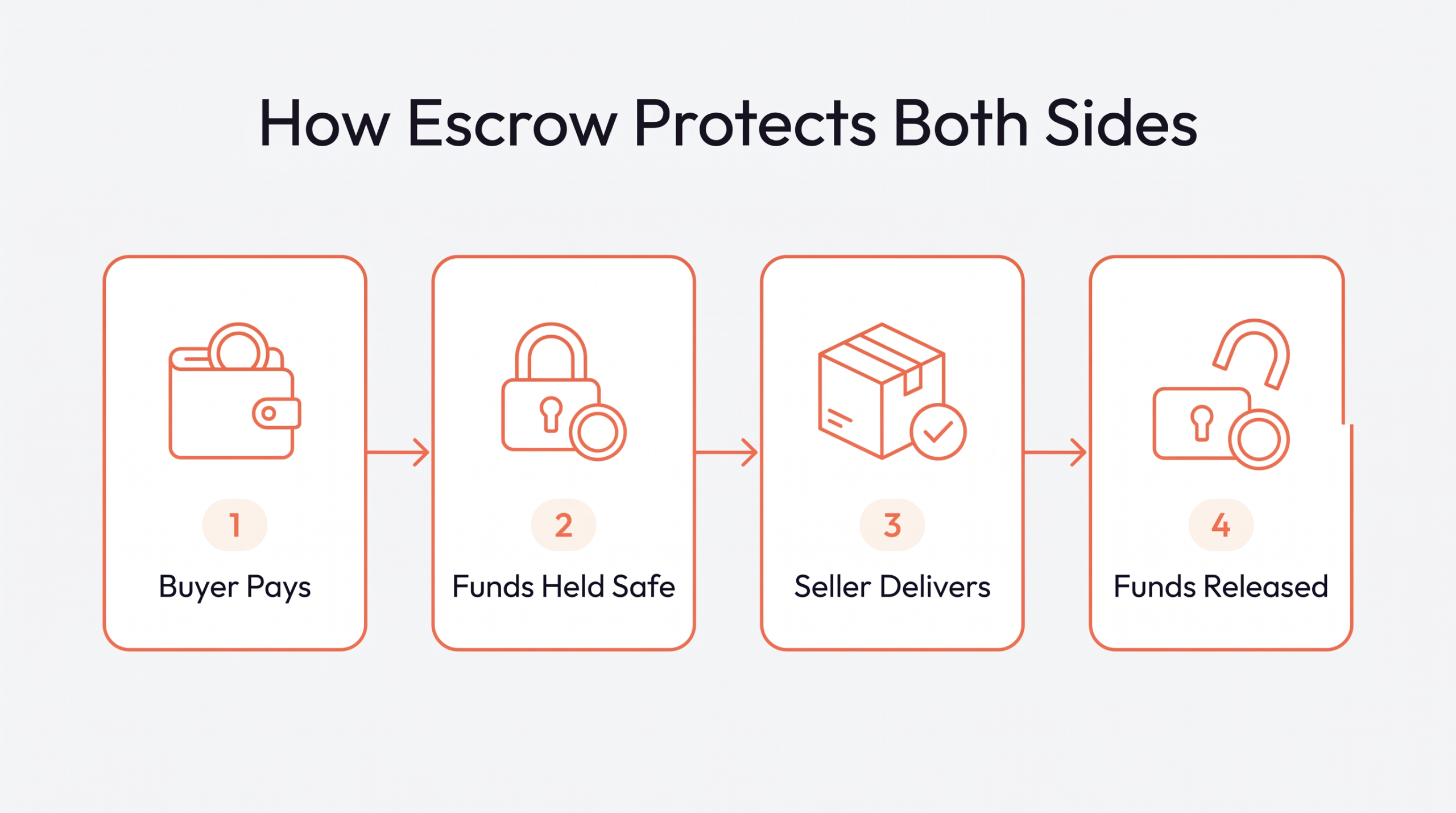
A massive slice of marketplace fraud is really just a timing con: somebody gets paid before they deliver or gets the goods before they pay. Escrow slams that window shut. You hold the buyer’s money and only hand it over once both sides have actually done their bit, so nobody can grab the cash and disappear halfway through.
It is brutal on non-delivery scams and the overpayment or partial deposit tricks, the ones that happen in that exact handover moment. The cash just stays there, untouchable, until the agreed thing really happens. No payoff for grabbing and running, so most of them don’t even bother trying.
- Hold every buyer payment in escrow until delivery or completion is confirmed
- Release funds only against clear proof, like tracking or a signed handoff
- Set fair timeouts and a neutral path for when a deal stalls
- Never let a seller pressure a buyer into releasing the escrow early
5. Score Every Transaction for Risk Before It Goes Through
Every transaction still deserves a quick sniff test even with verified users and escrow doing their jobs. A real-time risk score reads a stack of signals the second someone checks out. Then it makes the call in milliseconds to either let it through or pull it for a closer look.
That is where passive signals really do their job: a device fingerprint or an order that just doesn’t fit the account’s own history. Tight transaction monitoring reads each order against that transaction history and catches triangulation fraud and card testing before a single cent moves.
- Score every transaction live, blending device fingerprint signals with the account’s own history
- Auto-approve clean orders and route only the genuinely risky ones to review
- Flag velocity spikes, such as many orders or new cards within minutes
- Tune your score thresholds often so false positives stop punishing legitimate customers
6. Watch the Platform Around the Clock and Respond Fast
Transaction scoring catches fraud at checkout. But loads of fraud doesn’t show up there. It surfaces later, as a slow pattern creeping across multiple accounts or a ring warming up over a week.
To spot that kind of suspicious activity, something has to be watching your whole marketplace activity all the time, ready to pounce the moment it shows its face.
The trouble for a small team is simple: fraud doesn’t clock off at 5 pm. Account-takeover waves and fraud rings testing your defenses love to kick off overnight and on weekends, right when you are asleep.
On a young platform, alerts stack up faster than two or three humans can read, and the genuinely scary ones hide in a barrage of false alarms. Hiring a 24/7 team you can’t afford isn’t the move.
A smarter option is the kind of setup people call an agentic SOC. It teams AI agents up with human analysts and lets each do what they are genuinely good at. The agents handle the routine tasks, adding context to every alert and clumping related signals together. It then surfaces the ones that look like known fraud, round the clock at a scale no human could touch.
That frees your actual people for the handful of calls that need a real brain, like how big an incident truly is or whether to freeze a payout without torching an innocent seller.
For a marketplace owner, that is how you get genuine round-the-clock monitoring and fast response without a round-the-clock payroll, long before you could justify a full safety team of your own.
- Set alerts for coordinated patterns across accounts, not just single bad transactions
- Keep a written response guide so anyone can act fast at 3 am
- Freeze related payouts and listings the moment a fraud ring is confirmed
- Feed every confirmed case straight back into your detection rules and models
7. Keep Every Chat and Payment Inside Your Platform
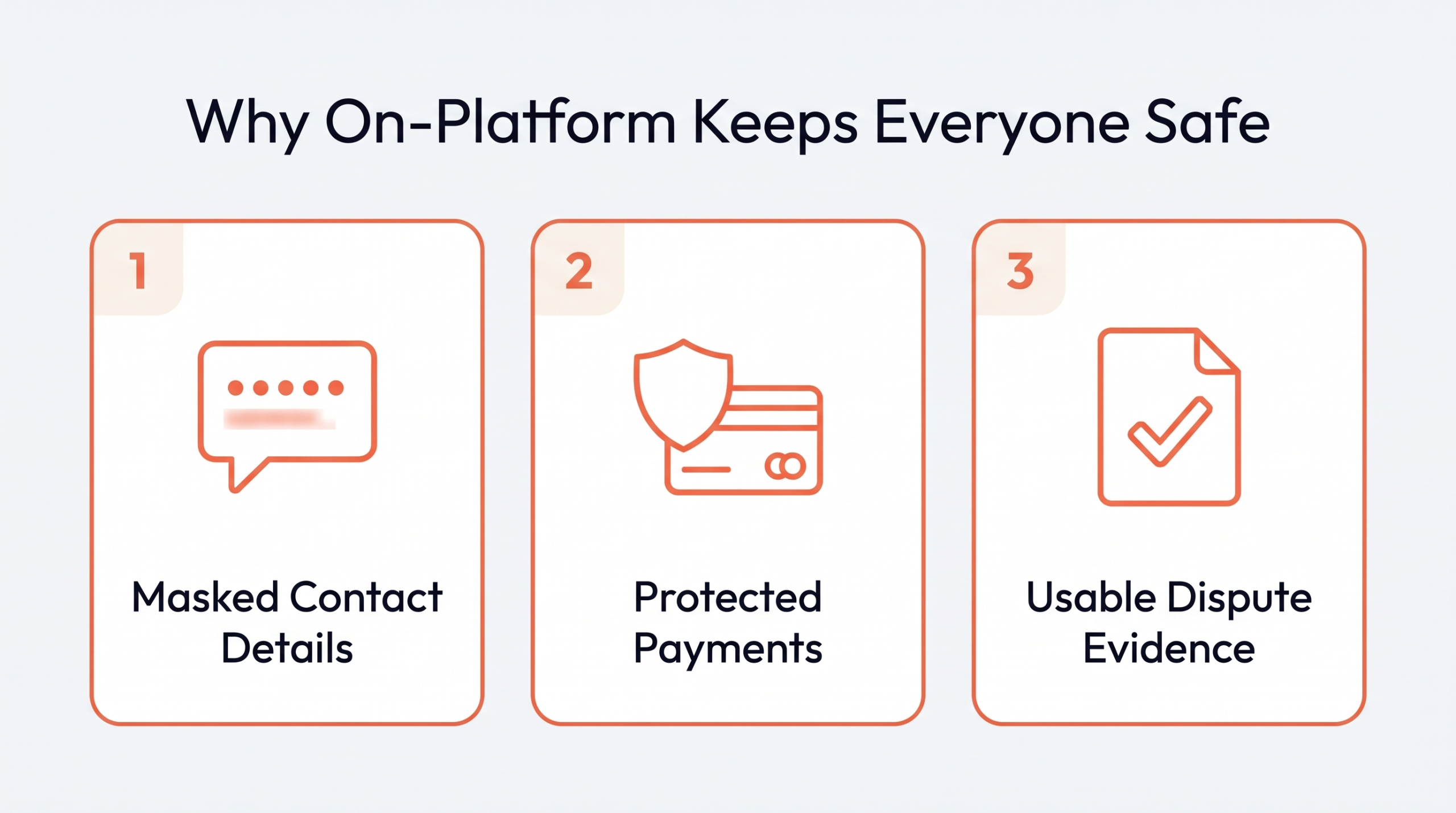
The oldest trick in the whole book is coaxing people off your platform. “Just Venmo me and we’ll skip the fees” sounds matey and helpful, right up until you realize it is exactly how phishing scams and off-platform cons get going.
The instant a deal leaves your rails, you go blind. And the buyer hands payment information straight to a stranger with zero safety net.
Keeping chat and payments in-house isn’t you being a control freak. It is the only way your escrow and your monitoring can protect anybody at all. Off-platform is where your careful safeguards and a buyer’s sensitive information both go to die.
- Mask phone numbers and emails inside your in-app messaging system by default
- Automatically filter in-app chat for off-platform payment hints and contact-sharing attempts
- Make on-platform payment the easy default, with fees that genuinely feel fair
- Warn buyers plainly that paying off-platform removes every protection you offer
8. Give People an Easy Way to Report and Resolve Problems
No system catches everything, so your users end up being your sharpest sensor. A stupidly simple report button turns thousands of buyers and sellers into an early-warning system. And a fair, fast way to settle disputes is usually the thing that decides whether a burned user sticks around or walks for good.
Disputes also protect you from your own customers, oddly enough. Not every chargeback is real fraud; in fact, around 61% of chargeback disputes are friendly fraud, legitimate customers disputing things they genuinely bought.
Sort those with your own records, before they ever reach the card networks and their financial institutions, and you will keep compliance officers off your back as you scale.
- Put an obvious report button on every listing and every chat thread
- Acknowledge every report quickly and tell the user exactly what happens next
- Settle disputes using the evidence in your own escrow and message logs
- Track both repeat reporters and repeat offenders to spot organized abuse early
9. Let Reviews and Community Signals Surface Repeat Offenders
Your community spots stuff your dashboards never will. Reviews, ratings, and repeat-buyer patterns add up to a living reputation layer that makes it genuinely expensive for a bad actor to pull the same con twice under one name. The issue is that the review system itself becomes a target the moment it actually means something.
Fake reviews swing both ways, pumping up a fraudulent seller or kneecapping an honest rival. So these signals only help if you guard them. A reputation score worth anything is one a scammer can’t just buy or botnet into existence overnight. This means your ratings need nearly as much protecting as your payments do.
- Only let verified buyers who actually completed a purchase leave a review
- Weight recent, consistent behavior above any sudden burst of five-star ratings
- Watch for review rings, like clustered new accounts all praising each other
- Show buyers a seller’s full track record, not just the headline rating
3 Marketplace Fraud Prevention Mistakes That Sink New Platforms Fast
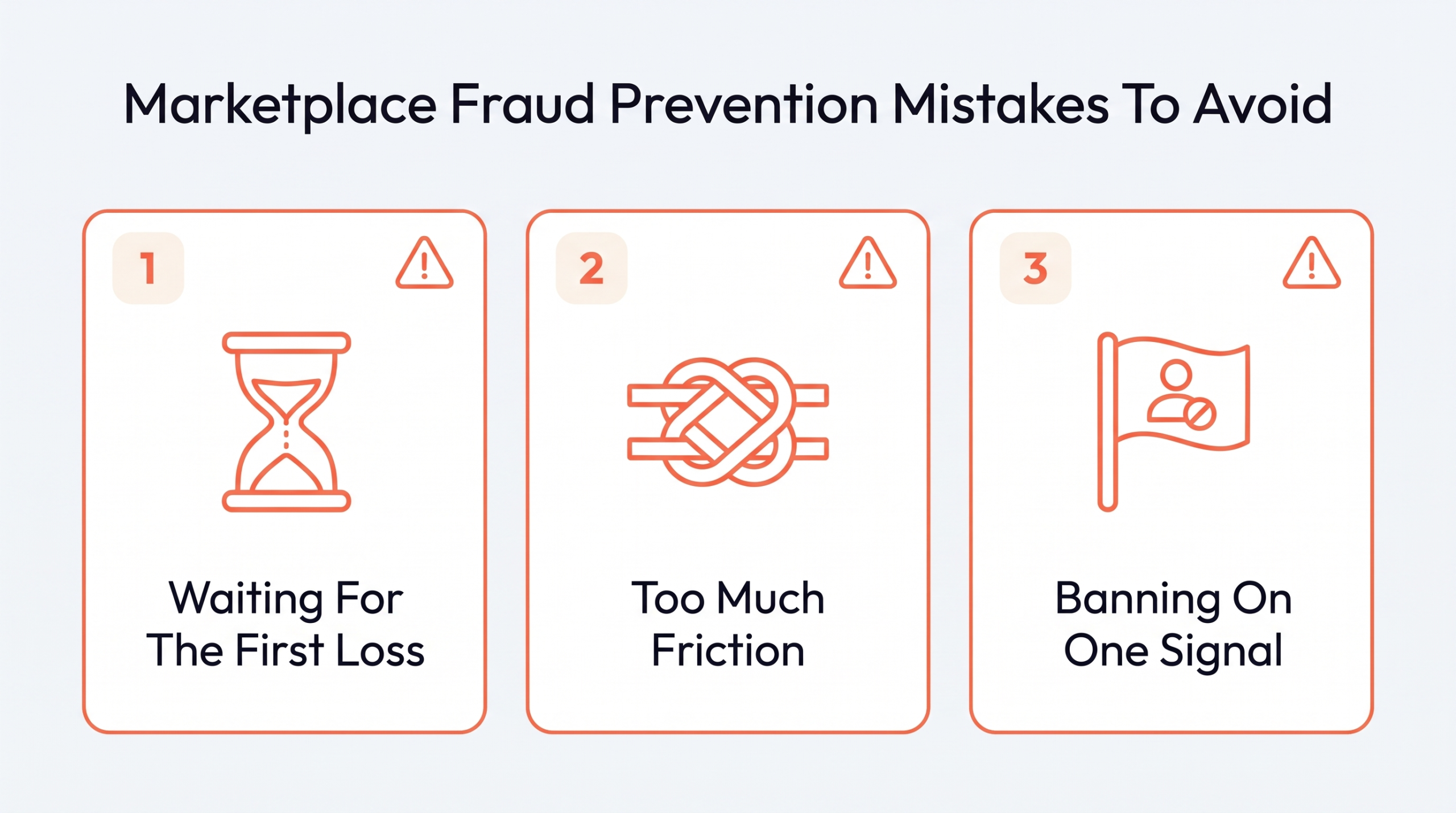
You can handle almost all of this and still score an own-goal. These three hold back new platforms more than anything else, mostly because every one of them looks completely sensible while you are doing it.
1. Waiting Until the First Big Loss to Take Fraud Seriously
The classic founder move is seeing fraud as something to deal with once there is real volume. Then one coordinated hit arrives, the chargebacks come in waves, and your payment processor starts eyeing the exit. Adding defenses to a live, already-bruised platform costs way more than just building them in from the start.
How to Fix: Build the basics in before you launch. Identity checks and escrow aren’t v2 features, and neither is a report button. Start with the cheap and high-impact layers, and just assume someone will probe you in week one. You don’t need an enterprise fraud stack on day one. You need the front door actually locked.
2. Making Verification So Painful That Honest Users Quit
Over-correct, though, and you faceplant the other way. Pile on checks and endless hoops, and the fraudsters, who are nothing if not patient, get through anyway. Meanwhile, your legitimate users take one look at the gauntlet and leave for a competitor. Congratulations, you have built a fortress nobody wants to shop in.
How to Fix: Spend friction where the actual risk is, not everywhere. Let a first-time, low-value buyer pass through, and save the heavy stuff for high-value items and risky payout requests. Watch your drop-off at every step, because a check that scares off 10 good users to stop one fraudster is a lousy trade, full stop.
3. Banning Good Users on a Single Weak Signal
The downside of catching fraud is accidentally catching your own customers. Act on one shaky signal, a mismatched location, say, or a shared device, and you will generate false positives that ban real people. Those people almost never come back, and they almost always tell everyone within earshot exactly why they left.
How to Fix: Require more than one signal before any hard action. Prefer a soft step, like a quick verification, over a ban. Give anyone you flag by mistake a fast, human appeal path. Aim for accuracy, not a big ban count, since every false positive is a paying customer you chose to lose.
Conclusion
Marketplace fraud prevention is more of a habit you build into how your marketplace platform grows up. Start with identity and escrow, and add monitoring and community signals as you scale. Keep tweaking so you are stopping fraud without choking the honest users who make the whole thing worth running.
Frequently asked questions
What is marketplace fraud prevention?
Marketplace fraud prevention is how a two-sided platform stops bad actors from abusing it: fake signups, scam sellers, stolen cards, and chargeback abuse. It combines identity checks at signup, seller vetting, transaction risk scoring, escrow, and ongoing monitoring so fraud is caught early instead of after the money is gone.
Why are new marketplaces targeted more than established ones?
Fraudsters assume a young platform has not built its defenses yet, so the checks are weak and the team is small. Early fraud also does outsized damage: a handful of scams can wipe out the trust a new marketplace needs to grow, which is why prevention has to be in place before scale, not after.
What are the main types of marketplace fraud?
Three show up first. Account and signup fraud (fake or stolen identities creating accounts), seller and listing fraud (bad actors posing as legitimate sellers to take money for goods that never ship), and payment fraud (stolen cards, chargebacks, and triangulation schemes). Most prevention strategies map to stopping one or more of these.
How do you prevent fraud without hurting real users?
Match the friction to the risk. Keep signup light for low-risk actions, and step up verification only when the signals warrant it, such as a high-value transaction, a new seller, or a mismatch in the risk score. Done well, honest users barely notice the checks while fraudulent ones get stopped.
Does escrow actually reduce marketplace fraud?
Yes. Holding the buyer’s payment until delivery is confirmed removes the main incentive for seller scams, because the fraudster never gets paid for goods that do not arrive. It also gives you a clean window to resolve disputes before funds move, which is one of the most effective controls a new platform can add.