



By Sharifur Rahman, Founder & CEO, Xgenious. Updated 25 November 2026.
Disclosure: we make ProHandy, a ready-made handyman marketplace script, and it is one of the three build paths below. TaskRabbit facts come from TaskRabbit’s own support centre, and cost ranges are cited to their sources. Everything was checked on 25 November 2026.
An app like TaskRabbit is three products: a customer app to find and book help, a provider (“Tasker”) app to accept and manage jobs, and an admin panel that runs payments, fees, verification and disputes. You can have an agency build all three from scratch, rent a hosted marketplace platform, or start from a ready-made script. The cost difference between those paths is roughly a hundred times, so choose the path before you choose features.
How TaskRabbit works (the model you are copying)
- Clients choose the Tasker. Clients see each Tasker’s hourly rate and pick who they hire, rather than the platform assigning a pro.
- Taskers pay once to join. TaskRabbit charges Taskers a one-time, non-refundable $25 registration fee and says all other fees are charged to clients, not Taskers.
- Clients pay the fees. On top of the Tasker’s rate, clients pay a Service Fee (a percentage of the task price) and a Trust & Support fee (a percentage of the hourly rate). In California and Massachusetts invoices show the Service Fee only.
- Taskers are checked. In the US, Taskers pass an ID check and a background check and use the Tasker app on iOS or Android (TaskRabbit requirements).
You don’t have to copy every part. Many local marketplaces charge the provider a commission instead of charging the client a fee, or mix both. Our guide to monetization models for home service marketplaces compares the options.
The features an MVP needs
| App | Must-have at launch | Can wait |
|---|---|---|
| Customer app | Sign-up, categories and search, provider profiles with rates and reviews, booking with date and time, in-app chat, payment, rating | Subscriptions, loyalty points, live tracking |
| Provider app | Onboarding with ID documents, service and price setup, job requests, accept or decline, chat, earnings and withdrawals | Team or staff accounts, route planning |
| Admin panel | Provider approval, categories and areas, commission or fee settings, payouts, refunds, disputes, coupons, reports | Advanced analytics, multi-admin roles |
The full checklist mapped to screens is in on-demand service app development: 12 features, and the provider side is covered in service provider app development.
What it costs: three build paths
| Path | Typical cost | Time to launch | You own the code? |
|---|---|---|---|
| Custom build by an agency | $40K–$90K for an MVP; $80K–$150K for a full platform (RaftLabs, Nov 2026) | 14–24 weeks (MVP) | Yes |
| Hosted marketplace platform | Sharetribe: $39/month to build and test, $199/month (billed yearly) to go live, plus usage above included credits (Sharetribe pricing) | Weeks | Partly: you rent the back end |
| White-label agency clone | Oyelabs lists handyman app packages at $999, $1,999 and $4,999 (Oyelabs) | Varies by package | Depends on package |
| Ready-made script (for example ProHandy) | $69 for web + admin + customer and provider apps; hosting, app store accounts and any customisation extra | Days to a few weeks | Yes, source code included |
Whichever path you choose, budget separately for hosting, payment gateway fees, Google Maps usage, SMS, app store developer accounts and provider background checks. These are running costs, not build costs.
Step by step: building an app like TaskRabbit
- Pick one city and two or three task types. Furniture assembly, mounting and small repairs are easy to price and need few licences. A tight launch area keeps response times low.
- Choose how jobs are matched. TaskRabbit lets clients pick a Tasker by hourly rate. You can also offer fixed-price instant booking, or let customers post a job and receive offers. See job posting vs instant booking.
- Decide who pays what. Client service fee, provider commission, provider registration fee, or a mix. Write it down before development so the admin settings match.
- Choose the build path from the table above, based on budget and how unusual your workflow is.
- Recruit providers before customers. Verify ID and skills, and have enough providers per category to answer every request. Our provider onboarding guide has a checklist.
- Set up trust and quality controls: reviews, dispute handling, refund rules and provider suspension. See quality control and rating systems.
- Launch, then market locally. City and service pages, Google Business Profile and referral offers usually beat broad ads at the start. More in marketing strategies for on-demand businesses.
Building a TaskRabbit-style app with ProHandy
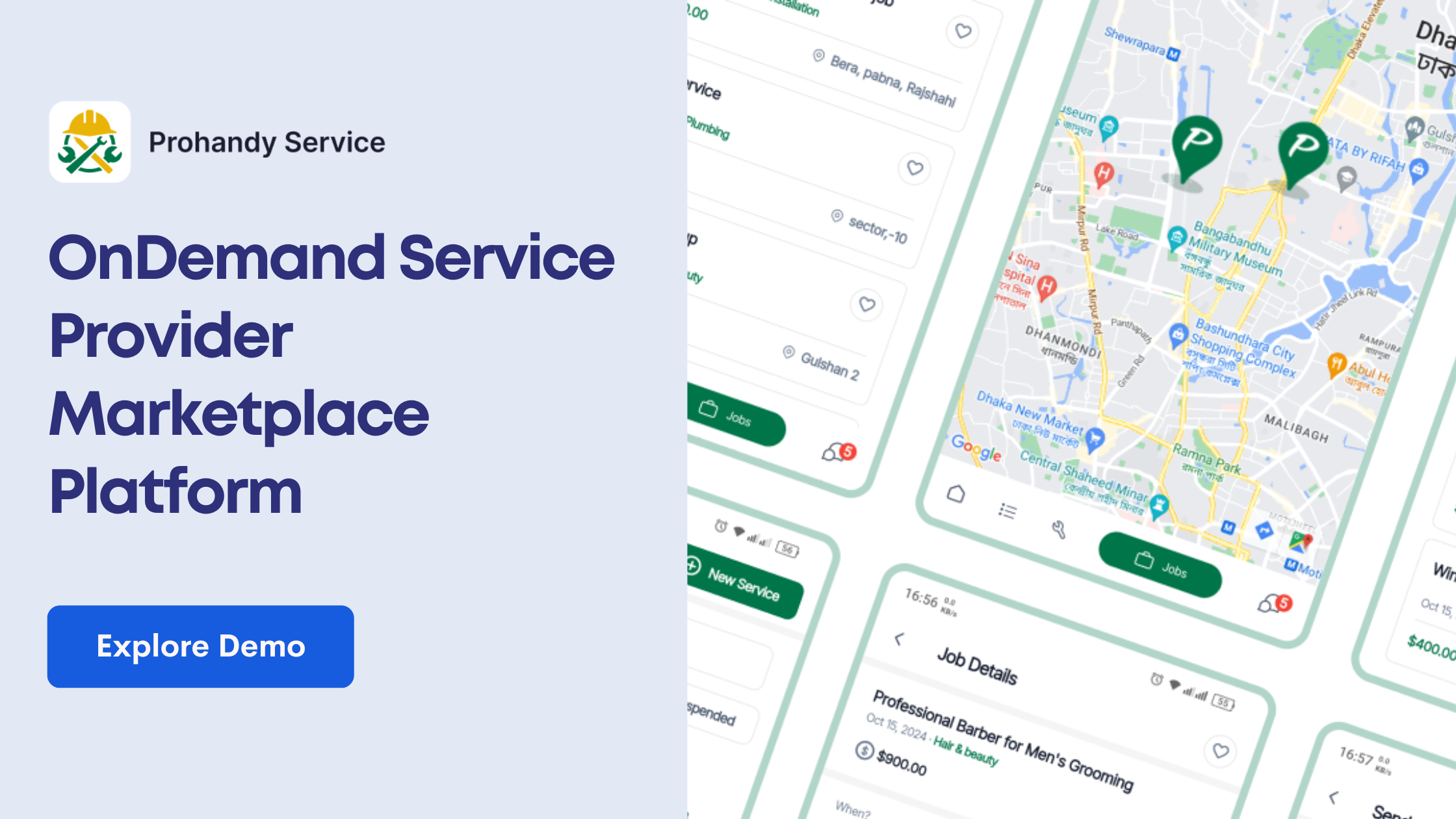
ProHandy is a Laravel and Flutter script with a customer app, a provider app and an admin panel. Out of the box it covers the MVP column above:
- Cart booking with add-ons, time slots and a preferred staff member
- Job posting: customers post a job and providers send offers with a cover letter, the closest match to TaskRabbit’s “choose your Tasker”
- Real-time chat, provider identity verification, provider withdrawals, coupons, tax, support tickets and an earnings report
- 19 payment gateways, multi-language, and country, state, city and area lists
The $39 Regular licence is the web platform and admin; the customer and provider apps and the premium plugins come in the $69 Everything Bundle. The apps use the latest Flutter, and the demo apps are on Google Play. ProHandy runs on PHP 8.0+ and MySQL, works on cPanel hosting, and includes free installation.
What ProHandy does not do yet: live map tracking of providers, provider subscription plans and a separate serviceman app are on our roadmap, not in the current release. If you need them at launch, plan custom work or compare other scripts in our best on-demand service marketplace scripts list.
Frequently asked questions
How much does it cost to build an app like TaskRabbit?
A custom MVP built by an agency is commonly quoted at $40K–$90K over 14–24 weeks (RaftLabs, November 2026). A ready-made script such as ProHandy costs $69 for web, admin and both apps, plus hosting and customisation.
How does TaskRabbit make money?
Taskers pay a one-time $25 registration fee, and clients pay a Service Fee and a Trust & Support fee on top of the Tasker’s rate, according to TaskRabbit’s support centre.
How long does it take to build a TaskRabbit clone?
A custom MVP typically takes 14–24 weeks. Starting from a script, most of the time goes into branding, setup, provider recruitment and app store publishing.
Do I need both a customer app and a provider app?
Yes, for a TaskRabbit-style marketplace. Providers need to receive and manage jobs on their phone, and customers expect to book and chat in an app.
Can I launch a TaskRabbit clone on shared hosting?
ProHandy runs on PHP 8.0+ and MySQL and works on cPanel hosting. As you grow, a VPS gives you more control over performance.
