



The HR manager at a 24-person agency I worked with recently was running performance reviews in Google Docs, attendance in a spreadsheet, leave requests in Slack, and payroll in a separate paid tool that did not talk to any of those. She had four systems that should have been one, and she was about to spend $400 a month on BambooHR to consolidate.
I asked her one question first: how many employees do you actually expect in 18 months? Answer: still around 25. BambooHR for 25 people is overkill. The best HR software for small business depends entirely on which version of small business you are, and most founders pick a platform built for a bigger company than they will ever be.
This piece walks through the seven HR platforms that genuinely deserve consideration when a small business is shopping. I rank them honestly using a 7-point scorecard rather than vendor marketing claims. Each pick has a “best for” tag so you can self-select rather than buying whatever pops up in a sponsored listicle. The best HR software for small business is the one that fits your team size and the way your business actually works.
I have placed our own product, Genius HRM, at position 3 because that is where it ranks for the team size it serves best (5 to 100 employees that want a complete free platform). The platforms at positions 1 and 2 (Gusto and BambooHR) are stronger for specific cases. The platforms at positions 4 through 7 are stronger for niche fits.
If you want the deeper free-only view, our free HR software for small business guide covers it. For the broader business software stack, the best free business software guide covers the wider Genius free suite. This piece is the seven-platform comparison of best HR software for small business, free and paid both.
Table of Contents
Why the best HR software for small business depends on team size
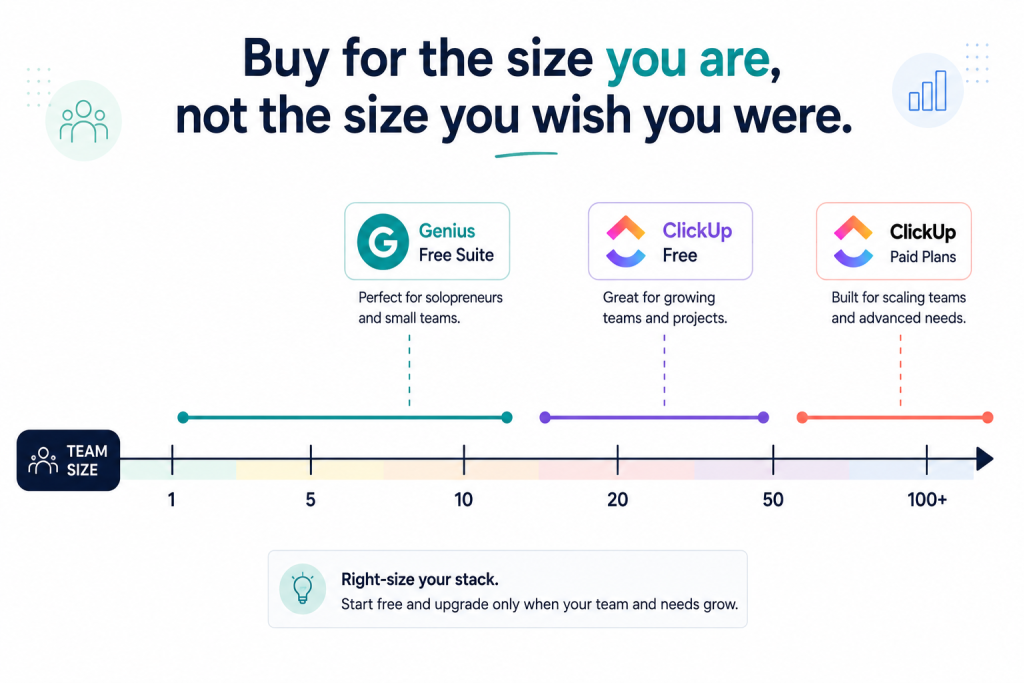
The single biggest mistake in HR software shopping is buying the platform you will need at 200 employees when you have 15 today. The HR software market has very different sweet spots: tools for 1 to 25 people, tools for 25 to 100, tools for 100 to 500, and tools for 500+. Each segment has its winners. Cross-segment buys waste money on features you do not use and create training overhead for people who will never touch them.
For 1 to 10 employees, most “HR software” is overkill. A spreadsheet, a shared calendar, and a payroll service cover the basics. The best HR software for small business at this size is the one you do not buy.
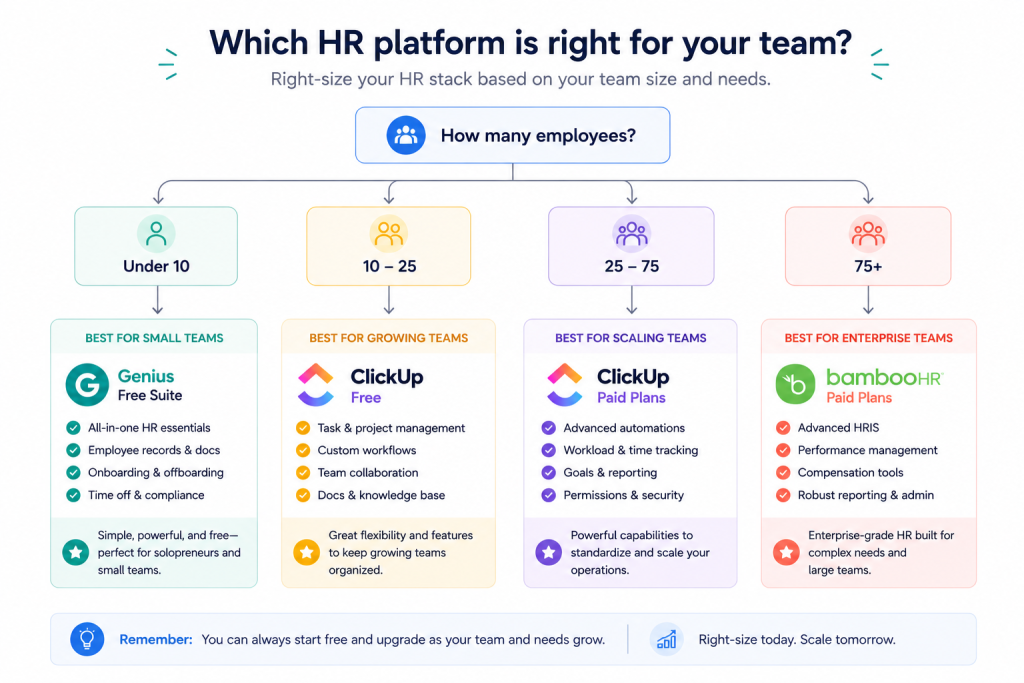
For 10 to 25 employees, the breakpoint hits. Manual processes start to fail. Leave requests get lost. Attendance gets fuzzy. Performance reviews skip a year. The best HR software for small business at this stage is one that handles the basics without forcing enterprise rituals (Genius HRM, Zoho People, Gusto for payroll-first teams).
For 25 to 100 employees, the segment most paid HR platforms target. BambooHR, Rippling, Gusto, and the upper tiers of Genius HRM all serve this range. The right pick depends on whether payroll, performance, or recruiting matters most.
For 100+ employees, enterprise HR platforms enter the picture (Workday, Oracle HCM, SAP SuccessFactors). These are not “small business” anymore and are outside the scope of this piece.
According to SHRM’s employee relations guidance, most HR software dissatisfaction comes from companies that bought for the wrong segment. The fix is not better software. It is better segment matching.
The 7-Point Small Business HR Scorecard framework
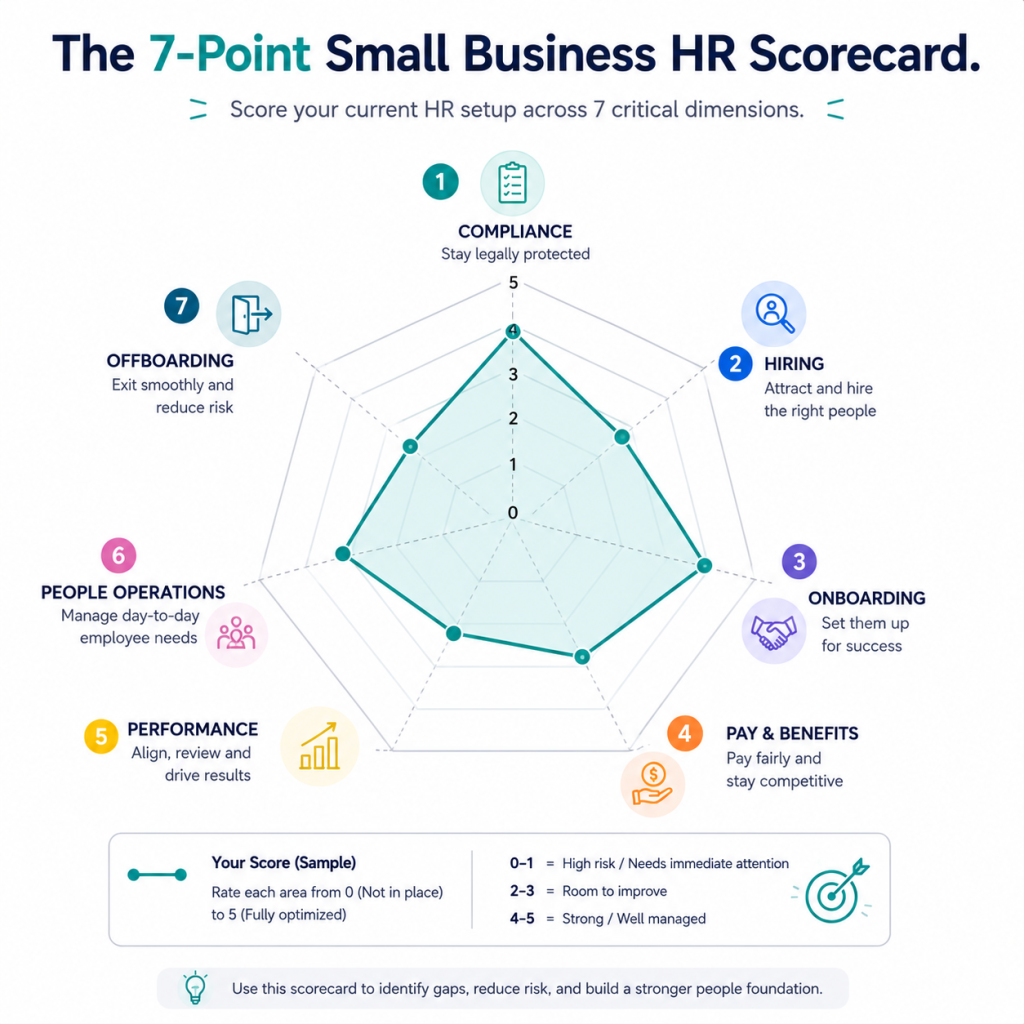
The 7-Point Small Business HR Scorecard rates each platform on seven dimensions that decide whether the best HR software for small business delivers in practice for the segment you fit. I order the dimensions by how much they affect daily satisfaction in a small business specifically.
The seven points:
- Employee directory and records quality
- Attendance and leave management
- Payroll capability (calculation, filing, payment)
- Performance reviews and goal tracking
- Recruiting and applicant tracking
- Total cost (license per employee per month, plus implementation)
- Time to value (how quickly the platform is live and useful)
Each platform below is scored 1 to 5 on each dimension, with total scores out of 35. I include the score in each pick. The SMBs I have advised weight cost and time-to-value much more heavily than enterprise teams do, because those two factors decide whether the platform gets used or shelved within three months.
A 5 on cost does not mean “expensive.” It means “best value for what you get.” A 5 on time-to-value means “live in a week, useful immediately.” A 5 on payroll means “calculates, files, and pays without manual intervention.” A 5 on recruiting means “you can run a hiring cycle inside the platform without leaving.”
The best HR software for small business depends on which dimensions matter most to you. Use the scorecard as a starting point. Adjust the weights based on your business stage. A 12-person team weights cost and time-to-value heaviest. A 75-person team starts caring more about performance and recruiting depth.
Pick 1: Gusto (best for payroll-led teams)
Gusto is the most-loved payroll-first HR platform in the US market. Around 300,000 small businesses use Gusto for payroll, with HR features layered on top. The platform is clean on payroll filing and tax handling, which is the single biggest pain point for most US small businesses.
The strengths are payroll automation (federal, state, and local tax filing handled), modern interface, fast onboarding, and the way Gusto handles contractor payments alongside W-2 employees. Benefits administration is integrated with major carriers for businesses in the states Gusto serves.
The trade-offs are price ($40 per month base plus $6 per employee on the Simple plan, more for higher tiers), US-only payroll filing (Gusto does not handle payroll for international teams), and lighter performance and recruiting features compared to BambooHR or Rippling.
Scorecard: Employee records 4, Attendance 3, Payroll 5, Performance 3, Recruiting 3, Cost 3, Time-to-value 5. Total: 26/35.
Best for: US small businesses where payroll is the primary HR pain. Gusto is the best HR software for small business teams that need clean payroll filing and want their HR layered on top of payroll rather than the other way around. Less of a fit if you operate internationally or need deep performance management.
Pick 2: BambooHR (best for 30 to 100 employees)
BambooHR is the most-installed dedicated HR platform for small to mid US businesses. The platform is built around the assumption that you have an HR person (or someone wearing the HR hat) who will use it daily, and it shines for teams large enough to justify that.
The strengths are clean employee records, strong performance review features, applicant tracking that works without a separate ATS, and a manager-friendly interface that non-HR people can use without training. Reporting is solid for HR-led conversations with leadership.
The trade-offs are price (Essentials at $6 per employee per month, Advantage at $8, both with $250+ implementation fees), payroll that requires the Advantage tier or a separate integration (Gusto, OnPay), and the fact that under 25 employees the platform feels heavier than the team needs.
Scorecard: Employee records 5, Attendance 4, Payroll 3, Performance 5, Recruiting 4, Cost 3, Time-to-value 3. Total: 27/35.
Best for: US small businesses in the 30 to 100 employee range with dedicated HR support. BambooHR is the best HR software for small business teams that have grown past Gusto’s HR depth and want a platform built for HR people specifically. Less of a fit for very small teams or for budget-constrained operations.
Pick 3: Genius HRM (best free option)
Genius HRM is our offering at Xgenious, included at position 3 because that is where it honestly ranks for the team size it serves best. I have scored it using the same 7-point scorecard as the other picks.
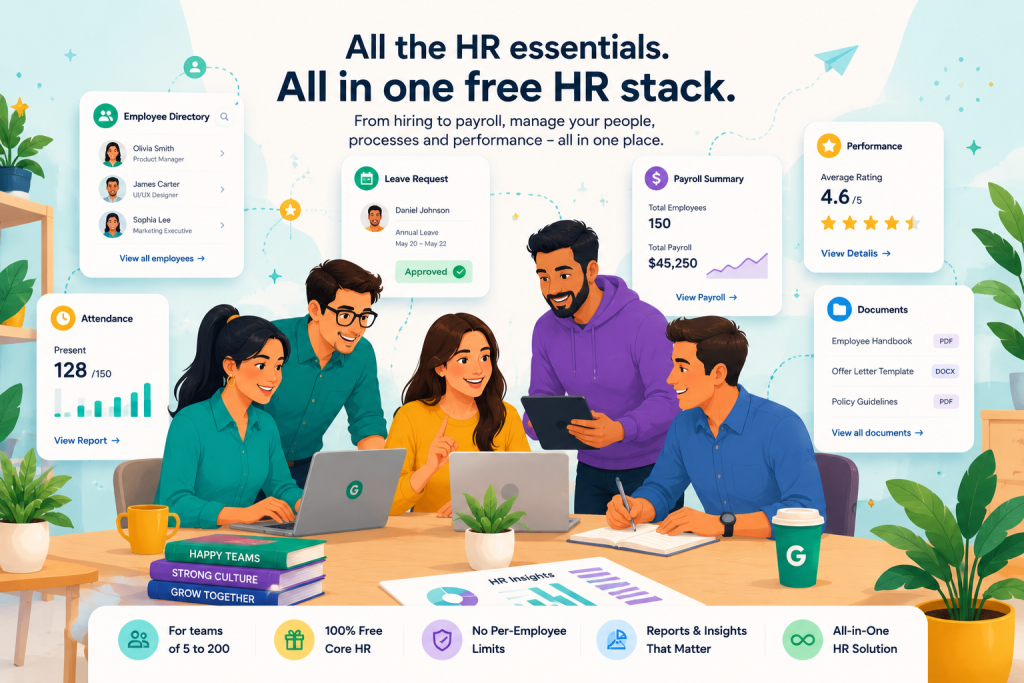
The strengths are price (free without per-employee limits), module completeness (the 8 functions from the Lean HR Stack: employee records, attendance, leave, payroll basics, performance, recruiting, document management, compliance reporting), and time to value (most small businesses are live within a week). Suitable for businesses from 5 to 200 employees.
The trade-offs are payroll filing (Genius HRM calculates payroll but does not file taxes; combine with Gusto or Patriot for that), benefits administration (records benefits but does not connect to insurance carriers), and dedicated vendor support (email response with same-week SLA, no 24/7 contracts).
Scorecard: Employee records 4, Attendance 4, Payroll 3 (calculation only), Performance 4, Recruiting 3, Cost 5, Time-to-value 5. Total: 28/35.
Best for: small businesses from 5 to 100 employees that want the best HR software for small business without per-employee subscription costs, and are willing to pair it with a dedicated payroll service for tax filing. Full details on the Genius HRM product page. Deeper feature audit in our free HR software for small business guide.
Pick 4: Zoho People (best for Zoho ecosystem)
Zoho People is the HR platform inside the Zoho One ecosystem. The platform makes most sense for small businesses already using Zoho CRM, Zoho Books, or Zoho Mail, because the integrations are tight and the single-sign-on works without extra configuration.
The strengths are integration with the broader Zoho suite, multi-country support (Zoho operates from India and supports international teams better than US-centric competitors), and pricing that scales gently. The free tier supports up to 5 employees. Paid tiers start at $1.25 per employee per month, which is the lowest in this comparison.
The trade-offs are the depth of payroll features (Zoho Payroll is a separate product available only in select countries), recruiting features that require a separate Zoho Recruit subscription, and an interface that some find dated compared to newer entrants.
Scorecard: Employee records 4, Attendance 4, Payroll 3, Performance 4, Recruiting 3, Cost 5, Time-to-value 4. Total: 27/35.
Best for: small businesses already using other Zoho products who want their HR data integrated with sales and finance. Zoho People is the best HR software for small business teams committed to the Zoho ecosystem, particularly for international operations.
Pick 5: Rippling (best for fast-growing teams)
Rippling is the most aggressive entrant in the small-to-mid HR market. The platform combines HR, IT, and finance into a single workflow, which makes onboarding particularly fast (a new hire’s HR record, laptop provisioning, Slack account, and payroll setup all happen in one workflow).
The strengths are the integrated HR-IT-finance approach, modern interface, global payroll capability (Rippling handles US plus 50+ other countries), and the speed at which new hires get fully set up. Strong for distributed teams that need to onboard remote employees in different jurisdictions.
The trade-offs are price (modular pricing typically lands $8 to $15 per employee per month once you add the modules you actually use), complexity (the platform has so much depth that small businesses can feel overwhelmed in the demo), and the fact that some modules require commitment-level pricing that locks in for a year.
Scorecard: Employee records 5, Attendance 4, Payroll 5, Performance 4, Recruiting 4, Cost 2, Time-to-value 3. Total: 27/35.
Best for: fast-growing small businesses (especially those with technical or distributed teams) that need integrated HR, IT, and finance from day one. Rippling is the best HR software for small business teams that expect to scale to 100+ employees within two years and want a platform that does not need replacing along the way.
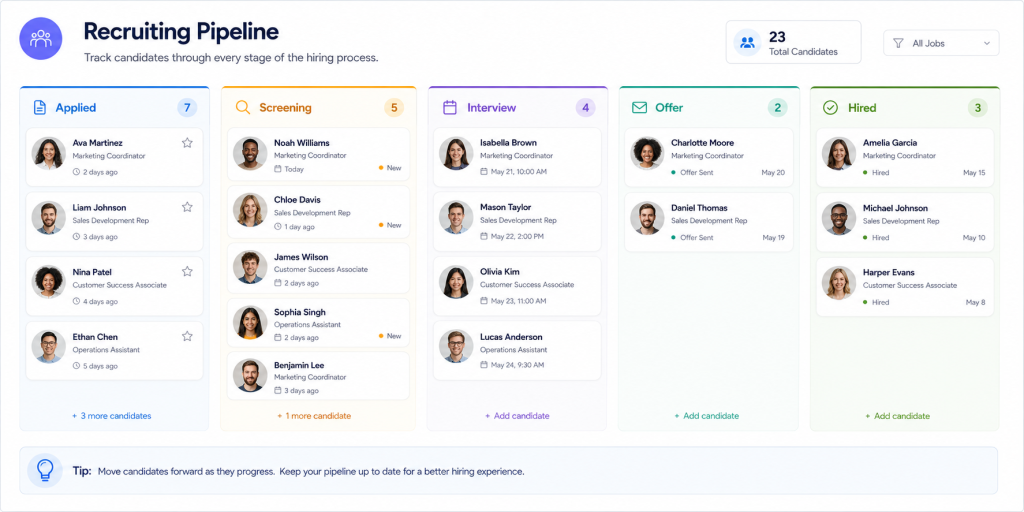
Pick 6: Freshteam (best for recruiting-heavy SMBs)
Freshteam is part of the Freshworks ecosystem and focuses specifically on the recruiting and onboarding side of HR. The platform is the right pick if your small business is hiring frequently (5+ new hires per quarter) and the standard HR features in BambooHR or Gusto are not enough on the recruiting side.
The strengths are the applicant tracking system (career site, job posting integration with LinkedIn and Indeed, candidate pipeline management, interview scheduling), the onboarding workflow (offer letters, e-signature, structured first-week experience), and integration with the broader Freshworks suite (Freshdesk, Freshservice).
The trade-offs are weaker core HR features (Freshteam is recruiting-first, with employee records and time off included but lighter than dedicated HR platforms), and pricing that adds up if you need both recruiting and HR depth (around $59 per month for the Pro tier, plus per-employee charges).
Scorecard: Employee records 3, Attendance 3, Payroll 2, Performance 3, Recruiting 5, Cost 3, Time-to-value 4. Total: 23/35.
Best for: small businesses where recruiting is the dominant HR activity. Freshteam is the best HR software for small business teams that hire 20+ new people per year and need an ATS more than they need deep payroll integration. Pair with a dedicated payroll service for the full HR stack.
Pick 7: OrangeHRM (best open source)
OrangeHRM is the most-established open-source HR platform. The community edition is genuinely free and self-hosted. A paid hosted version (OrangeHRM Advanced) is available for businesses that want the same platform without self-hosting overhead.
The strengths are module coverage (employee records, leave, attendance, recruiting, performance), the freedom to customise the platform (open source code, modifiable), and zero license cost for the community edition. Used by thousands of small and mid businesses globally.
The trade-offs are the self-hosting overhead (server costs, maintenance, security patching), an interface that has not been modernised at the pace of commercial competitors, and the fact that some advanced modules (claims management, recruitment workflow depth) are only in the paid Advanced edition.
Scorecard: Employee records 4, Attendance 4, Payroll 3, Performance 3, Recruiting 4, Cost 5 (community), Time-to-value 2. Total: 25/35.
Best for: small businesses with technical staff comfortable self-hosting, or those in countries where commercial HR platforms have limited presence and a customisable open-source option fits the local context. OrangeHRM is the best HR software for small business teams that prioritise customisation and zero license cost over modern UX and hands-off operation.
How to choose the best HR software for your team size
The seven picks cluster into four buyer profiles that map to small business shape.
For 1 to 10 employees: do not buy a dedicated HR platform yet. The best HR software for small business at this stage is the one you do not need. Use a spreadsheet for employee records, a shared calendar for leave, and a payroll service (Gusto, Patriot, or local equivalent) for payroll. Reassess at 12 employees.
For 10 to 25 employees: the breakpoint where manual processes start to fail. Genius HRM, Zoho People, or Gusto (if payroll is the dominant pain) are the strongest picks. Cost matters more than feature depth at this stage. Free or low-priced options usually win.
For 25 to 75 employees: the segment where most paid HR platforms shine. BambooHR is the dominant pick if HR depth matters. Gusto wins if payroll continues to be the focus. Genius HRM remains viable if budget is constrained. Rippling enters the picture if you expect to scale fast and want integrated HR-IT-finance.
For 75 to 200 employees: the upper edge of “small business.” BambooHR, Rippling, and Gusto Premium all compete here. The best HR software for small business at this scale depends on whether payroll, performance, or workforce-wide integration matters most.
For recruiting-heavy businesses at any size: Freshteam beats the others on the ATS side. Pair it with Gusto for payroll or Genius HRM for core HR.
For technical teams or international operations with limited budget: OrangeHRM Open Source is the strongest self-hosted pick. Zoho People is the strongest commercial-free option for international small businesses.
The best HR software for small business is not the highest-scored platform on the list. It is the platform that fits your team size and your operational style. Use the scorecard to map your priorities, then narrow to two or three options for a real evaluation. A 90-minute demo with your real data tells you more than 30 hours of marketing pages.
For broader market trends, HR Dive industry coverage and Deloitte’s Global Human Capital Trends cover the wider context.
What the best HR software for small business will look like at 50 employees
The best HR software for small business at 50 employees looks different from what it looks like at 15 employees. Knowing the shape in advance helps you pick a platform you will not outgrow in 18 months.
At 50 employees, the HR function starts needing dedicated time. Someone is the HR person, whether or not “HR” is in their job title. They spend 10 to 20 hours a week on HR work. The software has to support that work without being either too simple (tools for 5-person teams that hit ceilings) or too complex (enterprise tools that need a certified administrator).
The features that start mattering at 50 employees:
- Multi-level approval workflows (manager approves leave, HR confirms, payroll sees it)
- Org chart functionality with reporting lines and team structures
- Performance review cycles with goal-setting and peer feedback
- Benefits administration with carrier integration
- Compliance reporting (EEO-1 in the US, similar elsewhere)
- Document e-signature for offer letters and policy acknowledgments
- Asynchronous onboarding workflows for distributed hires
At this scale, the dimensions on the 7-Point Scorecard that matter most shift from cost and time-to-value to employee records depth, performance, and payroll filing. The best HR software for small business at 50 employees is one that handles those three dimensions cleanly.
The platforms that handle the 50-employee transition well: BambooHR (designed for this size), Rippling (integrated HR-IT-finance works well), Gusto (if payroll remains the focus and benefits matter), and Genius HRM with a paired payroll service (for budget-constrained operations). Zoho People and Freshteam tend to feel limited at 50 employees unless used in combination with other Zoho or Freshworks tools.
If you are 20 employees today and expecting to hit 50 within 18 months, pick a platform that will scale through that transition rather than one that will need replacing.
Common mistakes when picking small business HR software
A few mistakes show up repeatedly when small businesses pick the best HR software for small business.
Mistakes One
The first is buying for the company you wish you were rather than the company you are. A 12-person team that buys BambooHR because they plan to grow to 100 in three years usually finds the platform overwhelming and underused. The math is simple: pay for what you have plus a 50 percent growth buffer, not for what you might become in three years.
Mistakes Two
The second mistake is underestimating payroll complexity. Calculating gross-to-net is easy. Filing taxes across multiple US states, handling 1099 contractors alongside W-2 employees, and reconciling year-end W-2s and 1099-NEC forms is hard. The best HR software for small business teams handling multi-state US payroll is one that files taxes for you (Gusto, Rippling), not one that exports a spreadsheet.
Mistakes Three
The third is ignoring the implementation timeline. BambooHR’s “implementation fee” buys you a checklist and a few support calls, not a hands-on consultant. Plan for 4 to 8 weeks of internal time to load data, configure workflows, and train staff. Free platforms like Genius HRM cut this to 1 to 2 weeks but the work is still on your team. Budget the time.
Mistakes Four
The fourth is buying without involving the people who will use it daily. The HR person (or hat-wearer) and the office manager have to be in the demo. Their veto carries more weight than the founder’s. The platform that makes them faster gets adopted. The platform that makes them slower gets resented.
Mistakes Five
The fifth is locking into multi-year contracts to save 10 percent. Annual contracts are usually fine. Multi-year deals trade future flexibility for marginal discount. At small business stage, you do not know what your HR needs will be in three years. Avoid the long lock-in.
Free vs paid HR software for small business
The free vs paid decision for the best HR software for small business is not binary. It is a phased decision tied to specific upgrade triggers.
The case for staying free (Genius HRM, OrangeHRM Open Source, Zoho People Free at low headcount):
- Under 30 employees with simple payroll needs (or paired with a dedicated payroll service)
- Single jurisdiction operation
- No complex benefits administration with carrier integration
- Email or community support is acceptable
- You want to test HR processes before committing to paid software
The case for switching to paid (BambooHR, Gusto, Rippling):
- Past 30 employees and HR is taking 15+ hours per week to run on free tools
- Multi-state US payroll filing becomes a regular pain point
- Benefits administration with carrier integration becomes required
- You need vendor support contracts with response-time SLAs
- Compliance requirements specific to your industry need certified platforms (SOC 2, HIPAA, GDPR for EU data)
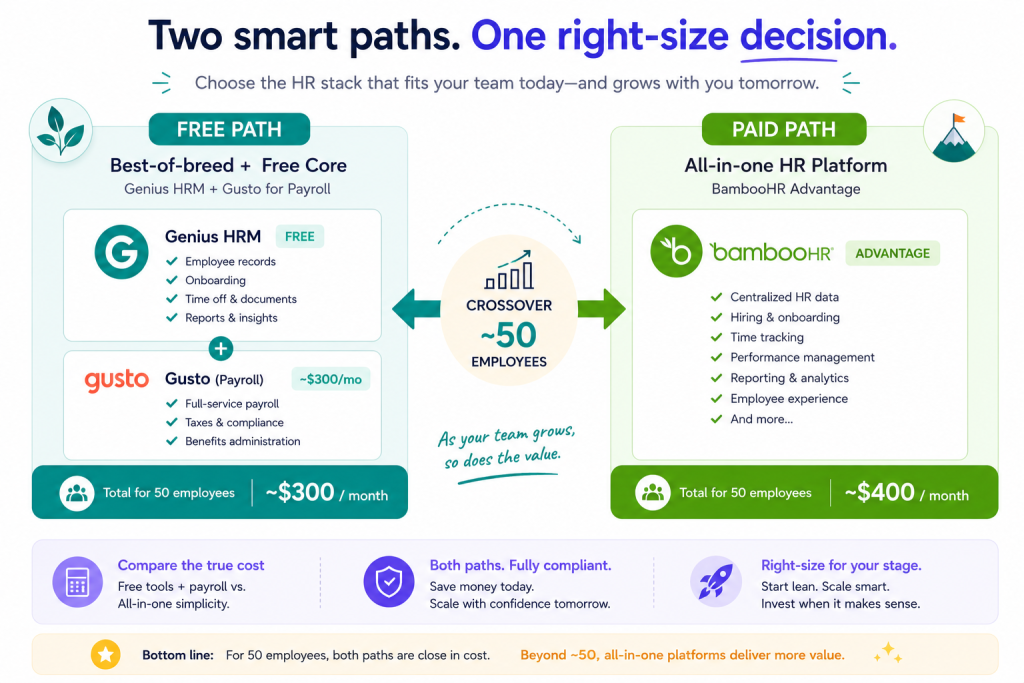
The migration moment is usually somewhere between 30 and 60 employees, when the cumulative time cost of running HR on free tools exceeds the license cost of a paid platform. For a $6 per employee per month platform with 50 employees, the bill is $300 per month, or about $3,600 per year. If the paid platform saves 8 hours per month of HR time (at $40 per hour blended cost), that is $3,840 per year of saved time. The math justifies the switch.
The pattern we see most often is: small businesses start on free HR (Genius HRM is common), validate the HR processes they actually need, and switch to paid only when a specific trigger fires. The best HR software for small business is one that supports clean data export so the eventual migration is painless.
Final word on the best HR software for small business
The best HR software for small business is the one that fits your team size, your dominant HR pain, and your budget. The seven platforms above cover the main shapes of small business HR buyer: US payroll-first (Gusto), HR-led mid-market (BambooHR), free-and-complete (Genius HRM), Zoho ecosystem (Zoho People), fast-growing integrated (Rippling), recruiting-heavy (Freshteam), and open-source self-hosted (OrangeHRM).
Use the 7-Point Small Business HR Scorecard to map your priorities first, then narrow to two or three options for real evaluation. Most small businesses spend more time reading comparison articles than evaluating platforms, which is backwards. A 90-minute demo with your real data tells you more than 30 hours of marketing pages.
If your team is in the 5 to 100 employee range with budget constraints, Genius HRM is our offering at Xgenious and the option I would pick if I were running an SMB today. Free without per-employee limits, covers all 7 scorecard dimensions cleanly, and easy to migrate away from if a specific paid trigger fires later. Deeper feature audit in our free HR software for small business guide. For the broader free business software view, the best free business software guide covers the wider Genius suite. Whatever route you take, run the scorecard first. The scorecard separates real HR software decisions from auto-renewals you regret six months in.
Frequently asked questions about the best HR software for small business.
What is the best HR software for small business overall?
There is no single best HR software for small business for every team, which is why this article scored 7 platforms against a 7-point scorecard rather than picking one. Gusto is the best for US payroll-led teams. BambooHR is the best for 30 to 100 person HR-led operations. Genius HRM is the strongest free option. Rippling is the best for fast-growing teams that need integrated HR-IT-finance. Freshteam is the best for recruiting-heavy SMBs. The best HR software for small business depends on your team size and dominant HR pain.
What is the cheapest HR software for small business?
The cheapest HR software for small business is the free options: Genius HRM (hosted, no per-employee limit), Zoho People Free Tier (up to 5 employees), and OrangeHRM Community Edition (self-hosted, free license). Among paid platforms, Zoho People paid tier (from $1.25 per employee per month) is the lowest entry point. Gusto at $40 + $6 per employee per month is the cheapest US payroll-integrated platform. Total cost includes implementation and training, so factor those in when comparing.
How long does HR software implementation take?
Implementation time varies. Genius HRM and Zoho People can be live in 1 to 2 weeks for a clean small business. BambooHR and Gusto typically take 3 to 6 weeks including data migration and staff training. Rippling can take 4 to 8 weeks because of the cross-functional setup (HR + IT + finance modules). OrangeHRM self-hosted varies based on technical readiness. Plan implementation during a calm period rather than during hiring spikes or year-end.
Should I pick free or paid HR software for my small business?
If your small business has fewer than 30 employees, simple payroll needs, and limited budget, free HR software covers your usage cleanly. As you scale past 30 employees, the case for paid platforms strengthens because payroll filing, benefits administration, and vendor support start saving more time than the license fees cost. The best HR software for small business often starts as a free option and migrates to paid when specific triggers fire (multi-state payroll, benefits, compliance certifications).
What HR software handles payroll for small business?
The HR platforms that handle full US payroll (calculation, tax filing, direct deposit) are Gusto, Rippling, BambooHR Advantage tier, and ADP Run. Most other HR platforms (Genius HRM, Zoho People, OrangeHRM) calculate payroll but require a separate payroll service for tax filing. The clean pattern for a small business with constrained budget is to use free HR software paired with a dedicated payroll service (Gusto stand-alone at $40 + $6 per employee).
Can HR software handle multi-country small businesses?
Most US-focused HR platforms (Gusto, BambooHR, Genius HRM US edition) handle US operations cleanly but struggle with international payroll. The best HR software for small business teams operating internationally is Rippling (handles US plus 50+ countries) or Zoho People (strong international coverage from the Indian-headquartered Zoho parent company). For very international teams, a global payroll provider like Deel or Remote layered on top of any HR platform is often the cleanest pattern.
How do I migrate from one HR platform to another?
Migration is the biggest reason small businesses delay switching HR platforms. The serious platforms include import tools that handle CSV imports of employee records, attendance history, and leave balances. The migration usually takes 2 to 6 weeks depending on data volume. Plan migration during a calm period (not during hiring spikes or year-end), run both systems in parallel for at least one payroll cycle, and budget time to retrain staff on the new platform.