



On-demand home services business models are how companies like Urban Company and TaskRabbit turned booking a plumber or a cleaner into a few taps on a phone. If you want to own a home services business in 2026, the on-demand home services business model you pick on day one shapes everything after it: your costs, your control, how fast you scale, and how you make money.
The demand is real. The online on-demand home services market is projected to grow from about 5.92 billion dollars in 2025 to 6.79 billion in 2026, a roughly 14.8 percent jump, according to The Business Research Company. People want convenience, and they are willing to pay for it.
This guide breaks down the eight on-demand home services business models worth knowing in 2026, the pros and cons of each, what they cost to build, and how to choose. I will be straight about the trade-offs, because the model that looks best on paper is often the hardest to run well. By the end you will know which on-demand home services business model fits your budget, your team, and your goals.
Key takeaways
- An on-demand home services business model decides your control, cost, scale, and revenue, so choose it before you build anything.
- The three core models are single vendor, multi-vendor aggregator, and lead generation. Five more (hybrid, subscription, franchise, labor marketplace, and white-label SaaS) suit specific goals.
- The aggregator model scales fastest but depends on providers you do not employ, so quality control becomes the real work.
- Lead generation is the cheapest and lightest to launch, while the single vendor model gives you the most control over quality.
- The fastest way to launch any of these is a ready-made platform like Prohandy, not a year of custom development.
Table of Contents
What is an on-demand home services business?
An on-demand home services business connects customers who need a household task done with the professionals who can do it, through an app or website. Cleaning, plumbing, electrical work, beauty services, appliance repair, and pest control all fit. The customer books, the provider shows up, and the platform sits in the middle making it smooth.
What makes it on-demand is speed and convenience. Instead of calling around for quotes, a customer opens an app, picks a service, sees a price, and books a slot. That simple flow is what has pulled billions of dollars into the sector.
The part that trips up new founders is thinking the app is the business. It is not. The business is the on-demand home services business model behind it: who delivers the service, who sets the price, and how the money flows. That is what we are here to sort out.
Why the business model decision matters so much
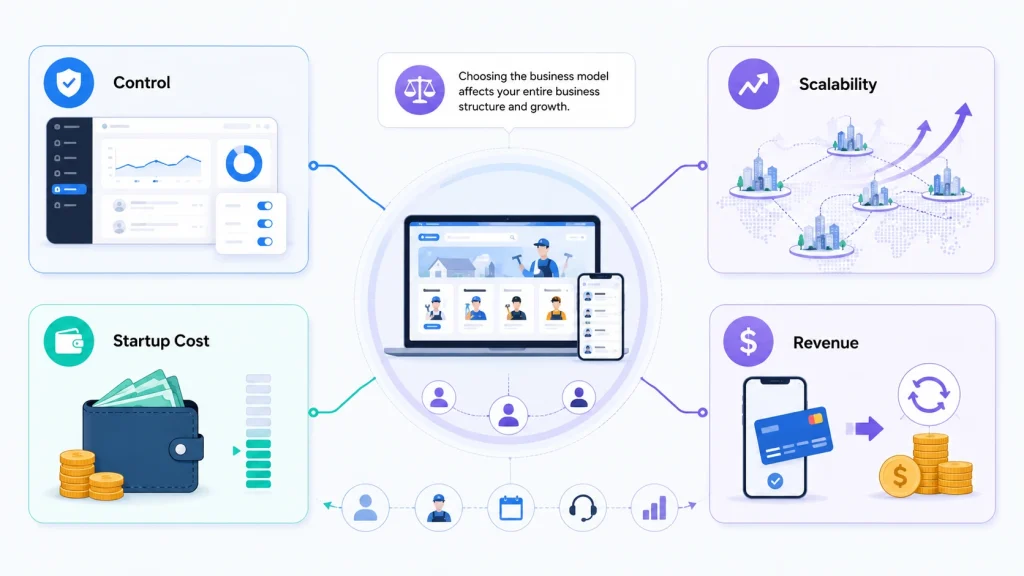
Pick the wrong on-demand home services business model and you can spend a year building something that does not fit your resources. Pick the right one and you grow with far less friction. The model decides four things that are hard to change later.
1. It decides your control.
Do you deliver the service yourself, or do independent providers do it under your roof? More control means more quality but more operational weight.
2. It decides your cost.
Some models need a fleet of staff and heavy operations. Others run lean with a small team and software.
3. It decides your scale.
One model tops out in a single city. Another can spread across regions without you lifting a finger on delivery.
4. It decides how you make money.
Flat fees, commissions, subscriptions, or paid leads. Your model and your revenue stream have to match, or the numbers never work.
An on-demand home services business model is not set in stone. Plenty of companies start with one model and shift as they learn what their market wants. What matters is starting with the on-demand home services business model that fits your resources today, not the one that looks best in a pitch deck. Get the first version live, learn from real bookings, and let the business evolve from there.
The 8 on-demand home services business models at a glance
Before the deep dive, here is the whole picture in one table so you can compare the eight on-demand home services business models on the levers that matter.
| # | Model | Control | Scalability | Startup cost | How you earn |
|---|---|---|---|---|---|
| 1 | Single vendor (managed) | High | Low to medium | Medium | Direct service fees |
| 2 | Multi-vendor aggregator | Medium | High | High | Commission, subscriptions, ads |
| 3 | Lead generation (directory) | Low | High | Low | Pay-per-lead, paid listings |
| 4 | Hybrid managed marketplace | Medium to high | Medium to high | High | Commission plus premium service fees |
| 5 | Subscription / membership | Medium | Medium | Medium | Recurring monthly plans |
| 6 | Franchise / area license | Medium | High | Medium | License fees plus royalties |
| 7 | On-demand labor marketplace | Low to medium | High | Medium | Commission on hourly bookings |
| 8 | White-label SaaS platform | Low | Very high | Medium to high | Software subscriptions from operators |
Now let us look at each one properly.
1. Single vendor model
In the single vendor model, the platform provides all the services itself, using in-house staff or contractors hired under your brand. You control the whole experience end to end: who does the work, what it costs, and how it feels for the customer. Think of a cleaning company that owns its own fleet and books every job through its own app.
This is the on-demand home services business model to start with if quality is your edge. Because every worker is yours, you can train them, standardize the service, and build a brand people trust. The downside is weight. You carry payroll, scheduling, equipment, and every operational headache that comes with actually delivering the service.
Pros: full control over quality and brand, consistent customer experience, simpler to launch in one city, no need to recruit outside vendors.
Cons: high operational load, harder to scale beyond your local area, costs rise with every new worker and vehicle.
How you make money: flat service charges, premium pricing for urgent or after-hours bookings, and service packages or memberships.
Best for: local startups that want an on-demand home services business model where they start small, own their quality, and grow deliberately in one market before expanding.
If you are drawn to this route, our list of profitable on-demand service business ideas is a good place to find your niche.
2. Multi-vendor aggregator model
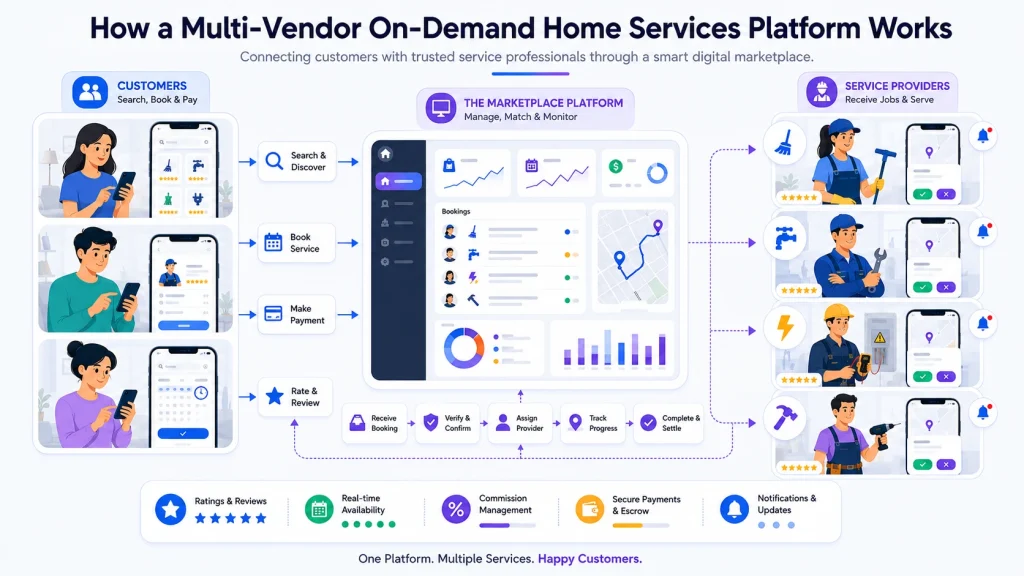
The multi-vendor aggregator is the Uber approach to home services. You build the platform, independent providers register and list their services, and customers book them through you. You do not deliver the work. You run the marketplace that makes the match and takes a cut. This is the most scalable on-demand home services business model, and it is what Urban Company and TaskRabbit are built on.
The appeal is obvious. You grow fast without hiring an army, because your providers are the workforce. The catch is trust. Your reputation rides on people you do not employ, so screening, ratings, and quality control become the real work. Get onboarding wrong and one bad provider can sour a customer on your whole brand.
Pros: scales across cities and service types, low delivery cost since vendors do the work, multiple revenue streams, network effects as more vendors attract more customers.
Cons: you depend on vendor quality you do not fully control, onboarding and vetting are constant work, it is a two-sided marketplace so you must grow supply and demand at the same time.
How you make money: commission on each booking, subscription fees from vendors, and featured listings or ads.
Best for: founders who want to scale and are ready to invest in vendor management and a solid platform.
Getting good providers on board is the hardest part, so read our guide to onboarding service providers before you launch.
3. Lead generation model
The lead generation model is the lightest of the core three. You do not process bookings or handle payments. Customers post what they need, and you sell those leads to registered professionals, or let providers bid for the job. Your product is the connection, not the service.
This is the easiest on-demand home services business model to build technically, and vendors like it because they only pay for warm leads. The weakness is that you own less of the experience. You cannot guarantee the job gets done well, and without booking or payment control, your relationship with the customer is thin. It works best in higher-value niches where a single lead is worth real money.
Pros: cheapest and fastest to build, no payment or delivery logistics, high vendor adoption since they pay only for leads.
Cons: little control over service quality, weak customer relationship, revenue depends on constant lead volume.
How you make money: pay-per-lead, premium subscriptions for better visibility, and verified badge sales.
Best for: niche or high-ticket services like home renovation, moving, or wellness, where each lead carries strong value.
This model rewards good content and SEO, since you win by capturing search traffic. Our marketing strategies for on-demand businesses covers how to pull in both customers and providers.
4. Hybrid managed marketplace model
The hybrid model sits between single vendor and aggregator, and it is where a lot of maturing platforms end up. You keep a core of vetted, quality-controlled providers (sometimes your own staff for premium jobs) while also letting independent vendors list on the platform. Customers get the reliability of a managed brand with the selection of a marketplace.
This on-demand home services business model gives you the best of both worlds, but it also carries both sets of costs. You run vendor management and some in-house operations at the same time. It is a strong model once you have proven demand and want to raise quality without giving up scale.
Pros: stronger quality control than a pure aggregator, still scalable, lets you charge premium prices for a managed tier.
Cons: more complex to operate, higher cost than either pure model, needs mature processes.
How you make money: commission on marketplace bookings plus higher fees on managed, premium jobs.
Best for: platforms that have outgrown a pure aggregator and want an on-demand home services business model that competes on trust as well as selection.
5. Subscription and membership model
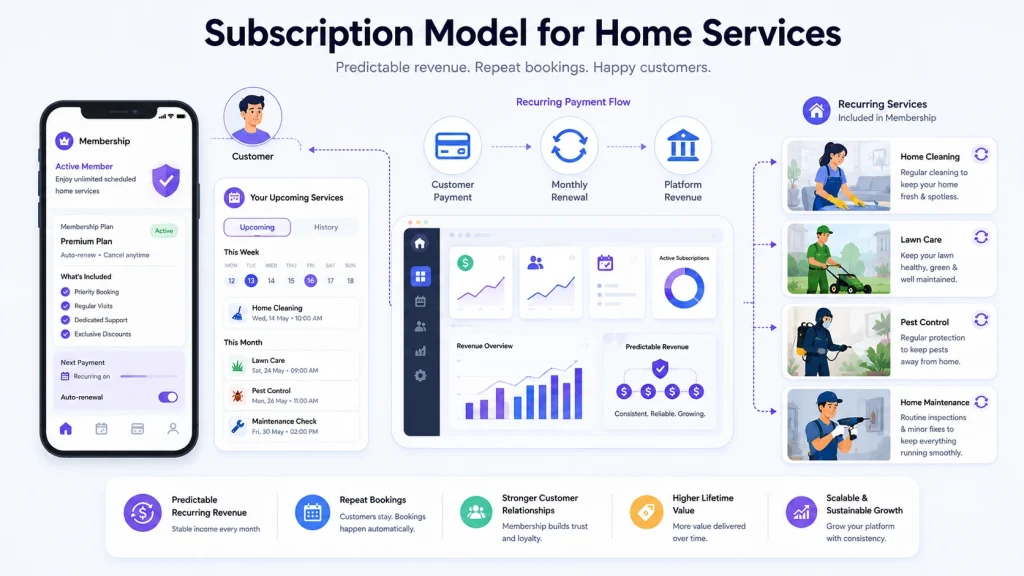
Instead of charging per job, the subscription model charges customers a recurring fee for regular services. A weekly cleaning, monthly pest control, or a seasonal maintenance plan all fit. The platform can layer this on top of any delivery model, but it changes the economics completely: revenue becomes predictable, and customer lifetime value climbs.
This on-demand home services business model is rising fast across the sector because recurring revenue stabilizes a business that would otherwise ride booking spikes. The trade-off is that you have to earn the renewal every month, so service quality and reliability matter even more.
Pros: predictable recurring revenue, higher customer lifetime value, stronger retention.
Cons: you must deliver consistently to keep members, harder to sell up front than a one-off booking.
How you make money: recurring monthly or annual membership fees, often with add-on charges for extra services.
Best for: any on-demand home services business model built around services people need on a regular schedule, like cleaning, lawn care, or maintenance.
6. Franchise or area license model
In the franchise model, you build the brand, the platform, and the playbook, then license the right to run it in a specific city or region to local operators. They handle local delivery and marketing under your name; you collect a license fee and ongoing royalties. It is how service brands expand across regions without operating every location themselves.
This on-demand home services business model scales through partners rather than headcount, which is powerful, but it lives or dies on the strength of your brand and systems. If your playbook is weak or your quality control across franchisees slips, the brand suffers everywhere at once.
Pros: scales across regions using partners’ capital and local knowledge, recurring royalty income, brand grows without you running every market.
Cons: you need a proven, documented system, quality control across operators is hard, slower to set up than a pure app model.
How you make money: upfront license fees plus ongoing royalties on each franchisee’s revenue.
Best for: established brands with a repeatable playbook that want national or regional reach.
7. On-demand labor marketplace model
The labor marketplace focuses on hourly, task-based help rather than fixed services. Customers book a person for a block of time to move furniture, assemble flat-pack, mount a TV, or run errands. TaskRabbit is the classic example. It is a cousin of the aggregator, but the unit is labor by the hour, not a defined service with a set price.
This on-demand home services business model is flexible and covers the long tail of odd jobs that do not fit neat categories. The challenge is pricing and trust, since the work is variable and the outcome depends heavily on the individual worker.
Pros: covers a huge range of tasks, flexible for both sides, scales like an aggregator.
Cons: variable quality, harder to standardize pricing, trust and safety are critical.
How you make money: commission on each hourly booking, plus optional service or booking fees.
Best for: general-help and handyman-style platforms that want an on-demand home services business model covering many task types rather than a single-service niche.
8. White-label SaaS platform model
The most different model here is not running a home services business at all, it is selling the software that powers one. In the white-label SaaS model, you provide the platform and other operators pay you a subscription to launch their own branded home services business on it. Your customers are entrepreneurs, not homeowners.
This on-demand home services business model has very high margins and scales without any service delivery, but it is a software business with software problems: you need a genuinely strong, reliable product and real support. It suits technical founders more than operators, and it is the one on-demand home services business model where your product is the platform itself. It is also exactly the gap a ready-made platform fills for everyone choosing the other seven models.
Pros: very high margins, no service delivery, scales like any SaaS, recurring revenue.
Cons: you are building and supporting real software, competitive space, needs ongoing development.
How you make money: monthly or annual software subscriptions, tiered by features or usage.
Best for: technical teams who would rather sell the tools than run the operation.
What each model costs to build
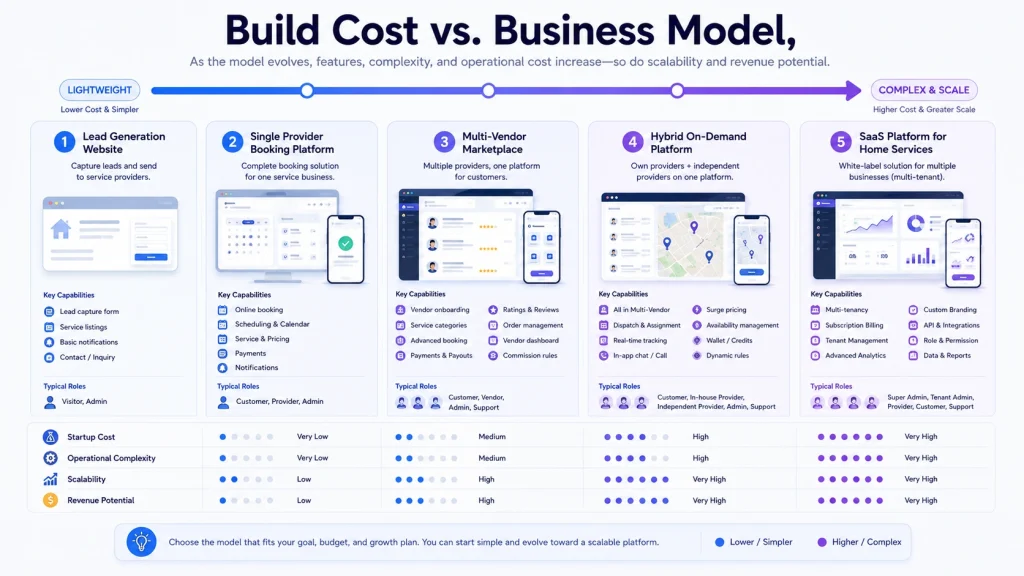
Budget is where a lot of founders get an unpleasant surprise, so here is a realistic picture. These are rough ranges, not quotes, and they move with features and location.
A lead generation platform is the cheapest. You need listings, a job-posting flow, and a way to sell leads. A single vendor managed platform sits in the middle on software but adds real operational cost for staff, equipment, and scheduling. A multi-vendor aggregator, a hybrid, or a labor marketplace is the priciest to build well, because you need provider apps, customer apps, payments, ratings, dispatch, and an admin panel that ties it together. Subscription and franchise models add billing and operator-management layers on top of whichever delivery model you choose.
The smart move for any of these on-demand home services business models is to not build from scratch. A ready-made platform gets you to market in weeks instead of months and costs a fraction of custom development. That is exactly what Prohandy is for. It is a self-hosted, multi-provider home services platform with Flutter apps for customers and providers and a Laravel admin panel, so you can launch an aggregator or hybrid model without paying for a year of development. If you are leaning toward the single vendor or lead-gen route instead, it still gives you a strong foundation to adapt.
How to choose the right on-demand home services business model
There is no single best model, only the best fit for your situation. Run through these four questions honestly and the answer usually becomes clear.
Who is your target market?
Urban professionals often expect instant, same-day booking, while smaller towns may value flexible scheduling and trust over speed. Match the on-demand home services business model to how your customers actually behave.
What resources do you have?
Your budget, team size, and tech skills decide what is realistic. A single vendor model needs operational muscle. A lead generation model can run lean with a couple of people.
What is your team good at?
If you have people strong in logistics and customer service, the managed or hybrid model plays to that. If your strength is software, the white-label SaaS model may fit better than running operations.
How far do you want to scale?
Staying local points you toward single vendor. Planning to spread across regions points you toward the aggregator, franchise, or SaaS models, which grow without piling operational load on you for every job.
If you want a deeper walkthrough of turning the model into a live business, read how to build an on-demand service business online.
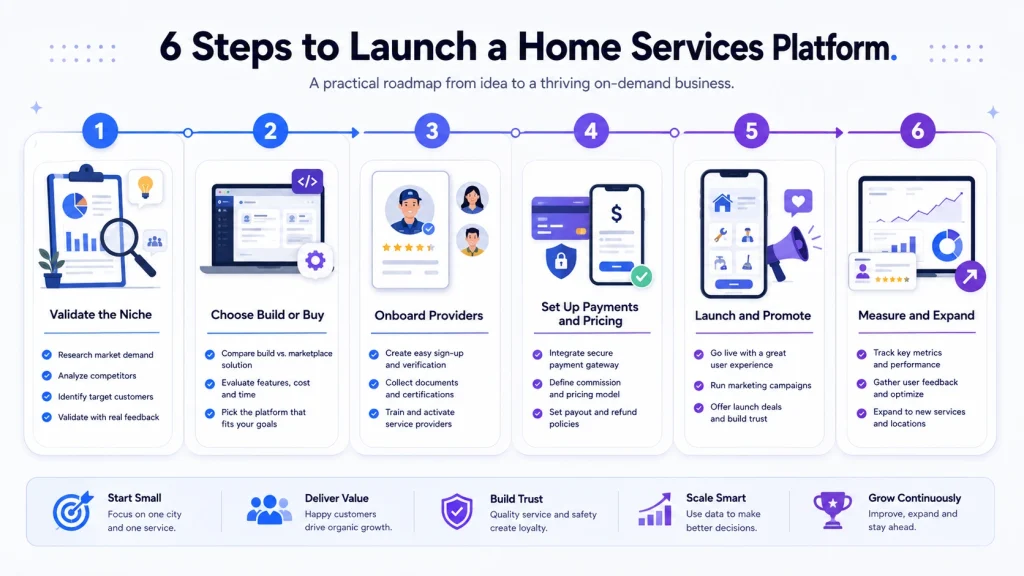
How to launch your platform step by step
Once you have chosen your on-demand home services business model, the path to launch follows the same shape.
Step 1: Validate the niche.
Pick one service and one area to start. A focused launch, say home cleaning in one city, is far easier to get right than ten services across a region. Talk to real customers and providers before you build anything.
Step 2: Choose build or buy.
Decide whether to develop custom software or start from a ready-made platform. For most founders, a ready-made solution like Prohandy is faster and cheaper, and you can customize it as you grow.
Step 3: Onboard your first providers.
For aggregator, hybrid, and lead-gen models, supply comes first. Line up a small group of vetted, reliable providers before you chase customers, so early bookings actually get fulfilled well.
Step 4: Set up payments and pricing.
Connect your payment gateways and decide your revenue model, whether that is commission, flat fees, subscriptions, or pay-per-lead. Test a real booking end to end before launch.
Step 5: Launch small and promote.
Go live in your one niche and one area, then push hard on local marketing and SEO. Track quality closely and fix problems fast while you are small enough to do so.
Step 6: Measure and expand.
Once bookings are steady and quality holds, add services or new areas. Real-time tracking and ratings help you keep standards up as you grow. Our guide on real-time tracking systems for service platforms is useful here.
On-demand home services trends shaping 2026
The models are stable, but how they run is shifting. A few trends are worth building into your plan.
Smartphone-first booking is now the default, not an option. Your customer app has to be fast and clean or you lose the booking, and providers increasingly expect a mobile app too.
Remote diagnostics are growing. Urban Company rolled out a tool that lets customers show a plumbing or electrical problem through their phone camera, used across millions of bookings. Features like this raise customer expectations for every platform.
Subscriptions are rising across the sector. More platforms are moving customers onto recurring plans for regular services like cleaning, which is why the subscription model earned its own place on this list.
Asia-Pacific is the fastest-growing region, driven by rapid urbanization. If you are outside saturated Western markets, there is real room to build.
Real-world examples of on-demand home services business models
Seeing these on-demand home services business models in action makes the choice easier. Each of the big names built on one of the approaches above.
Urban Company is the clearest example of the aggregator model. It connects vetted independent professionals with customers across cleaning, beauty, and repair, taking a commission on each booking, and it has leaned hard into technology to scale that model to its full potential.
TaskRabbit runs the labor marketplace model, matching Taskers with people who need help moving, assembling furniture, or handling odd jobs by the hour. The platform handles discovery, booking, and payment while independent workers do the actual tasks.
A local cleaning company that owns its staff and books only through its own app is the single vendor model in practice. Meanwhile, home improvement directories that sell customer leads to contractors show the lead generation model at work, and a brand that licenses its system to local operators is running the franchise model.
The lesson across all of them is the same. The winners picked one on-demand home services business model, matched it to their market, and executed it well rather than trying to be everything at once.
Mistakes to avoid
A few errors sink new platforms regardless of the on-demand home services business model. Watch for these.
- Choosing the model before knowing your market. Fit the on-demand home services business model to your customers and resources, not to what sounds impressive.
- Building everything from scratch. Custom development eats months and budget. A ready-made platform gets you live faster and cheaper.
- Chasing customers before you have providers. In aggregator, hybrid, and lead-gen models, empty supply means unfilled bookings and lost trust.
- Ignoring quality control. One bad job spreads through reviews. Ratings and vetting are not optional.
- Spreading too wide too early. Nail one service in one area before you expand across regions.
Final Verdict
The eight on-demand home services business models each suit a different founder, and there is no universally correct answer. The best on-demand home services business model is simply the one that matches your money, your market, and your team right now. The single vendor model gives you control and quality for a focused local launch. The aggregator and hybrid models give you scale if you can manage vendors. Subscription and franchise models change how you earn and expand, the labor marketplace covers the long tail of odd jobs, and the white-label SaaS model sells the tools instead of the service. Match the model to your situation, and you will not waste a year building the wrong thing.
Frequently asked questions
What is the best on-demand home services business model?
It depends on your goals. For full control and branding, the single vendor model wins. To scale fast without delivering services yourself, the multi-vendor aggregator is best. To start cheap and lean, the lead generation model is easiest.
How do on-demand home services platforms make money?
Through commissions on bookings, subscription fees from providers or customers, pay-per-lead charges, and paid featured listings or ads. Your revenue model should match the business model you pick.
What is the difference between a managed marketplace and an aggregator?
In a managed (single vendor) marketplace, the platform delivers the service itself. In an aggregator, independent vendors list and fulfill their own services while the platform connects them to customers.
Which model needs the least investment?
The lead generation model, since you do not handle bookings or payments. You simply connect customers and providers and charge for leads.
Can I switch business models later?
Yes. Many platforms start with one on-demand home services business model and evolve. A single vendor operation can grow into a multi-vendor aggregator on-demand home services business model once it has the infrastructure and demand.
Do I need to build the app from scratch?
No. A ready-made platform like Prohandy gives you customer and provider apps plus an admin panel out of the box, so you can launch your chosen model in weeks and customize as you grow.