



Self-hosted email marketing software lets you run campaigns and outreach on your own server, with no per-contact fees and no vendor renting you their sender reputation. Tools like Mailchimp, Smartlead, and Instantly charge monthly bills that grow with your list, on top of the email provider you already pay for. Self-hosting removes that penalty: you bring your own AWS SES or Gmail Workspace, and your data and sending domain stay yours.
This guide compares the eight best self-hosted email marketing software options for 2026 by price, features, and what each is actually good at. For each one you get who it fits and where it falls short. Full disclosure: Genius Campaign, the first tool on the list, is our own free product, and I have scored it honestly and pointed out where a different tool is the better pick.
Key takeaways
- Self-hosted email marketing software runs on your own server with no per-contact fees and no shared vendor IP pool.
- Most tools split into two camps: newsletter broadcasters (Listmonk, Mautic) and cold-outreach tools (Smartlead, Instantly, which are SaaS-only).
- Genius Campaign is one of the few free options that does both marketing campaigns and cold-outreach sequences with sender rotation.
- Bringing your own AWS SES or Gmail Workspace keeps your sending domain’s reputation yours, not tied to a vendor’s pool.
- The right pick depends on whether you send newsletters, run cold outreach, or need both in one console.
Table of Contents
Why go self-hosted for email
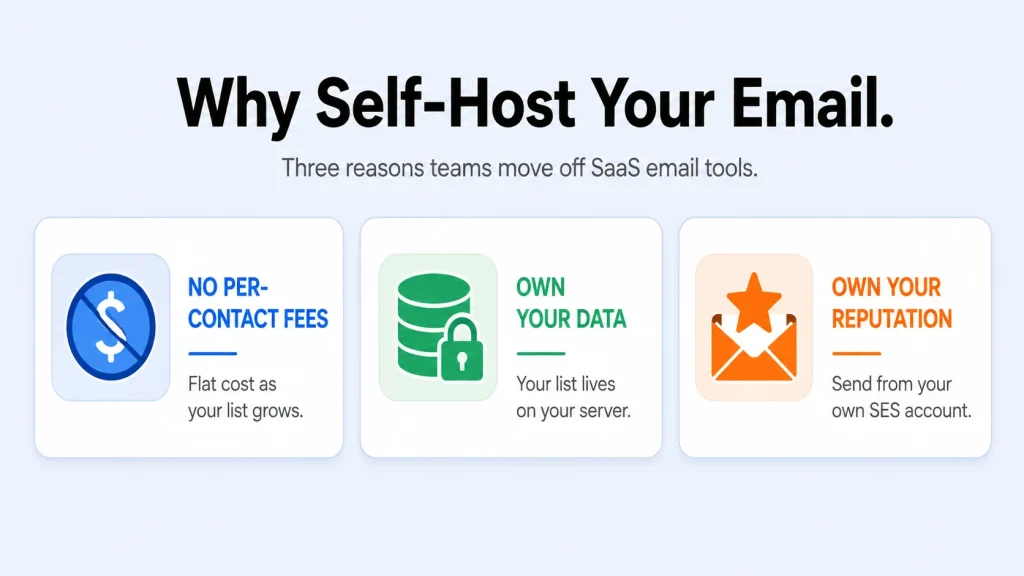
If SaaS email tools are so polished, why choose self-hosted email marketing software at all? Three reasons keep coming up.
The first is cost. Mailchimp runs $13 to $350 a month, Smartlead $39 to $379, Instantly $37 to $358 and up, and every one of those bills scales with your contact count and send volume. Self-hosted email marketing software is a one-time free or low-cost download, and it does not charge more as your list grows. Over a year, moving to self-hosted email marketing software can save thousands.
The second is data ownership. Your contact list and campaign data are among your most valuable assets. With self-hosted email marketing software, they live on your server, not a vendor’s, which matters for privacy, compliance, and simply not being locked in. If you are building a SaaS product, owning your customer list end to end is worth even more.
The third, and the one people underrate, is sender reputation. SaaS tools often send from shared IP pools, so a vendor-wide deliverability incident can drag your domain down with everyone else on the platform. When you bring your own AWS SES or Gmail Workspace, the reputation you build stays attached to your own account. That control is the real reason serious senders move to self-hosted email marketing software.
What to look for in self-hosted email marketing software
Not every tool that calls itself self-hosted email marketing software does the same job. Some are newsletter broadcasters, some are cold-outreach tools, and the difference matters. Before you install any self-hosted email marketing software, run the option through this checklist.
- Campaigns or sequences (or both). Broadcasts are one-off sends to a list. Sequences are multi-step drip automations for outreach. Decide which you need, or pick a tool that does both.
- Sender rotation. For cold outreach, rotating sends across multiple SES or Gmail accounts protects deliverability. Newsletter tools rarely have this.
- Bring your own sending. The best self-hosted email marketing software connects directly to your own AWS SES or Gmail Workspace, so nothing routes through a third party.
- Deliverability tools. Email verification before sending, plus SPF, DKIM, and DMARC support, keeps you out of the spam folder.
- Webhooks and API. For connecting to the rest of your stack and auto-enrolling contacts.
- License and cost. Confirm it is genuinely free or low-cost, open source, and has no per-contact fee waiting as you scale.
The 8 best self-hosted email marketing tools at a glance
Here is the shortlist of the best self-hosted email marketing software before the detail. Confirm current specs on each project’s site before you commit.
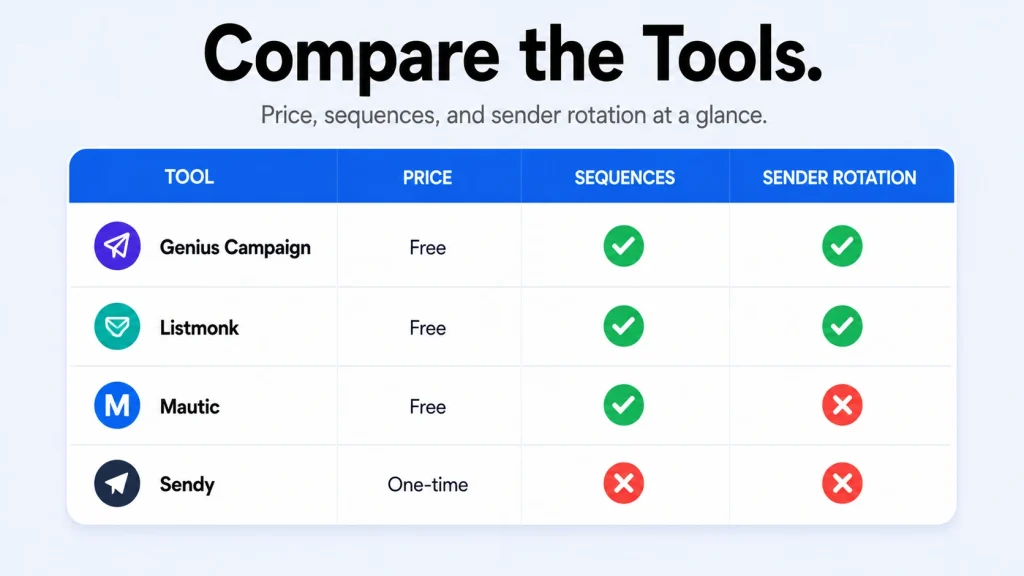
| # | Tool | Price | Cold-outreach sequences | Sender rotation | Best for |
|---|---|---|---|---|---|
| 1 | Genius Campaign | Free (MIT) | Yes | Yes | Campaigns and cold outreach in one |
| 2 | Listmonk | Free | No | No | High-volume newsletters |
| 3 | Mautic | Free | Partial | No | Full marketing automation |
| 4 | Sendy | $69 one-time | No | No | Budget BYO-SES broadcasts |
| 5 | Keila | Free | No | No | Simple Mailchimp alternative |
| 6 | phpList | Free | No | No | Veteran newsletter tool |
| 7 | Mailtrain | Free | No | No | Open-source broadcaster |
| 8 | SendPortal | Free | No | No | Multi-workspace newsletters |
1. Genius Campaign (best for campaigns and cold outreach together)
Price: free, MIT licensed. Cold-outreach sequences: yes. Sender rotation: yes. Disclosure: this is our own tool.
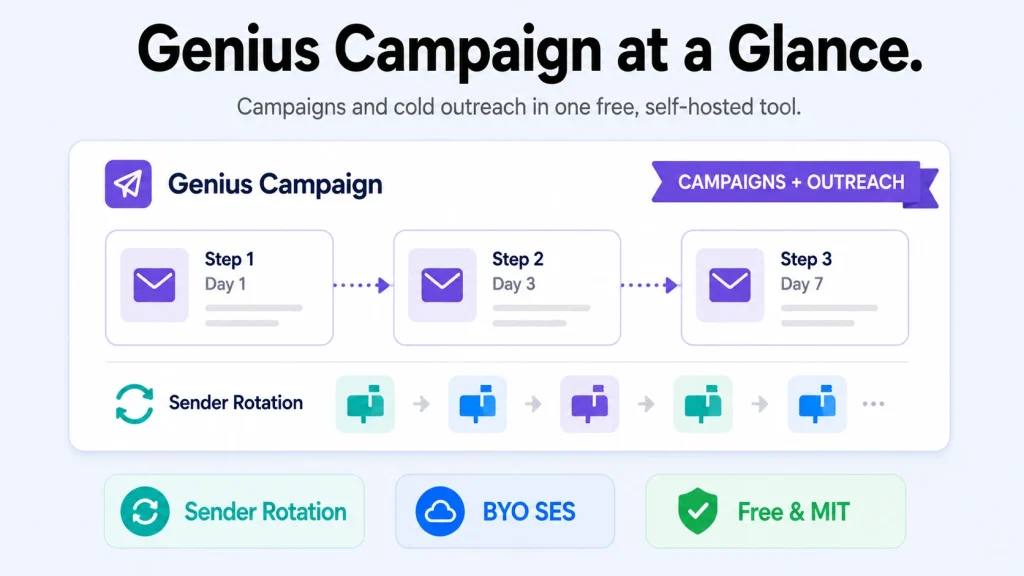
Genius Campaign is a free, open-source, self-hosted email marketing and outreach platform. It puts contacts, templates, campaigns, and multi-step sequences in one console, and it rotates sends across your own AWS SES and Gmail Workspace accounts, quota-aware, with email verification before every send. It is the rare tool that does both broadcast marketing and cold outreach.
Pros:
- Does both campaigns and cold-outreach drip sequences, unlike the newsletter-only tools
- Quota-aware sender rotation across AWS SES and Gmail Workspace
- Bring your own sending, nothing routes through a third party
- Built-in email verification, webhooks, public API, and AI-assisted templates
- Free and MIT licensed, so agencies can white-label it for clients
Cons:
- Newer than veterans like phpList, so a smaller community
- Requires your own SES or Gmail Workspace setup (that is the point, but it is a step)
- Best fit is teams comfortable self-hosting with Docker
Honest positioning: if you only send newsletters, a dedicated broadcaster like Listmonk is simpler. If you run cold outreach, or want both outreach and campaigns in one self-hosted console without a SaaS bill, Genius Campaign is the tool built for exactly that.
2. Listmonk
Price: free. Cold-outreach sequences: no. Sender rotation: no.
Listmonk is the most popular open-source self-hosted email marketing software for newsletters. It is fast, handles large lists well, and covers subscribers, campaigns, templates, and analytics cleanly. If newsletters are your only job, this is the self-hosted email marketing software most people reach for first, and for pure broadcast sending at scale it is excellent.
Pros:
- Very fast and handles large lists
- Clean campaign and subscriber management
- Simple single-binary or Docker deploy
Cons:
- Newsletter-only, no cold-outreach sequences
- No sender rotation across multiple accounts
- Lighter on automation than a full marketing platform
Listmonk is the right pick if you send newsletters to a list and want a lean, reliable broadcaster. It is not built for cold outreach.
3. Mautic
Price: free. Cold-outreach sequences: partial. Sender rotation: no.
Mautic is the most comprehensive open-source marketing automation platform, with lead nurturing, landing pages, forms, and campaign workflows. It is powerful, and with power comes complexity.
Pros:
- Full marketing automation, not just email
- Landing pages, forms, and lead scoring
- Large community and plugin ecosystem
Cons:
- Steep learning curve and heavier to run
- Not designed for cold outreach with sender rotation
- Overkill for teams that just want to send email
Choose Mautic if you want an all-in-one automation platform and have the time to learn it. For focused email sending, it is more than most teams need.
4. Sendy
Price: $69 one-time. Cold-outreach sequences: no. Sender rotation: no.
Sendy is a self-hosted email marketing software that sends through your own AWS SES, which makes bulk sending very cheap. It is a paid one-time purchase rather than free, and it focuses on newsletters and broadcasts.
Pros:
- Very cheap sending via your own AWS SES
- One-time cost, no monthly fee
- Simple and proven for broadcasts
Cons:
- Paid, not free or open source
- No cold-outreach sequences or multi-sender rotation
- Broadcast-focused, limited automation
Sendy is a solid budget choice if you want cheap SES-based newsletters and do not mind a one-time fee. It does not do outreach sequences.
5. Keila
Price: free. Cold-outreach sequences: no. Sender rotation: no.
Keila is a newer open-source self-hosted email marketing software positioned as a clean Mailchimp alternative. It sends via SES, SMTP, Mailgun, and others, and covers newsletters, segments, and basic automation with a friendly interface.
Pros:
- Clean, modern, easy to use
- Works with SES, SMTP, and major providers
- Good for small teams and newsletters
Cons:
- Newsletter-focused, no cold outreach
- No multi-account sender rotation
- Younger project, smaller ecosystem
Keila is a good pick if you want a simple, pleasant Mailchimp replacement for newsletters. It is not an outreach tool.
6. phpList
Price: free. Cold-outreach sequences: no. Sender rotation: no.
phpList is one of the oldest open-source self-hosted email marketing software projects, dependable for list management and newsletter sending over SMTP or SES. It is basic on modern automation but rock-solid for its core job.
Pros:
- Extremely mature and stable
- Handles large lists reliably
- Free and widely documented
Cons:
- Dated interface
- No cold outreach or sender rotation
- Light on automation and modern features
phpList suits teams that want a proven, no-frills newsletter sender and do not care about a modern UI.
7. Mailtrain
Price: free. Cold-outreach sequences: no. Sender rotation: no.
Mailtrain is a free self-hosted email marketing software for newsletters, with list management, templates, and SMTP or SES sending. It sits alongside phpList as a dependable open-source broadcaster.
Pros:
- Free and open source
- Solid list and campaign management
- Works with SES and SMTP
Cons:
- Broadcast-only, no outreach sequences
- No sender rotation
- Less active development than the leaders
Mailtrain is a reasonable broadcaster if you want a straightforward open-source newsletter tool.
8. SendPortal
Price: free. Cold-outreach sequences: no. Sender rotation: no.
SendPortal is a self-hosted email marketing software with subscriber and list management, campaigns, tracking, and multiple workspaces, which suits agencies managing several senders. It is broadcast-focused.
Pros:
- Multiple workspaces for agencies
- Clean campaign and reporting tools
- Free and self-hostable
Cons:
- No cold-outreach sequences
- No multi-account sender rotation
- Smaller community
SendPortal fits agencies that run newsletters for several clients from one install. For cold outreach, look elsewhere.
Newsletter tool or cold-outreach tool: which do you need?
This is the distinction most comparison articles skip, and it decides which self-hosted email marketing software is right for you. Get it wrong and you will fight your tool; get it right and the self-hosted email marketing software does the work for you.
A newsletter tool sends broadcasts to people who opted in: subscribers, customers, a mailing list. Listmonk, Keila, phpList, Mailtrain, and SendPortal all do this well. If your job is sending a monthly update or a promotion to an existing list, any of them works.
A cold-outreach tool sends personalized, multi-step sequences to prospects who have not opted in yet, and it rotates senders to protect deliverability. This is what Smartlead and Instantly do, and it is a fundamentally different workflow. Almost no open-source newsletter tool does it.
Genius Campaign is unusual because it does both. You can run a newsletter campaign to your list and a cold-outreach sequence to prospects from the same console, with sender rotation across your own SES and Gmail accounts. If you only need one of the two, a specialist tool is fine. If you need both, that overlap is the reason to pick it.
Self-hosted vs SaaS cold email
For cold outreach specifically, the real comparison is against SaaS tools like Smartlead and Instantly, not the newsletter broadcasters. Here the case for self-hosted email marketing software is about cost and control.
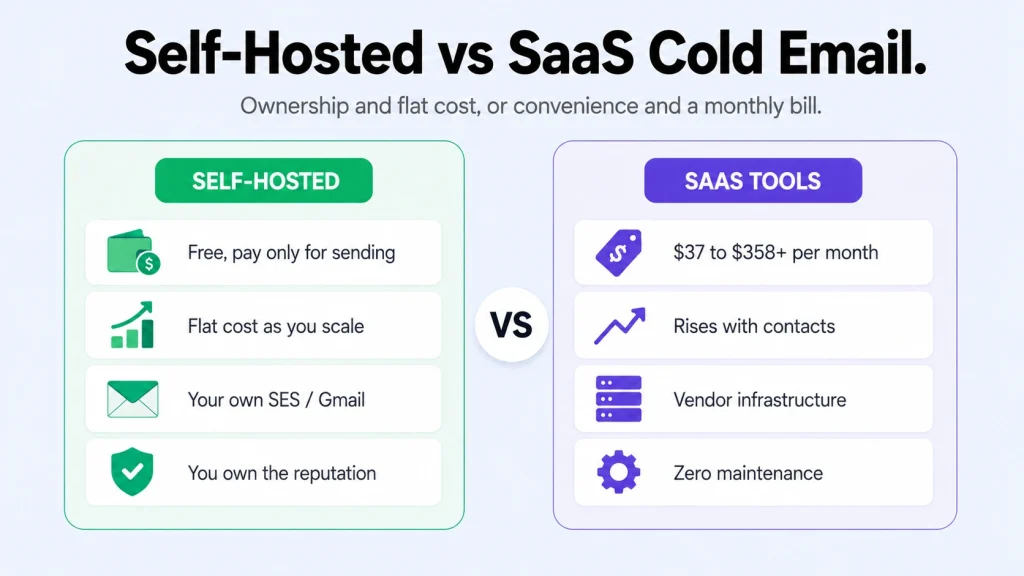
Smartlead and Instantly are polished and start around $37 to $39 a month, climbing past $350 as you scale contacts and mailboxes. They also send through their own infrastructure, so you are building reputation on a platform you do not own. Self-hosting flips both: no recurring bill, and you send from your own AWS SES and Gmail Workspace, so the deliverability you earn is yours to keep. The table below lays out the trade.
| Factor | Self-hosted (Genius Campaign) | SaaS (Smartlead / Instantly) |
|---|---|---|
| Monthly cost | Free, you pay only for sending | $37 to $358+ per month |
| Cost as you scale | Flat, no per-contact fee | Rises with contacts and mailboxes |
| Sending infrastructure | Your own AWS SES or Gmail | Vendor’s shared infrastructure |
| Sender reputation | Yours, on your own account | Built on the vendor’s platform |
| Data ownership | Fully on your server | Stored with the vendor |
| Sender rotation | Yes, across your accounts | Yes, managed for you |
| Maintenance | You host and update the app | Zero, fully managed |
| Mailbox setup | You connect your own | Included and automated |
| Best for | Ownership and predictable cost | Convenience and zero setup |
The trade-off is honest. SaaS tools are zero-maintenance and include managed mailbox infrastructure. Self-hosted email marketing software asks you to set up your own sending and run the app. For teams that value ownership and predictable cost over convenience, that trade is easy.
How sender rotation and bring-your-own-SES protect deliverability
Two features separate serious self-hosted email marketing software from a basic sender, and both protect the thing that matters most: landing in the inbox.
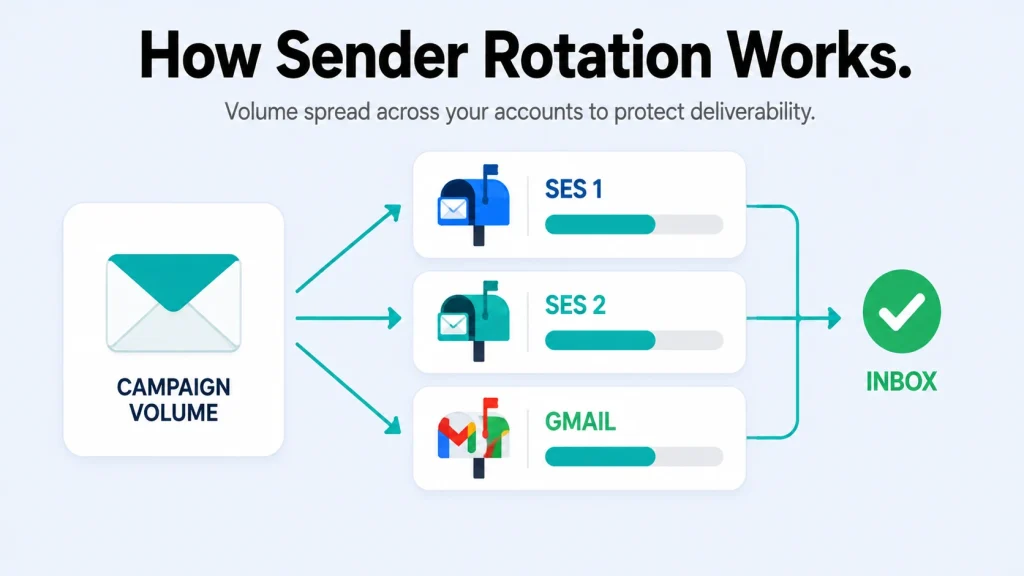
Sender rotation spreads your volume across multiple sending accounts instead of pushing everything through one address. One mailbox blasting thousands of emails looks like spam and gets throttled. The same volume split across several SES and Gmail accounts, quota-aware, looks natural and keeps deliverability healthy. This is standard in cold-outreach tools and almost absent from newsletter tools.
Bring-your-own-SES means your emails go directly from your deployment to AWS or Google, not through a shared vendor pool. Your sending domain’s reputation is built on your own account, so you are never dragged down by another customer’s bad behavior. Pair that with proper SPF, DKIM, and DMARC and email verification before each send, and your self-hosted email marketing software can match or beat SaaS deliverability, on infrastructure you own.
How to choose the right self-hosted email marketing software
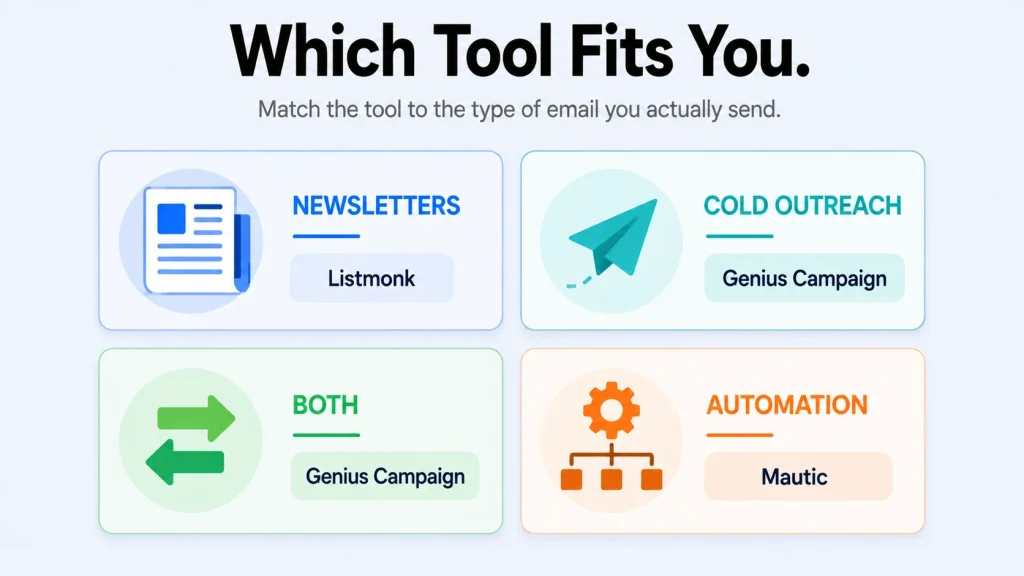
The best self-hosted email marketing software depends on what you send. Match your situation to these picks.
- You send newsletters to a list. Listmonk for scale, Keila for simplicity, or Sendy if you want cheap SES broadcasts and do not mind a one-time fee.
- You run cold outreach to prospects. Genius Campaign, since it is the free self-hosted option with sequences and sender rotation.
- You need both campaigns and outreach in one place. Genius Campaign is built for exactly that overlap.
- You want full marketing automation. Mautic, if you can invest the time to learn it.
- You are an agency managing many senders. SendPortal for newsletters, or Genius Campaign if clients need outreach too, since the MIT license allows white-labeling.
Two rules for any choice. Match the tool to the type of email you actually send, and make sure it connects to your own AWS SES or Gmail so you keep your reputation. Email is also one of the strongest channels when you launch an ecommerce website, so owning it early pays off. If you also want to own the rest of your stack, our free Genius Debug and Genius Support round out a self-hosted toolkit.
Final thoughts
Self-hosted email marketing software gives you campaigns and outreach without per-contact fees, without handing your data to a vendor, and without renting your sender reputation. For pure newsletters, Listmonk or Keila are excellent picks in the self-hosted email marketing software category. For cold outreach, or for running both outreach and campaigns from one console, the free options thin out fast.
That is the gap Genius Campaign fills: a free, MIT-licensed, self-hosted email marketing software platform that handles campaigns and cold-outreach sequences with quota-aware sender rotation across your own AWS SES and Gmail Workspace. Download it, connect your sending, and you own the whole outreach stack. And if you would rather have a team build or run it for you, our custom software development service can help.
Frequently asked questions
Is self-hosted email marketing software really free?
Most of the open-source options (Genius Campaign, Listmonk, Mautic, Keila, phpList, Mailtrain) are genuinely free. You pay only for your server and your own sending costs through AWS SES or Gmail. Sendy is the paid exception at a one-time fee.
Does self-hosted email marketing software work with AWS SES?
Yes. The strongest options, including Genius Campaign and Sendy, are built to send through your own AWS SES, which keeps sending costs very low and your reputation on your own account. Many also support SMTP and Gmail Workspace.
What is the difference between a newsletter tool and a cold-outreach tool?
A newsletter tool broadcasts to an opted-in list. A cold-outreach tool sends personalized multi-step sequences to prospects and rotates senders to protect deliverability. Most open-source tools do only the first. Genius Campaign does both.
Is self-hosted email as deliverable as SaaS?
It can be as good or better, because you control your own domain reputation instead of sharing a vendor’s IP pool. Proper SPF, DKIM, DMARC, email verification, and sender rotation are what get you there.
Can agencies white-label self-hosted email marketing software?
Yes, if the license allows it. Genius Campaign is MIT licensed, so you can rebrand it, run it under your own domain, and deploy it for clients without a per-client SaaS fee.
Which is the easiest to set up?
For newsletters, Listmonk and Keila are quick. For campaigns and outreach with Docker, Genius Campaign deploys with a single compose command once your SES or Gmail is connected.