



If you are building an online store on Laravel, you do not have to start from an empty project. A good Laravel ecommerce package hands you the hard parts already built, products, carts, orders, payments, an admin panel, so you can spend your time on the parts that make your store yours.
This guide covers five Laravel ecommerce packages worth your shortlist in 2026, what each one is, who it fits, and where it falls short. By the end you will know which one matches the store and the team you actually have.
At a glance
Five packages, five different jobs. Here is the one-line verdict on each before we dig in:
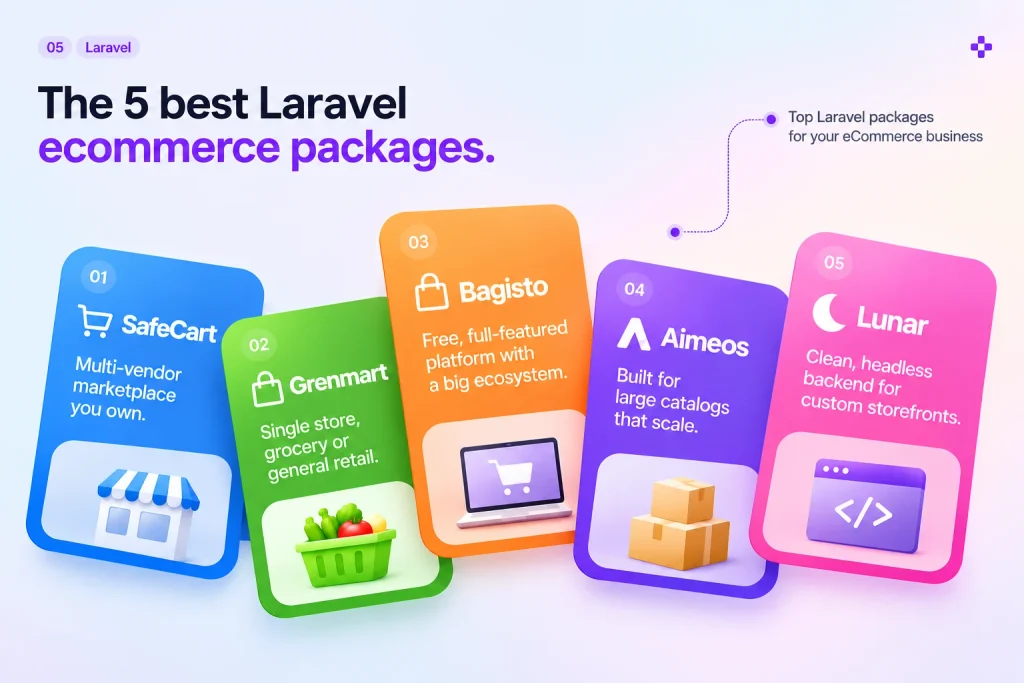
- SafeCart is the pick if you want a multi-vendor marketplace you own outright. One-time from $39, no monthly fees.
- Grenmart suits a single store, grocery or general retail, that you want live fast and keep. Also one-time from $39.
- Bagisto is the free, full-featured platform for teams who want a big ecosystem and do not mind building on Laravel and Vue.
- Aimeos is the one to reach for when your catalog is huge. It scales into the millions of items. Free, with paid extensions.
- Lunar is for developers who want a clean, headless backend and plan to build their own storefront. Free and MIT-licensed.
Boiled down: if you want to own the code and launch fast, go SafeCart or Grenmart. If your team wants a free open-source base, go Bagisto, Aimeos, or Lunar depending on scale and how custom your storefront needs to be.
Table of Contents
Why build your ecommerce store on Laravel?
Before the list, it helps to know why Laravel keeps showing up in ecommerce at all. It is one of the most popular PHP frameworks for a reason, and those reasons matter double for an online store.
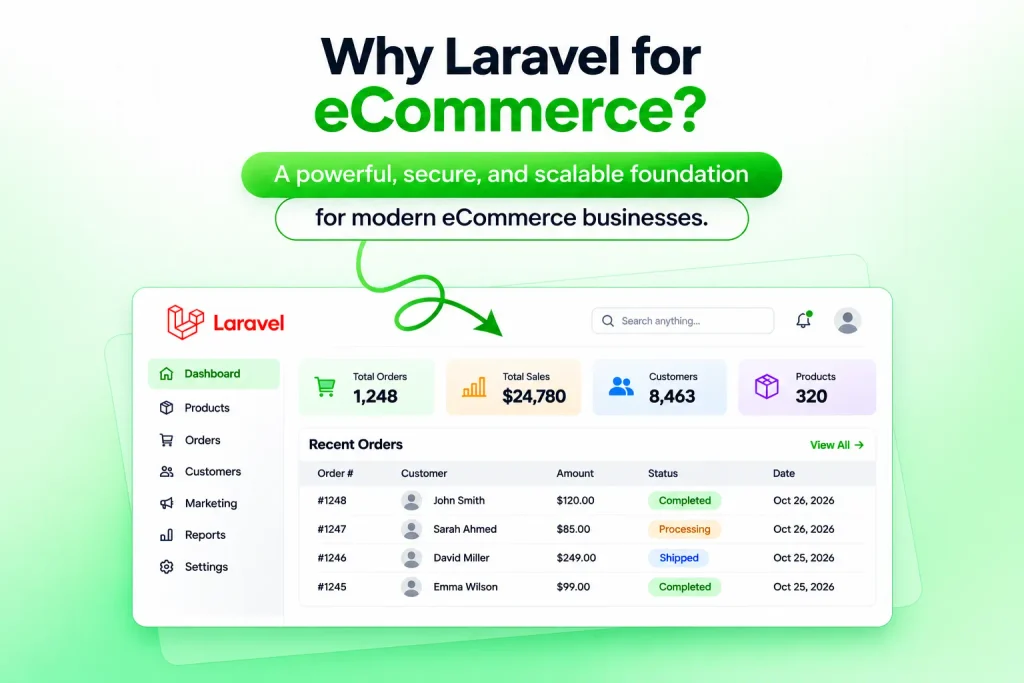
Security is the big one. A store holds customer data, order history, and payment details, so it is a target. Laravel ships with protection against the common attacks, cross-site scripting, cross-site request forgery, and SQL injection, plus solid authentication and password hashing out of the box.
Scalability is the second. Laravel handles a small shop and a large catalog on the same foundation, so you are not forced to re-platform when you grow. It is also an MVC framework, which keeps code organized and easy to test and maintain, and it has a huge developer community, so finding help or hiring is rarely a problem.
Add clean APIs for payment gateways, analytics, and third-party tools, plus a large library of ready-made packages, and you have a framework built for commerce. If you are weighing Laravel against other options entirely, our guide to choosing an ecommerce platform walks through the trade-offs.
The 5 best Laravel ecommerce packages
Here are the five worth shortlisting, grouped by what they actually are so you can match one to your situation.
1. SafeCart, a multi-vendor store you own
SafeCart is a self-hosted multi-vendor ecommerce platform built on Laravel. It runs as a single-vendor shop or a full marketplace from the same codebase, so you can start as your own store and switch on vendor registration later with no rebuild. It is our top pick for anyone who wants a marketplace they own outright instead of renting one.
Standout features:
- Separate admin, vendor, and customer dashboards, with per-vendor commission rates.
- Three Flutter mobile apps (customer, vendor, and delivery) in the bundle, Android and iOS ready.
- A POS system with barcode scanning, plus real-time delivery tracking on a live map.
- 26+ payment gateways and a built-in digital wallet for refunds and vendor payouts.
- Four no-code builders for pages, menus, forms, and widgets.
Best for: founders and agencies building a multi-vendor marketplace who want full source code, no monthly fees, and no commission taken on sales.
Pricing: one-time from $39, with bundles that add the plugins and mobile apps. Detailed online documentation covers install and setup.
Watch out for: you host and maintain it yourself, which is the trade-off for owning the platform rather than renting it.
2. Grenmart, a ready-made store for grocery and retail
Grenmart is an organic grocery and multipurpose ecommerce script built on Laravel. It is grocery-first but works for any catalog, so it suits fashion, electronics, or general retail just as well. Like SafeCart, you buy it once and own the source.
Standout features:
- A no-code drag and drop page builder with 50+ widgets and three home page variants.
- Advanced inventory with variant and attribute level stock, handy for weight-based grocery items.
- Coupons, campaigns with countdown timers, and autocomplete search to lift average order value.
- 20+ payment gateways, advanced tax and shipping rules, and an optional Flutter app.
- Built-in SEO tools, sitemap generation, and full right-to-left language support.
Best for: single-vendor stores, especially grocery and daily-needs retail, that want to launch a polished store quickly and keep it.
Pricing: one-time from $39, with a bundle that adds the mobile app.
Watch out for: it is a single-vendor store at heart, so if you need a true marketplace with many sellers, SafeCart is the better fit.
3. Bagisto, a free full-featured platform
Bagisto is a popular open-source ecommerce platform built on Laravel and Vue.js, maintained by Webkul. It is free, well supported, and used by large brands, which makes it a safe open-source choice when you want a complete platform without a license fee.
Standout features:
- A complete admin panel with multi-channel and multi-store support out of the box.
- Marketplace, B2B, multi-tenant SaaS, and headless setups available as extensions.
- A large extensions marketplace plus a mobile app and POS module.
- Multi-currency, multi-language, and a strong theming system.
Best for: teams that want a free, battle-tested platform with a big ecosystem and are comfortable working with Laravel and Vue.
Pricing: free and open source, with paid extensions for advanced features like the full marketplace.
Watch out for: the richer features (marketplace, some integrations) are paid extensions, and customizing deeply means working across both Laravel and Vue.
4. Aimeos, built for large catalogs
Aimeos is an open-source Laravel ecommerce framework built for scale. It is designed to handle very large catalogs, into the millions of items, with fast response times, which makes it the pick when your main concern is size and performance rather than a ready-made storefront.
Standout features:
- Scales from a small shop to enterprise-level catalogs on the same modular architecture.
- API-first with both JSON REST and GraphQL, so it pairs well with Vue, React, or a mobile frontend.
- Multi-vendor marketplaces, B2B pricing, and multi-tenant SaaS supported out of the box.
- Subscriptions with recurring payments and 100+ payment gateways via Omnipay.
Best for: enterprise projects, large product catalogs, and marketplaces where scale and API flexibility are the priority.
Pricing: free and open source core, with paid commercial extensions for advanced features.
Watch out for: the power comes with a steeper learning curve, so it is a better fit for experienced Laravel teams than for a quick first store.
5. Lunar, a headless engine for developers
Lunar is an open-source, headless Laravel ecommerce package built on plain Eloquent models. It gives you the commerce backend and an admin panel, and you build the storefront yourself in whatever stack you like. It is the developer’s pick when you want full control over the front end.
Standout features:
- Pure Eloquent models and pipelines, so it feels like normal Laravel rather than a separate system.
- A production-ready admin panel for products, orders, and customers.
- Multi-currency, customer groups, tiered pricing, and flexible product variants.
- Built for modern workflows, with documentation and tooling aimed at AI coding agents.
Best for: developers and agencies building a bespoke storefront who want a clean, MIT-licensed backend that stays out of the way.
Pricing: free and open source under the MIT license.
Watch out for: it is headless, so there is no ready-made storefront, you build that part, which is the point for some teams and a dealbreaker for others.
Ready-made script or open-source base? How to choose
The five packages split into two camps, and knowing which camp you are in makes the decision easy.
A ready-made script like SafeCart or Grenmart is finished software. You install it, add products, and launch, often the same day. You own the source code for a one-time price, with no monthly fees and no sales commission. This is the right path when you want to be selling quickly and you do not have a development team sitting idle.
An open-source base like Bagisto, Aimeos, or Lunar is a foundation your team builds on. It is free to start, infinitely customizable, and backed by a community, but it expects development work to reach a finished store, more so with headless Lunar than with platform-style Bagisto. This is the right path when you have developers and specific requirements that a packaged script cannot meet.
A few more questions to narrow it down:
- Single store or marketplace? A marketplace points to SafeCart, Bagisto’s marketplace extension, or Aimeos. A single store fits Grenmart or any of them.
- How big is the catalog? Millions of items point to Aimeos. Normal catalogs run fine on any of them.
- Do you want a ready storefront? Yes points to SafeCart, Grenmart, or Bagisto. No, you will build it, points to Lunar.
- What is your budget shape? One-time ownership points to SafeCart or Grenmart. Free-to-start with your own build time points to the open-source trio.
If you are still torn between Laravel and a hosted option, or between a script and a custom build, our ecommerce platform comparison lays the options side by side, and our Nazmart multi-tenancy platform is worth a look if you are building a SaaS where others run their own stores.
Which one should you pick?
Work backward from your situation and the choice gets easy. Have a team and specific requirements? An open-source base rewards the effort: Bagisto for a full platform, Aimeos for scale, Lunar for a custom storefront.
The one move to avoid is picking the package with the longest feature list instead of the one that fits the store and the team you actually have. Start from the job you need done, and the right package usually picks itself.

Frequently asked questions
Is Laravel good for building an ecommerce website?
Yes. Laravel is secure, scalable, and well structured, with built-in protection against common web attacks, clean APIs for payment and third-party integrations, and a large library of ready-made packages. Paired with a good ecommerce package, it is a strong base for stores of any size.
What is the difference between a Laravel ecommerce script and a framework?
A script like SafeCart or Grenmart is a finished store you install and launch, usually for a one-time price. A framework or headless engine like Aimeos or Lunar is a foundation your developers build on. Scripts are faster to launch, frameworks are more flexible for custom requirements.
Which Laravel ecommerce package is best for a marketplace?
SafeCart is the Laravel ecommerce package built for multi-vendor marketplaces, with vendor dashboards and per-vendor commissions out of the box. Bagisto offers a marketplace through a paid extension, and Aimeos supports multi-vendor setups natively, so all three are worth comparing for a marketplace.
Are there free Laravel ecommerce packages?
Yes. Bagisto, Aimeos, and Lunar are all open-source Laravel ecommerce packages that are free to start. Bagisto and Aimeos offer paid extensions for advanced features, while Lunar is MIT-licensed and fully free. The trade-off is that free open-source packages usually need more development work to reach a finished store.
Do I need a developer to use these Laravel ecommerce packages?
It depends on which Laravel ecommerce package you choose. Ready-made scripts like SafeCart and Grenmart can be installed and run with little coding thanks to their no-code builders. Open-source bases, especially headless Lunar, expect development work. If you want it handled for you, a development team can install, customize, and launch any of them.