

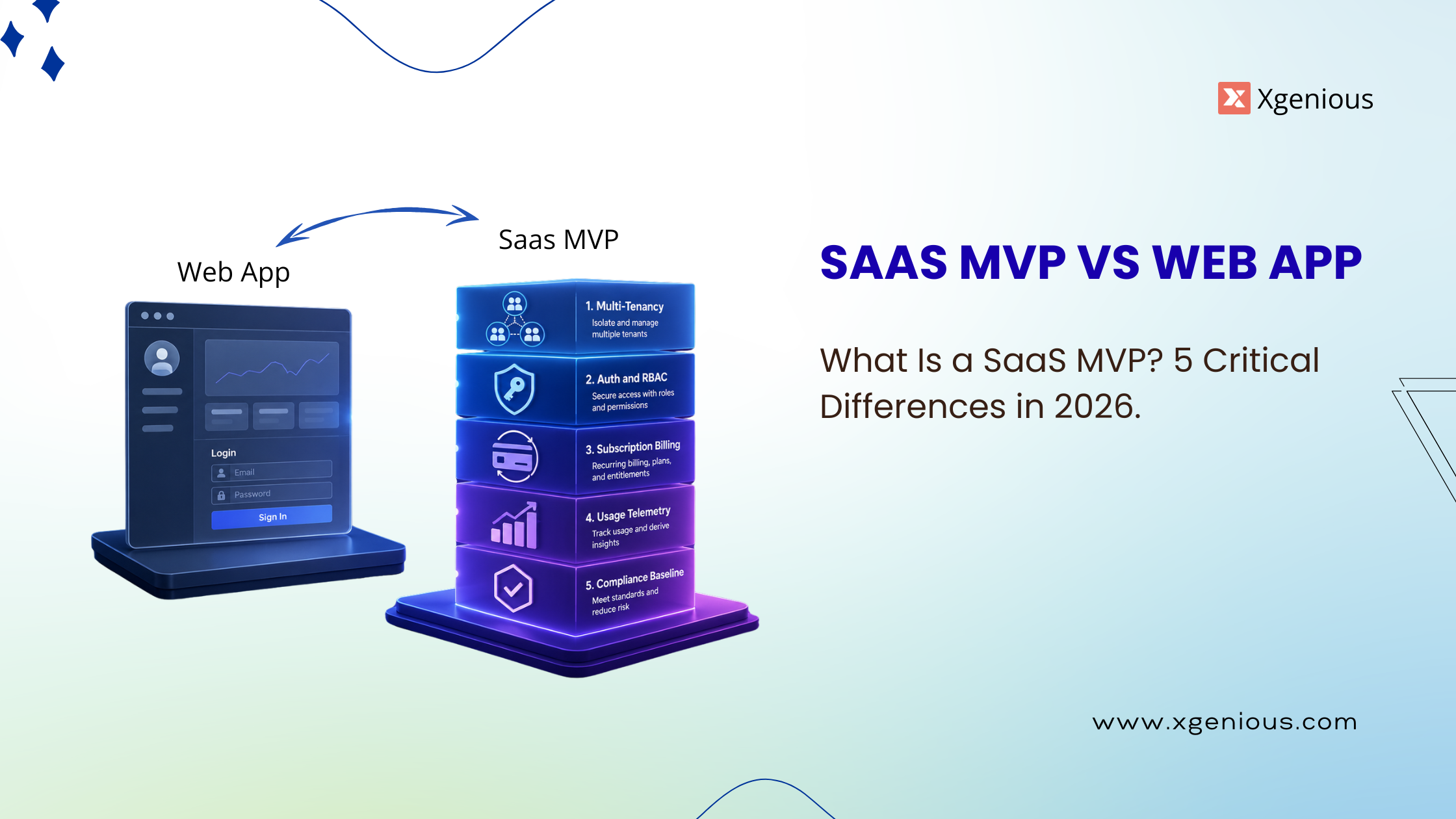


Founders commission “a web app” and get something that cannot bill, cannot isolate customers, and cannot survive a security review. The question of what actually counts as a SaaS MVP matters here because it decides whether the product can charge recurring revenue, onboard a second customer without breaking, and pass an enterprise procurement check. Most teams that confuse the two ship a polished web app, then discover six months later that turning it into a real SaaS requires a partial rewrite.
This guide answers the question “what is a SaaS MVP” at the technical level, not the marketing level. It walks through the five markers that define a SaaS MVP in practice, the economics that make a SaaS MVP cost two to three times a web app, the four archetypes founders confuse, and the migration path for teams that already shipped a web app and need to upgrade.
Five takeaways before reading on: the one-sentence SaaS MVP test, the five technical markers, the cost delta versus a plain web app, four product archetypes that get conflated, and when a web app is actually the right call. For the broader context on how this fits into a complete build, see how to build a SaaS in 2026.
The SaaS MVP, In One Sentence: A Web App That Pays Rent
The simplest way to describe a SaaS MVP is this: a web app that pays rent. A web app delivers software functionality through a browser. A SaaS MVP delivers software functionality through a browser, charges customers on a recurring schedule for the privilege, isolates each customer’s data from every other customer, and provides enough operational visibility for the team to run the business without manually inspecting the database.
That sentence captures more than it looks like. “Pays rent” implies subscription billing, which implies multi-tenancy (one billing relationship per tenant), which implies authentication (so the right tenant gets billed), which implies usage telemetry (so the right amount gets billed), which implies a compliance baseline (so the customer is willing to pay rent in the first place). The five technical markers covered in this article unfold from that single phrase.
A SaaS MVP also explicitly excludes things founders sometimes assume are required. It does not require deep enterprise features. It does not require an admin panel. It does not require a public API. It does not require a marketing site. It requires the smallest set of architectural decisions that allow the product to acquire, charge, and retain its second paying customer without manual intervention.
A Short History of How the SaaS MVP Became Its Own Category
In 2010, “SaaS” and “web app” were nearly synonymous. Salesforce had already proven the model, but most early-stage products lived on shared databases, billed quarterly through invoices, and treated security as something the IT department of the customer worried about. The SaaS MVP standard that exists today did not yet exist as a category because the failure modes had not yet matured.
By 2018, two forces split the categories. First, GDPR put data residency and tenant isolation on every founder’s checklist. Second, Stripe Billing reached the maturity where subscription mechanics, dunning, proration, and tax handling became table stakes for any serious recurring-revenue product. A “web app” with a Stripe Checkout button stopped looking like SaaS to investors, enterprise buyers, and engineering leads. The SaaS MVP standard tightened.
By 2026, the gap between a web app and a SaaS MVP has widened further. SOC 2 has crept down-market into ARR ranges that used to be GDPR-only. AI inference costs make per-tenant usage telemetry a financial necessity, not a nice-to-have. Multi-tenant architecture patterns have matured to the point that any greenfield SaaS shipping a single-tenant database design is making a costly choice on purpose, not by ignorance. The minimum viable SaaS in 2026 is meaningfully heavier than the minimum viable SaaS of 2018, and lighter than the full SaaS most enterprise products eventually become.
The line that defines the modern SaaS MVP: enough infrastructure to charge a second customer without manual work, and not one feature more.
The SaaS MVP in Practice: 5 Markers That Separate It From a Web App
A working SaaS MVP needs a checklist, not just a sentence. Five technical markers, taken together, separate a SaaS MVP from a sophisticated web app. Hit all five and the product is a SaaS MVP. Miss two or more and it is a web app, regardless of how the marketing positions it.
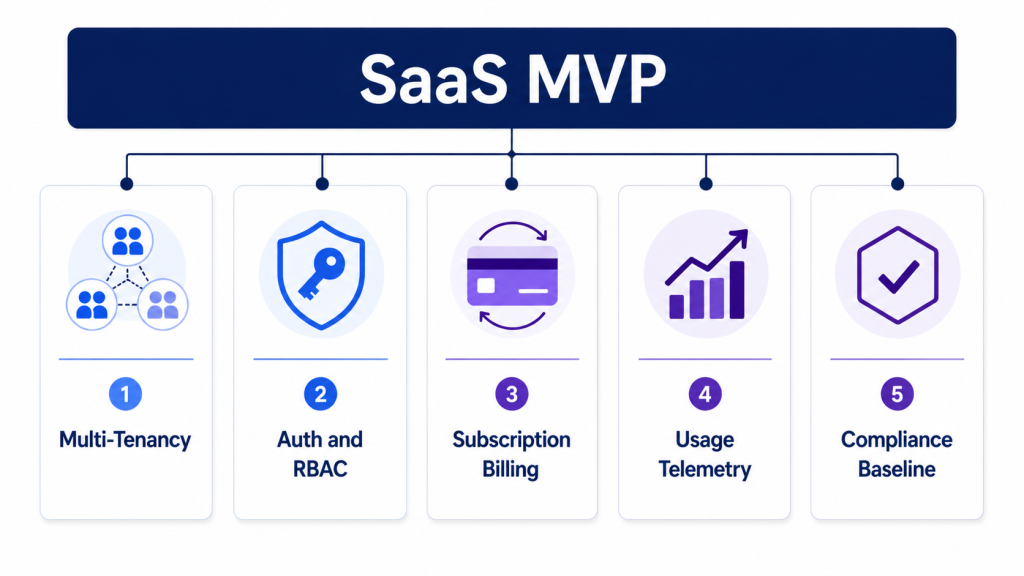
The five markers:
- Multi-tenancy. A single application instance serves multiple customers, with strict data isolation between tenants.
- Authentication and RBAC. Users belong to tenants, roles within a tenant govern permissions, and the system enforces both at the data layer.
- Subscription billing plumbing. Recurring billing logic, including proration, dunning, plan changes, and tax handling. Not just a checkout button.
- Usage telemetry and metering. The product knows what each tenant did, when, and how much, in a way that supports billing, debugging, and product analytics.
- Compliance baseline. Audit logs, encryption at rest and in transit, deletion-on-request, and the architectural primitives that allow GDPR conformance and a path to SOC 2.
The framework is binary by design. A product that has multi-tenancy, RBAC, and billing but lacks usage telemetry and compliance baseline is a payment-enabled web app, not a SaaS MVP. A product that has billing and compliance but lacks multi-tenancy and RBAC is a single-tenant SaaS deployment, which is closer to bespoke enterprise software than to SaaS.
The next sections take each marker in turn and explain what passing it actually requires in code and architecture. The full SaaS MVP standard is the union of all five.
Marker 1 of a SaaS MVP: Multi-Tenancy
Multi-tenancy is the architectural property that lets one application instance serve many customers safely. Founders new to building a SaaS MVP often assume “one database per customer” satisfies this, because each customer’s data is technically isolated. It does not. One database per customer is a single-tenant deployment repeated, which is operationally the opposite of multi-tenancy.
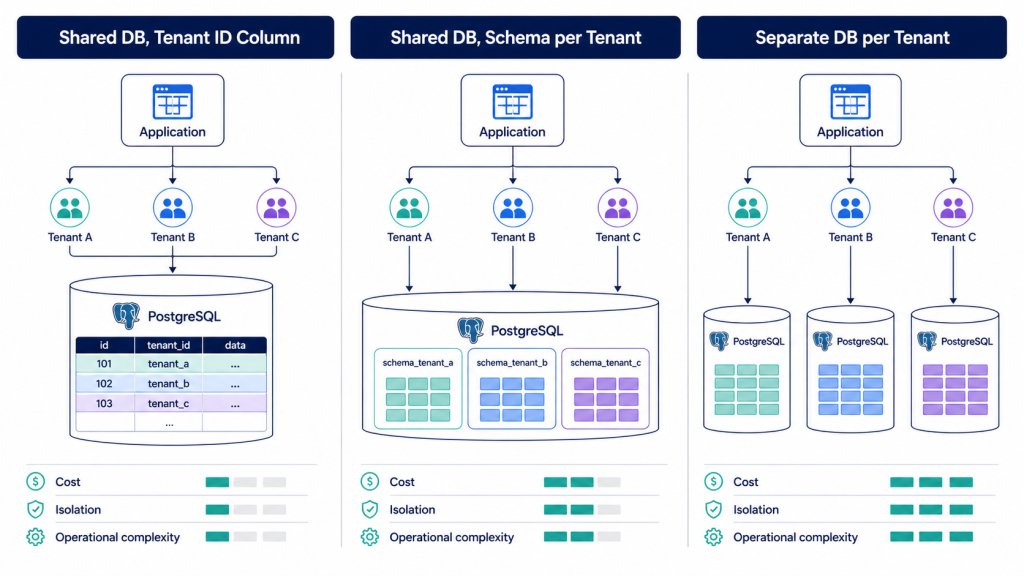
The three common multi-tenancy patterns:
i. Shared database, shared schema, tenant ID column. The default for most SaaS in 2026. Every table has a tenant_id column, every query filters on it, and row-level security in Postgres enforces isolation at the database layer. Cheap to operate, fast to ship, and the pattern most fixed-price MVP packages assume.
ii. Shared database, separate schema per tenant. Each tenant gets its own Postgres schema in the same database. Higher isolation, somewhat more operational overhead, sometimes required by mid-market customers who want stronger boundaries. Still passes the SaaS MVP test.
iii. Separate database per tenant. Each tenant has a dedicated database instance. Strongest isolation, highest operational cost, and almost always wrong for an MVP. This pattern is appropriate when individual tenants have data residency requirements that no other pattern satisfies, or when individual tenants are large enough to justify the operational overhead. For most founders, picking this pattern at MVP stage is a stack mistake covered in the 2026 SaaS tech stack.
Why “one DB per customer” fails the SaaS MVP test: each new customer requires manual database provisioning, schema migrations apply per database (multiplying operational risk), backups multiply, and the per-customer cost floor becomes high enough that low-tier pricing turns unprofitable. The whole point of SaaS economics is that the marginal cost of an additional tenant approaches zero. Single-database-per-customer makes the marginal cost approach the cost of a small VPS.
The minimum implementation that passes the marker: a tenants table, a tenant_id column on every business-data table, query-level enforcement, and either Postgres row-level security or middleware that adds the tenant filter to every database call. This is two to three days of careful work for a senior engineer at the start of a build, and several weeks of careful work to retrofit later.
Marker 2 of a SaaS MVP: Authentication, Roles, and Permissions
The second piece of a SaaS MVP architecture is identity. A web app authenticates users. A SaaS MVP authenticates users, links them to tenants, assigns them roles within a tenant, and enforces permissions at every layer of the application.
The minimum viable RBAC structure:
Users table. Email, hashed password (or SSO identity), basic profile fields.
Tenants table. Organization name, billing details, subscription status.
Memberships table. Joins users to tenants with a role (owner, admin, member, viewer at minimum).
Permission checks. Every protected route, every database query, every API endpoint verifies that the requesting user belongs to the relevant tenant and has the required role.
Why RBAC from day one matters: retrofitting it after launch means rewriting every controller, every database query, every API surface, and every test. Founders who skip RBAC in v1 (treating “the founder is the only admin”) consistently pay for it within four months when the first paying customer asks for a teammate seat. Wiring RBAC at the start adds two to four days to an MVP build. Adding it later adds two to four weeks plus a security review.
Authentication choice also matters. A managed identity provider such as Auth0, Clerk, AWS Cognito, or Supabase Auth costs roughly $25 to $200 per month at MVP stage and saves weeks of work that would otherwise go into password reset flows, email verification, MFA, social login, and SSO integration. Building authentication from scratch is one of the slowest paths to a SaaS MVP that actually passes a security review. Use a managed provider unless there is a specific reason not to.
For the broader treatment of how identity fits into the SaaS architecture decision, see the 2026 SaaS tech stack guide.
Marker 3 of a SaaS MVP: Subscription Billing Plumbing
The third element of a SaaS MVP is recurring billing. A web app with a Stripe Checkout button can collect payments. A SaaS MVP runs the full subscription lifecycle: signup, free trial or freemium gating, paid conversion, plan changes (upgrades and downgrades with proration), payment failures (dunning), cancellations, refunds, and tax handling across jurisdictions.
The work most founders underestimate:
Proration. When a customer upgrades mid-cycle, how much do they owe today? When they downgrade, do they get a credit or a refund? Stripe Billing handles this if the integration is set up correctly, but the integration is non-trivial.
Dunning. Roughly 6 to 8 percent of recurring charges fail every month. Without a dunning workflow (retry schedule, email reminders, grace period, automatic cancellation), failed payments turn into lost revenue and angry customers. Stripe Smart Retries plus a custom email sequence is the minimum.
Tax. VAT, GST, and US sales tax compliance is real work. Stripe Tax (additional 0.5 percent of revenue) or Paddle (Merchant of Record, 5 percent take-rate) handle this. Rolling tax compliance manually is the single fastest way to ship something that fails its first cross-border audit.
Plan changes. Upgrades, downgrades, add-ons, seat increases, and cancellations all need to update the billing system, the application’s permission state, and any usage limits. Each transition is its own state machine.
Webhook reliability. Stripe sends events asynchronously. The application must handle webhook delivery, retries, idempotency, and the case where a webhook arrives before the application’s local state has caught up. This is where many SaaS billing implementations break in production.
The canonical reference for getting subscription mechanics right is the Stripe Billing documentation. The pragmatic guidance: do not attempt a custom billing system in an MVP. Use Stripe Billing, Paddle, or Chargebee, and accept that even with a managed billing platform, integration work is meaningfully larger than founders assume. Wiring billing properly into a SaaS MVP adds one to two weeks of build time. Skipping it produces a web app, not a SaaS.
Marker 4 of a SaaS MVP: Usage Telemetry and Metering
The fourth marker of a SaaS MVP is operational visibility. A web app does not need to know what users do beyond basic page-view analytics. A SaaS MVP must know what each tenant did, when, and how much, in a way that supports billing decisions, debugging incidents, and product analytics.
The minimum telemetry surface:
Per-tenant event logging. Every meaningful user action (signup, login, feature use, upgrade, downgrade) writes a structured event tagged with tenant_id, user_id, event_name, timestamp, and metadata. This is the substrate for everything else.
Metering for billing. If pricing has any usage component (API calls, AI tokens, seats consumed, documents processed), the application must count those events accurately enough to bill on. Inaccurate metering is one of the fastest paths to refund disputes and churn.
Application monitoring. Error rates, latency percentiles, and uptime, broken down per tenant where possible. A single tenant generating 80 percent of errors should be visible without manual log spelunking.
Product analytics. Conversion funnels, activation rates, feature adoption, and retention cohorts. These signals shape every product decision after the MVP ships.
Telemetry tools at MVP stage typically combine three categories. Application monitoring through Sentry or Datadog. Product analytics through PostHog or Mixpanel. A simple events table in the same Postgres database for the metering layer, queried for billing reconciliation. Total monthly cost for the telemetry layer at MVP stage: $50 to $400, depending on traffic.
What separates this marker from “we have Google Analytics installed” is the per-tenant dimension. Tenant-aware telemetry is what makes a SaaS MVP operationally complete. Without it, the product cannot tell whether a billing dispute is legitimate, cannot identify which tenant is consuming disproportionate resources, and cannot run the customer-success motion that retention depends on.
Marker 5 of a SaaS MVP: Compliance Baseline
The final marker of a SaaS MVP is the compliance posture. Not full SOC 2 Type II audits and not enterprise legal review, but the architectural primitives that make those certifications cheap to add later when the sales pipeline justifies them.
The compliance baseline at MVP stage:
Audit logs. Immutable, queryable records of every data-modifying action, attributable to a user and a tenant. Implement once at the data layer and every later compliance check becomes a query, not a project.
Encryption. At rest (database, backups, file storage) and in transit (TLS 1.3 minimum). Most managed cloud services provide both by default. The work is configuration, not implementation.
Deletion-on-request. A documented process for handling GDPR Article 17 requests. The minimum implementation is a tenant-level soft-delete flag that cascades through all related tables, plus a 30-day retention policy before hard deletion.
Data residency. The ability to keep tenant data in specific regions when contracts require it. Most SaaS at MVP stage does not need active multi-region deployment, but it does need the architecture to support it later without rewrites.
Privacy policy and data processing agreement. Lightweight legal documents that any cross-border SaaS needs. Templates exist; the actual work is review by qualified counsel before the first paying customer.
The pragmatic interpretation: SOC 2 Type II is a $20K to $40K spend with a six-month timeline, and most pre-seed SaaS should not pursue it until the first enterprise contract justifies it. GDPR conformance, by contrast, is functionally non-optional. A SaaS MVP includes GDPR architecture from day one and SOC 2 readiness as deferred work. The architectural reference for both is the AWS Well-Architected SaaS Lens.
The Economics: Why a SaaS MVP Costs 2 to 3x a Web App (and Earns 10x)
A web app costs $10K to $30K to build at MVP scope. A SaaS MVP that satisfies the five markers above costs $25K to $80K. The cost delta sits in five places: multi-tenant data architecture, RBAC scaffolding, billing integration, telemetry instrumentation, and compliance primitives. Each is meaningfully more work than its web-app equivalent.
The build-time delta breaks down roughly as follows:
Multi-tenant architecture. Adds 3 to 5 days of senior engineering at MVP stage.
RBAC and managed identity. Adds 2 to 4 days plus the recurring cost of an identity provider.
Subscription billing plumbing. Adds 1 to 2 weeks of integration and webhook handling.
Telemetry layer. Adds 2 to 4 days of instrumentation plus tool subscription costs.
Compliance baseline. Adds 3 to 5 days of architectural setup plus legal review.
Total: an additional 3 to 6 weeks of build time on top of a comparable web app. At specialized agency rates, that is the difference between a $20K web app and a $50K SaaS MVP.
The earnings delta is much larger. A web app charges per project or per one-off transaction, with no recurring revenue and no compounding customer relationships. A SaaS MVP at $99 per tenant per month with 30 paying tenants generates $35K in year-one ARR with the same product. By year three, with churn, growth, and tier expansion, the same product generates $200K to $600K in ARR. The 2 to 3x build-cost premium is recovered in months 4 to 9, then becomes pure compounding return.
Where founders get the math wrong: assuming a web app can be “upgraded later.” Every retrofitted SaaS feature costs 3 to 5x what designing it in from day one would have cost, plus a security review. The economics of a SaaS MVP only work when the markers are present from the start.
Where the SaaS MVP Fits: Four Product Archetypes Compared
Founders consistently confuse four distinct product archetypes, and the confusion drives most early-stage build mistakes. The four archetypes:
Website. Static or near-static pages, no user accounts, no data layer beyond a contact form. Marketing site, blog, brochure. Build cost: $2K to $10K.
Web app. Dynamic functionality behind a login, single tenant or no tenant model, payments handled through one-off Stripe Checkout if at all. Project management tool for one team. Build cost: $10K to $30K.
SaaS MVP. Meets the five markers above. Multi-tenant, RBAC, recurring billing, telemetry, compliance baseline. Sells to its second customer without manual intervention. Build cost: $25K to $80K.
Full SaaS. SaaS MVP plus public API, SSO and SCIM, advanced reporting, white-label support, SOC 2 Type II, multi-region deployment, dedicated customer-success motion. The product an established SaaS company sells into mid-market and enterprise. Build cost: $400K to $2M cumulative across the first two years.
The mapping that catches founders: a “SaaS” product idea pitched to investors usually requires a SaaS MVP at minimum, and most founders end up commissioning a web app because the price quote feels more comfortable. The result is a product that looks like SaaS in the deck and behaves like a web app in production. Six months later the team is rewriting the data layer, retrofitting RBAC, and explaining to investors why “we shipped” did not translate to “we can scale.”
A related but different category, the SaaS-marketplace hybrid, has its own architectural requirements that diverge from both web apps and pure SaaS. For when each model fits, see SaaS vs marketplace.
The Web App to SaaS MVP Migration Path
Many founders arrive at this article with a web app already in production and the realization that they need to satisfy the full SaaS MVP standard to scale. The migration is meaningful work but is rarely a full rewrite. The path follows five sequential phases.
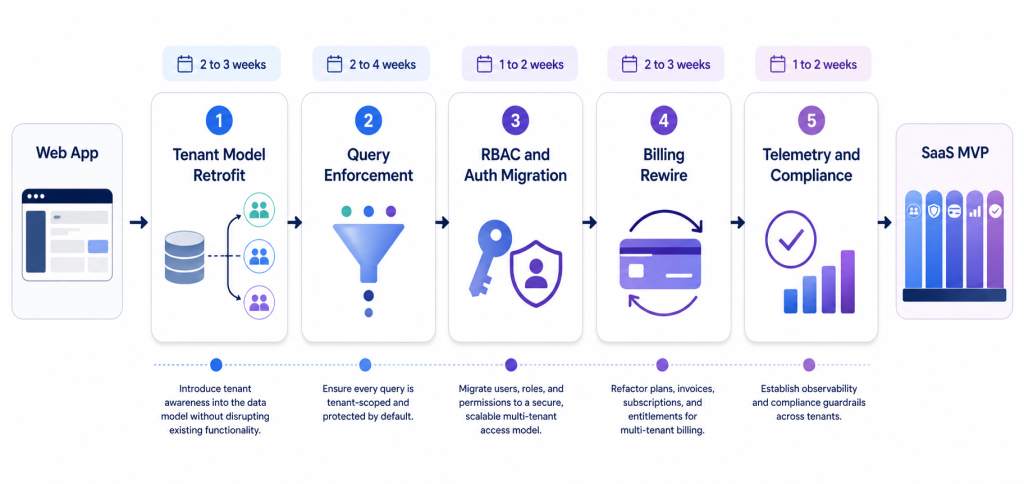
Phase 1: Tenant model retrofit. Add a tenants table, a memberships table, and a tenant_id column on every business-data table. Backfill existing data into a single default tenant. Estimated time: 2 to 3 weeks of focused engineering.
Phase 2: Query enforcement. Update every database query, controller, and API endpoint to filter by tenant_id, or implement row-level security in Postgres if the database is Postgres. This is the largest phase and where security gaps tend to hide. Estimated time: 2 to 4 weeks plus security review.
Phase 3: RBAC and auth migration. Move users from the existing auth model to a memberships-based model with roles. Migrate to a managed identity provider if not already on one. Estimated time: 1 to 2 weeks.
Phase 4: Billing rewire. Replace one-off payment flows with subscription billing. Wire webhooks, dunning, proration, and tax handling. Estimated time: 2 to 3 weeks.
Phase 5: Telemetry and compliance. Add per-tenant event logging, audit logs, and the deletion-on-request workflow. Estimated time: 1 to 2 weeks.
Total migration time: 8 to 14 weeks of focused work, depending on the size of the existing codebase and the discipline of the original architecture. Migration cost typically lands in the $30K to $90K range, which is comparable to building a SaaS MVP from scratch.
The honest assessment: if the existing web app is small (under 20K lines of code) and the team is junior, a clean rewrite using a fixed-price MVP package is often cheaper than a migration. If the web app is mature with paying customers, the migration is usually the right call. For a realistic week-by-week build cadence on either path, see the SaaS MVP timeline.
When a Web App Is Actually the Right Call (Not Every Product Needs a SaaS MVP)
Not every product needs a SaaS MVP. The five markers add cost and complexity, and there are categories where a plain web app is the correct choice.
Internal tools. A single-tenant product used by one organization does not need multi-tenancy or subscription billing. Build it as a web app.
One-time-purchase software. Products sold once, with no recurring revenue model, do not need subscription billing plumbing. Calculators, configurators, and lead magnets fit this profile.
Open-source projects. Self-hosted software where users deploy their own instance does not need multi-tenancy at the application layer.
Consumer products with ad-supported revenue. Products that monetize through advertising rather than subscriptions skip most of the SaaS MVP markers by design.
Prototypes and proofs of concept. Validation prototypes built to test a hypothesis can skip the markers entirely. The point is to learn, not to scale.
The danger is not building a web app when a web app is right. The danger is building a web app when SaaS economics are the actual goal, then treating the markers as deferred work. Choose deliberately.
Conclusion: The SaaS MVP as a Design Constraint
A SaaS MVP is a web app that pays rent. Five technical markers turn that one-line phrase into an actionable design constraint: multi-tenancy, authentication and RBAC, subscription billing plumbing, usage telemetry and metering, and a compliance baseline. Hit all five and the product is a SaaS MVP. Miss two and it is a web app, regardless of how the product gets marketed.
The economics behind the SaaS MVP are unambiguous. The build-cost premium is 2 to 3x a web app, recovered in 4 to 9 months of recurring revenue, then compounded across years. The migration cost from a non-compliant web app to a SaaS MVP is roughly equal to the cost of building a SaaS MVP from scratch, which is why designing for the markers from day one is almost always the right call. For the broader build framework that places this decision in context, see how to build a SaaS in 2026.
SaaS MVP FAQ
1. Can I launch without multi-tenancy on day one?
Technically yes, practically no. A single-tenant launch with one beta customer can defer multi-tenancy for a few weeks, but every additional customer that arrives before the retrofit multiplies the migration cost. The honest answer in the SaaS MVP framework: design multi-tenancy in at the start, even if only one tenant exists in the first month. The architectural cost of designing it in is 2 to 3 days. The cost of retrofitting it after launch is 4 to 8 weeks plus a security review.
2. Is a web app with Stripe Checkout technically SaaS?
Not under the SaaS MVP standard used here. Stripe Checkout collects payments. SaaS billing requires the full subscription lifecycle: proration, dunning, plan changes, tax handling, and webhook reliability. A web app with Stripe Checkout can charge customers but cannot run a subscription business cleanly. The distinction matters at the operational layer where actual billing disputes happen.
3. How minimal is “minimum” in a SaaS MVP?
Minimum means the smallest set of features that lets the product acquire, charge, and retain its second paying customer without manual intervention. The five markers are non-negotiable. Beyond the markers, almost everything else is optional. An admin panel is optional. A public API is optional. Advanced reporting is optional. The marketing site can be a single landing page. The point of “minimum” is to ship the SaaS economics, not the SaaS feature list.
4. What is the fastest way to turn a web app into a SaaS MVP?
Two paths. Path one: phased migration as described in the migration section above, 8 to 14 weeks of work. Path two: clean rewrite using a fixed-price MVP package, 8 to 12 weeks plus data migration. For web apps under 20K lines of code with simple data models, the rewrite is often faster and cleaner. For mature web apps with significant business logic, the migration is the right call.
5. Can I skip RBAC in version 1?
Only if the product genuinely never needs role-based access (extremely rare in B2B SaaS). Founders who skip RBAC in v1 because “the founder is the only admin” routinely pay for it within four months when the first paying customer requests a teammate seat. RBAC at the start adds 2 to 4 days. RBAC retrofitted adds 2 to 4 weeks plus a security review. Skipping it in version 1 is almost never the right call.
6. Does a SaaS MVP need an admin panel?
No. An admin panel is operational tooling, not part of the SaaS MVP markers. Founders frequently confuse the two and waste 2 to 3 weeks building a beautiful internal admin UI that exists to do work they could do directly in the database during the first three months. Build the admin panel after the first 10 paying customers, not before.