




The cost of skipping saas idea validation is depressingly consistent across thousands of failed startups. Eighty thousand dollars on a build no one wants. Six months of wasted runway. A team that quietly drifts apart. Investors who stop returning calls. The pattern is so well-documented that “validate first” has become startup folklore, yet most founders still rush past it because validation feels slow, ambiguous, and unglamorous compared to shipping code.
This guide answers the question of how to do saas idea validation properly, in 30 days or less, without a technical background, and with a falsifiable result at the end. It walks through the Validation Debt Ledger, a framework for ranking assumptions by the cost of being wrong. Then it covers the five-step validation sequence (assumptions, conversations, fake-doors, pre-sells, concierge MVP). It then explains how saas idea validation differs by motion (B2B, B2C, PLG), and finally how to read the signals correctly so the decision to build (or kill) is based on data, not hope.
Five takeaways before reading on: the three saas idea validation mistakes founders make, the Validation Debt Ledger framework, the 20-conversation rule with a real script, the pre-sell as the only validation that fully counts, and the green-yellow-red signal map. For the broader build framework that places this stage in context, see how to build a saas in 2026.
Why “Just Build It” Is the Most Expensive Advice in Saas Idea Validation
“Just build it and see what happens” sounds bold. It is also the single most expensive piece of advice in early-stage saas, because it conflates two very different activities: validation (learning whether a problem is worth solving) and execution (building the solution). The two require different skills, different time horizons, and different capital allocations. Treating execution as a substitute for saas idea validation is the standard founder error.
The economics are unambiguous. A six-week saas idea validation cycle costs roughly $2,000 to $8,000 in tools, ad spend, and founder time. A six-month MVP build costs $25,000 to $80,000 plus the opportunity cost of the founder’s runway. Founders who skip validation and build first are not saving money; they are betting the entire MVP budget on an unvalidated hypothesis. Of those bets, roughly 70 to 80 percent lose, according to data tracked across YC, Techstars, and major accelerator alumni networks.
What makes “just build it” so persuasive despite the math is that building feels like progress. Code accumulates. The product becomes more real. Screenshots look impressive in updates to investors and friends. None of it changes whether anyone will pay. Saas idea validation is the unglamorous work of finding out whether the problem is real before the build cost is committed.
The reframe: validation is not a phase that delays the build. Validation is the build. The MVP is what gets shipped after the saas idea validation has produced a falsifiable answer.
The Three Saas Idea Validation Mistakes Founders Make
Three mistakes account for most failed saas idea validation efforts. Each is rationalizable in the moment and predictable in hindsight.
Mistake 1: Asking leading questions. Founders interviewing prospective customers consistently bias their conversations toward agreement. “Would you use a tool that did X?” produces polite yeses that have zero predictive value. The fix is the Mom Test framing: ask about the prospect’s past behavior in detail, never about hypothetical future behavior. “Tell me about the last time you tried to solve this problem” produces information; “would you pay for a tool that solves this problem” produces noise.
Mistake 2: Counting interviews instead of insights. Founders track “I did 30 customer interviews” as if the number alone proves something. The signal that matters is whether the interviews changed the founder’s understanding of the problem. Saas idea validation that does not update the founder’s beliefs is theater. Ten conversations that produce three meaningful pivots beats thirty conversations that confirm the original idea unchanged.
Mistake 3: Mistaking interest for intent. A prospect saying “this sounds interesting, send me a link when it’s ready” is not validation. It is politeness. The only reliable signal in pre-build saas idea validation is behavior that costs the prospect something: a deposit, a paid waitlist signup, a calendar invite kept, a contract signed contingent on the product shipping. Words are free. Money is not.
The thread running through all three mistakes is the same. Founders want validation to confirm the idea, so they design the validation process to confirm it, then they get confirmation, then they build, then they discover that confirmation was not validation. The Validation Debt Ledger framework that follows is built specifically to prevent this drift.
The Validation Debt Ledger: A Saas Idea Validation Framework
The Validation Debt Ledger is the framework this article is built around. It treats every unvalidated assumption as a debt, prices the debt in dollars based on the cost of being wrong, and attacks the most expensive debts first.
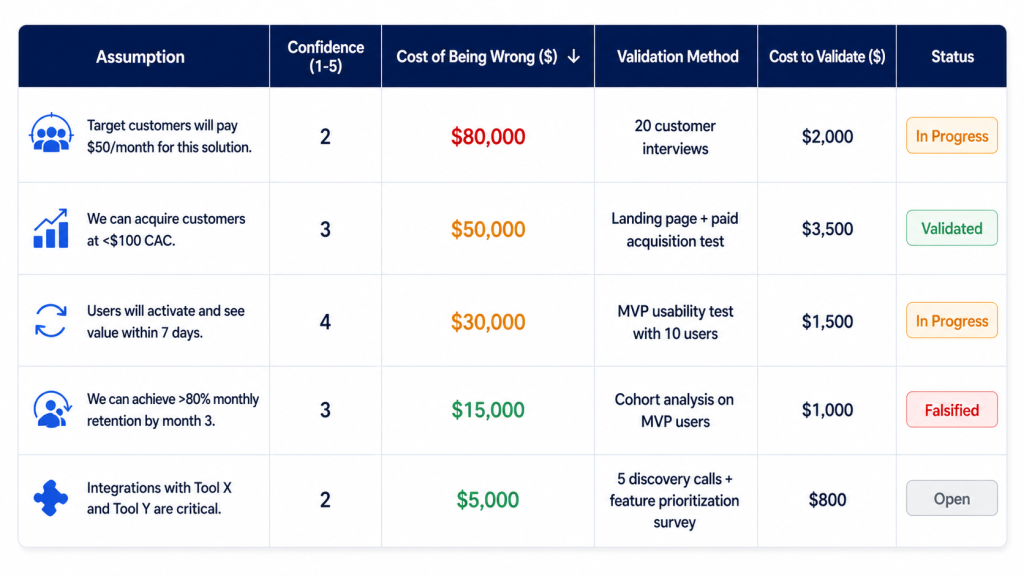
The structure of the Ledger:
Column 1: Assumption. Every belief embedded in the saas idea, written in falsifiable language. “The target buyer is a VP of Operations at a 50 to 200 person logistics company” is an assumption. “People want this” is not (it is too vague to test).
Column 2: Confidence. A 1 to 5 score on how confident the founder is that the assumption is true. Honesty matters more than precision.
Column 3: Cost of being wrong. The dollar amount the build will lose if the assumption turns out to be false. An assumption that “10 percent of trial users will convert to paid” being wrong by 5x is worth $50K to $200K depending on funnel volume. An assumption about button color is worth $0.
Column 4: Validation method. The specific test that would falsify the assumption. Customer interviews, fake-door tests, pre-sell pages, paid ads, concierge MVP, and so on.
Column 5: Cost to validate. The dollars and time required to run the validation. A landing-page test costs $500 in ads and 3 days. A 20-conversation cycle costs 2 weeks of founder time. A concierge MVP costs 1 to 4 weeks of manual work.
Column 6: Status. Open, in-progress, validated, or falsified.
The Ledger is sorted descending by Column 3 (cost of being wrong). The founder works the top of the list, not the easiest items. This sounds obvious and is the single most violated principle in saas idea validation. Founders consistently start with cheap, comfortable assumptions (“the brand colors should pop”) and avoid expensive uncomfortable ones (“the target buyer does not actually have this problem”). The Ledger forces the inversion.
The downloadable template lives at the end of this article. Every step that follows in this guide maps to one or more rows in the Ledger.
Step 1 of Saas Idea Validation: List Every Assumption You’re Making
Step 1 of saas idea validation is filling out Column 1 of the Ledger. This is harder than it sounds because most founders do not realize how many assumptions they are making. Every line of a pitch deck contains 3 to 7 assumptions; most product specs contain 50 or more.
A useful prompt: write out the saas idea in three sentences (problem, solution, who pays). Then for every noun, every verb, and every adjective, ask “what am I assuming here?” and write that assumption on a separate row.
Worked example. Saas idea: “An AI tool that helps small accounting firms summarize client meeting notes and turn them into invoices.”
Assumptions extracted: small accounting firms hold client meetings; meetings produce notes worth summarizing; the notes are recorded, transcribed, or written down; the notes contain billable information; firms currently turn notes into invoices manually; the manual process is painful enough to pay to fix; the firm owner is the buyer (not an admin or partner); summarization quality at current AI levels is good enough to trust on billable data; the firm is willing to upload client notes to a third-party tool; the firm’s current accounting software does not already do this.
That is ten assumptions from one three-sentence description, and the list is not exhaustive. Each one needs a row in the Ledger, a confidence score, and a cost-of-being-wrong estimate. Founders who skip this step and go straight to building usually learn three or four of these assumptions are wrong, after the build is finished and the runway is gone.
The discipline is uncomfortable because it surfaces how much of the idea is faith. That is the point. Saas idea validation that does not produce uncomfortable assumptions is not real validation.
Step 2 of Saas Idea Validation: The 20-Conversation Rule
Step 2 of saas idea validation is talking to twenty target buyers. Not five, not ten, not fifty. Twenty is the rough threshold where pattern repetition becomes statistically meaningful for early-stage validation. Below that, founders hear what they want to hear; at twenty, the actual problem shape emerges.
The conversation is not a sales pitch. It is a structured interview about the prospect’s past behavior. The Mom Test framing applies throughout: never ask about hypothetical future behavior, always ask about specific past actions.
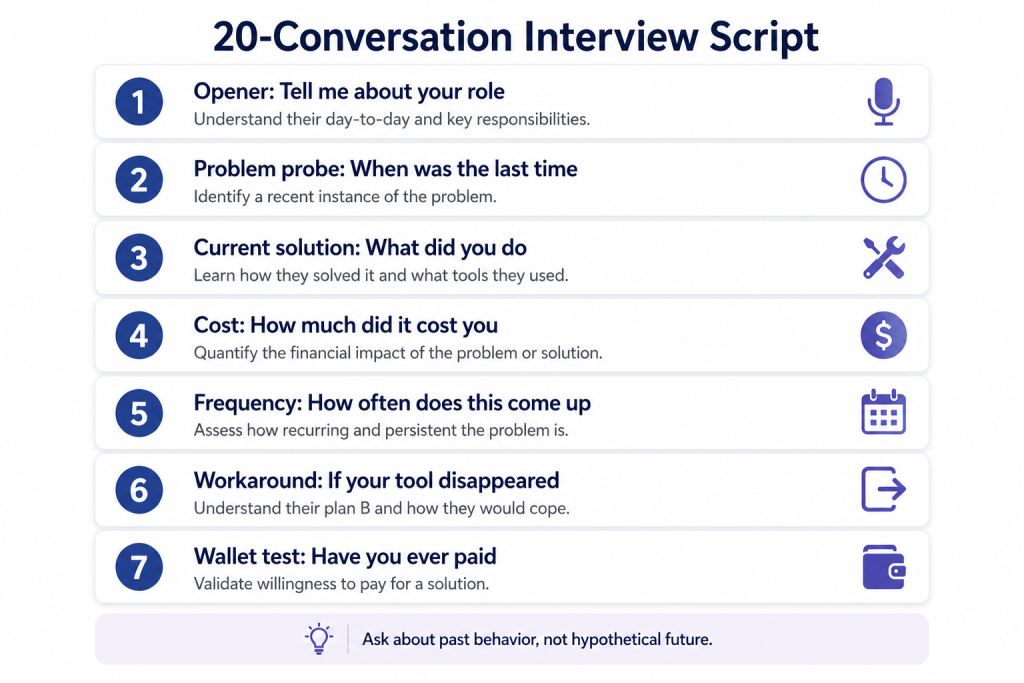
A working interview script:
- Opener. “Tell me about your role and what you do day to day.” Get them talking about their actual work.
- Problem probe. “When was the last time you ran into this problem area? Walk me through what happened.” Past tense, specific incident, no leading.
- Current solution. “What did you do to solve it? What tools did you use?” Reveals current spend, current pain level, current alternatives.
- Cost question. “How much time or money did that situation cost you?” Anchors the value of solving the problem.
- Frequency question. “How often does this come up?” Distinguishes a one-off annoyance from a recurring expensive problem.
- Workaround test. “If your current solution disappeared tomorrow, what would you do?” Reveals dependency and switching cost.
- Wallet test. “Have you ever paid for anything in this category? What did you pay?” Reveals price sensitivity and existing budget allocation.
The disqualification criteria matter as much as the questions. If the prospect cannot describe a specific past incident, the problem is not real to them. If they have never paid for anything in the category, they are unlikely to start now. If their workaround takes less than 30 minutes per week, the problem is too small to monetize. The full customer development methodology is canonized at the Y Combinator Startup School curriculum.
Twenty conversations following this script will produce one of three outcomes: clear validation (5+ prospects describe the same painful incident with the same workaround), partial validation (the problem exists but the proposed solution is wrong), or falsification (the problem does not exist as described). All three are useful. The only useless outcome is a vague “people seem interested,” which usually means the founder asked leading questions.
Step 3 of Saas Idea Validation: Fake-Door Tests and Landing-Page Signals
Step 3 of saas idea validation is the fake-door test: a landing page that describes the product as if it exists, with a clear call-to-action, and tracking on what visitors actually do.
The structure is simple. A single-page site (Carrd, Framer, or a basic WordPress page) describing the value proposition in headline form, three features, a price, and a “Get Early Access” or “Start Free Trial” button. The button leads to a “Coming soon, join the waitlist” form that captures email, ideally with a small deposit option.
What gets measured: traffic source, time on page, scroll depth, button click rate, form completion rate, and (if a deposit is offered) deposit conversion rate. A typical paid traffic test runs $500 to $2,000 across LinkedIn, Google, or Reddit ads, targeted to the buyer profile.
Benchmarks for B2B saas idea validation at this stage: a 4 to 6 percent button click rate suggests message-market fit; below 2 percent suggests the headline is wrong or the audience is wrong. A 25 to 40 percent form completion rate after click suggests the offer is credible; below 15 percent suggests the value proposition does not survive scrutiny. A 5 to 10 percent deposit conversion is the strongest signal short of a full pre-sell.
The fake-door test is faster than 20 conversations and produces complementary data. Conversations reveal the why; landing pages reveal the magnitude. Run both in parallel where possible. For specific scope decisions about what to actually build after the validation produces a clear answer, see saas mvp vs web app.
Step 4 of Saas Idea Validation: The Pre-Sell
Step 4 of saas idea validation is the pre-sell, and it is the only validation that fully counts. Every other test produces signals; the pre-sell produces money. Money is the only universally trusted form of feedback in early-stage saas.
A pre-sell takes one of three forms. Annual contract with delivery commitment, where the prospect pays for a year of access at a discount in exchange for a delivery date 60 to 120 days out. Founding-customer deposit, where 5 to 20 prospects each pay a $500 to $5,000 deposit to lock in a “founding customer” rate. Letter of intent with payment terms, where larger enterprise prospects sign a binding LOI specifying payment on first invoice within 30 days of delivery.
The mechanics are not complicated. A pre-sell offer page (Stripe handles this in 30 minutes), an explicit delivery timeline, a refund policy, and a clear “what you get for paying now” benefit. The hard part is asking. Founders consistently overestimate how unusual it is to ask a prospect for money before the product exists; in reality, every successful B2B saas founder either pre-sold or had a fully validated equivalent (warm referral pipeline, strong design partner). The Stripe Atlas pre-sale guide covers the legal and operational mechanics.
Three pre-sell conversions in 30 days is a strong validation signal. Zero conversions across 20 qualified pitches is falsification. Founders who get one or two conversions are in partial-validation territory and need to dig into the objections from the other 18 prospects to understand why.
The pre-sell also exposes a hidden truth: most founders who claim they “validated” never actually pre-sold. They got positive interviews, ran a fake-door test, collected emails, and called it validation. Real saas idea validation produces a customer list before the build starts, not a waitlist that converts at 0.5 percent after launch.
Step 5 of Saas Idea Validation: The Concierge MVP
Step 5 of saas idea validation is the concierge MVP, and it answers a question that interviews and pre-sells cannot: does the proposed solution actually solve the problem when applied? A concierge MVP delivers the value proposition manually, by hand, behind the scenes, before any code is written.
The pattern is well-documented across early-stage saas. Stripe started as a manual onboarding process where the founders personally walked customers through integration. DoorDash started as a single landing page where the founders themselves picked up and delivered orders. Many B2B saas products that look like sophisticated software in 2026 spent their first 90 days as a founder running spreadsheets, sending emails, and manually performing the work the product would later automate.
The concierge model serves three purposes in saas idea validation. First, it confirms whether the value proposition actually delivers value once delivered. A landing page can show 10% interest; the concierge MVP shows whether 10% of those who paid actually use the value. Second, it reveals the unglamorous edge cases that no founder anticipates from a whiteboard. Third, it produces the first cohort of paying customers whose feedback shapes the actual product.
The cost is founder time, not dollars. A typical concierge MVP runs 2 to 6 weeks at half-time founder commitment, serving 3 to 10 paying customers. The rule for ending the concierge phase: when the manual work becomes repetitive enough that automating it has clear ROI, the concierge MVP has done its job and the actual MVP build can begin.
The danger is staying in concierge mode too long. Founders enjoying the customer interaction sometimes resist transitioning to product, which delays scale. The signal to graduate: when the founder is working 30+ hours a week on concierge delivery and revenue is plateauing, the build should start.
Saas Idea Validation by Motion: B2B vs. B2C vs. PLG
Saas idea validation looks meaningfully different across three primary go-to-market motions: B2B sales-led, B2C, and product-led growth (PLG). Founders who copy validation tactics from the wrong motion frequently validate the wrong things.
B2B sales-led validation. The buyer is a specific role at a specific company size. Validation success looks like 3 to 5 signed letters of intent or pre-sell deposits from named target accounts within 60 days. Volume is low, contract value is high. Twenty conversations is the right number; conversations come from cold outbound and warm referrals. Pre-sells in the $500 to $5,000 range per founding customer. The fake-door test signal threshold is lower because the addressable audience is smaller.
B2C validation. The buyer is an individual, contract value is low, volume is high. Validation success looks like 100+ paid waitlist conversions or 50+ pre-orders within 30 days. Conversations are useful but lower-fidelity because consumers say things they will not do. Landing-page signals matter more than conversations. Paid traffic costs are lower per click but the conversion threshold for validation is higher (1 to 3 percent of paid traffic to deposit). Refund risk is also higher.
PLG validation. The buyer is the user, conversion happens inside the product, and validation requires shipping a product (or near-product) for usage signals to exist. Pure pre-build PLG validation is hard. The substitute is a manual concierge run that approximates the self-serve flow, plus aggressive landing-page testing on copy, pricing tiers, and feature emphasis. The bar for “validation” before build is higher than B2B because PLG product mechanics rarely survive translation from spreadsheet to software.
Most saas founders running validation default to B2B-style customer interviews because that is the most-written-about playbook. B2C and PLG founders who copy this end up with fluffy validation that does not predict launch performance. The motion determines the validation. For the related categorization decision about whether the product is even saas or actually a marketplace (which has a different validation discipline entirely), see saas vs marketplace.
Channel-Specific Saas Idea Validation: LinkedIn, Cold Email, Communities
The right saas idea validation channel depends on where target buyers actually spend time. Three channels dominate B2B founder validation in 2026.
LinkedIn outbound. Best for B2B saas where the buyer is a director-level or above professional with a clean job-title filter (VP of Engineering, Head of Operations, Chief of Staff at companies of size X to Y). LinkedIn DM response rates run 8 to 15 percent for well-crafted outreach. The cost: 30 to 60 minutes of outbound work per scheduled conversation. The right pace: 10 to 15 outbound messages per day, generating 1 to 2 conversations.
Cold email. Best for B2B saas targeting roles that are reachable by email but harder to find on LinkedIn (operations leads at non-tech companies, agency owners, niche industry specialists). Reply rates run 2 to 6 percent on cold emails sent through tools like Apollo, Instantly, or Lemlist. The cost is the tooling subscription ($50 to $200 per month) plus the time to write 5 to 7 distinct email variants for testing. Volume can scale higher than LinkedIn.
Communities. Best for prosumer saas, developer tools, and indie saas. Reddit (specific subreddits matched to the buyer profile), Slack and Discord communities, niche forums, and specialty Substacks. The validation play is participation, not pitching. Two to four weeks of authentic engagement, followed by a soft launch of a fake-door page or pre-sell, generates higher trust and higher conversion than cold outbound. Conversion data is messier (community-driven traffic does not segment as cleanly) but signal quality is higher.
The wrong channel for the buyer profile produces zero signal regardless of how good the message is. The fix is not better copy; the fix is the right channel. The First Round Review archives have extensive case studies on channel-fit at validation stage.
A common mistake in saas idea validation: founders run all three channels at half-effort and conclude “outbound does not work.” The correct test is one channel at full effort for 30 days. The wrong channel at full effort still produces a clear no-signal result, which is more useful than three half-tested channels.
Reading Saas Idea Validation Signals: Green Light, Yellow Light, Red Light
Saas idea validation produces signals that founders frequently misread. A working signal map sorts every result into three buckets.
Green light: build. Twenty conversations producing 5+ specific past-incident stories with quantified pain. Three or more pre-sell conversions or signed LOIs at the target price. A landing-page test converting at 4 to 6 percent button click and 25 to 40 percent form completion. A concierge MVP run that generates positive feedback and at least one referral. Combined, these signals produce a build decision with a high probability of finding paying customers post-launch.
Yellow light: keep validating. Conversations producing some pain stories but inconsistent across prospects (the problem exists but the buyer profile is wrong). Landing-page signals at the lower edge of the threshold. One or two pre-sells but not three. The yellow-light response is not “build with caution,” it is “iterate the validation.” Re-segment the buyer profile, rewrite the headline, or change the pre-sell offer. Validating again on a sharper hypothesis usually moves the result to either green or red within 30 days.
Red light: kill or pivot. Conversations producing polite interest but no specific past incidents. Landing-page conversion below threshold. Zero pre-sells across 20 qualified pitches. The honest response: the saas idea validation has falsified the hypothesis. Killing the idea is the correct action; pivoting to an adjacent problem (a different buyer, a different solution to the same pain, a different category entirely) is also correct. Continuing to build is wrong.
Founders consistently misread yellow as green. The signal that distinguishes them: yellow has gaps the founder can name; green has gaps the founder cannot find. If the answer to “what is your weakest signal?” is detailed and specific, the validation is yellow. If the answer is “I think it is all strong,” the validation is either green or the founder is not looking carefully.
When to Stop Saas Idea Validation and Start Building
The other failure mode is the opposite: founders who validate forever, never building, because validation feels productive and building feels risky. Saas idea validation has a stopping rule, and the rule is concrete.
Stop validating and start building when three conditions are met. First, the Validation Debt Ledger has no remaining rows above $20K cost-of-being-wrong with confidence below 4 out of 5. Every expensive assumption has been tested. Second, at least three pre-sell conversions or three signed LOIs exist from named target accounts. Real money has changed hands. Third, the concierge MVP (if applicable) has produced positive feedback from at least one customer who has used the value beyond the initial purchase.
Validation that continues past this point is procrastination. The remaining unknowns are no longer answerable through customer conversations or fake-door tests; they are answerable only through shipping a product and watching how customers use it. That is product-market fit work, not validation. For the deeper treatment of the PMF threshold and how to recognize it, see finding saas product-market fit.
The opposite failure mode is also worth naming: founders who declare validation complete after fewer than 10 conversations, no pre-sells, and a single landing-page test that hit threshold. That is not validation, that is confirmation bias. The Ledger is the corrective. If the Ledger has unaddressed rows above $20K cost-of-being-wrong, validation is not finished, regardless of how the founder feels.
A Worked Example: 30 Days of Saas Idea Validation, End to End
A worked example anchors the methodology. The hypothetical saas: an AI-powered tool that summarizes call transcripts for managed-services-provider (MSP) sales teams, generating CRM-ready notes in under 60 seconds.
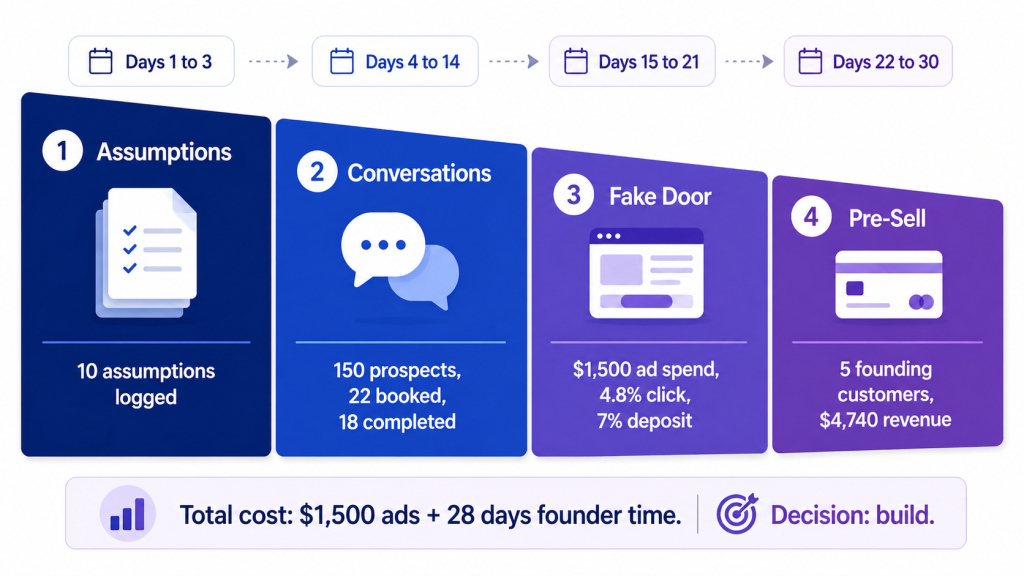
Days 1 to 3. Fill out the Validation Debt Ledger. Top three assumptions by cost-of-being-wrong: MSP sales reps actually take meaningful call notes (cost: $50K), the buyer is the sales manager not the rep (cost: $40K), and CRMs in this segment will accept structured imports from a third-party tool (cost: $30K).
Days 4 to 14. Twenty LinkedIn conversations with sales managers at MSPs sized 20 to 200 employees. Outreach sent to 150 prospects, 22 conversations booked, 18 completed. Findings: 14 of 18 confirmed call notes are a real pain point, but 11 of 18 said the buyer is the rep (not the manager) when the tool is paid for through expense-it budgets under $50 per month. The buyer-profile assumption was wrong. The Ledger gets updated; pricing model assumptions move up to top priority.
Days 15 to 21. A fake-door landing page targeting “SDRs and AEs at MSPs,” $99 per month price point, “Get early access” CTA. $1,500 in LinkedIn ad spend. Results: 4.8 percent button click rate (above threshold), 31 percent form completion (in range), 7 percent deposit conversion at $50 deposit. Signal: yellow trending green.
Days 22 to 27. Pre-sell pitch to the 31 prospects who completed the form. Five accept the founding-customer rate of $79 per month with a 60-day delivery commitment. Total pre-sell revenue: $4,740. Two prospects sign LOIs for team licenses pending team approval.
Days 28 to 30. Final Validation Debt Ledger review. All assumptions above $20K cost-of-being-wrong are now validated or falsified-and-pivoted. Five paying pre-sell customers exist. Decision: build. The MVP scope is informed by what the validation surfaced (rep-as-buyer, $79 price point, focus on CRM import features). Total validation cost: $1,500 in ads, $200 in tools, 28 days of founder time. For the broader build framework that picks up from this point, see how to build a saas in 2026.
This is what successful saas idea validation looks like in practice. The end state is not a beautifully validated business plan. It is a small list of paying customers, an updated set of assumptions, a clear price point, and a defensible reason to build.
Conclusion: Saas Idea Validation as a Discipline, Not a Phase
Saas idea validation is not a phase that delays the build. It is the foundational discipline that decides whether the build is worth doing at all. The Validation Debt Ledger ranks assumptions by cost-of-being-wrong. The five-step sequence (assumptions, conversations, fake-doors, pre-sells, concierge MVP) tests them. The signal map (green, yellow, red) reads the results. The stopping rule (no $20K-plus assumptions unaddressed, three pre-sells in hand, concierge feedback positive) decides when to ship.
Founders who run this process honestly produce one of two outcomes: a small list of paying pre-sell customers and a defensible reason to build, or a clearly falsified hypothesis and a saved $80K MVP budget. Both outcomes are good. The only bad outcome is skipping validation and discovering the answer 6 months and $80K later. For the broader build framework that begins after saas idea validation produces a green light, see how to build a saas in 2026.
Saas Idea Validation FAQ
1. How many interviews before I build?
Twenty is the rough threshold for B2B saas idea validation. Fewer than that and the founder is hearing what they want to hear; more than that and the marginal interview rarely produces new information. The interview count is not the goal; the goal is reaching pattern repetition where the next prospect’s answers are predictable. If after 20 interviews the answers are still inconsistent, the buyer profile is wrong and re-segmentation is needed before continuing.
2. Can I do saas idea validation without a technical background?
Yes. Validation is the part of building a saas that requires zero technical skill. Customer conversations, landing-page tests, and pre-sells are all founder-skill activities. The technical work begins after validation produces a green light. Many of the strongest validations in early-stage saas history were run by non-technical founders, precisely because non-technical founders cannot fall back on “let me just build it.”
3. Validation versus market research, what is the difference?
Market research describes existing market dynamics. Saas idea validation tests specific assumptions about whether a specific product will be paid for by a specific buyer. Market research is wide and shallow; validation is narrow and deep. Market research is useful for sizing the opportunity; it cannot replace validation. Many founders confuse a strong market-research deck for a validated product, which is one of the more expensive errors in early-stage saas.
4. Should I build a no-code prototype first?
Sometimes, as part of Step 5 (concierge MVP) or as a fake-door asset. A no-code prototype is useful when the value proposition is hard to convey in static landing-page copy and a clickable demo unlocks the conversation. The trap: no-code prototypes can take 2 to 4 weeks and become a building project of their own. If the prototype is taking longer than 5 days, the scope is wrong and the founder is building instead of validating.
5. How do I do saas idea validation when buyers are hard to reach?
Hard-to-reach buyers (regulated industries, senior enterprise roles, niche specialists) require warm-introduction strategies. Investor networks, advisor introductions, industry communities, and conference outreach replace cold LinkedIn at this tier. The validation methodology is the same; only the channel changes. If the buyer truly cannot be reached even through warm channels, the addressable market is too small or the product is targeting the wrong layer of the buying organization.
6. What if everyone I talk to says yes?
Two possibilities. Either the question structure is leading (asking about hypothetical future behavior instead of past actions), or the founder is talking to friends and contacts who are biased toward agreement. The fix: re-screen the prospect list for actual target buyers, not friends, and re-run the conversations using the Mom Test framing. If 20 properly-screened target buyers all genuinely say yes with specific past-incident stories, the validation is real and rare. The yellow-flag is the polite yes, not the qualified yes.
7. When is the data lying to me?
Validation data lies when the founder has selected the data to confirm an existing belief. Common signs: the prospects pitched were friends or warm contacts; the questions asked were leading; the landing-page test was run on an audience already aware of the founder’s social media presence; the pre-sell was offered to early supporters who would back any project the founder ran. The fix: re-run the validation with cold prospects, neutral questions, paid traffic from a fresh audience, and pre-sell pitches to people who do not know the founder. If the signal still holds, it is real.