



Online retailers in 2026 do not pick ecommerce platforms by brand recognition. They pick by the SaaS ecommerce features that map to how their business actually operates. A retailer running a 50-SKU specialty store needs something different from a multi-vendor marketplace running 50,000 SKUs across several regions. Both need software that handles real operational complexity, but the SaaS ecommerce features that matter for each are not the same.
The market has matured a lot since 2020. Cloud-hosted platforms now bundle product management, order fulfillment, customer relationships, marketing automation, analytics, payments, and mobile commerce into integrated suites that small and mid-market retailers can deploy in days, not months. The choice founders face is no longer build or buy. It is which platform’s feature set fits your catalog, your buyers, and your growth plan.
This guide walks through the 7 SaaS ecommerce features retailers should evaluate before choosing a platform. These SaaS ecommerce features are: product management, order management, customer management, marketing and promotion, analytics and reporting, payment gateways, and mobile commerce. For each one you get what it does, what to look for, and the red flags that signal a platform is not ready for serious retail.
Key takeaways
- SaaS ecommerce features fall into 7 categories that together decide whether a platform fits how your store actually runs.
- Product management is the foundation of your SaaS ecommerce features; get the catalog structure wrong and you pay for it at month 6 or 12.
- Order management complexity scales with volume, and customer management is where retention compounds.
- Payment gateway choices decide cross-border viability, and mobile commerce is no longer optional at 60 to 75 percent of traffic.
- Match the SaaS ecommerce features to your operational reality, not to whatever looks impressive in a demo.
Table of Contents
Why these features matter for online retailers
The platform a retailer adopts shapes every operational decision for the next 3 to 5 years. It determines which products can be listed, which markets can be served, which payment methods can be accepted, which marketing channels can be activated, and which insights the team can act on. Most of these features come built into a modern eCommerce PHP script, so a small team rarely has to code them from scratch.
Three forces explain why SaaS ecommerce features matter more than they did in 2020.
First, consumer expectations have risen. Shoppers expect one-click checkout, real-time inventory, multi-currency pricing, and fast delivery quotes as baseline. Platforms weak in these areas lose conversions to platforms that are strong.
Second, multi-channel selling is now standard. Retailers sell through their own store, Amazon, social commerce, and marketplaces at the same time, and features that integrate cleanly across channels save the team from reconciling data across disconnected systems.
Third, the SaaS model puts capabilities that were enterprise-only five years ago within reach of sub-$1M revenue stores.
The choice of SaaS ecommerce features is the single most leveraged operational decision a retailer makes in year one, so it deserves real care. For the broader build framework that places this choice in context, see how to build a SaaS in 2026. For an example of an opinionated ecommerce SaaS built around these categories, see Nazmart.
1. Product management: catalog control
Product management is the foundational layer of any store’s SaaS ecommerce features. Every other capability depends on the catalog being structured correctly, and retailers who underestimate it end up restructuring at month 6 or 12, which is expensive and disruptive.
- Catalog structure. Unlimited categories with multi-level nesting, SKU management with variant inheritance, and bulk import/export via CSV or API. Single-level structures break around 200 to 500 SKUs.
- Variant handling. Products with size, color, or material need true variant support, not a separate product per variant. Variant inventory should track independently while sharing metadata, with per-variant pricing overrides.
- Inventory tracking. Real-time levels per SKU, per variant, and per warehouse. Multi-location inventory, low-stock alerts, and checkout reservation logic prevent overselling.
- Media management. Multiple images per variant, video, 360-degree views, and bulk upload, with image optimization that keeps Core Web Vitals healthy.
- Product information management. Centralized descriptions, specs, attributes, and SEO metadata that flow consistently across the store, marketplaces, and marketing surfaces.
- Bulk operations. Updating 1,000 products at once (pricing, category, attributes) without one-by-one editing. Stores with 500+ SKUs lose hours a week to platforms that lack this.
Evaluation checklist for these SaaS ecommerce features: can the catalog handle 10x your current SKU count without an architecture change; do variants behave like first-class entities; does inventory sync in real time across all channels; is bulk operation depth genuine. The architecture patterns that support catalog scale are covered in multi-tenant SaaS architecture.
2. Order management: fulfillment flow
Order management is the second most critical group of SaaS ecommerce features. Every order has to be captured, validated, paid, fulfilled, shipped, tracked, and sometimes returned. Weak order handling shows up as fulfillment delays, complaints, and inventory mistakes.
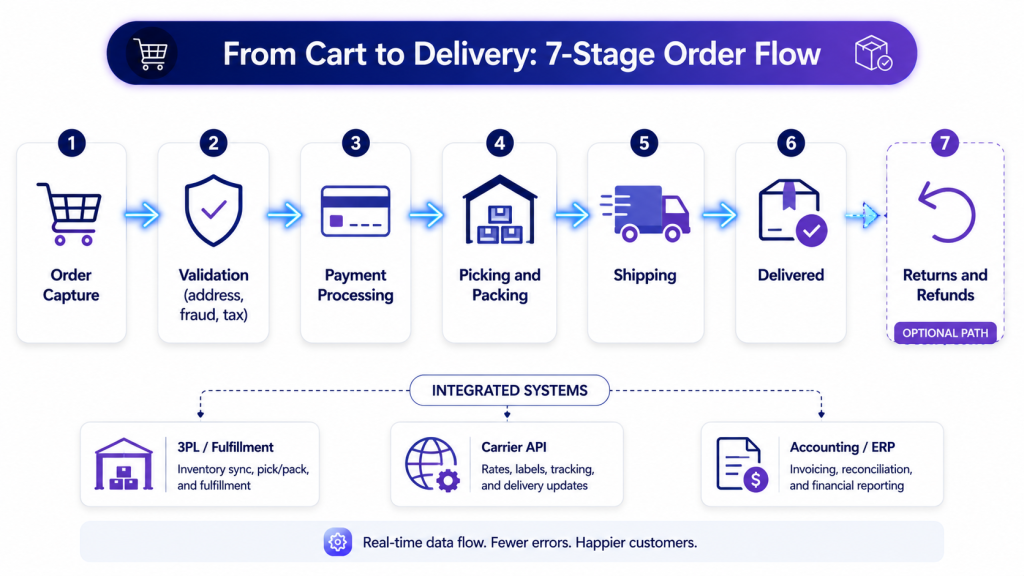
- Capture and validation. Real-time capture from web, mobile, marketplace, and POS into one queue. Address validation, fraud screening, and tax calculation happen at capture, and problem orders route to manual review instead of failing silently.
- Workflow states. Pending, paid, processing, picking, packed, shipped, delivered, returned, refunded, plus custom states like “awaiting supplier” for drop-ship. Transitions trigger inventory reservations, picking lists, notifications, and accounting entries.
- Shipping integration. Native carrier integration (UPS, FedEx, USPS, DHL, regional couriers) for rate quoting, labels, and tracking. Multi-carrier rules cut shipping cost meaningfully for geographically diverse stores.
- Fulfillment automation. Pick-pack-ship for in-house, plus 3PL integrations (ShipBob, ShipStation, Easyship) for outsourced. The routine work is automated so the team handles only exceptions.
- Returns and refunds. Customer-initiated requests, approval workflows, return labels, refunds to the original method, and inventory updates on restock. Returns run 5 to 40 percent of volume depending on category.
- Order routing. Rules that decide which warehouse or drop-ship supplier fulfills each order, cutting time and cost together.
- Manual order entry. Backend entry that mirrors checkout, so B2B and phone orders do not require a second, disconnected system.
Evaluation checklist for order management SaaS ecommerce features: can the workflow match your fulfillment pattern; do shipping integrations cover your carrier mix; does the returns flow work without engineering; can manual orders be entered with the same data integrity. For scoping these in an MVP, see SaaS MVP vs web app.
3. Customer management: retention
Customer management is the set of SaaS ecommerce features that decides whether your customer base is a transactional list or a compounding asset. Strong tools turn first-time buyers into repeat buyers; weak ones leave every sale as a one-off.
- Customer profiles. Unified records with purchase history, lifetime value, average order value, preferred categories and channels, and contact preferences, built from every channel into one view.
- Segmentation. Slice by recency, frequency, and monetary value (RFM), product preference, geography, and custom attributes. Segments feed automation, personalization, and loyalty.
- Service tools. Native ticketing or help-desk integrations (Zendesk, Intercom, Front, Help Scout), with order history and customer notes visible to agents.
- Account management. Customer account pages with order history, saved addresses and payment methods, loyalty points, wishlist, and subscription management. Weak account pages produce one-time buyers.
- Loyalty programs. Native points or integrations (Smile.io, Yotpo, LoyaltyLion), with tiers that customers can see and progress through.
- Subscriptions. For consumables (beauty, supplements, pet food, coffee), recurring order generation, self-service pause/skip/cancel, and dunning on failed payments. Subscriptions can double lifetime value in eligible categories.
- Wishlist and saved items. Saved items that survive across sessions and feed price-drop and back-in-stock alerts.
- Communication. Transactional emails, marketing emails, SMS, and push routed through the customer’s preferred channel, with behavior-triggered automation (cart abandonment, post-purchase, win-back).
Evaluation checklist for customer management SaaS ecommerce features: does the profile aggregate every channel; can segments be built without engineering; do account pages drive repeat purchases; is communication automation flexible enough for your retention strategy. The customer angle in the platform-vs-marketplace question is discussed in SaaS vs marketplace.
4. Marketing and promotion: growth
Marketing SaaS ecommerce features turn the catalog and customer base into a growth engine. Without them, retailers burn engineering time wiring third-party tools the platform should provide.
- Discount and coupon engine. Percentage, fixed-amount, free shipping, buy-X-get-Y, tiered, and segment-specific offers, with stacking rules, expiry, usage limits, and minimum thresholds.
- Campaign management. Time-bounded campaigns with segments and revenue attribution, not just discount volume.
- Email marketing. Native email or integrations (Klaviyo, Mailchimp, Omnisend, ActiveCampaign) with behavioral triggers that fire on customer behavior.
- SMS marketing. Opt-in, segmented campaigns, transactional SMS, and two-way conversational commerce. SMS conversion runs several times higher than email on promotional sends.
- Social integration. Product feeds to Meta, TikTok Shop, Pinterest, and Google Shopping, native social checkouts where available, and UGC on product pages.
- SEO and content. Per-product metadata and schema, clean URL structure, a blog for content marketing, sitemaps, and Core Web Vitals optimization.
- Affiliate and influencer programs. Native tracking, custom commissions, attribution links, and payout processing. In word-of-mouth categories this can drive a meaningful share of revenue.
- A/B testing. Native or integrated testing for product pages, checkout, pricing, and promotions, so you optimize with data rather than by gut.
Evaluation checklist for marketing SaaS ecommerce features: can the discount engine express your most complex rule without custom code; do email and SMS support behavioral triggers natively; can social feeds be maintained without engineering; does the platform expose enough data for proper attribution. The wider go-to-market framework is contextualized in how to build a SaaS in 2026.
5. Analytics and reporting: business intelligence
Analytics SaaS ecommerce features turn raw transaction data into decisions. Without strong reporting, retailers decide by gut; with it, the data becomes their advantage.
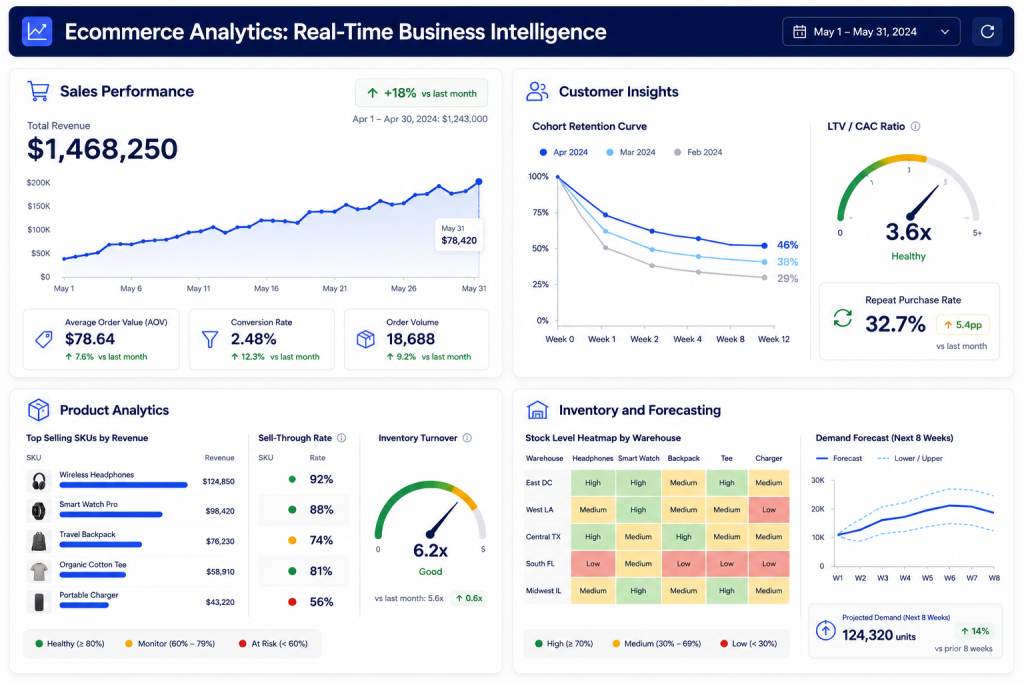
- Sales analytics. Revenue by day, week, month, and year with prior-period comparison, plus revenue by channel, product, category, segment, and geography. Order volume, average order value, and conversion trends on a daily dashboard.
- Performance metrics. Conversion from session to cart to checkout to paid, drop-off at each stage, page-level performance on top products, and cart abandonment and recovery rates.
- Customer analytics. Acquisition cost by channel, lifetime value, repeat purchase rate and timing, churn, and cohort retention curves.
- Product analytics. Best sellers, slow movers, frequently returned items, high-add-low-checkout products, and cross-sell affinity.
- Inventory analytics. Turnover by SKU and category, sell-through on launches, dead-stock identification, and demand forecasting from velocity plus seasonality.
- Custom reporting and exports. Build reports on any dimension and export to CSV, Excel, or Sheets, with API access for BI tools (Looker, Mode, Tableau).
- Real-time dashboards. Live updates rather than 24-hour batches, which matters during flash sales and launches.
Evaluation checklist for analytics SaaS ecommerce features: can custom reports be built without engineering; do funnel metrics break down to the granularity you need; is cohort retention visible without manual work; can data be exported for external BI. For how analytics fit product-market fit, see finding SaaS product-market fit.
6. Payment gateways: global transactions
Payment SaaS ecommerce features decide which markets you can serve and how much revenue actually reaches your bank account. Weak payments cap expansion; strong payments unlock cross-border revenue.
- Multiple payment options. Cards, digital wallets (Apple Pay, Google Pay, Shop Pay), buy-now-pay-later (Klarna, Affirm, Afterpay), bank transfers (ACH, SEPA), and emerging methods. Each method served lifts conversion in its native geography.
- Secure processing. PCI DSS handled by the gateway, tokenization so you never store raw card numbers, 3D Secure for fraud and chargeback protection, and fraud screening.
- Global payments. Local-currency display, multi-currency settlement with managed FX, and country-specific methods (iDEAL, Bancontact, Boleto, UPI).
- Subscriptions and recurring billing. Stored methods, automatic retries, dunning on declines, and self-service portals for updating payment details.
- Tax handling. Destination-based calculation (US states, EU VAT, GST), inclusive vs exclusive display per market, and reporting for filing. Stripe Tax, TaxJar, and Avalara are the common integrations.
- Payout management. Daily, weekly, or instant payouts, multi-currency payout, transparent fees, and reconciliation that matches payouts to orders.
- Failed payment recovery. Retry logic, card-updater services, and smart routing. A meaningful share of recurring charges fail each month, and recovery turns that loss back into revenue.
Evaluation checklist for payment SaaS ecommerce features: does the gateway support the methods your customers prefer in each market; is PCI fully handled by the gateway; can subscriptions and dunning be configured without custom code; is tax accurate across your jurisdictions; do payout terms fit your cash flow. Payments tie closely to the SaaS vs marketplace decision, since marketplaces add Stripe Connect on top of standard billing.
7. Mobile commerce: smartphone buyers
Mobile handles 60 to 75 percent of ecommerce traffic globally, so weak mobile SaaS ecommerce features lose that traffic to competitors with better experiences.
- Responsive design. The storefront renders correctly on every screen size without horizontal scroll, broken layouts, or tiny touch targets. Separate mobile sites are obsolete.
- Mobile-optimized checkout. One-page or accordion checkout that minimizes typing, supports autocomplete, and integrates digital wallets for one-tap. Mobile checkout conversion typically trails desktop, and optimization closes the gap.
- Progressive Web App support. Add-to-home-screen, offline browsing of recent products, and push notifications for order and promo updates, without an app-store install.
- Native app integration. For larger retailers, APIs the app uses for catalog, cart, checkout, and account. Native apps drive higher repeat purchase rates than mobile web.
- Performance optimization. Image compression and responsive delivery, lazy loading, code splitting, and CDN distribution. Every second of mobile load time correlates with a measurable conversion change.
- Touch-optimized interactions. Swipe galleries, tap-friendly button sizes, and no hover-only interactions.
Evaluation checklist for mobile commerce SaaS ecommerce features: does the mobile experience match desktop without simplification; do digital wallets work without custom integration; can you measure mobile metrics separately; does the platform expose APIs for a native app if you need one. The stack decisions behind strong mobile commerce are covered in the 2026 SaaS tech stack.
How to choose the right features for your store
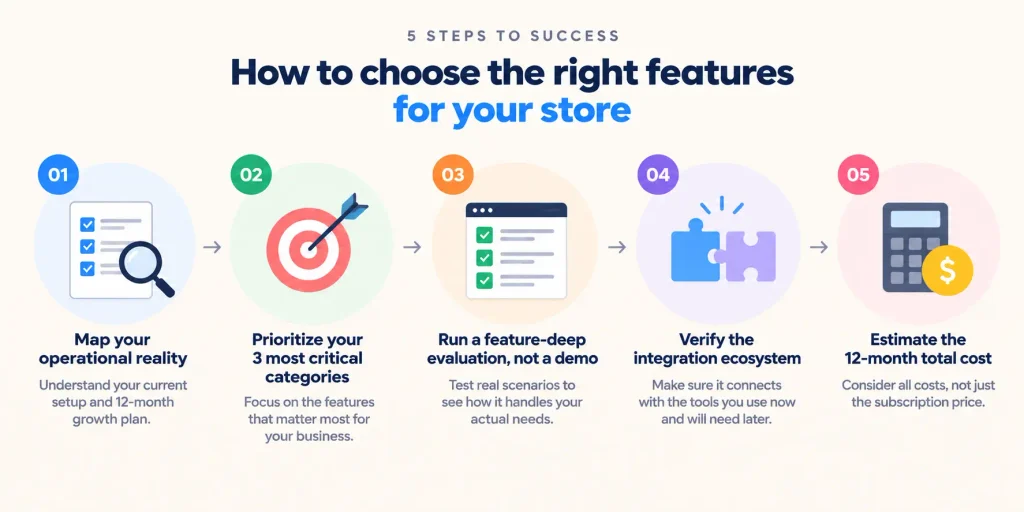
With seven categories of SaaS ecommerce features and dozens of competing platforms, the decision is non-trivial. Run this 5-step framework before committing.
Step 1: Map your operational reality. Document current SKU count, monthly order volume, sales channels, payment methods, fulfillment model, customer segments, and 12-month growth plan. The SaaS ecommerce features that matter for you are the ones that map to this, not the ones that look good in a demo.
Step 2: Prioritize your 3 most critical categories. Most retailers can name 2 to 3 groups of SaaS ecommerce features that disproportionately matter. A subscription beauty brand prioritizes customer management and subscription billing. A marketplace prioritizes order management and payments. A flash-sale retailer prioritizes inventory and performance. Your top 3 should drive 80 percent of the evaluation.
Step 3: Run a feature-deep evaluation, not a demo. Demos show the polished surface. For each of your top 3 categories, run 5 to 10 specific scenarios, for example, “a customer returns one item from a five-item order shipped to a different address.” Platforms whose SaaS ecommerce features handle these without custom code fit; platforms that need workarounds will cost you weekly hours forever.
Step 4: Verify the integration ecosystem. What you need today is not everything you will need in 12 months. Confirm clean integration with your marketing, analytics, payment, fulfillment, and accounting tools. Weaker native features plus strong integrations often beat stronger native features in a closed ecosystem.
Step 5: Estimate the 12-month total cost. Subscription, transaction fees, app and integration costs, payment processing, and team hours. The cheapest-looking platform is often the most expensive once total cost is counted.
This is a 3 to 5 year commitment. Replatforming costs 6 to 12 months of disruption plus engineering, so the choice deserves disproportionate care. For the broader build-vs-platform framework, see how to build a SaaS in 2026.
Conclusion
The seven categories together decide whether a platform supports how your store actually runs: product management for catalog depth, order management for fulfillment, customer management for retention, marketing for growth, analytics for intelligence, payments for transaction scale, and mobile commerce for the channel that now dominates traffic. Strong platforms deliver depth across all seven groups of SaaS ecommerce features; weaker ones force you to bolt on third-party tools or accept friction.
The framework that produces the right call: map operational reality, prioritize three categories, run a feature-deep evaluation against real scenarios, verify integrations, and estimate 12-month total cost. Retailers who follow it choose platforms that grow with the business; those who skip it replatform within 18 to 24 months at real cost.
If you want a platform that ships these seven categories out of the box with the architectural control most hosted tools do not give you, Nazmart is a productized, multi-tenant ecommerce SaaS built around exactly these capabilities. And if you would rather build something custom to your operational model, our custom SaaS development team can help. For a wider view of your options, compare the 13 best SaaS ecommerce platforms.
Frequently asked questions
1. What saas ecommerce features matter most for a new online retailer?
Among all the SaaS ecommerce features, product management, order management, and payments matter most for any new store, because they handle the basics every store needs. Customer management and marketing become critical once you pass roughly 100 orders a month. Analytics and mobile matter from day one and become higher-stakes as you grow past $50K monthly revenue.
2. Are saas ecommerce features better than custom-built features?
For most retailers, yes. SaaS platforms deliver these categories at a price and quality that custom builds cannot match without six-figure budgets and ongoing engineering. Custom builds make sense only when your model is genuinely unique or you are large enough that platform fees exceed in-house engineering cost.
3. How do I evaluate the depth of saas ecommerce features before signing up?
Run 5 to 10 specific scenarios from your business through a free trial or sandbox: bulk-update 100 SKUs, process a partial-refund return, run a tiered discount, build a custom report by category. Platforms that handle these without workarounds have the depth you need.
4. Which saas ecommerce features are non-negotiable in 2026?
Mobile-responsive checkout with digital wallets, automated behavioral email (cart abandonment at minimum), real-time inventory across channels, multi-currency display for cross-border sellers, and PCI-compliant payments handled by the gateway. Any platform missing these is below baseline.
5. Can I add saas ecommerce features through apps and integrations?
Yes, and most retailers do. Native features cover the core; apps cover specialized needs like loyalty, advanced analytics, and regional payments. The key question is whether the integration ecosystem is deep enough to cover the gaps.
6. How much do saas ecommerce features cost in 2026?
Entry tier (Shopify Basic, BigCommerce Essentials): roughly $30 to $100 a month plus transaction fees. Mid tier: $200 to $500 a month. Enterprise (Shopify Plus, Salesforce Commerce Cloud): $2,000 to $20,000+ a month. Productized open-source options like Nazmart sit between mid tier and enterprise in depth while offering more architectural control.