





A $50/hour freelancer often costs more than a $200/hour saas development agency. The reason is hidden in coordination overhead, risk premium, opportunity cost, and the rework that comes when a freelance build does not survive its first compliance review. Founders who compare hourly rates side by side make the wrong decision roughly 60 percent of the time, because hourly rate is not the comparable unit of cost.
This guide compares the three smart choices for building a saas (freelancer, saas development agency, in-house team) across the dimensions that actually matter: true cost over 12 and 36 months, IP ownership, compliance posture, velocity, and risk. It includes the Build Team Matrix framework that maps stages (validation, MVP, scale) against options, the contract structures that protect founders, the IP clause most founders skip, the 10-point vetting checklist for any agency engagement, and the red flags to avoid in each option.
Five takeaways before reading on: why hourly rate is the wrong comparison, the true-cost equation that rewrites the math, the Build Team Matrix that routes founders to the right option per stage, the 12-month TCO comparison with real numbers, and the vetting checklist for any saas development agency engagement. For the broader build framework that places this hiring decision in context, see how to build a saas in 2026.
The Three Saas Development Agency Alternatives, Honestly Defined
Three options dominate saas build decisions in 2026. Each carries a distinct cost profile, risk profile, and velocity profile.
Freelancer. A single contractor, usually working remote, billing by the hour or by the project. Best when scope is small and tight, the founder has prior PM experience, and the build does not require deep compliance or cross-functional design. Hourly rates: $30 to $150 depending on geography and seniority.
Saas development agency. A team of 3 to 8 people (engineers, designer, project lead) operating as a coordinated build unit, billing by fixed-price project, time-and-materials, or milestone. Best when scope is meaningful, compliance matters, and the founder wants predictable delivery. Effective rates equivalent to $80 to $250 per person-hour, often packaged as fixed-price MVP deals from $15K to $120K.
In-house team. A permanent payroll team of 2 to 10 engineers plus design and PM, working only on the saas. Best post-product-market-fit when ongoing product velocity is the primary constraint and the saas has revenue to support permanent salaries. Annual cost: $300K to $800K for a US team, $150K to $400K for a hybrid US/offshore team.
The mistake founders make: comparing the three options as if they are interchangeable across all stages. They are not. A pre-MVP solo founder choosing in-house is over-engineering; a scaled saas with paying customers using only freelancers is under-investing. The Build Team Matrix framework below maps stage to option correctly.
Why Hourly Rate Is the Wrong Saas Development Agency Comparison
The single most expensive mistake in saas development agency vs freelancer comparisons is treating hourly rate as the comparable unit of cost. Hourly rate ignores four costs that vary dramatically by option.
Coordination overhead. A freelancer requires founder time for PM, design direction, QA, and integration management. The implicit founder labor at 10 to 15 hours per week, multiplied by an opportunity-cost rate (what the founder could earn in sales, fundraising, or strategic work), often adds $5K to $20K per month to the freelance arrangement.
Risk premium. A freelancer carries higher delivery risk than an agency. The probability of disengagement (the freelancer takes another contract mid-build, gets sick, drops responsiveness) is meaningfully higher for solo contractors than for agencies with a bench. Risk premium translates to expected rework cost, which agencies absorb internally and freelancers leave on the founder’s plate.
Opportunity cost of slow velocity. A freelancer ships at the rate of one person; an agency ships at the rate of three to five people in parallel. A 12-week freelance build vs. an 8-week agency build represents 4 weeks of additional runway burn, marketing delay, and missed customer acquisition. At early-stage saas economics, 4 weeks of delay can be worth $20K to $50K in cumulative opportunity cost.
Compliance and IP cleanup. Freelance builds frequently produce IP ownership ambiguity (was the work-for-hire clause clear? does the founder own the code?), missing compliance work (no audit logs, no GDPR architecture), and security gaps that require an agency or in-house team to fix later. Cleanup work runs $10K to $40K and pushes the launch by 4 to 8 weeks.
The honest framing: hourly rate is the entry-level price; total cost of ownership is the real number. The Stack Overflow Developer Survey provides industry hourly-rate benchmarks, but those benchmarks are the smallest part of the actual saas development agency vs freelancer cost equation. Focus on TCO, not rate cards.
The True-Cost Equation for Saas Development Agency Hiring
The true cost of a saas build follows a four-component equation, regardless of which option is chosen.
Cost = Labor + Coordination + Risk Premium + Opportunity Cost
Labor. The headline number, what most founders compare. Freelancer at $50/hour × 480 hours over 12 weeks = $24K. Agency fixed-price MVP: $15K to $120K. In-house: salary × time fraction.
Coordination. The founder time required to manage the build. For a freelancer, 10 to 15 hours per week × founder opportunity cost rate × 12 weeks. For an agency, 2 to 4 hours per week (the agency carries the PM burden). For in-house, 5 to 10 hours per week (founder must hire and manage the team).
Risk premium. Expected rework cost given the probability of failure modes. Freelancer: 30 to 50 percent risk of delivery slippage or quality gaps requiring rework, valued at 25 to 40 percent of original budget. Agency: 5 to 15 percent risk, often covered contractually. In-house: 10 to 20 percent risk during the team’s ramp period.
Opportunity cost. Revenue and market position lost during the build. A 4-week timeline difference at $99/month per customer with 30 customers acquired in the first month after launch represents $12K of delayed ARR plus the compounding effect across 12 months.
When the equation is run honestly, the freelance option that looked cheap at $50/hour often costs more in total than a saas development agency at $200/hour, because the agency carries the coordination, absorbs the risk premium, and ships faster (compressing opportunity cost). The math is counterintuitive but consistent across hundreds of post-mortems documented in agency and accelerator literature.
Freelance vs Saas Development Agency: When Each Works
The freelance option is not always wrong. Three scenarios where freelance beats both saas development agency and in-house.
Scenario 1: Tight, well-specified scope. A single-feature build (e.g., adding a specific integration to an existing app) where the scope is fully written, the design is done, and the integration boundaries are clear. Freelance cost: $5K to $20K. Agency overhead is unjustified.
Scenario 2: Founder is a strong technical PM. A founder with prior engineering experience can serve as the project lead, reducing coordination overhead to a level where freelance economics work. The founder absorbs the PM burden that an agency would normally carry.
Scenario 3: Augmenting an existing team. Bringing in a freelance specialist (mobile developer, ML engineer, security specialist) to add a specific capability to a primary team. Freelance is the right choice for scope-bounded specialization.
When freelance fails: full saas builds with compliance requirements, builds without strong PM oversight, builds where coordination overhead exceeds 8 hours per week, and any build requiring multiple specializations (front-end, back-end, design, DevOps) coordinated together. In those scenarios, a saas development agency consistently outperforms freelance on TCO.
Saas Development Agency: What You’re Actually Buying
A saas development agency is not “engineers for hire.” A saas development agency engagement bundles five services that founders frequently price as zero and discover were the most valuable parts of the engagement.
Coordination and project management. The agency carries the PM burden. Founders interface with one person (the project lead) instead of coordinating engineers, designers, and DevOps directly. Implicit value: 8 to 15 hours per week of founder time, valued at the founder’s opportunity cost rate.
Pre-built design and architecture patterns. Agencies that have shipped multiple saas builds bring opinionated patterns (multi-tenant architecture, billing integration, auth scaffolding, design system foundations) that compress weeks off the build. A new freelancer or in-house team builds these from scratch.
Risk absorption. Fixed-price agency contracts shift delivery risk from founder to agency. The agency bears the cost when scope estimates are wrong; the founder pays the agreed price regardless. This contractual structure is impossible with hourly freelance and difficult with in-house teams in their ramp period.
Compliance and security defaults. Established agencies bake compliance primitives (audit logs, encryption, tenant isolation, GDPR architecture) into every build by default. Freelance builds frequently skip these because they are not in the explicit scope.
Post-launch handoff. Quality agencies provide documented handoff (architecture decisions, runbooks, on-call rotations, deployment guides) that lets the founder transition to in-house engineering without a knowledge gap. Freelance handoffs are typically a code repository and a Slack message.
The pricing-vs-value gap in a saas development agency engagement: founders compare the labor line item ($60K for 8 weeks of engineering) but receive a bundle worth $80K to $120K when coordination, patterns, risk absorption, compliance defaults, and handoff are valued separately. The discount comes from the agency amortizing its bench across many engagements.
In-House Build vs Saas Development Agency: The Break-Even Point
In-house teams are the right answer at scale, not at MVP. The break-even point where an in-house team becomes cheaper than a saas development agency is later than founders typically expect.
Year 1 economics. A 4-engineer in-house team at average $150K loaded cost = $600K annual burn. An equivalent agency engagement for a full MVP plus 9 months of ongoing development runs $80K to $200K. The agency is meaningfully cheaper in year 1.
Year 2 economics. With the in-house team now ramped and shipping at full velocity, the cost-per-feature in-house begins to approach or exceed agency cost-per-feature. The break-even depends on feature volume, but typically lands around month 18 to 24.
Year 3 economics. In-house wins on cumulative cost-per-feature for any saas with sustained ongoing development needs. The team has accumulated product-specific knowledge, the velocity is high, and the agency’s external engagement is no longer cost-effective for steady-state work.
The right framing: agencies are cost-effective from MVP through roughly month 18, in-house wins from month 18 onward, and most successful saas use a hybrid (agency build, in-house scale). The break-even is later than most founders expect because they underestimate agency efficiency in early stages and overestimate in-house velocity during ramp.
The Build Team Matrix: A Saas Development Agency Framework
The Build Team Matrix is the framework that routes founders to the right option for their current stage. Three stages × three options = nine cells, each with a recommendation, cost range, and risk profile.
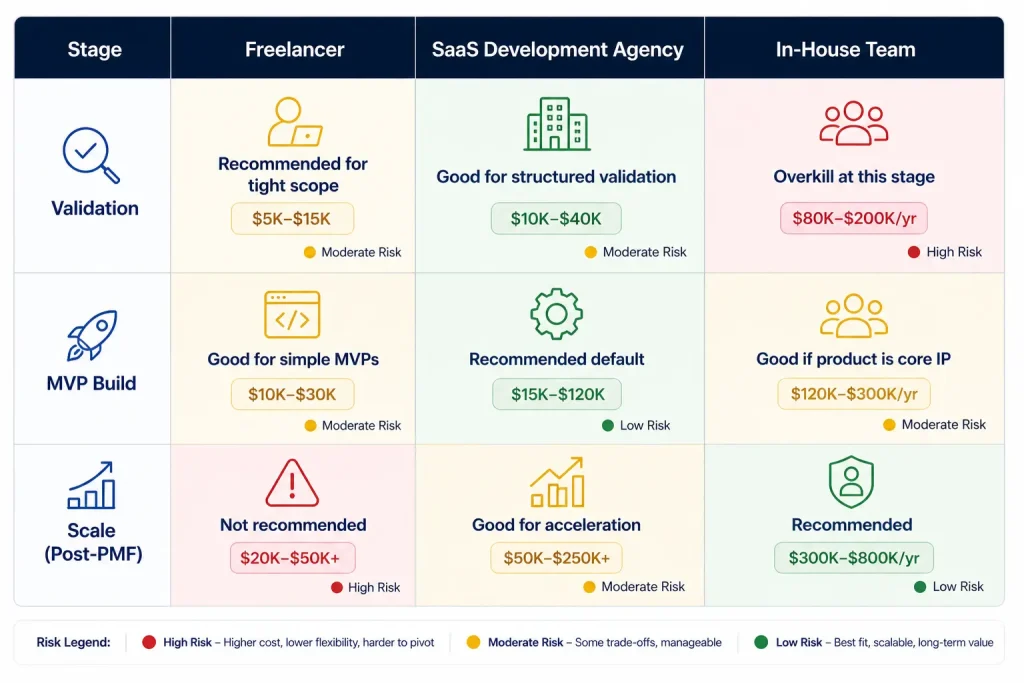
The nine cells:
Validation × Freelancer (recommended for tight scope). Pre-build prototypes, fake-door tests, single-feature work. $5K to $15K. Yellow risk: depends heavily on freelancer reliability.
Validation × Saas development agency (over-engineered). Most agencies are too expensive for pre-MVP validation work. Skip unless the agency offers a specific validation product. Red risk: poor cost fit.
Validation × In-house (premature). Hiring full-time engineers before validation is a capital-allocation mistake. Red risk: high burn before signal.
MVP × Freelancer (works for tight scope, otherwise risky). Possible for solo-developer-friendly scopes with strong founder PM. Yellow risk: most MVPs require multi-disciplinary coordination that freelance struggles with. $20K to $60K.
MVP × Saas development agency (recommended default). The best fit for compliance-aware, time-bound MVPs at predictable cost. $15K to $120K. Green risk: contractual delivery, bundled coordination.
MVP × In-house (expensive and slow at this stage). Hiring a team and ramping it during MVP build adds 3 to 6 months of ramp before any output. Red risk: high burn during ramp.
Scale × Freelancer (under-investing). Scaling a saas on freelance contractors creates technical debt and coordination problems. Red risk: long-term IP and continuity gaps.
Scale × Saas development agency (cost-effective for specific projects). Agencies remain useful for specific scope (compliance certifications, integrations, specialist work) at scale, but ongoing development belongs in-house. Yellow risk: not the right primary engine post-PMF.
Scale × In-house (recommended). Permanent team owning the product, accumulating institutional knowledge. $300K to $800K per year. Green risk: the right engine for sustained growth.
The Matrix is used as a starting point, not an absolute rule. Most successful saas hybridize across stages: agency for MVP, agency-plus-in-house transition during early growth, in-house dominant at scale with selective agency engagements for specific scope.
For the broader build framework that contextualizes this team decision, see how to build a saas in 2026. The seven mistakes that cause founders to pick the wrong option at the wrong stage are covered at common saas mvp mistakes.
Fixed-Price vs T&M vs Milestone: Saas Development Agency Contracts
Three contract structures dominate saas development agency engagements in 2026. Each shifts risk differently between founder and agency.
Fixed-price. The agency commits to a defined scope at a defined price by a defined deadline. The agency bears the risk of estimation errors, scope ambiguity, and execution delays. The founder bears the risk of late scope changes (which trigger change-order fees). Best for tightly-scoped MVPs where the deliverable is well-understood. Fixed-price MVP packages from $15K to $120K are the most common saas development agency contract structure for early-stage builds.
Time and materials (T&M). The agency bills for actual hours worked at agreed rates. The founder bears all risk; the agency bears none. Best when scope is genuinely uncertain (research projects, exploratory builds) or when the founder wants direct visibility into engineering hours. Risky for first-time founders because cost ceilings are notional, not contractual.
Milestone-based. The contract divides the build into 4 to 8 milestones, each with defined deliverables and a payment installment. The agency bears milestone-level risk; the founder retains exit rights between milestones. Best for builds longer than 12 weeks or when the founder wants check-in points to validate continued investment.
The pragmatic guidance for choosing a saas development agency contract: fixed-price for any build under 12 weeks with clear scope; milestone for builds over 12 weeks or compliance-heavy work; T&M only when working with an agency that has prior trust and clear cost ceilings.
The clause that founders consistently miss: change-order policy. Fixed-price contracts charge for scope changes mid-build, often at premium rates. Read the change-order section before signing; ambiguous change-order language is where fixed-price contracts blow their budgets.
IP Ownership in a Saas Development Agency Engagement
The single clause that founders skip most often when reviewing a saas development agency contract is the intellectual property ownership clause. Skipping it produces founders who think they own their saas and discover at fundraising or acquisition that they own only a license to use it.
Five contract patterns determine actual IP ownership:
Work-for-hire vs. assignment. Work-for-hire makes the agency the original author and assigns ownership to the founder upon payment. Assignment makes the agency the original owner and transfers ownership through a separate clause. Both can produce founder ownership, but the language must be explicit. “Work product is delivered to client” without specifying ownership transfer leaves IP ambiguous.
Exclusive vs. non-exclusive. Exclusive ownership means only the founder owns the work. Non-exclusive means the agency retains rights to use, reuse, or relicense parts of the codebase. Most legitimate agencies operate exclusive for client-specific work, but agency-built libraries or boilerplate may remain non-exclusive. Read the carve-outs.
Foreground vs. background IP. Foreground IP is the work product specifically created for the engagement (the founder’s saas application). Background IP is the agency’s pre-existing tools, frameworks, and patterns. Founders own foreground; agencies retain background but grant the founder a perpetual license to use it within the application.
Open-source contributions. If the agency uses open-source libraries (most do), the application’s license obligations follow those libraries. The contract should require the agency to disclose open-source usage and confirm license compatibility with the founder’s intended distribution model.
Source code escrow. The contract should require source code delivery to the founder’s repository (GitHub, GitLab) on a continuous basis, not at project end. Founders who discover at week 12 that the source lives in the agency’s repository face leverage problems.
The minimum IP language a saas development agency contract should include: “All foreground intellectual property created by [Agency] for [Client] under this Agreement shall be the exclusive property of [Client], assigned at the time of payment, free of any liens or encumbrances. [Agency] grants [Client] a perpetual, royalty-free license to all background intellectual property necessary for [Client] to use, modify, and distribute the work product.”
If this language is missing, ambiguous, or replaced with “the agency retains ownership of the work product,” the founder does not actually own the saas they paid for. Insist on the clause; quality agencies provide it without resistance.
Compliance and Security: Why a Saas Development Agency Wins Here
Compliance and security is where saas development agency engagements meaningfully outperform freelance and early-stage in-house. Three reasons.
Pattern reuse across builds. Established agencies have built dozens of compliance-aware saas products. They bring opinionated patterns (audit log schemas, encryption key management, GDPR deletion workflows, tenant isolation patterns) as defaults rather than features. Freelancers and new in-house teams build these from scratch each time, which costs weeks and produces variable quality.
Specialist depth on the bench. Agencies typically have at least one engineer with security or compliance specialization on the bench, accessible to every project. Freelance solo contractors rarely have this depth; in-house teams do not have it until they hire a security engineer (typically post-Series A).
Contractual liability allocation. Quality saas development agency contracts include warranty clauses for compliance posture (the agency warrants the work meets stated compliance standards) and liability limits for security incidents. Freelance contracts rarely include these clauses; in-house teams have employment law dynamics that make liability allocation different.
The compliance gaps that show up after freelance builds, listed in order of frequency: missing audit logs, missing data residency architecture, missing encryption key management, missing deletion-on-request workflow, hard-coded secrets in source control, missing security headers, missing dependency audit, no penetration test before launch.
The cost of fixing these gaps post-launch typically runs $20K to $60K in agency or specialist fees, plus 4 to 12 weeks of delay before the saas can sell to mid-market or enterprise customers. Designing them in from day one with a saas development agency that does this work as standard typically costs zero incremental dollars (the cost is already baked into the agency’s standard build).
12-Month TCO: Saas Development Agency vs Freelancer vs In-House
The 12-month total cost of ownership comparison is where the saas development agency case becomes concrete with real numbers. The scenario: a B2B saas MVP plus 9 months of post-launch development.
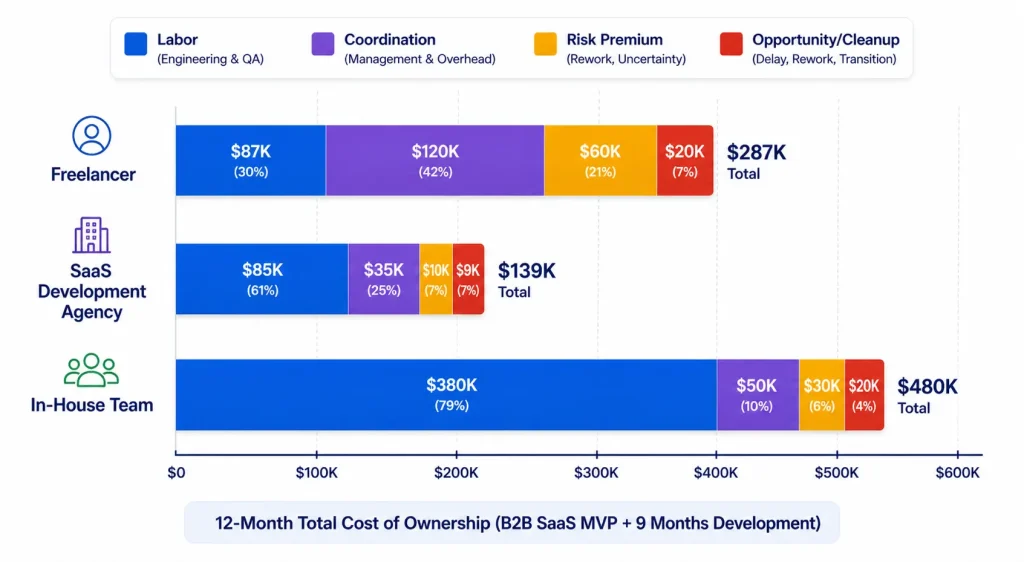
Freelance scenario. Solo freelancer at $80/hour, 30 hours/week, 12 weeks for MVP plus 9 months of part-time follow-on. Labor cost: $80 × 30 × 52 weeks = $124,800. Coordination overhead: 12 hours/week of founder time × $150/hour opportunity cost × 52 weeks = $93,600. Risk premium: 35 percent expected rework × $124K labor = $43,400. Cleanup work post-launch (compliance retrofit, security gaps): $25,000. Total 12-month TCO: ~$286,800.
Saas development agency scenario. Fixed-price MVP package at $40K (10-week Pro tier) plus 9 months retainer at $8K/month = $40,000 + $72,000 = $112,000. Coordination overhead: 3 hours/week × $150/hour × 52 weeks = $23,400. Risk premium: 8 percent built into fixed-price contract = $3,200. No cleanup needed (compliance and security baked in). Total 12-month TCO: ~$138,600.
In-house scenario. Senior full-stack engineer at $180K loaded + senior front-end at $160K loaded + part-time designer at $80K loaded + founder PM time. Total team annual cost: $420K. Productive output during 12 months: 9 months (3 months ramp). Effective cost per productive month: $46,700 × 12 = $560,000. Coordination is bundled into the founder’s role at minimal incremental cost. Total 12-month TCO: ~$420,000 to $560,000 depending on ramp speed.
The TCO results invert the hourly-rate intuition. The “cheap” freelance option ends up most expensive at 12 months due to coordination overhead and cleanup. The saas development agency option, paying $200/hour effective rates on paper, lands as the most cost-effective at 12 months by a wide margin. In-house wins on velocity at scale but is the most expensive at 12 months due to ramp cost.
For the realistic week-by-week timeline that fits this 12-month analysis, see the saas mvp timeline.
36-Month TCO: When In-House Beats a Saas Development Agency
At 36 months, the TCO math inverts again. The in-house team that was most expensive at 12 months becomes the cost-effective option for sustained development.
Year 1 in-house: $420K to $560K (as above).
Year 2 in-house: $480K (full team productive, modest salary growth, productive output across all 12 months at velocity).
Year 3 in-house: $520K (team grown to 5 to 6 engineers depending on saas scale).
Three-year in-house total: $1.42M to $1.56M.
Three-year saas development agency total (assuming continued retainer at $8K/month): $40K MVP + $96K/year × 3 years = $328K. Plus selective project engagements (compliance certification, integrations, specialist work) at $80K to $150K total. Three-year agency total: ~$408K to $478K.
Agency math wins on raw cost. So why does in-house win at scale?
Velocity per dollar. The in-house team produces 3 to 5x the output of an agency retainer engagement after the ramp period. The cost-per-feature, not the cost-per-month, is the relevant unit at scale. In-house cost-per-feature drops below agency cost-per-feature at month 18 to 24.
Institutional knowledge. An in-house team accumulates product-specific knowledge that compounds over years. An agency engagement, even a long-term one, restarts context for each new feature.
Strategic alignment. In-house engineers build for the company’s long-term roadmap. Agencies build to scope, with less context on whether the scope is the right work.
The right framing: agencies are cost-effective from MVP through month 18; in-house wins from month 18 onward for sustained development; agencies remain useful at scale for specific bounded scope (compliance, integrations, specialist work). Most successful saas use a hybrid pattern, covered next.
Hybrid Strategies: Saas Development Agency Build, In-House Scale
The hybrid pattern most successful saas converge on: saas development agency builds the MVP and ships through the first 6 to 12 months of growth, in-house team takes over for sustained development from month 12 to 18 onward. For the broader build framework that places this hybrid pattern in context, see how to build a saas in 2026.
The transition pattern works in three phases:
Phase 1 (months 0 to 12): Agency primary. Agency handles MVP build, launch, and post-launch iteration. Founder focuses on customer acquisition and validation. No in-house engineering hires yet.
Phase 2 (months 12 to 18): Hybrid handoff. First in-house engineer hires (typically a senior full-stack engineer or a head of engineering). Agency continues feature work in parallel while the new hire ramps and absorbs context. Knowledge transfer happens through pair programming, documentation handoff, and shared code review.
Phase 3 (months 18+): In-house primary. In-house team owns the product. Agency engagement reduces to specific bounded scope (compliance certification, mobile app development, integration projects) where agency efficiency outperforms in-house ramp time.
The hybrid pattern preserves agency velocity in the early stages while building in-house knowledge for scale. For the related question of when to add web app or mobile capabilities through agency engagement, see our web app development services and mobile app development services.
How to Vet a Saas Development Agency (10-Point Checklist)
Vetting a saas development agency before signing reduces engagement risk by 60 to 80 percent. The 10-point checklist:
1. Portfolio of similar saas builds. The agency has shipped at least 5 saas products in the same general category (B2B, consumer, vertical) as your build. Generic web agency portfolios do not transfer to saas.
2. Compliance experience matching your needs. If your saas needs HIPAA, SOC 2, or GDPR architecture, the agency has shipped multiple builds with that compliance posture. Compliance is not learned on your project.
3. Stack alignment. The agency’s primary stack matches the saas tech stack you want (Next.js + TypeScript + Postgres, Laravel, etc.). Cross-stack engagements add 30 to 50 percent to estimates.
4. Senior team composition. The team assigned to your build includes at least one senior engineer with 5+ years of saas experience. Junior-only teams are a red flag.
5. Fixed-price option available. The agency offers a fixed-price quote for your scope. Time-and-materials only is a red flag for first-time founder engagements.
6. References from past clients. Three references from past saas clients available, who will speak candidly about delivery, communication, and IP handoff.
7. Sample contract review. The agency provides a sample contract before serious negotiation. Read the IP ownership clause, change-order policy, warranty clauses, and termination terms.
8. Source code delivery practice. Code lives in your repository (GitHub, GitLab) from day one, with access provided to your team. Code that lives only in the agency’s repository is a leverage problem waiting to happen.
9. Documented project management cadence. The agency runs weekly status meetings, ships through a defined ticketing system (Linear, Jira), and provides written progress reports. Ad-hoc communication is a red flag.
10. Post-launch support and handoff. The agency offers documented post-launch support (warranty period, response SLAs, runbook handoff). Engagements that end at launch with no transition support produce orphaned codebases.
Independent verification through review platforms like Clutch provides reputation signal beyond the agency’s own references. Look for agencies with 20+ reviews, average rating above 4.5, and recent reviews (within the past 12 months).
Red Flags When Hiring a Saas Development Agency, Freelancer, or In-House
Each option has predictable failure patterns. Spotting red flags early prevents months of pain.
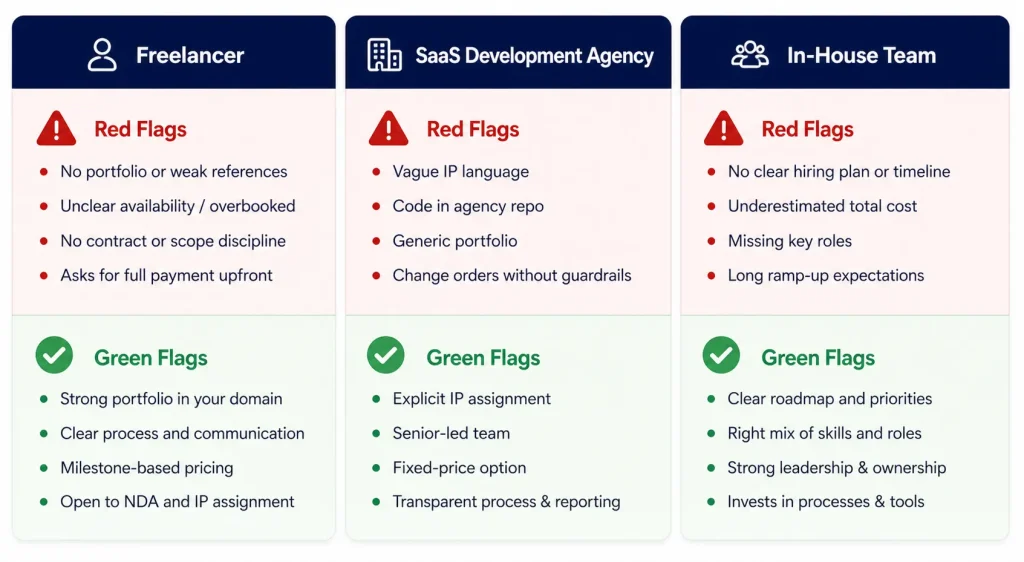
Saas development agency red flags: vague IP ownership in the contract, no senior engineer on the assigned team, time-and-materials with no cost ceiling, code in the agency’s repository instead of yours, generic portfolio without saas examples, no compliance experience for your needs, no fixed-price option, no references willing to speak candidly, no documented PM cadence, no post-launch handoff plan.
Saas development agency green flags: explicit IP assignment language, senior-led team with named individuals, fixed-price option with clear change-order policy, code in your repository from day 1, saas-specific portfolio with at least 5 similar builds, compliance shipped before, written references available, weekly status cadence, documented runbooks at handoff.
Freelancer red flags: unwilling to sign a written contract, no portfolio of saas builds, lowest rate in the market (rate races to the bottom usually mean inexperience), unwilling to use your repository, demands payment fully upfront, communication only through informal channels (no Slack, no project tool).
In-house team red flags: hiring before validation has produced paying customers or signed LOIs, hiring senior engineers without a senior leader to onboard them, hiring full-stack generalists without specialists in critical areas (auth, billing, compliance), no documented architecture for the new team to build against.
The pattern across all three: red flags compound. A single red flag is concerning; three or more in any option is disqualifying. Walk away rather than negotiate hard against multiple red flags; the engagement will deteriorate post-signature.
Conclusion: Choosing a Saas Development Agency or Alternative
The right choice between freelancer, saas development agency, and in-house team depends on stage, scope, and the founder’s PM capacity. Three smart choices, each with a fit profile: freelancer for tight, well-specified scope with strong founder PM; saas development agency for compliance-aware MVP and early growth; in-house for sustained development post-PMF. The Build Team Matrix routes each stage to the right option. The true-cost equation rewrites the hourly-rate intuition. The 12-month TCO numbers favor agencies meaningfully; the 36-month numbers favor in-house teams. The hybrid pattern (agency build, in-house scale) is the dominant successful pattern.
The single most expensive mistake in this decision is comparing hourly rates as if they are comparable units of cost. They are not. A $50/hour freelancer who needs 12 weeks plus 4 weeks of cleanup costs more than a $200/hour saas development agency that ships in 8 weeks with no cleanup. The smart choice is the one that wins on TCO and risk-adjusted velocity, not the one with the lowest rate card.
Saas Development Agency FAQ
1. What is a fair hourly rate for a saas developer in 2026?
US-based senior saas engineers: $150 to $250 per hour for agency engagement (effective billable rate to the client, including agency overhead), or $80 to $180 per hour for direct freelance. EU-based: $100 to $180 per hour for agency, $60 to $130 freelance. Offshore (South Asia, Eastern Europe, Latin America): $40 to $90 per hour for agency, $25 to $70 freelance. Quality varies more within rate bands than between them; rate is a weak signal of capability.
2. How do I vet a saas development agency?
Use the 10-point checklist above as the structured vetting framework. The three highest-leverage checks: portfolio of similar saas builds (5+ shipped products), compliance experience matching your needs, and three willing references from past saas clients. Skip agencies that fail any of these three; the other seven checks separate good agencies from great ones.
3. Should my first hire be a CTO or a senior engineer?
Senior engineer in almost all cases. CTOs at pre-PMF saas are usually over-titled senior engineers anyway, with elevated equity expectations and unclear roles. Hire a senior full-stack engineer who can ship features end-to-end, then promote or hire a CTO post-PMF when the role of CTO (architecture decisions, hiring, team leadership) actually exists.
4. Can I mix freelancer and saas development agency work?
Yes for bounded specialist work (mobile development, ML engineering, security review) layered on top of an agency engagement. No for primary engineering work split between freelancer and agency on the same codebase, which produces coordination overhead that exceeds either option alone.
5. Who owns the IP when an agency builds my saas?
Depends entirely on the contract language. Quality saas development agency contracts assign all foreground IP to the client at payment. Generic agency contracts often leave IP ambiguous, with the agency retaining ownership of “the work product” while granting the client a license. Read the IP clause carefully before signing; demand explicit assignment language if it is missing.
6. Should I hire an offshore or local saas development agency?
Offshore agencies (South Asia, Eastern Europe, Latin America) are 30 to 60 percent cheaper than US/EU agencies and have shipped equivalent-quality saas builds for the past decade. The trade-off is timezone friction, cultural communication style differences, and a stronger requirement for clear written specifications. Offshore works well when the founder has remote-management discipline; local works better when the founder needs frequent in-person collaboration. Most 2026 saas builds use offshore or hybrid offshore agencies because the cost difference is meaningful and quality differences have largely disappeared.
7. What is a fair milestone structure for a saas development agency contract?
Typical structure for an 8 to 12 week MVP: 4 to 6 milestones at $5K to $20K each, with 20 percent deposit, milestones aligned to gate deliverables (design system done, core workflow shipped, billing wired, soft launch complete), and final 10 to 15 percent withheld until 30 days post-launch. Avoid contracts with 50 percent or more upfront payment or with no withholding; both shift risk excessively to the founder.