

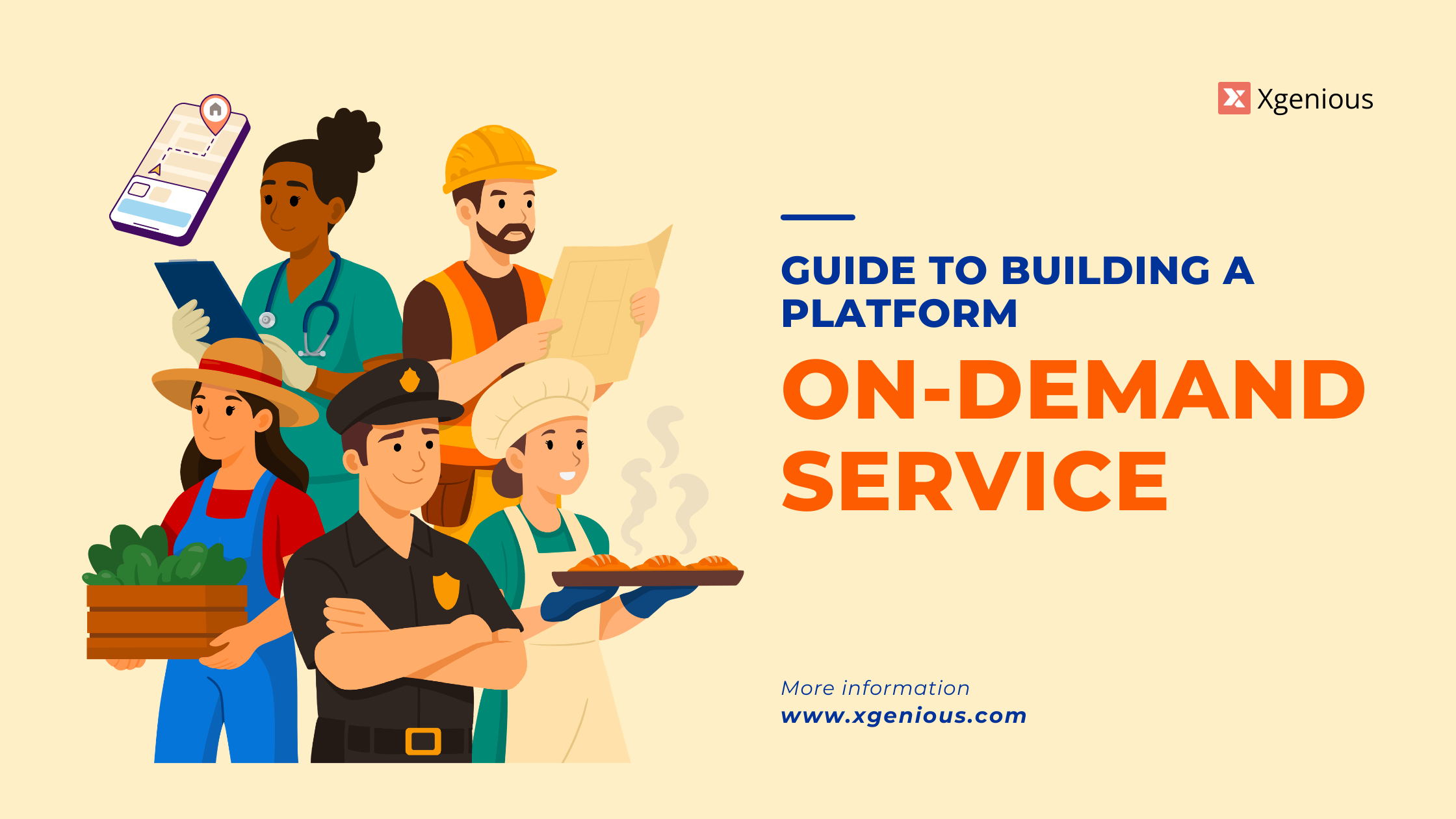


Ten years ago, hiring a plumber meant leaving three unreturned voicemails and waiting two days for a callback. Today, someone opens an app, submits a request, and a verified professional arrives within the hour. That shift did not happen because people got more patient. A better system replaced the old one.
An on-demand service connects a customer who needs something now with a provider who can deliver it, through a digital platform that handles matching, payment, and communication automatically. No phone tag. No quote that arrives three days after you have already found someone else.
The global on-demand service economy crossed $335 billion in 2023 according to Statista’s on-demand economy data, with projections tracking toward $1 trillion by 2030. Those numbers reflect a permanent reset in what customers consider acceptable when booking anything, from a cab ride to a home cleaning to a medical consultation.
This guide covers what an on-demand service is, how the platform model works at every step, which categories are driving the most growth, the technology underneath these platforms, and what it actually takes to build your own marketplace.
Table of Contents
What Is an On-Demand Service?
An on-demand service is any service available when the customer requests it, delivered through a digital platform that matches customers with providers in real time.
Traditional service businesses run on fixed schedules. You call on Monday, they fit you in on Thursday. The on-demand model inverts that entirely. The customer decides when the service happens, submits a request through an app or website, and the platform immediately surfaces an available provider. No wait. No back-and-forth to find a free slot. The customer does not have to find someone, negotiate a time, or wonder if the callback is coming.
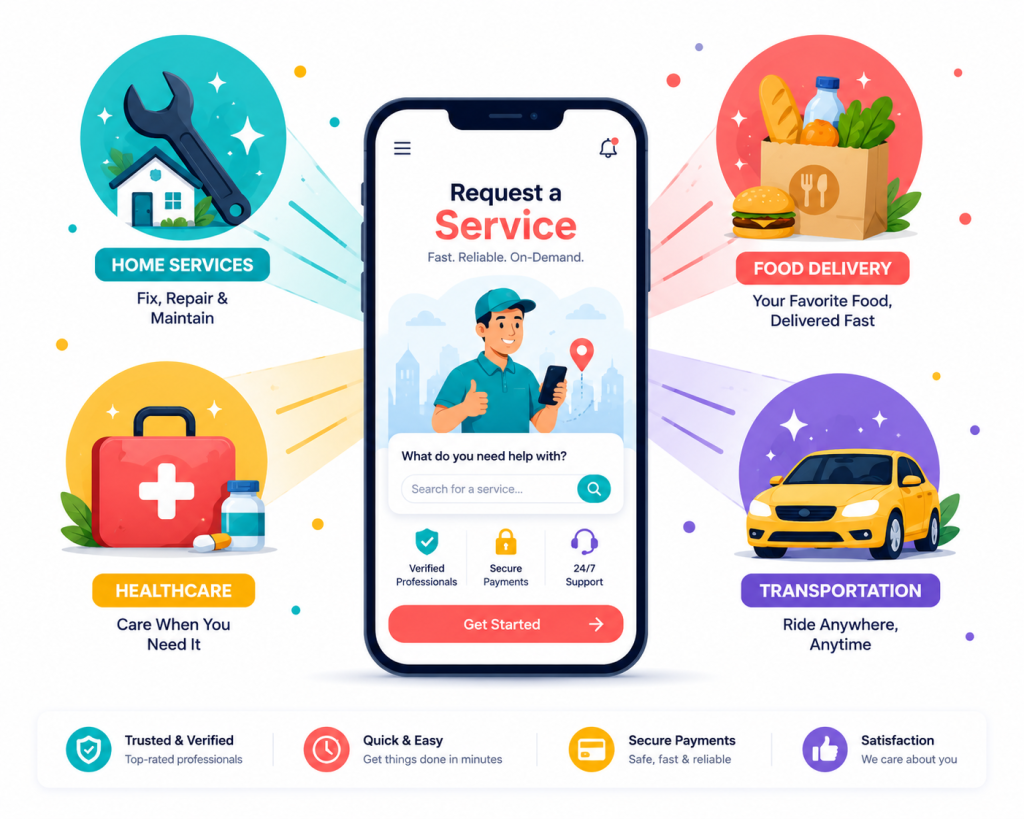
Three things define a genuine on-demand service:
Real-time matching.
The platform connects customer requests with available providers based on proximity, service category, and rating score. A well-built system completes this in seconds, not in a follow-up email the next morning.
Digital transaction.
Payment, confirmation, tracking, and review all live inside the platform. No cash at the door. No invoice sitting in someone’s inbox waiting to be paid a week later.
Speed as the product.
If a customer waits 24 hours for a response, that is a standard booking system. An on-demand service sells speed of fulfillment as a core feature. Remove the speed and the model breaks.
The structure holds across every category. Food delivery, home repair, healthcare, and legal advice all run on the same loop: customer requests, platform matches, provider delivers. What changes is the service type. The mechanics underneath do not.
Understanding this structure is what separates founders who build platforms that work from those who build complicated scheduling apps. If your system cannot make a match and deliver a service faster than the customer’s next available alternative, it is not a true on-demand service. It is just an app with a nice interface.
Why On-Demand Service Has Become the New Normal
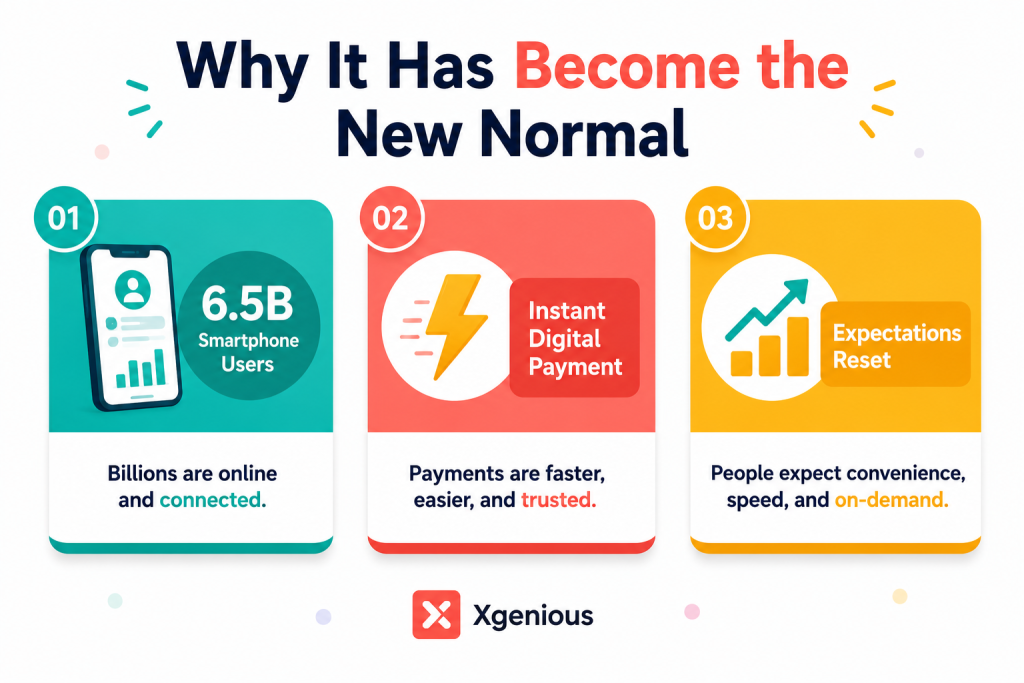
Three structural forces drove the rise of on-demand service, and none of them are reversing.
Smartphone penetration.
By 2024, over 6.5 billion people worldwide carry a smartphone. The model requires a customer who can request, pay, and track through a single device. That customer base reached critical mass around 2015 and has grown every year since. The platform is already in the customer’s pocket before they even know they need it.
Payment infrastructure.
Instant digital payment closes the transaction without friction. Stripe, PayPal, and regional equivalents process in milliseconds. Providers receive payment at job completion. Customers get receipts automatically. The financial side of every on-demand service exchange closes without cash handling or manual invoicing on either side.
Shifting consumer expectations.
Once someone uses a platform for food delivery, they start expecting the same speed from home repairs and healthcare. The expectation transfers across categories without asking permission. A business that does not offer an on-demand service option in a category where customers now expect one is not just behind. It is actively losing customers to competitors who deliver faster.
According to McKinsey research on the on-demand economy, 22% of US consumers use this type of platform at least once per week. That number doubles in the 18 to 35 age bracket. These are not early adopters. They are mainstream buyers who have decided that slower booking systems are not acceptable.
How an On-Demand Service Platform Works
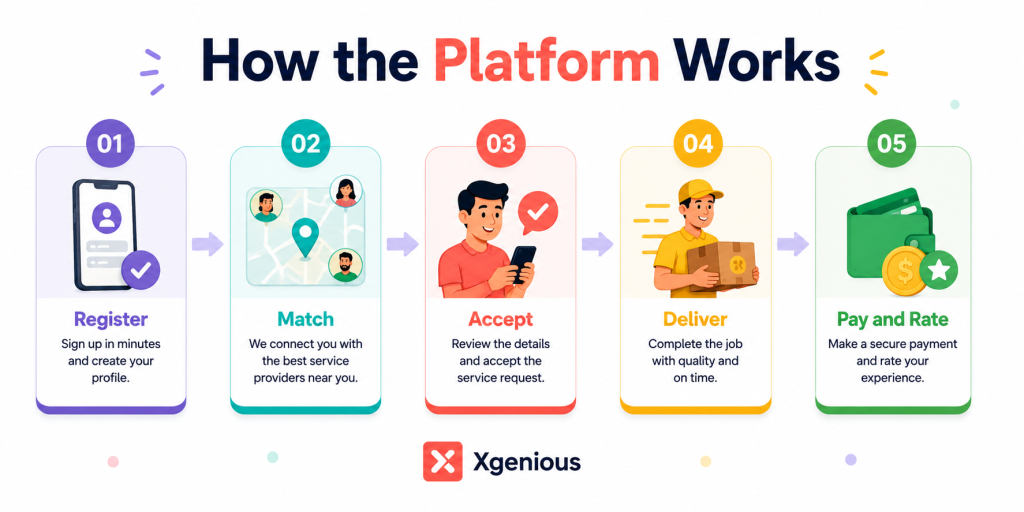
Every on-demand service platform follows the same five-step sequence, regardless of what category it serves.
Step 1: Registration and request. The customer creates an account and submits a service request. A typical home service request includes job type, location, and a preferred time window. Some platforms allow photo uploads so providers can assess the scope before accepting.
Step 2: Provider matching. The algorithm identifies available providers by proximity, service category, and rating score. The best platforms present customers with provider profiles, past reviews, and pricing before confirming, so the choice feels informed rather than random.
Step 3: Provider acceptance. The matched provider receives a notification and accepts. Some platforms use open bidding instead, where multiple providers submit proposals and the customer selects one. Both structures work. The right choice depends on the service category.
Step 4: Delivery and tracking. The provider completes the job. Real-time tracking keeps the customer informed throughout. In-app messaging handles any communication that comes up during the job and keeps everything documented inside the platform.
Step 5: Payment and review. Payment processes automatically at job completion. Both parties rate each other. That rating data becomes the quality control engine the on-demand service model depends on to self-regulate. Without it, quality drifts and the platform stops attracting both good providers and returning customers.
Prohandy uses cart-based checkout suited to home service categories. Qixer uses competitive bidding suited to freelance and professional categories. The Prohandy vs Qixer comparison explains which workflow fits which on-demand service business model.
The Five Major Categories of On-Demand Service
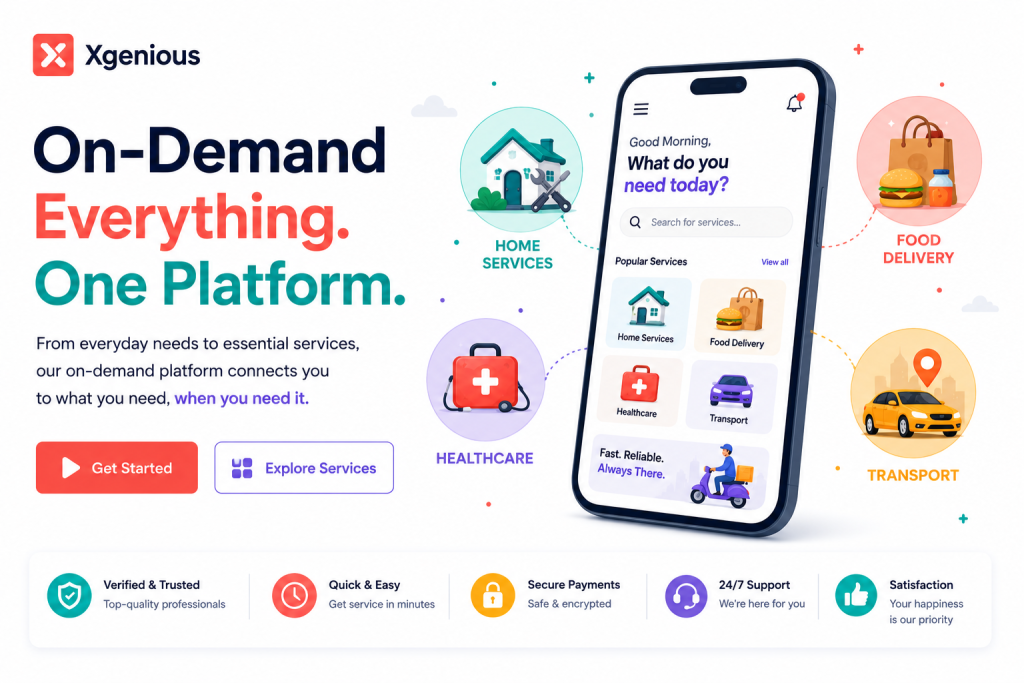
The on-demand service model has expanded well beyond ride-sharing and food delivery. Five categories account for most of the global market today.
1. Food and Grocery Delivery
Food delivery proved the model at commercial scale. DoorDash, Uber Eats, and Instacart showed that customers would pay a meaningful delivery premium for speed and convenience. Global online food delivery revenue crossed $1 trillion in 2023. Grocery delivery extended the same infrastructure into a second high-frequency category, serving customers who need everyday essentials without a store trip. The combination proved that the on-demand service model was not limited to a single niche. It was a framework that could travel.
2. Home Services
The home services category covers cleaning, plumbing, electrical work, landscaping, pest control, handyman work, and dozens of related subcategories. Home jobs are time-sensitive, geographically local, and highly variable in scope. These three characteristics make the platform model especially valuable here. A customer with a burst pipe needs a plumber in two hours, not next week. TaskRabbit and Handy built significant scale in this space. For founders, home services offer strong repeat purchase rates because most jobs recur regularly and customers rarely want to re-shop for a provider they already trust.
3. Healthcare and Telemedicine
Healthcare adopted the on-demand service model in 2020, and most patients did not go back. Teladoc, MDLive, and regional equivalents now handle millions of monthly consultations covering prescription renewals, mental health sessions, and chronic condition monitoring. Fast access turned out to matter to patients in the same way it matters to anyone booking a service. Waiting a week to see a doctor when a 20-minute telehealth slot is available the same afternoon is now a harder sell than it was five years ago.
4. Transportation and Logistics
Transportation was the original category to prove a platform could restructure a century-old industry. Uber and Lyft demonstrated that idle vehicles and available drivers represented untapped capacity that a matching algorithm could activate at scale. The same logic extended to last-mile delivery and same-day freight. Most major courier networks now run at least a partial on-demand service operation alongside their scheduled routes because customer expectations demanded it.
5. Freelance and Professional Services
The freelance segment applies the same mechanics to writing, design, legal advice, accounting, tutoring, and software development. Fiverr and Upwork operate on this model. The structure is identical to every other category: customer posts a need, providers respond, work gets delivered, both parties rate the experience. For specific niche opportunities across all five categories, the top on-demand service business ideas list covers dozens of verticals worth exploring.
The Technology That Powers an On-Demand Service Platform
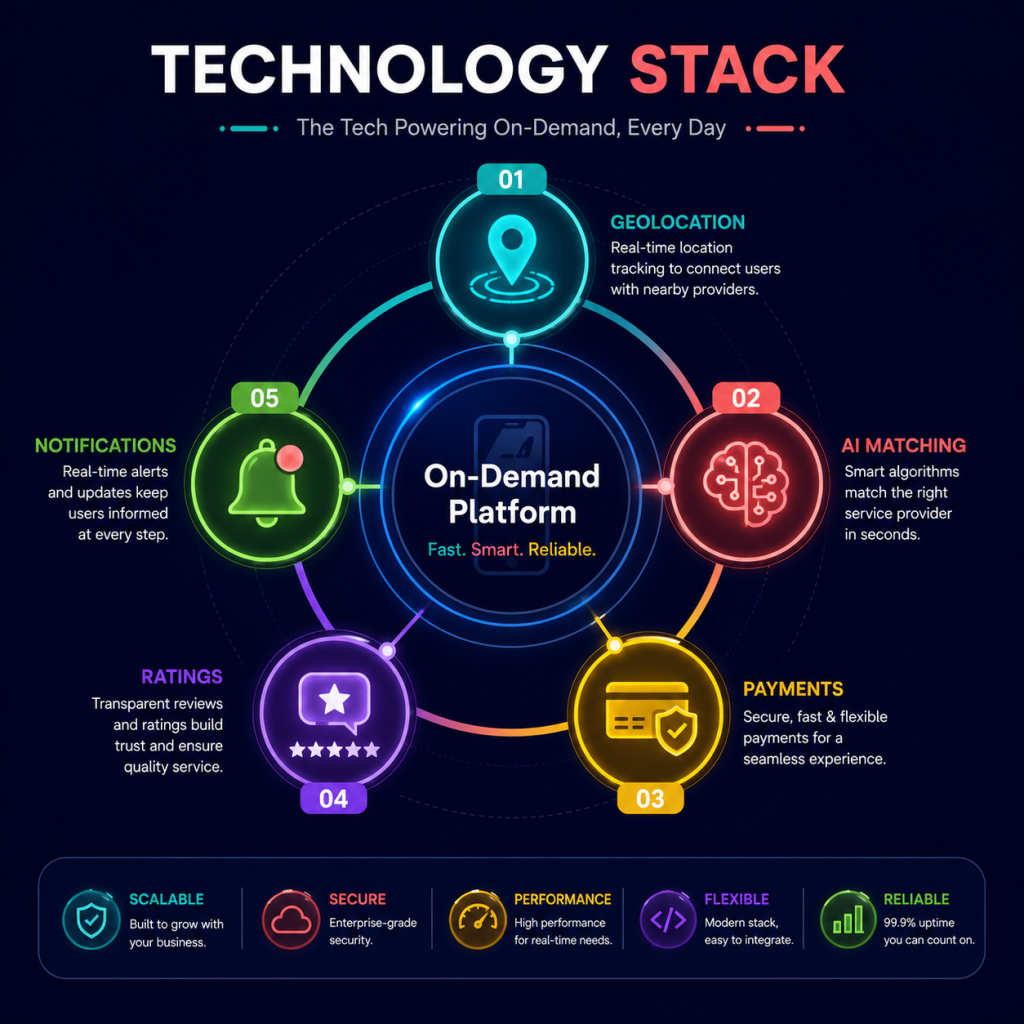
An on-demand service platform is a coordination system. The simplicity customers experience hides several interconnected technology layers that need to work together reliably every time a job is booked.
Geolocation and mapping. Every location-based platform depends on real-time GPS tracking. The system monitors provider locations, optimizes routing, and matches customers with nearby available providers. Poor geolocation leads to long wait times, missed connections, and bookings that get abandoned mid-flow.
AI-powered matching. The algorithm improves as the platform processes more transactions. It learns which providers complete which job types fastest and with the highest ratings, then prioritizes those providers in future matches. The on-demand service model gets measurably better at matching the more it is used.
Payment infrastructure. PCI-DSS compliance, multiple payment methods, and automatic refund handling are non-negotiable. A payment failure at checkout ends the transaction immediately and damages trust faster than almost any other failure the platform might experience.
Rating and trust systems. Ratings are the quality control engine. The model self-regulates when ratings function correctly. Strong providers rise to the top of the matching queue. Poor performers cycle out without requiring a manual review team or dedicated quality control staff.
Push notifications and in-app communication. Real-time updates from request confirmation through job completion reduce customer drop-off and anxiety. In-app messaging between customer and provider keeps all communication traceable and available for dispute resolution if needed.
Why Businesses Choose the On-Demand Service Model
The on-demand service model offers structural advantages that traditional service businesses cannot replicate.
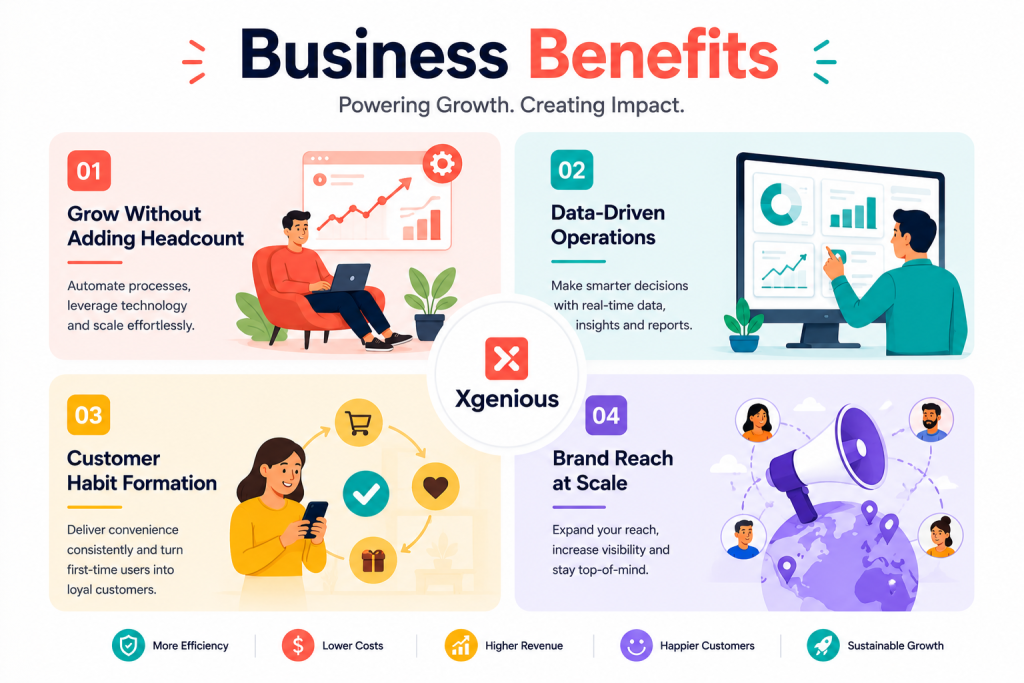
1. Scalability without proportional headcount growth. A traditional service business adds employees as revenue grows. A marketplace grows by adding providers to the platform instead. Each new provider increases capacity without increasing payroll. This separation of revenue growth from operational cost is the structural advantage that makes platform businesses so attractive at scale, and it does not exist inside a traditional service company.
2. Data-driven operations. Every transaction generates data on which services sell most, which providers perform best, which areas have unmet demand, and which price points convert. An on-demand service platform collects and acts on this data continuously. An offline service business running on spreadsheets cannot move at the same speed.
3. Customer habit formation. A customer who books weekly through the platform builds a routine. That routine creates real switching costs. Moving platforms means re-vetting providers and rebuilding trust, which most customers will not do unless the current experience breaks down. Habits are the most durable form of retention, and the on-demand service format creates them faster than most business models.
4. Brand reach through completed transactions. Every finished job is a brand impression. A platform with 500 active providers completing 5,000 jobs per month generates 5,000 customer touchpoints without spending on advertising to create them.
For a detailed breakdown of how to grow both sides of a marketplace, the marketing strategies guide for on-demand businesses covers acquisition, retention, and provider-side growth.
Challenges in Running an On-Demand Service Business
Running an on-demand service business is significantly harder than the consumer experience suggests.
Supply and demand balance. The platform needs enough providers to fulfill requests quickly and enough customers to keep providers earning consistently. Too many providers and they leave from low job volume. Too few and customers wait too long and stop booking. This is not a problem you solve once at launch. It is an ongoing operational responsibility that requires active monitoring every week.
Quality consistency. When a platform has 300 active providers, quality variance is real. Rating systems handle the worst performers, but proactive onboarding standards and regular performance check-ins reduce variance before it reaches customers and damages the platform’s reputation. The provider onboarding guide covers what a strong onboarding process looks like in practice.
Trust and safety. A home on-demand service that sends providers into customers’ homes carries trust obligations that food delivery does not. Background checks, identity verification, and appropriate insurance requirements are not optional in sensitive categories. Customers will not book a stranger into their home without visible, credible trust signals on the platform.
Pricing balance. Low prices attract more customers but tend to attract lower-quality providers. High prices attract stronger providers but shrink the customer base. Finding the right price positioning is specific to each category and each stage of platform growth. There is no universal formula. It requires testing.
How to Start Your Own On-Demand Service Business
Starting an on-demand service business in 2025 is faster and cheaper than it was five years ago because the platform technology is available as ready-built software.
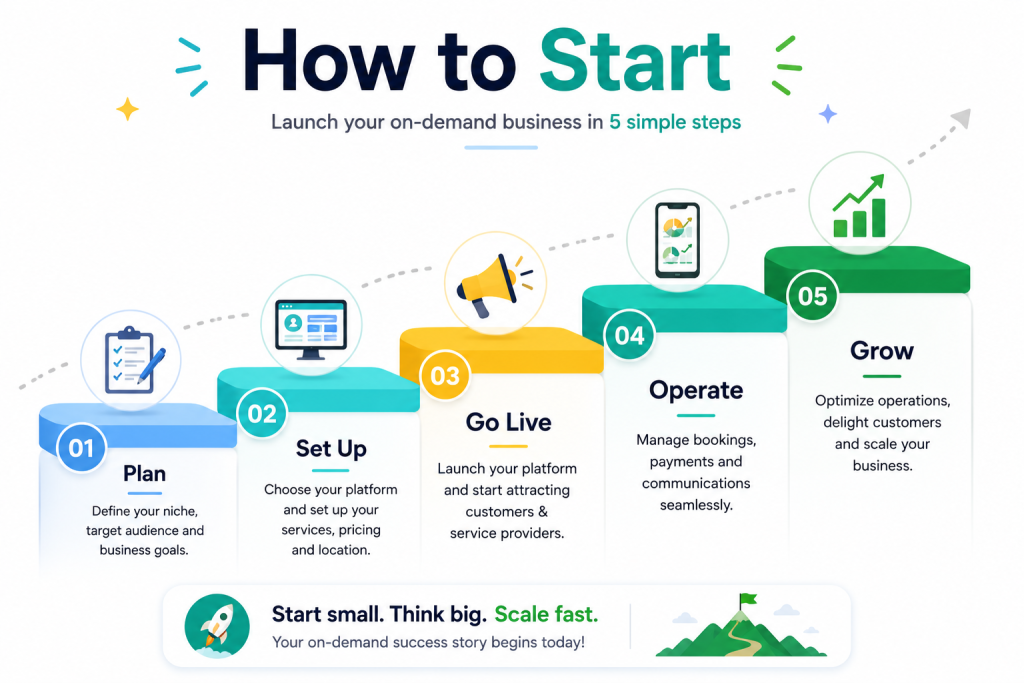
Step 1: Choose your niche.
The strongest opportunities are in categories with frequent repeat purchase, like cleaning, food delivery, and transportation, or in categories where customers experience real pain from slow access, like emergency home repairs and healthcare. Pick a niche where speed of fulfillment is the primary reason customers choose one provider over another.
Step 2: Define your model.
Choose between marketplace (providers compete, customer selects), managed (your own staff dispatched on demand), or hybrid. The marketplace model scales faster but requires building supply and demand simultaneously, which is the hardest part of the early stage.
Step 3: Choose your platform technology.
Building from scratch takes 12 to 18 months and a significant budget. A white-label on-demand service script like Prohandy or Qixer launches in weeks at a fraction of that cost. Prohandy handles home service categories with cart-based checkout. Qixer handles bidding-based categories for freelance and professional services.
Step 4: Build your provider base before you open.
No on-demand service platform survives a launch with 10 providers. Recruit and onboard at least 50 to 100 providers in your target geography before accepting customer bookings. Providers who arrive to an empty platform leave within days and rarely come back.
Step 5: Launch in one geography first.
The supply-demand balance problem is manageable at city level. A platform that launches nationally before proving the model in one market usually fails on both sides at the same time. The step-by-step on-demand build guide covers the entire process in detail.
Choosing the Right Platform for Your On-Demand Service
The platform script you choose is one of the most consequential technical decisions when launching a marketplace.
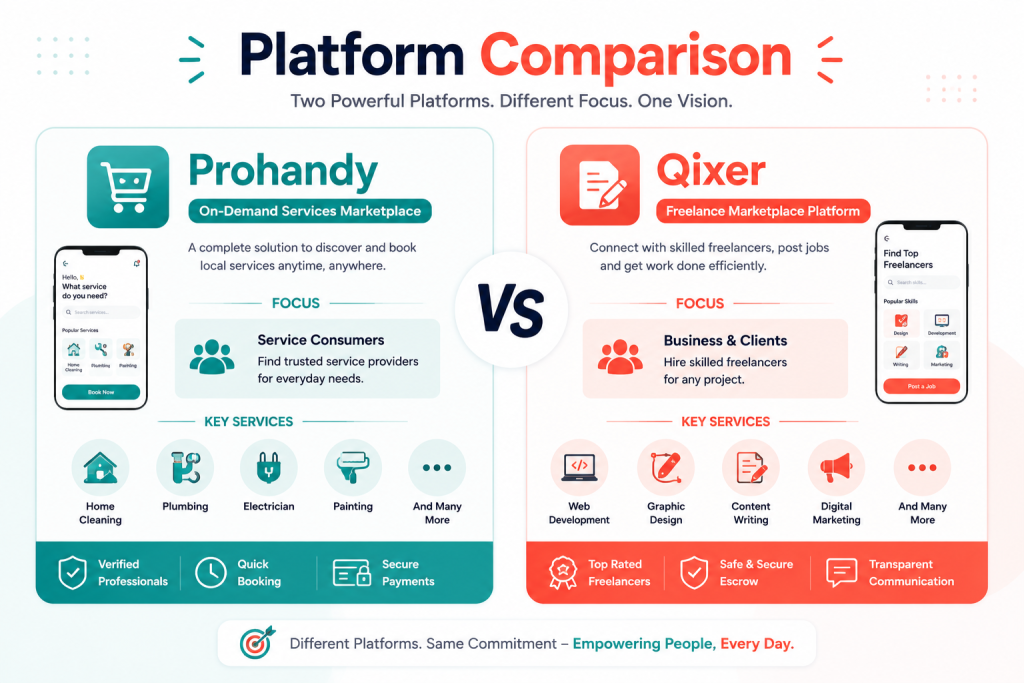
Prohandy suits home service categories. The cart-based checkout works well for customers who know what they want and need to book it at a fixed price upfront. If your on-demand service covers cleaning, plumbing, electrical work, beauty, or similar categories where the job scope is predictable, Prohandy is the stronger fit.
Qixer suits bidding-based categories where the scope and price vary by job. If providers need to review the details before quoting, which is common in freelance projects and complex renovation work, Qixer handles that workflow better. Customers post the job, providers bid, the customer selects the best offer.
Both are available through Xgenious as off-the-shelf scripts. For a broader evaluation, the best on-demand service marketplace platforms comparison covers additional options with feature breakdowns.
Final Thoughts
The on-demand service model has permanently changed what customers consider normal. Waiting two days for a plumber felt acceptable before platforms proved same-day matching was possible. A week’s wait for a doctor felt standard before telehealth showed a consultation could happen in 20 minutes. The bar for acceptable service speed has moved, and it is not moving back.
Every service category that has not yet shifted to this model is a potential platform business. The technology is available. The customer expectation already exists. The market is open. What remains is execution.
Whether you are evaluating niche ideas, comparing platform scripts, or planning your launch, the direction is clear. An on-demand service that consistently delivers on speed and quality builds customer loyalty faster than almost any other format in the service economy. Platforms that get this right earn repeat business automatically. Those that do not lose to the ones that do.
Frequently Asked Questions About On-Demand Service
What is an on-demand service?
An on-demand service is any service available when the customer requests it, delivered through a digital platform that matches customers with providers in real time and handles payment and communication automatically.
What are the most popular on-demand service categories?
The five largest categories are food and grocery delivery, home services, healthcare and telemedicine, transportation and logistics, and freelance and professional services. Each applies the same platform model to a different customer need.
How does an on-demand service platform make money?
Most platforms charge providers a commission per transaction (typically 10 to 30%), a subscription fee for platform access, or a combination of both. Surge pricing during peak demand is a third revenue stream some platforms use.
How much does it cost to build an on-demand platform?
Custom builds from scratch range from $100,000 to $500,000 and take 12 to 18 months. White-label scripts like Prohandy and Qixer reduce that to weeks at a fraction of the cost.
What makes a platform succeed long term?
Fast and accurate matching, a robust rating system, reliable payment infrastructure, and consistent quality control are the four fundamentals. Platforms that fail on any one of these struggle to retain both sides of the marketplace.
How do I attract quality providers to my platform?
Start with a clear earnings pitch and low-friction onboarding. Focus recruitment on one geography until providers are earning consistently before expanding. The provider onboarding guide covers the key steps.
What is the difference between Prohandy and Qixer?
Prohandy is built for home service categories with cart-based checkout. Qixer is built for bidding-based on-demand service categories like freelance and professional work. The Prohandy vs Qixer comparison breaks down which fits your business model.