

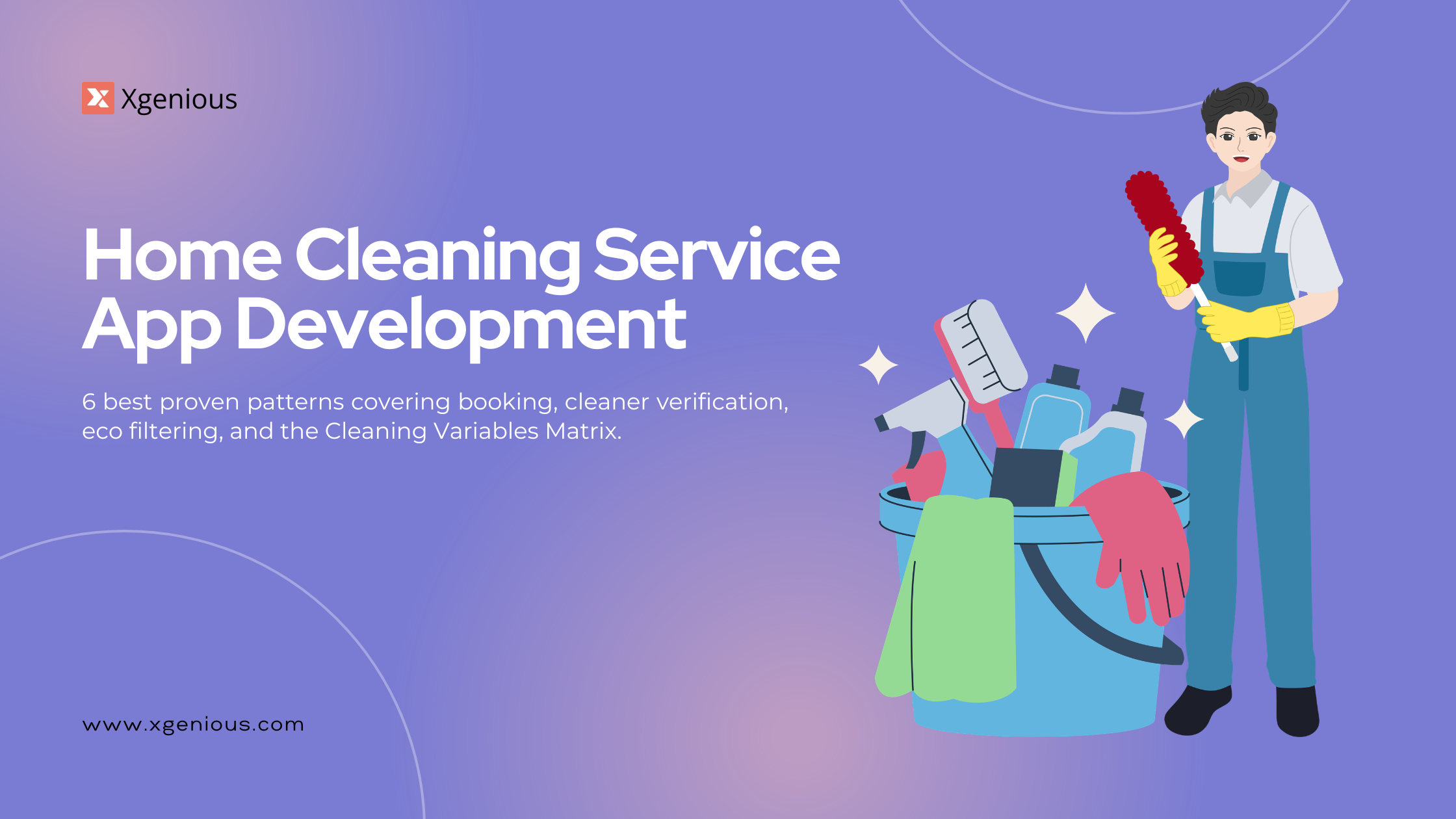


Home cleaning service app development is one of the highest-demand categories in the on-demand service marketplace space in 2026. Cleaning is a recurring need, the supply pool of cleaners is large, and consumer willingness to pay for convenience is strong. Platforms like Handy, Tidy, and Helpling have proven that the model works at scale, and regional and niche entrants continue to launch because no single platform dominates every geography or every cleaning sub-segment (residential, move-out, post-construction, eco-focused, and commercial).
Home cleaning service app development is meaningfully different from generic marketplace builds because cleaning has a variable scope (a studio apartment versus a 5-bedroom house), recurring demand patterns (weekly, biweekly, monthly), supply considerations (does the cleaner bring supplies or does the customer), and a rising consumer preference for eco-friendly products. Founders who copy a generic booking template into the cleaning vertical underestimate this complexity and ship platforms that cannot quote accurately or retain recurring customers.
This guide walks through 6 best proven patterns for home cleaning service app development, organized around the Cleaning Service Variables Matrix framework: recurring versus one-time booking architecture, cleaner verification and trust, supply inventory and eco-friendly filtering, the quote engine for variable scope jobs, pre-service and post-service photo documentation, and recurring subscription and loyalty features. It includes five real platform examples, realistic cost and timeline figures, and a 6-question FAQ.
Five takeaways before reading on: home cleaning is a recurring-revenue vertical, which makes subscription architecture central; variable job scope makes the quote engine the hardest technical component; cleaner verification is the trust anchor; eco-friendly filtering is a real differentiator in 2026; and photo documentation builds the trust that converts one-time customers into recurring ones. For the broader framework that places home cleaning in the full marketplace, see on-demand service marketplace development.
Why Home Cleaning Service App Development Is Different from Generic Marketplace Builds
Home cleaning service app development inherits two-sided marketplace patterns but adds cleaning-specific requirements that generic templates do not handle.
- Variable Job Scope
A handyman job is usually well-defined (“fix the leaking faucet”). A cleaning job varies enormously: home size, number of bedrooms and bathrooms, level of clutter, frequency of prior cleaning, special requests (inside the oven, inside the fridge, interior windows). The platform must capture enough scope detail to produce an accurate quote and dispatch the right cleaner with the right time allocation. Underestimating scope produces cleaners who run out of time; overestimating produces quotes that scare away customers.
- Recurring Demand Patterns
Cleaning is rarely a one-time need. Most customers who book a first cleaning want recurring service: weekly, biweekly, or monthly. Home cleaning service app development must treat recurring bookings as a first-class concept, not an afterthought. Platforms that optimize only for one-time bookings leave the recurring-revenue opportunity, which is the entire economic advantage of the cleaning vertical, on the table.
- Supply Logistics
Some cleaners bring their own supplies and equipment; some expect the customer to provide them. Some customers insist on specific products (eco-friendly, fragrance-free, pet-safe). The platform must capture supply expectations on both sides and match accordingly. A mismatch (cleaner arrives without supplies, customer expected them to bring supplies) produces a failed service and a refund.
- Trust at the Home-Entry Level
Cleaners enter customer homes, often when the customer is not present. The trust bar is higher than for services performed outside the home. Background checks, identity verification, and visible review history are non-optional in home cleaning service app development. Customers hand over house keys or access codes; the platform must earn that trust.
These four factors mean home cleaning service app development cannot copy a generic marketplace template unchanged. The vertical requires its own framework, covered next.
The Home Cleaning Marketplace Opportunity
The opportunity in the home cleaning vertical is large and structurally recurring, which makes it attractive for founders who understand the model.
1. Market Size
The global home cleaning services market exceeds $300 billion annually, with the residential segment accounting for the majority. Online and app-based booking penetration sits around 15 to 25 percent in developed markets, leaving meaningful room for digital platforms to capture share from offline incumbents (independent cleaners, traditional cleaning companies, word-of-mouth referrals).
2. Why Recurring Revenue Changes the Economics
The cleaning vertical has a structural advantage over one-off service categories: recurring demand. A customer who books weekly cleaning generates 52 transactions per year versus a handyman customer who might book twice. Recurring revenue means lower customer acquisition cost amortized across many transactions, higher lifetime value, and more predictable platform revenue. Home cleaning service app development that captures recurring bookings well produces meaningfully better unit economics than one-off service marketplaces.
3. Customer Segments
Three primary segments. Busy professionals and dual-income households (largest segment, value convenience, want recurring service). Move-in and move-out cleaning customers (one-time but high-value bookings, often triggered by life events). Specialized cleaning customers (post-construction, deep cleaning, eco-focused) who pay premium rates for specialized service.
4. Cleaner Supply Segments
Three primary cleaner types. Independent professional cleaners who clean full-time (highest quality, command premium rates). Part-time cleaners balancing other work (large segment, variable availability). Cleaning companies that list their teams on the platform (consistent quality, but the platform competes with the company’s direct business). Home cleaning service app development decisions vary by which supply segment the platform targets.
5. Geographic Dynamics
Like other in-person service marketplaces, cleaning requires hyper-local liquidity. A platform with 500 cleaners spread across 50 cities is liquid in zero cities. The same 500 cleaners concentrated in one metro area is dense and functional. Successful home cleaning platforms launch city-by-city, prove liquidity, then expand.
The Cleaning Service Variables Matrix: A Home Cleaning Service App Development Framework
The Cleaning Service Variables Matrix is the framework this guide is built around. It captures the four variables that define every cleaning job and determine how the platform must be built.
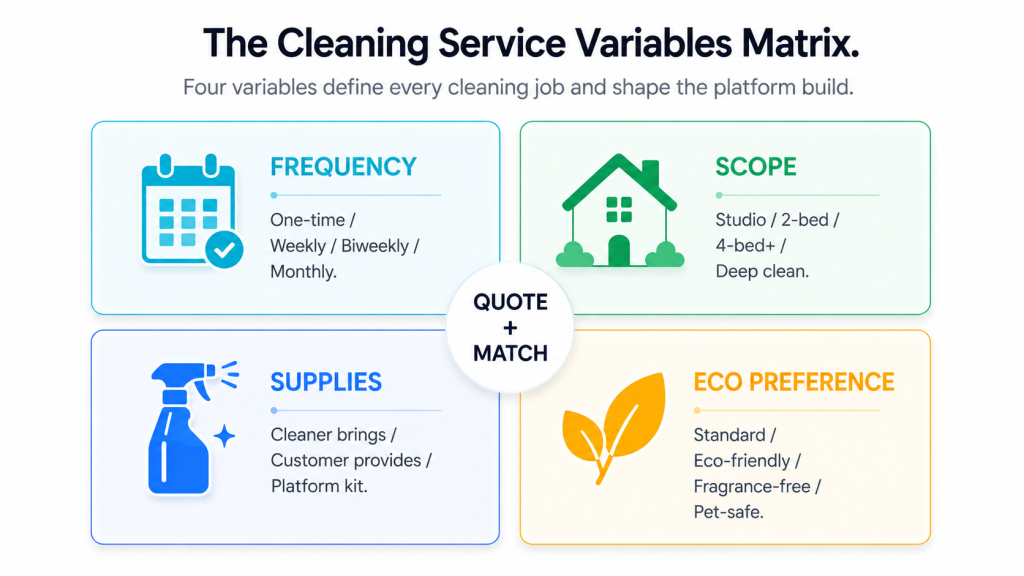
The Four Variables
Variable 1: Frequency. Is the job one-time, weekly, biweekly, or monthly? Frequency determines whether the booking is a single transaction or a recurring subscription. It also affects pricing (recurring customers get better rates) and cleaner assignment (recurring jobs benefit from the same cleaner each time).
Variable 2: Scope. How large is the home, how many rooms, what level of cleaning (standard, deep, move-out)? Scope determines the quote, the time allocation, and the cleaner skill match. Scope is the variable that generic templates handle worst.
Variable 3: Supplies. Does the cleaner bring supplies, does the customer provide them, or does the platform offer a supply kit? Supplies must be captured on both sides and matched to avoid failed services.
Variable 4: Eco Preference. Standard products, eco-friendly, fragrance-free, or pet-safe? Eco preference is a rising differentiator in 2026 and a real filter customers use when choosing cleaners.
How the Matrix Drives the Build
Every pattern in this guide maps to one or more variables. Recurring booking architecture (Pattern 1) handles Frequency. Cleaner verification (Pattern 2) underpins trust across all variables. Supply inventory and eco filtering (Pattern 3) handles Supplies and Eco Preference. The quote engine (Pattern 4) handles Scope. Photo documentation (Pattern 5) and recurring subscriptions (Pattern 6) compound trust and retention across all four variables.
The Matrix is the structural lens for home cleaning service app development. Every booking flows through the four variables; every platform decision should reference them.
Pattern 1: Recurring vs One-Time Booking Architecture
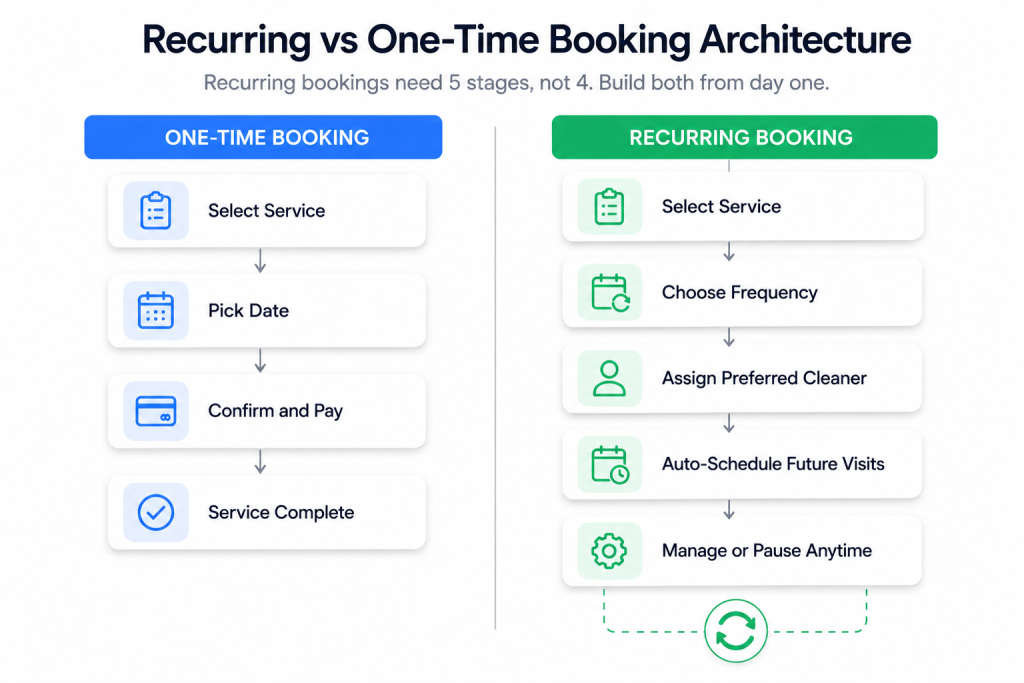
The first proven pattern in home cleaning service app development is building recurring and one-time bookings as distinct but connected architecture from day one.
One-Time Booking Flow
The one-time flow is simple: select service, pick date and time, confirm and pay, service completes. One-time bookings are common for move-in and move-out cleaning, deep cleaning, and customers testing the platform before committing to recurring service. The platform should make one-time booking frictionless because it is the trial that converts to recurring.
Recurring Booking Flow
The recurring flow adds critical stages. After selecting service and frequency (weekly, biweekly, monthly), the customer is assigned a preferred cleaner who handles all recurring visits. The platform auto-schedules future visits, charges the payment method on each service date, and lets the customer manage, pause, skip, or cancel the recurring plan. Recurring booking architecture is more complex but it is where the cleaning vertical’s economic advantage lives.
The Conversion Bridge
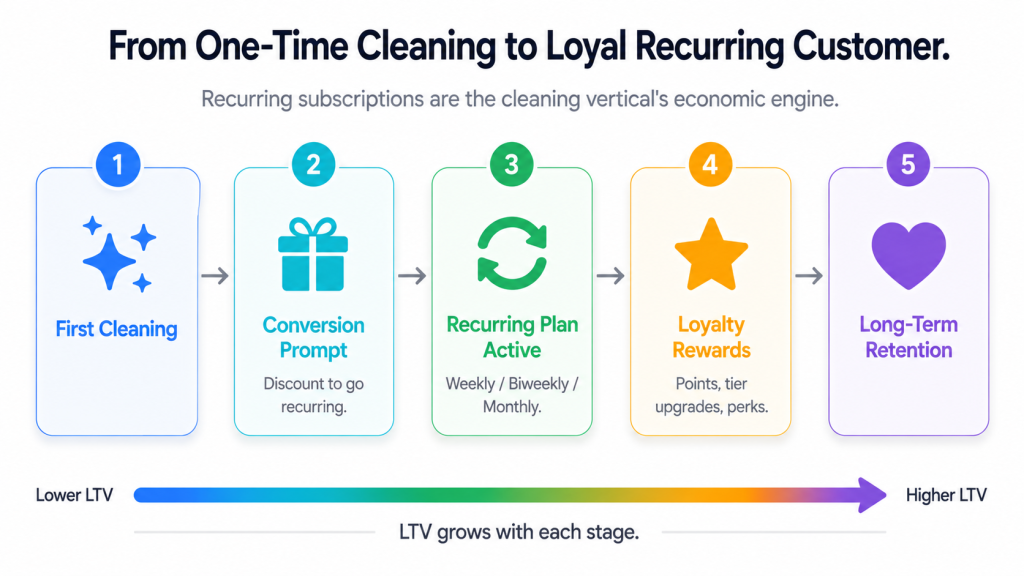
The strongest home cleaning service app development pattern connects the two flows: after a successful one-time cleaning, the platform prompts the customer to convert to a recurring plan, often with a discount incentive. The one-time-to-recurring conversion rate is one of the most important metrics in the cleaning vertical; platforms that optimize it produce meaningfully higher lifetime value.
Preferred Cleaner Assignment
Recurring customers strongly prefer the same cleaner each visit. The platform must support preferred-cleaner assignment, handle the case when the preferred cleaner is unavailable (offer a substitute or reschedule), and let customers change their preferred cleaner if a relationship is not working. Preferred-cleaner continuity is a major retention driver.
The booking architecture pattern is roughly 20 to 25 percent of home cleaning service app development build effort. Treating recurring bookings as an afterthought is the single most common mistake in this vertical.
Pattern 2: Cleaner Verification and Trust Layer
The second proven pattern in home cleaning service app development is the cleaner verification and trust layer. Customers grant cleaners access to their homes, often when absent. Trust is the foundation of the entire platform.
Identity Verification
Government ID verification through Onfido, Persona, Stripe Identity, or Veriff confirms every cleaner is who they claim to be. Required before a cleaner can list. Identity verification produces an audit trail for incident response.
Background Checks
Criminal background checks are non-optional for home-entry services. Services like Checkr, Sterling, or GoodHire handle US checks; DBS Checks in UK; local equivalents elsewhere. Background checks for home cleaning typically cost $20 to $60 per cleaner. The platform absorbs this cost during onboarding or shares it with the cleaner.
Experience and Skill Verification
Beyond identity and background, the platform may verify cleaning experience through reference checks, trial cleanings observed by platform staff, or customer ratings during a probationary period. Experience verification filters out cleaners who claim skills they do not have.
Visible Trust Signals
Verification only builds trust if customers can see it. The cleaner profile displays verified-identity badges, completed-background-check status, years of experience, total cleanings completed, and review history with dimensional ratings. Home cleaning service app development that hides trust signals loses to platforms that surface them prominently.
Insurance and Liability
Home cleaning involves liability risk: property damage, theft accusations, injury. The platform should require or provide liability insurance, document the insurance status on cleaner profiles, and have a clear claims process. Insurance is both a trust signal and a genuine risk-management requirement. For the regulatory framework around home services, the FTC home services business guidance covers consumer protection expectations.
Ongoing Trust Maintenance
Verification is not a one-time event. The platform re-runs background checks periodically (every 2 to 3 years), monitors rating trends to catch declining cleaners, and suspends cleaners who fall below quality thresholds or accumulate trust complaints.
The verification and trust pattern is roughly 15 to 20 percent of home cleaning service app development build effort plus meaningful ongoing operational cost. It is the pattern that cannot be cut.
Pattern 3: Supply Inventory and Eco-Friendly Filtering
The third proven pattern in home cleaning service app development is supply inventory and eco-friendly filtering. This pattern handles the Supplies and Eco Preference variables from the Matrix.
Supply Expectation Capture
At booking, the platform asks who provides cleaning supplies and equipment: the cleaner brings everything, the customer provides everything, or a hybrid (cleaner brings equipment, customer provides specialty products). The expectation is stored on the booking and communicated to the cleaner before the visit. Capturing supply expectations prevents the failed-service scenario where a cleaner arrives unprepared.
Cleaner Supply Profiles
Cleaners indicate in their profile what supplies and equipment they carry: standard cleaning products, eco-friendly products, specialized equipment (steam cleaners, carpet equipment), pet-safe products. The supply profile feeds the matching algorithm so customers with specific needs match to cleaners who can meet them.
Eco-Friendly Filtering
Eco-conscious customers want cleaners who use environmentally friendly, non-toxic, fragrance-free, or pet-safe products. The platform lets customers filter for eco-friendly cleaners and lets cleaners advertise their eco credentials. In 2026, eco filtering is a meaningful differentiator; platforms that support it capture a growing customer segment that competitors ignore.
Platform Supply Kits
Some home cleaning service app development projects offer platform-branded supply kits: the platform sells or provides a standardized set of cleaning products that cleaners use. Supply kits ensure consistency, create an additional revenue line, and let the platform guarantee eco-friendly or pet-safe standards across all cleaners. Supply kits add operational complexity (inventory, logistics) but produce quality consistency.
The supply and eco pattern is roughly 8 to 12 percent of build effort. It is often underbuilt, then added after launch when supply mismatches start producing failed services and refunds.
Pattern 4: Quote Engine for Variable Scope Jobs
The fourth proven pattern in home cleaning service app development is the quote engine. Cleaning jobs have variable scope, and accurate quoting is the hardest technical component in the vertical.
Scope Capture at Booking
The quote engine starts by capturing scope: home type (apartment, house, condo), number of bedrooms, number of bathrooms, square footage if known, level of cleaning (standard, deep, move-out), clutter level, and special requests (inside oven, inside fridge, interior windows, baseboards). The more scope detail captured, the more accurate the quote.
Quote Calculation Models
Fixed Pricing by Home Size
The simplest model: a 1-bedroom standard cleaning is $89, a 2-bedroom is $119, a 3-bedroom is $149. Fixed pricing is easy for customers to understand and easy to build. It works when cleaning scope is reasonably predictable within each home-size tier.
Hourly Estimation
The platform estimates how many cleaner-hours the job needs based on scope, multiplies by an hourly rate, and presents the estimate. Hourly estimation handles scope variation better than fixed pricing but requires the platform to estimate hours accurately.
Dynamic Quote with Adjustment
The platform produces an initial quote from scope inputs, then allows adjustment after the cleaner sees the home. The cleaner can request a scope revision (the home is more cluttered than described, additional rooms were added) with customer approval before extra work proceeds. Dynamic quoting handles scope uncertainty best but adds workflow complexity.
Quote Accuracy and Customer Trust
Quote accuracy directly affects customer trust. A quote that turns into a much larger final bill produces the bait-and-switch feeling that destroys trust in home services generally. The strongest home cleaning service app development pattern: produce accurate upfront quotes, require explicit customer approval for any scope change, and document scope changes with photos. Transparent quoting is a competitive advantage in a vertical where customers expect to be overcharged.
Time Allocation for Cleaners
The quote engine also produces a time allocation for the cleaner: this job should take 2.5 hours. Accurate time allocation prevents two failure modes: cleaners who run out of time and leave the job incomplete, and cleaners who finish early and feel underpaid because the allocation was too generous.
The quote engine pattern is roughly 15 to 20 percent of home cleaning service app development build effort. It is the component that most differentiates a professional cleaning platform from a generic booking template.
Pattern 5: Pre-Service and Post-Service Photo Documentation
The fifth proven pattern in home cleaning service app development is photo documentation. Before-and-after photos build the trust that converts one-time customers into recurring subscribers and resolves disputes cleanly.
Pre-Service Photos
When the cleaner arrives, the provider app prompts a quick set of photos documenting the home’s starting condition. Pre-service photos serve two purposes: they establish a baseline if a dispute arises later (the customer claims an item was damaged or missing), and they let the cleaner flag scope discrepancies before starting (the home is more cluttered than the booking described).
Post-Service Photos
At job completion, the provider app prompts after photos of the cleaned spaces. Post-service photos are the proof of work. They surface in the customer’s booking history, contribute to the cleaner’s portfolio, and reassure customers who were not home during the cleaning that the work was completed to standard.
Photo-Driven Trust Conversion
The before-and-after photo pair is one of the strongest trust signals in home cleaning service app development. A customer who sees a clear visual transformation feels confident booking again. Platforms that make before-and-after pairs prominent in the post-service summary see higher one-time-to-recurring conversion than platforms that skip photo documentation.
Dispute Resolution with Photo Evidence
When a customer disputes service quality, photos make resolution fast and fair. The platform reviews pre-service and post-service photos, compares them to the customer’s complaint, and decides on a partial refund, full refund, or replacement cleaning. Photo evidence reduces dispute resolution time from days of back-and-forth to a single review.
Photo Storage and Privacy
Home interior photos are sensitive. Home cleaning service app development must store photos securely, restrict access to the customer, the cleaner, and platform operations staff, and provide deletion on request. Photos should never be used for marketing without explicit customer consent.
The photo documentation pattern is roughly 8 to 12 percent of build effort. It is low-cost to build and high-value for trust, which makes it one of the best return-on-effort patterns in the vertical.
Pattern 6: Recurring Subscription and Loyalty Features
The sixth proven pattern in home cleaning service app development is recurring subscription and loyalty. This pattern captures the recurring-revenue advantage that makes the cleaning vertical economically attractive.
Subscription Plans
The platform offers recurring plans: weekly, biweekly, and monthly cleaning at a discount versus one-time pricing. Subscription plans are billed automatically through Stripe Billing on each service date. The Stripe Connect and Billing documentation covers the recurring billing mechanics, including proration when customers change plans and dunning when payments fail.
Subscription Management
Customers need self-service control over their recurring plan: skip a single cleaning (going on vacation), pause the plan (seasonal break), change frequency (weekly to biweekly), change the preferred cleaner, or cancel. Home cleaning service app development that makes subscription management easy reduces churn; platforms that make cancellation hard produce angry customers and bad reviews.
Loyalty and Rewards
Loyalty programs reward recurring customers and increase retention. Common mechanics: points earned per cleaning that convert to discounts, tier upgrades (bronze, silver, gold) that unlock perks, referral rewards when a customer refers a friend, and anniversary rewards for long-term subscribers. Loyalty programs work especially well in cleaning because the recurring relationship is long-running.
Dunning and Failed Payments
Roughly 6 to 8 percent of recurring charges fail each month due to expired cards or insufficient funds. Without a dunning workflow (automatic retries, email reminders, grace period before pause), failed payments become involuntary churn. Stripe Smart Retries plus an email sequence recovers 30 to 50 percent of failed payments.
The Retention Compounding Effect
The economic advantage of home cleaning service app development is retention compounding. A customer on a weekly plan for two years generates over 100 transactions. The acquisition cost is amortized across all of them. Loyalty features that extend the recurring relationship by even a few months produce meaningful lifetime value gains. This is why recurring subscription is the sixth and most economically important pattern.
The subscription and loyalty pattern is roughly 15 to 20 percent of build effort and produces the highest return of any pattern in the cleaning vertical.
Five Real Home Cleaning Platforms
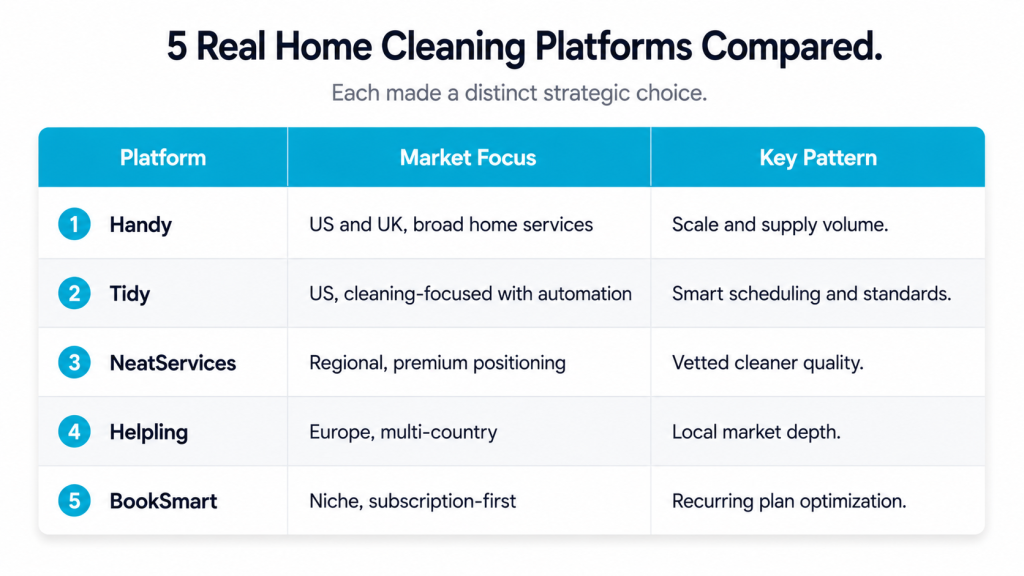
Five real platforms illustrate the patterns in home cleaning service app development. Each made distinct strategic choices.
i. Handy
One of the earliest at-scale home services platforms, Handy operates across the US and UK with a broad service catalog beyond cleaning. What it teaches: scale and supply volume create defensibility, but a broad catalog dilutes focus. New entrants often beat broad platforms by going deep in cleaning specifically.
ii. Tidy
Tidy focuses on cleaning with heavy automation: smart scheduling, standardized cleaning checklists, and automated quality management. What it teaches: automation and consistency are differentiators in a vertical where service quality varies cleaner-to-cleaner. Standardization is a competitive moat.
iii. NeatServices
A regional example of premium positioning: thoroughly vetted cleaners, higher prices, white-glove customer experience. What it teaches: premium positioning works in cleaning when the platform invests disproportionately in cleaner quality and trust signals. Not every platform should compete on price.
iv. Helpling
A European multi-country platform with deep local-market presence in Germany, France, and other European markets. What it teaches: local market depth beats shallow international coverage. Helpling’s strength is being genuinely local in each market, not generically global.
v. BookSmart
A niche subscription-first platform that optimizes heavily for recurring plans rather than one-time bookings. What it teaches: leaning into the recurring-revenue advantage of the cleaning vertical produces strong unit economics. Subscription-first design is a valid strategic focus.
The pattern across all five: successful home cleaning service app development comes from a clear strategic choice (scale, automation, premium, local depth, or subscription focus) executed deeply, rather than trying to be everything to everyone. For a related home-service vertical with different dynamics, see handyman app development.
Home Cleaning Service App Development Cost and Timeline
Realistic cost and timeline figures for home cleaning service app development depend on scope.
Cost Ranges
- Single-vertical cleaning MVP: $50K to $80K. Cleaning-only platform, single geography, customer app and cleaner app plus web admin, 10 to 12 weeks. For founders validating the cleaning vertical in one city.
- Standard cleaning marketplace: $80K to $130K. Cleaning with sub-categories (standard, deep, move-out), multi-geography support, full mobile app suite, recurring subscriptions, loyalty features, 12 to 16 weeks.
- Premium or feature-rich cleaning platform: $130K to $220K. Advanced quote engine, supply kit logistics, sophisticated loyalty, white-glove operations tooling, 16 to 22 weeks.
- White-label customization: $30K to $70K. Customize an existing on-demand home service platform for the cleaning vertical, 4 to 8 weeks. The fastest and lowest-cost path.
Timeline Patterns
Most home cleaning service app development MVPs ship in 10 to 16 weeks. The build phases: discovery and design (weeks 1 to 2), booking and cleaner features (weeks 3 to 6), payments and recurring subscriptions (weeks 6 to 9), photo documentation and quality features (weeks 9 to 11), QA and mobile app store submission (weeks 11 to 13), soft launch and stabilization (weeks 13 to 16).
Ongoing Operating Cost
Beyond the build, budget for ongoing costs: infrastructure and hosting ($200 to $2,000 per month at MVP scale), background check costs ($20 to $60 per cleaner onboarded), payment processing fees (2.9 percent plus Stripe Connect fees), communication infrastructure ($50 to $400 per month), and trust and safety operations staff. Year 1 operating cost typically runs $30K to $100K depending on scale.
What Drives Cost Up
Cost rises with: multi-geography launch instead of single-city, supply kit logistics, advanced dynamic quoting, deep loyalty program mechanics, and compliance requirements. Cost stays controlled with: single-city launch, fixed or hourly pricing instead of dynamic quoting, and white-label customization instead of greenfield build.

Conclusion: Building a Home Cleaning Platform That Retains Customers
Home cleaning service app development succeeds when the build reflects the vertical’s defining characteristics: variable job scope, recurring demand, supply logistics, and home-entry trust. The 6 best proven patterns covered in this guide (recurring versus one-time booking architecture, cleaner verification, supply and eco filtering, the quote engine, photo documentation, and recurring subscriptions) provide the structural foundation. The Cleaning Service Variables Matrix (frequency, scope, supplies, eco) is the lens that connects every pattern to a real job-defining variable.
The dominant pattern across successful home cleaning platforms: a clear strategic choice executed deeply, recurring-subscription architecture treated as the economic engine, cleaner verification as the trust anchor, and accurate transparent quoting as a competitive advantage in a vertical where customers expect to be overcharged. Platforms that nail recurring retention produce meaningfully better unit economics than one-off service marketplaces.
Home Cleaning Service App Development FAQ
1. How much does home cleaning service app development cost?
$50K to $220K depending on scope. A single-vertical cleaning MVP runs $50K to $80K. A standard cleaning marketplace runs $80K to $130K. A premium feature-rich platform runs $130K to $220K. White-label customization of an existing platform runs $30K to $70K and is the fastest path to market. Add $30K to $100K for Year 1 operating costs.
2. How long does it take to build a home cleaning marketplace app?
10 to 16 weeks for most MVPs. 10 to 12 weeks for a single-vertical single-city build. 12 to 16 weeks for a standard multi-geography marketplace with recurring subscriptions. 4 to 8 weeks for white-label customization of an existing platform.
3. Should a home cleaning app focus on one-time or recurring bookings?
Build both, but optimize for recurring. One-time bookings are the trial that converts customers; recurring subscriptions are the economic engine. The cleaning vertical’s advantage over one-off service categories is recurring demand, so home cleaning service app development should treat recurring subscription architecture as a first-class concept and optimize the one-time-to-recurring conversion rate.
4. What background checks do cleaners need?
Criminal background checks are non-optional for home-entry services. Use Checkr, Sterling, or GoodHire in the US, DBS Checks in the UK, or local equivalents. Checks cost $20 to $60 per cleaner. Combine background checks with government ID verification and re-run checks every 2 to 3 years. Visible verification badges on cleaner profiles are what convert hesitant customers.
5. How does the quote engine handle variable cleaning scope?
Three models. Fixed pricing by home size (simplest, works when scope is predictable within tiers). Hourly estimation (estimates cleaner-hours from scope inputs). Dynamic quoting with adjustment (initial quote from inputs, cleaner can request scope revision with customer approval). The dynamic model handles scope uncertainty best but adds workflow complexity. Whatever model you choose, require explicit customer approval for scope changes and document them with photos to maintain trust.
6. Is eco-friendly filtering worth building?
Yes, in 2026. A growing customer segment specifically wants cleaners using non-toxic, fragrance-free, or pet-safe products. Eco-friendly filtering is a real differentiator that most competitors handle poorly. Building eco preference into the Cleaning Service Variables Matrix and the matching algorithm captures a segment that price-focused platforms ignore.