



Customer retention strategies for e-commerce are what turn one-time buyers into loyal repeat customers, and they cost far less than chasing new ones. The gap is stark: keeping an existing customer is roughly five times cheaper than acquiring a new one, and research from Bain & Company found that raising retention by just 5 percent can lift profit anywhere from 25 to 95 percent.
Yet most online stores pour their budget into acquisition and treat retention as an afterthought. This guide covers 12 proven customer retention strategies for e-commerce, from easy accounts and loyalty programs to fast delivery and email, so you can turn more first-time shoppers into repeat buyers.
The short version
- Customer retention strategies for e-commerce keep existing customers buying again, which is cheaper and more profitable than constant acquisition.
- Raising retention by 5 percent can increase profit by 25 to 95 percent, and keeping a customer costs roughly five times less than winning a new one.
- The 12 strategies: easy accounts, a post-purchase discount, a referral program, a loyalty program, order accuracy, fast delivery, an unboxing experience, a UGC page, better customer support, feedback collection, regular notifications, and engaging email.
- The highest-impact tactics for most stores are a loyalty program, email, and fast, reliable delivery.
- Retention works best as a system: combine several of these strategies rather than relying on one.
Why Customer Retention Strategies for e-commerce Matter
Customer retention is necessary because it is profitable for your business. Holding an existing customer is much easier than gaining the trust of a new customer.
There are many reasons why customer retention is important. Keeping your existing customers happy is much more profitable and cost-effective than grabbing new ones.
- Customer loyalty is important for any business. Loyal customers refer services or products to their friends and family, which works like positive marketing.
- Customer retention is cheaper than getting new customers. You don’t need to promote your business to your existing customers.
- Existing customers like to spend more on a new product than new customers.
- Customer retention rate leads to great profits and lifetime customer value.
- Loyal customers provide feedback and useful data for brand campaigns and strategies.
Customer Retention Strategies for e-commerce
Customer retention strategies are one of the most effective ways to attract new customers, improve the shopping experience, and expand reach.
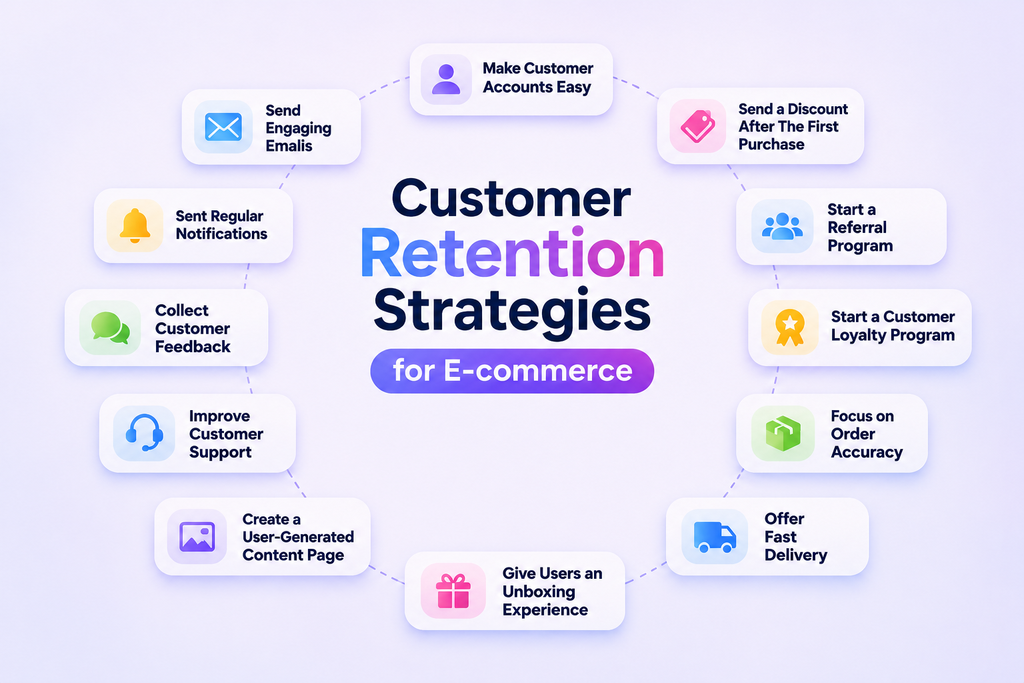
In eCommerce, customer retention is important, just like customer acquisition. Here we will explore customer retention strategies to increase customer retention rate and grow revenue.
1. Make Customer Accounts Easy
One of the first strategies is to make it easy for your customers to open an account. Customers like an easy process to open an account.
When customers make their first purchase, they should only have to enter their information once.
When an old customer visits and return to your website for again purchase, all of their data remains and they will directly go through the purchase process.
2. Send a Discount After The First Purchase
Sending a discount after the first purchase provides an incentive for customers to make a second purchase.
This type of post purchase offer can create a sense of urgency and encourage repeat business.
Additionally, it helps to create a sense of loyalty by rewarding the customer for their repeat business.
It’s worth noting that the discount should be substantial enough to make a difference for the customer but not so much that it affects the business profitability.
Also, it’s important to note that it’s not always about discounts. Other types, such as free shipping, exclusive access or loyalty programs, can also effectively retain customers.
3. Start a Referral Program
A referral program is a recommendation of mouth to grow a business’s customer base through the network of its current customers.
A referral program has two advantages – one is it motivates new customers to purchase and second, it remunerates your customers. This is more valuable than other marketing tactics.
4. Start a Customer Loyalty Program
A customer loyalty program is a strategic initiative designed to encourage customers to make repeat purchases.
It is based on the basis that by rewarding existing customers, businesses can increase customer retention and stimulate long-term brand loyalty.
This type of program often includes rewards such as store credit, discounts, etc.
5. Focus on Order Accuracy
Focus on order accuracy is a critical part of customer satisfaction as it is crucial to ensure that the customer receives the products that they have ordered in a timely and precise manner.
This can be accomplished through quality control measures that guarantee the reliability of customer orders.
Utilize an order tracking system to monitor and estimate the efficiency of the order fulfillment process.
6. Offer Fast Delivery
Offering fast delivery provides a convenient and satisfying experience for customers.
This can include options such as a same day or next day delivery and can help to build a positive brand image by showing the customer that their satisfaction is a top priority.
Additionally, offering fast delivery can help differentiate a business from its competitor, making it more appealing to customers and increasing the chances of repeat business.
For example, suppose customers know that they can receive their purchased product quickly. In that case, they may be more likely to repeat purchases.
This can be particularly effective for businesses that sell products that are frequently restocked or for companies that sell products that are time sensitive such as fashion or gifts.
7. Give Users an Unboxing Experience
The unboxing experience is a unique concept that has become popular in recent years.
It leverages the power of experimental marketing to create a connection between the user and the product.
By providing users with an engaging and emotional experience, this method gives them a sense of ownership and belonging that can be difficult to duplicate through traditional methods.
8. Create a User-Generated Content Page
A user generated content page can be a powerful tool for customer retention.
UGC pages showcase reviews, testimonials, and photos which can provide social proof for potential customers that the product or services offered by the business are high quality and trustworthy.
This can increase customer engagement and loyalty by creating a sense of community among customers.
Additionally, UGC pages allow customers to see how other customers have used the products, which can help them envision how they might use them as well.
This can increase personalization and make customers feel more connected to the brand.
UGC page also increases the product’s visibility as it allows customers to view products through the lens of the other customers.
Furthermore, it can increase brand awareness and drive sales without the need for expensive marketing campaigns.
Sometimes UGC pages provide personalized product recommendations based on customer reviews and feedback, which also increase sales and customer loyalty.
9. Improve Customer Support
Improving customer support is a crucial aspect of customer retention for e-commerce businesses.
By providing fast and efficient customer support in ecommerce businesses can resolve customer issues quickly and prevent them from becoming bigger problems.
Providing helpful, friendly and accurate customer support can help build trust with customers and trust is a key factor in customer retention.
Customers are more likely to return to a business they trust. Additionally, providing exceptional customer support can enhance the overall customer experience.
Always address individual customers’ specific needs and concerns; it can make them feel valued and appreciated.
Making customer support accessible through various phone, email, and chat channels increases retention.
Finally, continuously improving customer support by gathering customer feedback, analyzing metrics and making data-driven decisions can help to improve customer retention over time.
10. Collect Customer Feedback
Customers Feedback is a form of qualitative research that seeks to gather insights into customers’ experiences, opinions, and points of view regarding a product or service.
Collecting customer feedback provides an understanding of how a customer judges a brand, enabling businesses to develop new strategies based on this data.
11. Sent Regular Notifications
Sending regular notifications is a practice of communicating with existing customers in a timely manner by sending messages regularly.
This exercise functions to ensure that the existing customers are informed of any updates.
12. Send Engaging Emails
Email is one of the best ways to grow your connection with customers. You can send welcome emails to your new customers who purchase for the first time.
It’s very helpful to generate repeat purchases. You can also send emails to your existing customers. Let them inform about offers, discounts, coupon codes, etc.
Conclusion
Customer retention strategies are essential for any eCommerce business.
The key to success has a plan that includes data analytics, understanding customer needs, and providing incentives.
It’s also important to ensure customers to have a positive experience with your brand.
When these aspects are performed correctly, businesses can create long-term relationships with their customers and gain a competitive edge in the market.
Frequently Asked Questions
What are customer retention strategies for e-commerce?
Customer retention strategies for e-commerce are the tactics an online store uses to keep existing customers buying again, instead of relying only on new-customer acquisition. They include loyalty and referral programs, post-purchase discounts, fast delivery, strong support, and email, all aimed at turning first-time buyers into repeat customers.
Why is customer retention important for e-commerce?
Because it is cheaper and more profitable than acquisition. Keeping a customer costs roughly five times less than acquiring a new one, repeat customers tend to spend more, and loyal buyers refer others, which brings in new customers at no extra marketing cost.
What is a good customer retention rate for e-commerce?
It varies by category, but many ecommerce stores see retention rates around 25 to 30 percent, and a rate above that is strong. The more useful habit is to track your own rate over time and work to improve it, rather than chase a single benchmark.
Is customer retention really cheaper than acquisition?
Yes. Acquiring a new customer typically costs about five times more than retaining an existing one, and existing customers convert at higher rates and larger order values. That is why shifting even a small part of your budget from acquisition to retention usually pays off.
Which customer retention strategy is the most effective?
There is no single winner, but for most stores a loyalty program, consistent email marketing, and fast, reliable delivery deliver the biggest returns. Retention works best when you combine several of the strategies in this guide into one coherent experience.