




Beauty service app development is one of the most retention-driven categories in the on-demand service marketplace space. Unlike one-off service categories, beauty is inherently recurring: people get haircuts every 4 to 8 weeks, color every 6 to 10 weeks, nails every 2 to 4 weeks. A customer who finds a stylist they trust often stays with that stylist for years. This makes beauty service app development a retention game first and an acquisition game second.
Beauty service app development is meaningfully different from generic marketplace builds because the customer-stylist relationship is personal and long-running, the service has visual outcomes that customers want to see before booking, scheduling is appointment-based with strict time slots, and the economics depend heavily on rebooking and loyalty rather than constant new-customer acquisition. Founders who copy a generic booking template into the beauty vertical underestimate the retention mechanics and ship platforms that acquire customers but fail to keep them.
This guide walks through 9 smart booking features for beauty service app development, organized around the Booking-to-Loyalty Funnel framework: stylist profiles with portfolio galleries, real-time calendar with stylist availability, service catalog with variant pricing, pre-appointment confirmation flow, in-salon add-on upsell, post-appointment photo and review capture, loyalty points and rebooking prompts, membership subscription architecture, and a mobile app with calendar sync. It includes five real platform examples, realistic cost and timeline figures, and a FAQ.
Key Takeaways
- Build separate applications for customers, beauty professionals, and administrators to streamline operations.
- Prioritize essential features like appointment booking, secure payments, real-time availability, push notifications, and customer reviews.
- Decide early whether you’re building a single-salon app or a beauty marketplace, as this impacts architecture, features, and monetization.
- Modern beauty apps are commonly built using Flutter or React Native with a scalable backend such as Laravel or Node.js.
- A basic MVP typically takes 3–6 months, while enterprise-grade or marketplace solutions may require 6–12 months.
- Revenue can come from service commissions, subscriptions, membership plans, featured listings, and in-app advertising.
Table of Contents
Why beauty apps are growing so fast
Booking a stylist through an app has gone from novelty to default, and the numbers explain why building in this space makes sense in 2026.
- The market is large and growing. The global beauty and personal care market is worth about 698 billion dollars in 2026, with online driving roughly 30 percent of it, according to Statista. The services slice that a booking app serves is over 200 billion dollars of that.
- Customers want to book online. About 67 percent of salon clients prefer to book online and 62 percent have booked through a mobile app, per salon industry data. Phone reservations are being replaced fast.
- Online booking drives retention. First-time customers who book online return for a second visit around 78 percent of the time, versus about 39 percent for walk-ins. Online booking does not just add convenience, it roughly doubles the odds of a rebooking.
- Bad booking loses sales. Around 69 percent of clients have skipped an appointment entirely because booking was too hard. A smooth app captures demand that phone-only salons lose.
- Membership and reminders lift repeat visits. Membership-based salons retain customers at higher rates, and well-timed push reminders measurably increase rebooking, which is why the loyalty features in this guide matter so much.
Why Beauty Service App Development Is a Retention Game
Beauty service app development succeeds or fails on retention. The vertical’s defining characteristics all point toward keeping customers, not just acquiring them.
Recurring by Nature
Beauty services are scheduled on biological and aesthetic cycles. Hair grows, color fades, nails chip. A customer does not decide whether to get another haircut; they decide where and with whom. Beauty service app development that captures the rebooking moment owns a recurring revenue stream; platforms that treat each booking as a fresh acquisition leave money on the table.
The Stylist Relationship Is the Product
In beauty, customers are loyal to stylists, not platforms. A customer who loves their colorist will follow that colorist. This creates a strategic tension: the platform wants to own the customer relationship, but the customer’s loyalty is to the stylist. Smart beauty service app development resolves this by making the platform genuinely useful to both sides, so neither has a reason to take the relationship off-platform.
Visual Outcomes Drive Trust
Beauty is visual. Customers want to see a stylist’s previous work before booking. A portfolio of before-and-after photos is more persuasive than any rating. Beauty service app development must treat the visual portfolio as a first-class feature, not an afterthought.
Appointment-Based, Not On-Demand
Unlike a cleaning or a ride, beauty services are appointment-based. Customers book specific time slots with specific stylists, often days or weeks in advance. The scheduling system must handle stylist availability precisely, prevent double-booking, and manage the cancellation and rescheduling that appointment-based services generate.
Disintermediation Risk Is Real
Because the customer-stylist relationship is personal, both sides have incentive to move off-platform after the first appointment (the stylist avoids the take-rate, the customer books directly). Beauty service app development must make the platform so convenient (reminders, easy rebooking, loyalty rewards, payment handling) that staying on-platform is easier than leaving.
These five characteristics mean beauty service app development requires a retention-focused build, captured in the Booking-to-Loyalty Funnel framework.
The Beauty Marketplace Market Landscape
The beauty services market is large, fragmented, and increasingly digital, which makes it attractive for platform builders.
Market Size
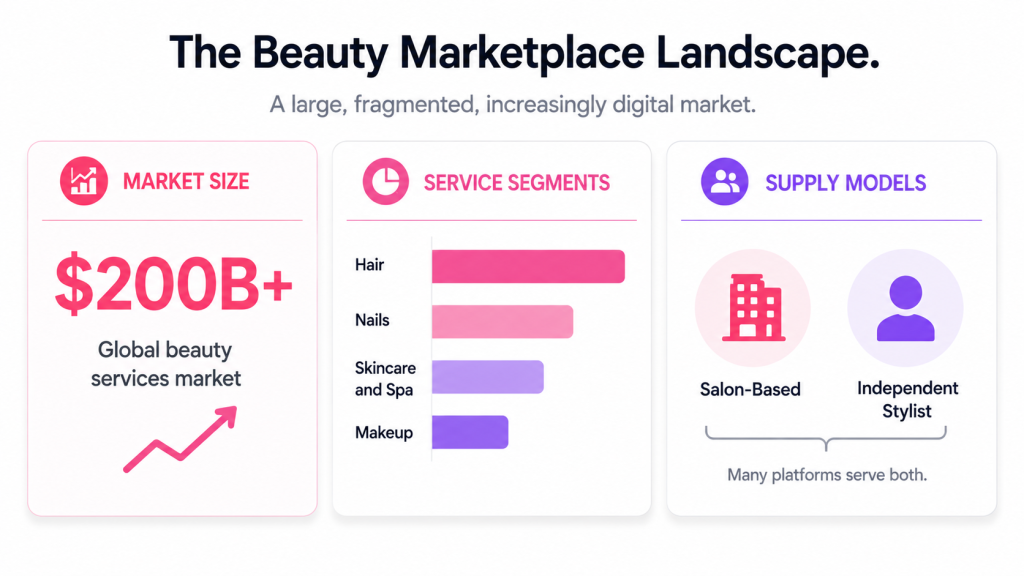
The global beauty and personal care services market exceeds over 200 billion dollars in services, within a wider 698 billion dollar beauty and personal care market” (or just delete that line, since this new section now carries the figure, spanning hair, nails, skincare, makeup, and spa services. Online booking penetration has grown steadily, with platforms like Booksy, StyleSeat, and Fresha capturing meaningful share, but a large portion of bookings still happen through phone calls and walk-ins, leaving room for digital platforms to capture.
Two Models: Salon-Based and Independent Stylist
Beauty service app development serves two supply models. Salon-based platforms list salons and their staff, handling salon-level scheduling and multi-stylist coordination. Independent stylist platforms list individual stylists who rent chairs, work from home studios, or travel to clients. Many platforms support both. The model choice shapes the scheduling architecture and the commission structure.
Service Sub-Segments
Hair (cuts, color, styling, treatments) is the largest sub-segment. Nails (manicure, pedicure, extensions) is high-frequency. Skincare and spa (facials, massage, waxing) is premium-priced. Makeup (event makeup, lessons) is occasion-driven. Beauty service app development decisions vary by which sub-segments the platform targets; a nails-focused platform optimizes for high-frequency rebooking, while an event-makeup platform optimizes for occasion-based discovery.
Customer and Stylist Segments
Customers range from price-sensitive (book whoever is cheapest and available) to relationship-loyal (follow a specific stylist anywhere). Stylists range from salon employees to independent chair-renters to mobile stylists who travel to clients. Beauty service app development that understands which segments it serves builds the right features for them.
Geographic Dynamics
Beauty services are local. A customer in one neighborhood books stylists in that neighborhood. Like other in-person service marketplaces, beauty platforms need hyper-local liquidity and should launch city-by-city or even neighborhood-by-neighborhood rather than nationally.
Beauty marketplace vs single-salon app: which to build
Decide early whether you are building a multi-provider marketplace or an app for one salon. The choice shapes your features, architecture, and revenue.
| Feature | Marketplace | Single salon |
|---|---|---|
| Multiple providers | Yes | No |
| Commission revenue | Yes | No |
| Membership plans | Yes | Yes |
| Multi-location | Optional | Yes |
| Provider dashboard | Full | Limited |
| Customer wallet | Yes | Optional |
A marketplace earns commission across many stylists and scales wider, but it needs two-sided liquidity. A single-salon app is simpler and cheaper to run and suits an established salon taking its own bookings online. Many founders start with one salon to prove the model, then open the platform to more providers.
The Booking-to-Loyalty Funnel Framework
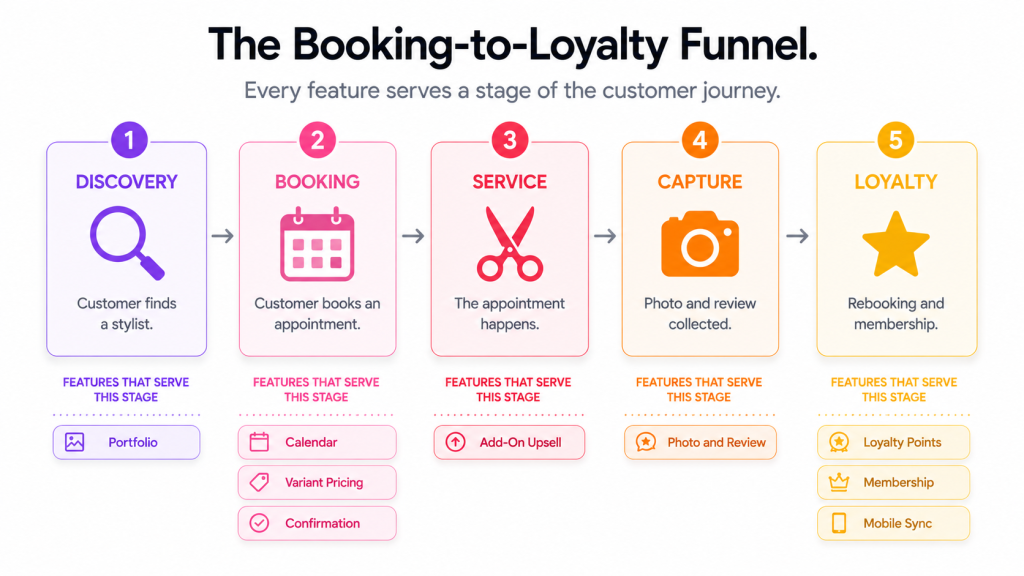
The Booking-to-Loyalty Funnel is the framework this guide is built around. It maps the customer journey in beauty service app development across 5 stages, and every one of the 9 features serves a specific stage.
The 5 Stages
Stage 1: Discovery. The customer finds a stylist. Feature 1 (stylist portfolio) serves this stage by giving customers the visual proof they need to choose.
Stage 2: Booking. The customer books an appointment. Features 2, 3, and 4 (real-time calendar, variant pricing, confirmation flow) serve this stage by making booking accurate and frictionless.
Stage 3: Service. The appointment happens. Feature 5 (in-salon add-on upsell) serves this stage by increasing the value of each visit.
Stage 4: Capture. The platform captures the outcome. Feature 6 (post-appointment photo and review) serves this stage by turning each service into trust content and a rebooking trigger.
Stage 5: Loyalty. The customer becomes a repeat customer. Features 7, 8, and 9 (loyalty points, membership, mobile calendar sync) serve this stage by making rebooking automatic and rewarding.
Why the Funnel Matters
The Booking-to-Loyalty Funnel reframes beauty service app development from “build a booking app” to “build a retention machine.” Each feature is not a standalone item on a checklist; it is a stage in a customer journey that ends in loyalty. Platforms that build features without the funnel lens ship disconnected functionality; platforms that build with the funnel produce a coherent experience that compounds retention.
Feature 1: Stylist Profile with Portfolio Gallery
The first smart feature in beauty service app development is the stylist profile with a portfolio gallery. This feature serves the Discovery stage.
The Portfolio as the Trust Signal
Beauty is visual, and the portfolio is the strongest trust signal in the vertical. A stylist profile should display a gallery of the stylist’s previous work: haircuts, color transformations, nail designs, makeup looks. High-quality before-and-after photos persuade customers more than star ratings alone. The portfolio answers the customer’s core question: “Will this stylist give me the result I want?”
Profile Components
Visual Portfolio
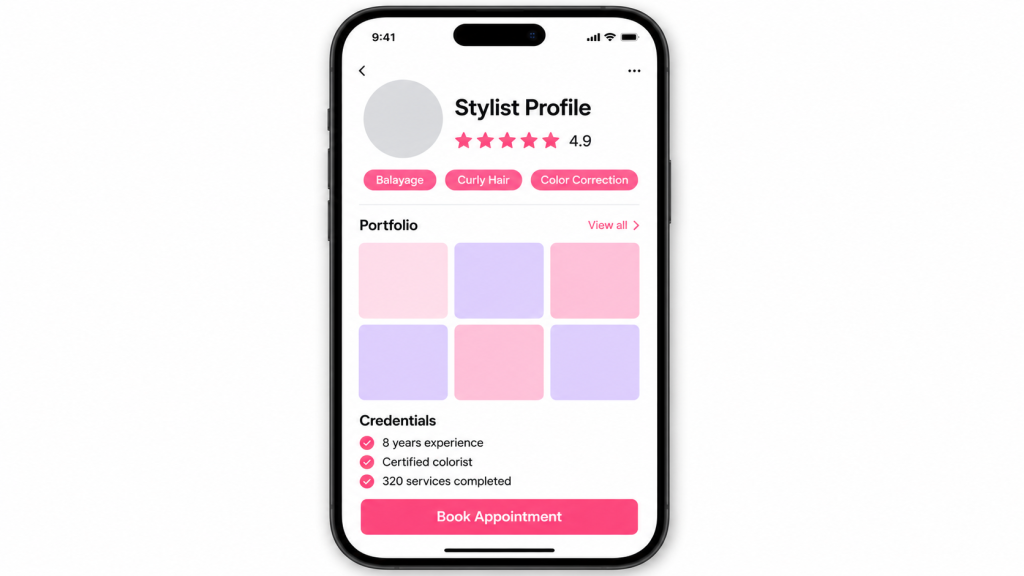
A grid gallery of the stylist’s work, ideally categorized by service type (cuts, color, styling). Customers browse the gallery to assess style fit. The platform should support easy photo upload from the stylist’s phone and optional tagging by service category.
Specialties and Skills
The profile lists the stylist’s specialties: balayage, curly hair, color correction, bridal styling, extensions. Specialties help customers self-select the right stylist and feed the discovery search filters.
Credentials and Experience
Years of experience, certifications, training, and salon affiliations. Credentials add credibility, especially for higher-stakes services like color correction or chemical treatments.
Reviews and Ratings
Customer reviews with dimensional ratings (skill, communication, punctuality, value). Reviews complement the portfolio: the portfolio shows the work, the reviews confirm the experience.
Discovery and Search
The stylist profile feeds the discovery experience. Customers search and filter by service type, specialty, location, price range, and availability. Strong beauty service app development surfaces the right stylists to the right customers quickly; weak discovery buries good stylists and frustrates customers.
Feature 1 is roughly 12 to 15 percent of beauty service app development build effort. The portfolio gallery is the single most important feature for converting a browsing visitor into a first booking.
Feature 2: Real-Time Calendar with Stylist Availability
The second smart feature in beauty service app development is the real-time calendar with stylist availability. This feature serves the Booking stage.
Why Real-Time Availability Matters
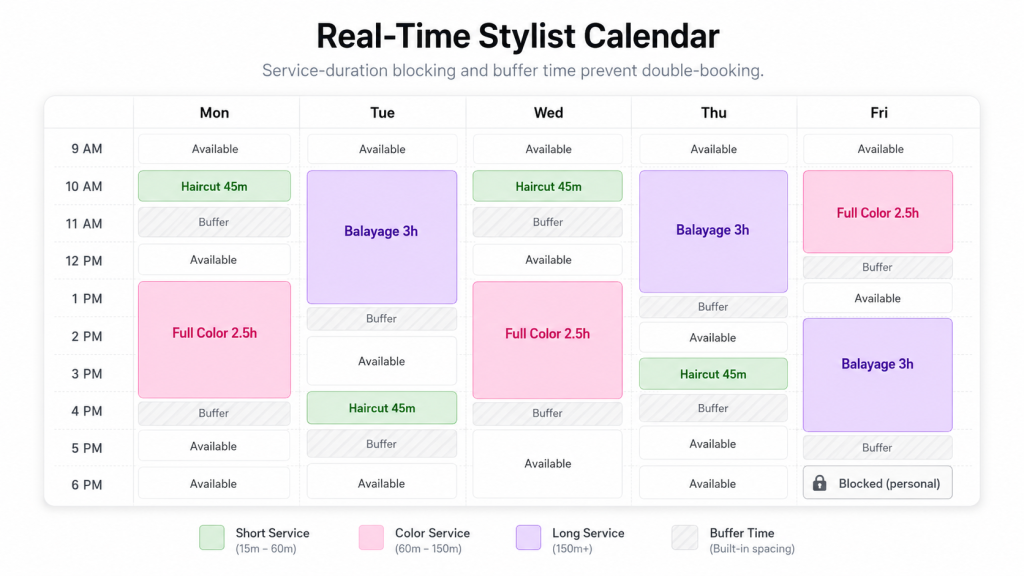
Beauty services are appointment-based. Customers book specific time slots. If the calendar shows availability that is not actually available, customers book slots that double-book the stylist, which produces canceled appointments and angry customers. Real-time accurate availability is non-negotiable in beauty service app development.
Calendar Components
Stylist-Set Availability
Each stylist defines their working hours, days off, breaks, and vacation time. The calendar only shows slots within the stylist’s set availability. Stylists update availability through the provider app.
Service Duration Blocking
Different services take different amounts of time: a haircut is 45 minutes, full color is 2.5 hours, a balayage is 3 to 4 hours. When a customer books a service, the calendar blocks the appropriate duration, not a fixed slot. Service-duration-aware blocking prevents the scheduling errors that fixed-slot calendars produce.
Buffer Time
Stylists need buffer time between appointments for cleanup and setup. The calendar adds configurable buffer time after each appointment so back-to-back bookings do not leave the stylist scrambling.
Real-Time Sync
When one customer books a slot, that slot disappears for all other customers immediately. Real-time sync prevents two customers from booking the same slot. The calendar also syncs with the stylist’s external calendar (Google Calendar, Apple Calendar) so personal commitments block availability automatically.
Salon-Level Coordination
For salon-based platforms, the calendar coordinates multiple stylists, shared resources (chairs, color stations, wash basins), and salon hours. Salon-level scheduling is meaningfully more complex than independent-stylist scheduling and is a key beauty service app development decision.
Feature 2 is roughly 15 to 18 percent of build effort. The calendar is the technical core of the booking experience; errors here produce the worst customer experiences in the vertical.
Feature 3: Service Catalog with Variant Pricing
The third smart feature in beauty service app development is the service catalog with variant pricing. This feature serves the Booking stage.
The Beauty Service Catalog
The catalog defines what services the platform offers. Top-level categories (hair, nails, skincare, makeup) contain specific services (women’s haircut, men’s haircut, full color, highlights, balayage, gel manicure, pedicure, facial). The catalog is the structured backbone of pricing, search, and stylist matching.
Why Variant Pricing Is Essential
Beauty service pricing varies by attributes that generic catalogs do not handle. A haircut price depends on hair length (short, medium, long). A color price depends on hair length and complexity (single-process, double-process, color correction). A manicure price depends on type (basic, gel, extensions). Beauty service app development needs variant pricing that captures these attributes and produces an accurate price.
Pricing Models
Stylist-Set Pricing
Most beauty platforms let stylists set their own prices within platform-defined ranges. A senior colorist charges more than a junior stylist for the same service. Stylist-set pricing supports the differentiation that beauty stylists depend on.
Service-Based Fixed Pricing
Some platforms set fixed prices per service to simplify the customer experience. Fixed pricing works for standardized services but fails for variable-complexity services like color.
Add-On Pricing
Services have add-ons: a haircut can add a deep-conditioning treatment, a manicure can add nail art. Add-on pricing in the catalog sets up the in-salon upsell feature covered later. The catalog should treat add-ons as first-class priced items.
Accurate Quoting at Booking
When a customer selects a service and its variants, the catalog produces an accurate price before booking. Price transparency builds trust; surprise charges at the salon destroy it. Beauty service app development that quotes accurately upfront, including foreseeable add-ons, sets the right expectation.
Feature 3 is roughly 10 to 12 percent of build effort. A well-structured catalog with variant pricing is what separates a professional beauty platform from a generic booking app.
Feature 4: Pre-Appointment Confirmation Flow
The fourth smart feature in beauty service app development is the pre-appointment confirmation flow. This feature serves the Booking stage and bridges into Service.
Why Confirmation Reduces No-Shows
No-shows are a major cost in beauty services. A no-show means a stylist’s blocked time produces zero revenue. A strong confirmation flow reduces no-shows by 20 to 40 percent compared to no confirmation system. Beauty service app development should treat the confirmation flow as a revenue-protection feature.
Confirmation Flow Components
Immediate Booking Confirmation
When a customer books, the platform immediately confirms via in-app notification, email, and SMS. The confirmation includes the stylist name, service, date, time, location, and price.
Reminder Cadence
The platform sends reminders at intervals: 48 hours before, 24 hours before, and 2 hours before the appointment. Reminders include a one-tap option to confirm attendance or reschedule. The reminder cadence is the single biggest lever for reducing no-shows.
Easy Rescheduling
Life happens; customers need to reschedule. The confirmation flow includes a frictionless reschedule option that finds the next available slot with the same stylist. Easy rescheduling converts what would have been a no-show into a kept (rescheduled) appointment.
Cancellation Policy Enforcement
The platform enforces the cancellation policy: cancellations within a defined window (typically 24 hours) may incur a fee or a deposit forfeiture. Clear policy enforcement protects stylist income while remaining fair to customers.
Pre-Appointment Preparation
For certain services, the confirmation flow includes preparation instructions: arrive with clean dry hair for color, remove old polish before a manicure, avoid caffeine before a facial. Preparation instructions improve service outcomes.
Deposits and Payment Holds
Some beauty service app development projects require a deposit at booking, especially for long high-value services like balayage. The deposit reduces no-shows and is applied to the final bill. Payment holds (authorize at booking, charge at service) are a lighter-touch alternative.
Feature 4 is roughly 8 to 10 percent of build effort. The confirmation flow is low-cost to build and high-value for protecting stylist revenue and platform reputation.
Feature 5: In-Salon Add-On Upsell
The fifth smart feature in beauty service app development is in-salon add-on upsell. This feature serves the Service stage and is one of the two economic multipliers in the vertical.
Why Add-On Upsell Matters
The customer is already in the chair. The marginal cost of adding a deep-conditioning treatment, a brow shape, or nail art to an existing appointment is low, and the customer is in a buying mindset. Add-on upsell increases average ticket value by 15 to 35 percent when done well. Beauty service app development that ignores add-ons leaves the easiest revenue in the vertical uncaptured.
Upsell Touchpoints
At Booking
The booking flow suggests relevant add-ons before the appointment: “Add a deep-conditioning treatment for $25?” Pre-appointment add-ons are planned revenue and let the stylist allocate time correctly.
During Service
The stylist app lets the stylist add services mid-appointment with customer approval. A colorist notices the customer’s ends need a trim and offers it; the customer approves through a quick confirmation; the add-on flows into the final bill. In-service add-ons capture spontaneous demand.
At Checkout
The checkout flow can suggest a product purchase (the shampoo the stylist used) or a pre-book discount for the next visit. Checkout-stage upsells convert the satisfied-customer moment into additional value.
Transparent Add-On Pricing
Add-on upsell must stay transparent. Every add-on shows its price before the customer approves it. Surprise add-on charges at checkout destroy trust. The strongest beauty service app development pattern requires explicit customer approval for every add-on, with the price visible at the moment of approval.
Stylist Incentive Alignment
Stylists drive add-on upsell during service. The platform should make add-ons easy to add in the stylist app and ensure stylists benefit from the upsell (they earn their normal commission on add-on revenue). Aligned incentives produce natural, non-pushy upselling.
Feature 5 is roughly 8 to 10 percent of beauty service app development build effort and produces meaningful average-ticket lift.
Feature 6: Post-Appointment Photo and Review Capture
The sixth smart feature in beauty service app development is post-appointment photo and review capture. This feature serves the Capture stage.
The Post-Appointment Moment
Immediately after a service, the customer is at peak satisfaction (assuming good service) and the result is fresh. This moment is the best time to capture a photo of the result and a review. Beauty service app development should prompt for both at the right moment, not days later when enthusiasm has faded.
Photo Capture
Result Photos
The stylist app prompts the stylist to photograph the finished result. With customer consent, result photos serve three purposes: they join the customer’s service history, they feed the stylist’s portfolio (Feature 1), and they become trust content for future customers.
Customer-Submitted Photos
The customer app also lets customers submit their own photos, including photos taken a few days later showing how the style held up. Customer photos add authenticity that stylist-submitted photos lack.
Review Capture
The customer app prompts a review shortly after the appointment: a star rating, dimensional ratings (skill, communication, cleanliness, value), and optional written feedback. The review prompt should be quick (a one-tap rating with optional detail) to maximize completion. Reviews feed the stylist profile and the discovery ranking.
The Capture-to-Loyalty Bridge
Post-appointment capture is the bridge from Service to Loyalty. The same post-appointment flow that captures a photo and review also presents the rebooking prompt: “Book your next appointment with [stylist] in 6 weeks?” Capturing the result and the next booking in one flow is a strong beauty service app development pattern.
Consent and Privacy
Photos of customers, especially before-and-after photos, are personal. The platform must capture explicit consent before using any customer photo in a portfolio or marketing context, and let customers delete their photos on request.
Feature 6 is roughly 8 to 10 percent of build effort. It is low-cost and high-value because it simultaneously builds trust content and triggers rebooking.
Feature 7: Loyalty Points and Rebooking Prompts
The seventh smart feature in beauty service app development is loyalty points and rebooking prompts. This feature serves the Loyalty stage.
Why Loyalty Mechanics Work in Beauty
Beauty is recurring, the customer-stylist relationship is durable, and customers visit the same stylist many times per year. These conditions make loyalty mechanics highly effective. A loyalty program that rewards repeat visits increases retention and rebooking frequency, which compounds across the long customer relationship.
Loyalty Program Components
Points Per Visit
Customers earn points for each completed appointment, which convert to discounts on future services. Points give customers a concrete reason to keep booking through the platform rather than going off-platform.
Tier Progression
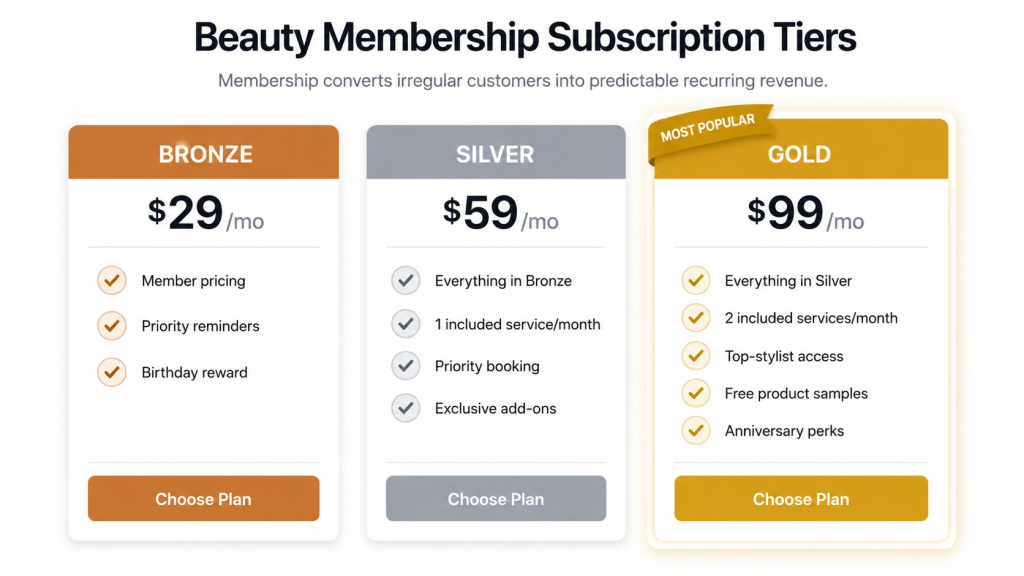
Tiered loyalty (bronze, silver, gold) rewards long-term customers with escalating perks: priority booking, exclusive add-ons, birthday rewards. Tier progression gives customers a status incentive to stay.
Referral Rewards
Customers earn rewards for referring friends. Beauty referrals are powerful because beauty results are visible, friends ask “who did your hair,” and the referral converts at high rates. The platform should make referral sharing a one-tap action.
Rebooking Prompts
Cycle-Aware Prompts
The strongest rebooking mechanic is cycle-aware. The platform knows a customer gets color every 8 weeks and prompts them at week 7: “Time to rebook with [stylist]?” Cycle-aware prompts catch customers at the natural rebooking moment.
One-Tap Rebooking
The rebooking prompt offers one-tap rebooking with the same stylist at a similar time slot. Reducing rebooking friction to a single tap dramatically increases rebooking rates.
Stylist-Initiated Rebooking
The stylist app lets the stylist book the customer’s next appointment before they leave the chair. In-person rebooking, captured in the app, is the highest-conversion rebooking moment in beauty service app development.
Feature 7 is roughly 10 to 12 percent of build effort. Loyalty and rebooking are where the retention game is won.
Feature 8: Membership Subscription Architecture
The eighth smart feature in beauty service app development is membership subscription architecture. This feature serves the Loyalty stage and is the second economic multiplier.
The Membership Model in Beauty
Beauty memberships convert irregular customers into predictable recurring revenue. Common models: a monthly fee that includes one service per month (a monthly blowout membership), a monthly fee that unlocks member pricing on all services, or a prepaid package (buy 10 services, get 1 free). Membership is increasingly common in beauty because it benefits both sides: customers get value and convenience, the platform and stylists get predictable revenue.
Membership Components
Subscription Billing
Memberships bill automatically each month through Stripe Billing. The billing system handles proration when members change tiers, dunning when payments fail, and pause or cancel requests. Roughly 6 to 8 percent of recurring charges fail monthly, so a dunning workflow is essential.
Member Benefits Engine
The platform tracks what each membership tier includes and applies benefits automatically: member pricing, included services, priority booking, exclusive perks. The benefits engine must apply the right benefits at booking and checkout without manual intervention.
Membership Management
Members need self-service control: view remaining included services, upgrade or downgrade tiers, pause membership, cancel. Beauty service app development that makes membership management easy reduces involuntary churn and member frustration.
Membership and Stylist Economics
Memberships raise a question: when a member uses an included service, how is the stylist compensated? The platform must define and automate this. Common approaches: the stylist receives their normal rate funded from the membership pool, or the stylist receives a defined per-service amount. Clear membership economics keep stylists willing to serve members.
Why Membership Compounds Retention
A member has prepaid or committed to a recurring fee. That commitment makes them far more likely to keep booking through the platform. Membership is the strongest retention mechanic in beauty service app development because it converts a behavioral intention (I will probably come back) into a financial commitment (I have already paid).
Feature 8 is roughly 12 to 15 percent of build effort. Membership architecture is complex but produces the most predictable revenue in the vertical.
Feature 9: Mobile App with Calendar Sync
The ninth smart feature in beauty service app development is the mobile app with calendar sync. This feature serves the Loyalty stage by keeping both customers and stylists organized.
Why Mobile Is the Primary Surface
Beauty bookings happen on phones. Customers browse stylists, book, get reminders, and rebook from mobile. Stylists manage their calendar, accept bookings, and run their day from mobile. Beauty service app development must treat the mobile app as the primary surface, not a companion to a web app.
The Customer App
The customer app handles discovery, booking, confirmation, reminders, post-appointment review, loyalty tracking, membership management, and rebooking. It is the customer’s entire relationship with the platform in their pocket.
The Stylist App
The stylist app handles calendar management, availability setting, incoming booking acceptance, in-service add-ons, result photo capture, earnings tracking, and customer communication. The stylist app determines how efficiently stylists run their day.
Calendar Sync
Two-Way Calendar Integration
The stylist app syncs two ways with Google Calendar and Apple Calendar. Platform bookings appear in the stylist’s personal calendar; personal commitments in the stylist’s calendar block platform availability. Two-way sync prevents the double-booking that destroys stylist trust in a platform.
Customer Calendar Sync
The customer app adds confirmed appointments to the customer’s personal calendar, with reminders. Calendar sync reduces customer no-shows by keeping the appointment visible in the customer’s daily life.
Build Approach
Most beauty service app development uses Flutter or React Native to build the customer app and stylist app efficiently from a shared codebase. The deeper treatment of mobile app architecture across customer, provider, and admin surfaces is at on-demand service mobile app development.
Feature 9 is roughly 20 to 25 percent of beauty service app development build effort because it spans two full mobile apps. Mobile is not optional; it is where the entire vertical lives.
Five Real Beauty Platforms
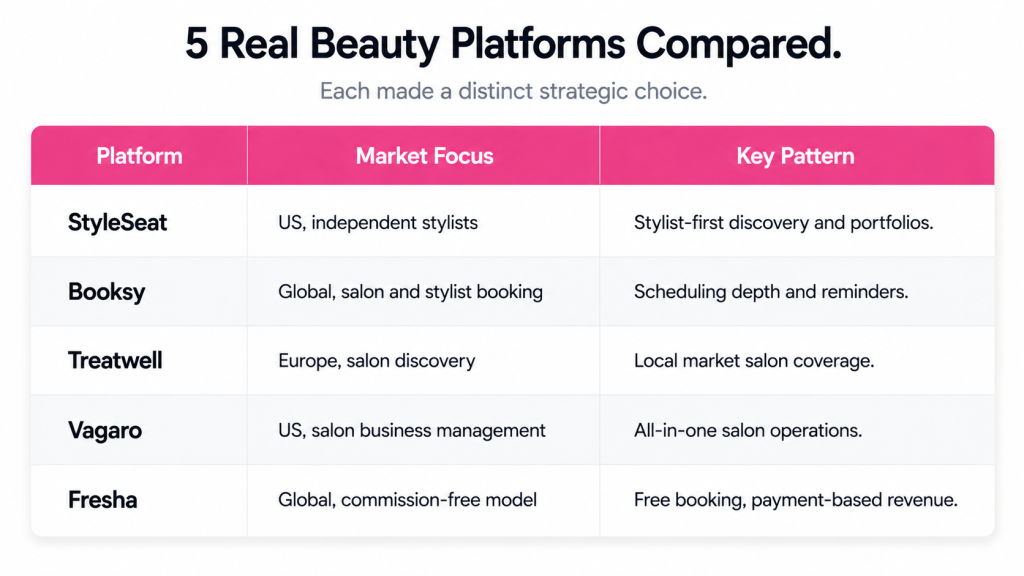
Five real platforms illustrate the patterns in beauty service app development. Each made distinct strategic choices.
StyleSeat
A US platform focused on independent stylists. StyleSeat built its position on stylist-first discovery and strong portfolio galleries. What it teaches: in beauty, the stylist is the product, and a platform that helps independent stylists build a client base earns stylist loyalty.
Booksy
A global platform serving both salons and independent stylists with deep scheduling and reminder features. What it teaches: scheduling depth and no-show reduction are real differentiators. Booksy’s investment in reminder cadence and calendar accuracy is a core reason stylists stay. The Booksy case study material documents the scheduling-first approach.
Treatwell
A European platform focused on salon discovery across multiple countries. What it teaches: local market coverage matters. Treatwell’s strength is genuine depth in each European market rather than shallow global presence.
Vagaro
A US platform positioned as all-in-one salon business management, covering booking, payments, payroll, inventory, and marketing. What it teaches: serving the salon’s full operational needs creates switching costs. A salon running its entire business on the platform does not leave easily.
Fresha
A global platform with a commission-free booking model, earning revenue from payment processing and add-on services rather than booking commissions. What it teaches: the revenue model is a strategic choice. Commission-free booking attracts supply aggressively; the platform monetizes through adjacent services. Beauty industry reports consistently note Fresha’s rapid supply growth driven by the commission-free model.
The pattern across all five: successful beauty service app development comes from a clear strategic choice (stylist-first, scheduling depth, local coverage, all-in-one operations, or commission-free) executed deeply. For a related recurring-relationship vertical, see personal trainer app development.
Want a beauty app built for you?
If you would rather have an experienced team design and build your platform, both the customer app and the stylist app, that is what we do. We handle scheduling, payments, loyalty, and the full booking-to-loyalty funnel from day one, through our mobile app development and custom SaaS development services.
Common mistakes in beauty service app development
Even good teams trip over the same errors. Avoid these.
1. Copying a ride-hailing booking flow.
Beauty is appointment-based, not instant-dispatch. A flow borrowed from Uber ignores time slots, service duration, and stylist choice.
2. Ignoring recurring appointments.
Beauty is recurring by nature. An app with no rebooking prompt or cycle-aware reminder throws away the vertical’s biggest advantage.
3. No cancellation policy.
Without deposits or a clear cancellation window, no-shows drain stylist income and platform trust.
4. Skipping provider verification.
Customers let stylists near their face and hair. Unverified providers are a trust and safety risk that sinks a platform fast.
5. Weak search and filters.
If customers cannot filter by service, specialty, price, and availability, they cannot find the right stylist, and they leave.
6. No loyalty system.
With no points, tiers, or membership, you compete on price alone and lose the retention that makes beauty profitable.
7. Poorly timed notifications.
Reminders sent too early or too often get ignored. Cycle-aware, well-timed prompts are what actually reduce no-shows.
8. Slow or clunky checkout.
Friction at payment kills conversions at the last step. Keep checkout to a few taps with saved payment details.
Final Words
Beauty service app development is a retention game. The vertical is recurring by nature, the customer-stylist relationship is durable, and the economics depend on rebooking and loyalty rather than constant new-customer acquisition. The 9 smart booking features covered in this guide (stylist portfolio, real-time calendar, variant pricing, confirmation flow, add-on upsell, photo and review capture, loyalty points, membership, mobile calendar sync) provide the structural foundation. The Booking-to-Loyalty Funnel framework connects every feature to a stage of the customer journey that ends in loyalty.
The dominant pattern across successful beauty platforms: a clear strategic choice executed deeply, the stylist portfolio as the visual trust signal, accurate appointment scheduling as the technical core, add-on upsell and membership as the economic multipliers, and rebooking prompts as the retention engine. Platforms that build the full funnel produce compounding retention; platforms that build disconnected features acquire customers and lose them.
Beauty Service App Development FAQ
1. How much does beauty service app development cost?
$60K to $200K, depending on scope. A single-segment MVP (hair only, one city) runs $60K to $90K. A standard multi-segment beauty marketplace with the 9 features and full mobile apps runs $90K to $150K. A feature-rich platform with advanced membership, salon operations tooling, and deep loyalty runs $150K to $200K+. White-label customization of an existing on-demand service platform runs $30K to $70K. Add $30K to $90K for Year 1 operating costs.
2. How long does it take to build a beauty booking app?
10 to 16 weeks for most MVPs. 10 to 12 weeks for a single-segment single-city build. 12 to 16 weeks for a standard multi-segment marketplace with all 9 features, membership, and full mobile apps. 4 to 8 weeks for white-label customization.
3. Should a beauty platform charge commission or be commission-free?
Both models work. Commission (15 to 30 percent of service value) is the traditional model and aligns platform revenue with transaction volume. Commission-free (like Fresha) attracts supply aggressively and monetizes through payment processing and adjacent services. Commission-free wins supply faster but requires the platform to find revenue elsewhere. The choice depends on whether supply acquisition or immediate revenue is the bigger constraint.
4. What is the most important feature in beauty service app development?
The stylist portfolio gallery for first bookings and the rebooking prompt for retention. Beauty is visual, so the portfolio converts browsers into first-time customers. Beauty is recurring, so the rebooking prompt converts first-time customers into the loyal repeat customers that make the vertical economically attractive. The whole Booking-to-Loyalty Funnel matters, but those two features anchor the two ends.
5. How does a beauty platform prevent stylists and customers from going off-platform?
Make the platform genuinely more convenient than going direct. Cycle-aware rebooking prompts, easy rescheduling, automatic reminders, loyalty rewards, membership benefits, integrated payments, and review history all create reasons to stay. Disintermediation happens when the platform adds no value beyond the first introduction; beauty service app development that keeps adding convenience keeps both sides on-platform.
6. Should the platform target salons or independent stylists?
Depends on the market and strategy. Independent-stylist platforms (StyleSeat model) are simpler to build and grow because each stylist is a single decision-maker. Salon-based platforms (Treatwell, Vagaro models) require multi-stylist scheduling and salon-level coordination but capture larger booking volume per account. Many platforms support both. Pick the model that matches your launch market’s supply structure.