

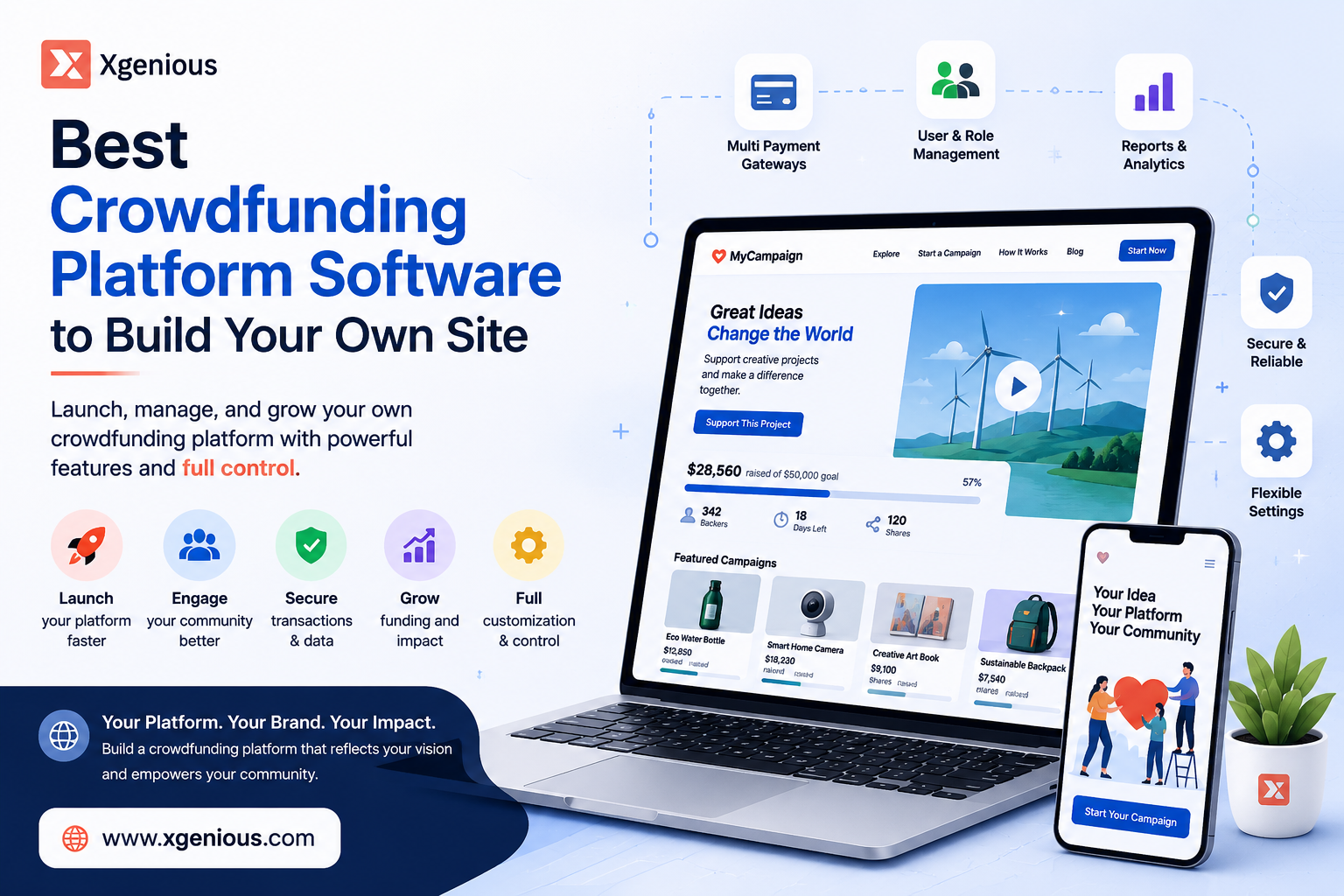


Whether you want to fund a product idea, raise money for a cause, or build the platform others campaign on, which crowdfunding platform you pick changes everything. The fees, the audience, the campaign mechanics, and the control over your own data, it all depend on which platform you use and why.
This guide compares the 10 best crowdfunding platforms in 2026 across every major use case: product launches, charitable fundraising, equity investment, creator memberships, and building your own crowdfunding site from scratch.
Table of Contents
What is a crowdfunding platform?
A crowdfunding platform is a website or software that lets you raise money from a large number of people instead of a single investor. Rather than approaching a bank for a loan or pitching one venture capitalist, you post your project publicly and collect small contributions from hundreds or thousands of backers.
The concept has been around for centuries (early book publishing worked exactly this way), but online crowdfunding became mainstream around 2009 when Kickstarter launched. Since then the market has split into two distinct categories.
The first covers established platforms where you list your campaign and tap into an existing backer audience. Kickstarter, GoFundMe, and Indiegogo fall here. The second covers software that lets you own and operate your own crowdfunding platform — Fundorex sits in this category, and the economics are completely different.
Understanding which category you actually need is the first decision to get right.
Types of crowdfunding platforms
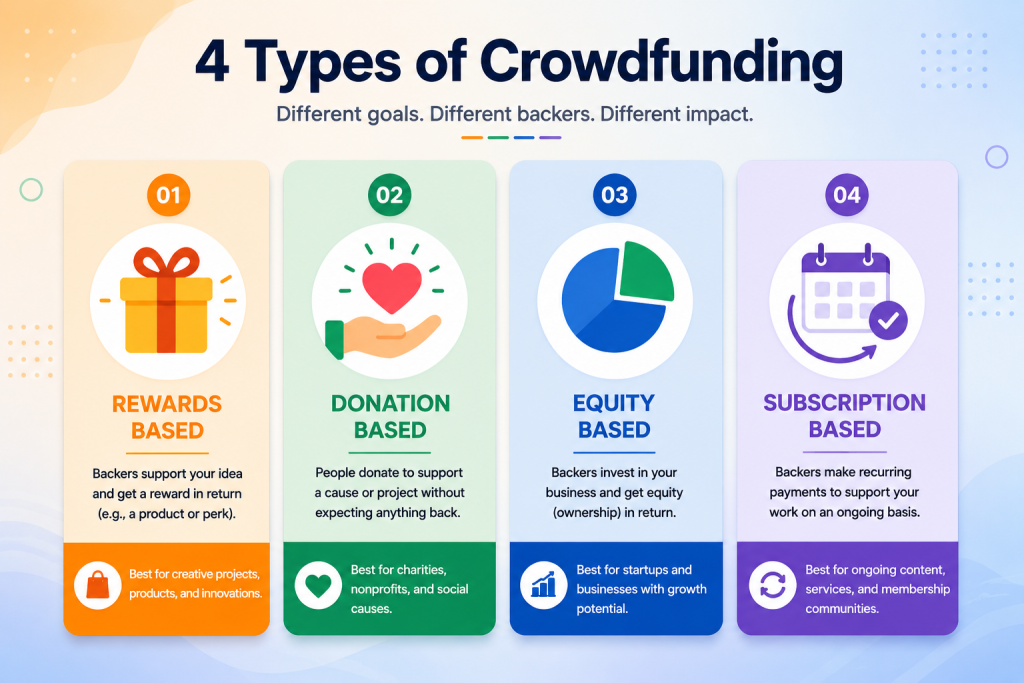
Most crowdfunding fits into four models. Different platforms specialize in different ones.
1. Rewards-based campaigns give backers a product, perk, or experience in return for contributing. Kickstarter and Indiegogo use this model. It works best for product launches, creative projects, and gadget pre-orders.
2. Donation-based campaigns collect money with no financial return to backers. Donation-based crowdfunding works best for personal emergencies, medical expenses, and charitable causes — GoFundMe is the most recognized example.
3. Equity-based campaigns give backers a share of the company. Republic, StartEngine, and Seedrs operate this model. It’s heavily regulated because it involves selling securities.
4. Subscription or membership campaigns have backers pay a recurring amount to support ongoing creative work. Patreon sits here, less about launching a project, more about building a sustained income from an audience.
How to pick the right crowdfunding platform
A few questions cut through the noise quickly.
1. Are you funding a project or building a business?
If you have one product to launch, you want an existing platform with built-in traffic. If you want to earn commission from other people’s campaigns, you need software to build your own platform. The PHP crowdfunding scripts comparison is worth reading if you’re in the second camp.
2. What’s your audience geography?
Kickstarter’s audience skews US and UK. GoFundMe covers English-speaking markets well. If your backers are primarily in South or Southeast Asia, check whether the platform supports local payment gateways before committing. A reliable payment gateway can make or break campaign conversions outside Western markets.
3. What campaign model does your project need?
A hardware product suits a rewards-based. A startup seeking investment suits equity. A personal cause suits donation. Picking a platform built for the wrong model creates friction at every step.
4. How much does data ownership matter to you?
On any third-party platform, backer contact data belongs to the platform, not you. If building a lasting audience relationship matters, self-hosted software is the only way to own that data outright.
The 10 best crowdfunding platforms in 2026
1. Fundorex — best for building your own crowdfunding platform
Type: Self-hosted crowdfunding platform software
Campaign models: Donation, rewards, equity, and lending
Commission: You configure your own rate
Starting cost: $49 one-time license
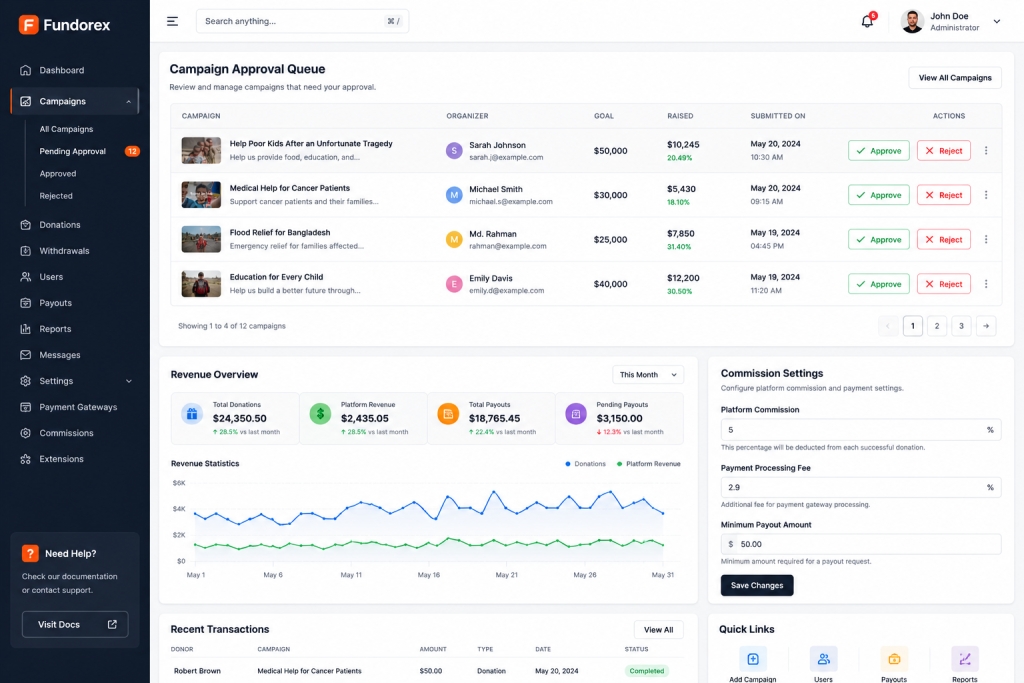
Fundorex answers a specific question: what if you want to be the platform, not the campaigner?
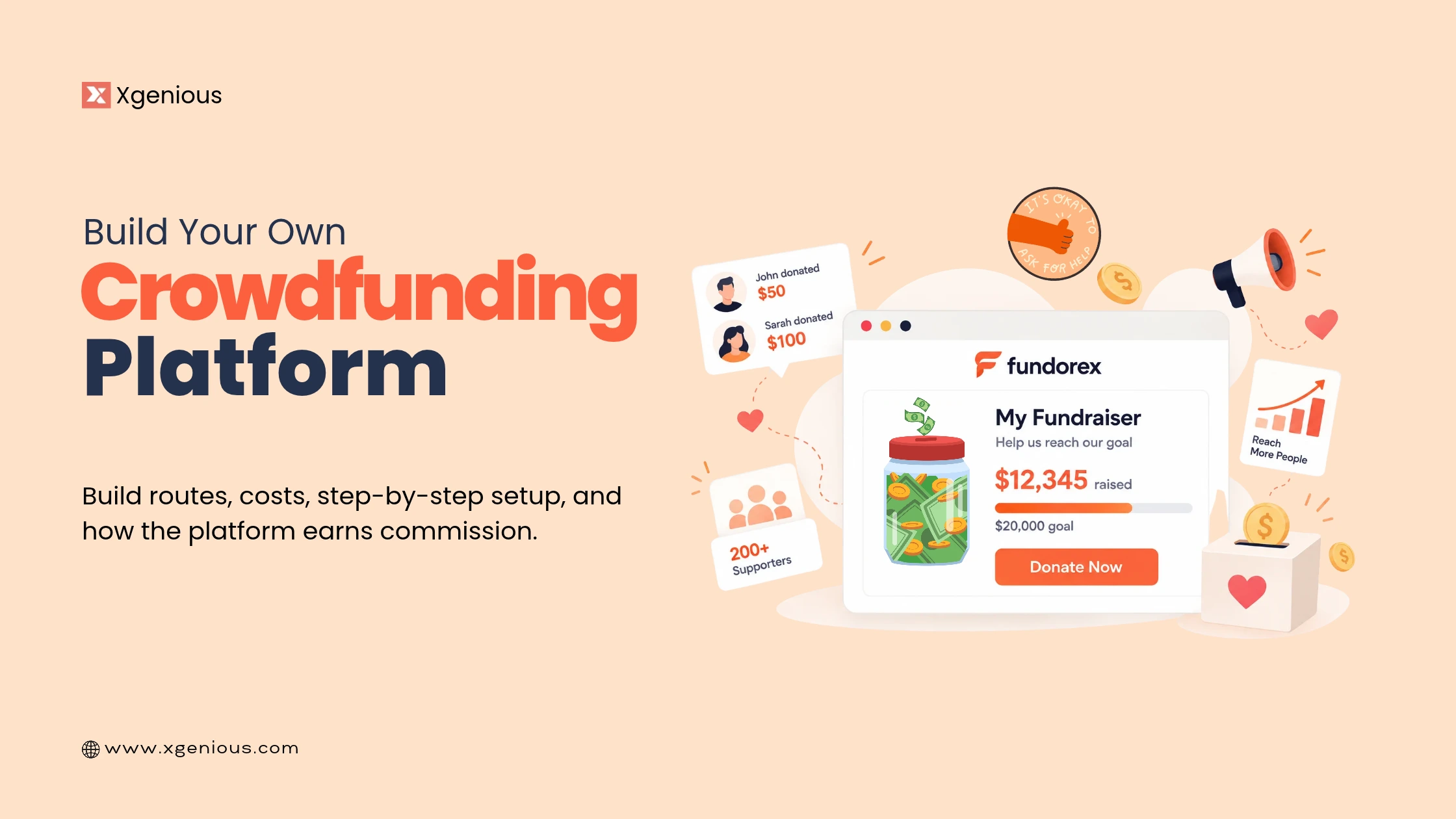
Built by Xgenious on Laravel, Fundorex gives you everything needed to launch a fully functional crowdfunding marketplace where other people run campaigns and you collect the commission. It supports all four crowdfunding models in a single installation, which means you can accept donation campaigns, rewards campaigns, equity rounds, and lending campaigns without running separate software for each.
The admin dashboard handles campaign approvals, user management, payout schedules, commission configuration, and financial reporting. The backer experience is clean and mobile responsive. Multi-language and multi-currency support means it works for international audiences out of the box.
At $49 for the regular license, it’s the lowest-cost path to owning a production-ready crowdfunding platform with no monthly fees beyond your hosting costs. The full breakdown of what it costs to build your own crowdfunding platform covers the realistic launch budget in detail.
Who it’s built for: entrepreneurs who want to own and operate a crowdfunding business, agencies building white-label crowdfunding products for clients, and founders looking to dominate a niche that existing platforms underserve.
2. Kickstarter — best for product and creative project launches
Type: Third-party crowdfunding platform
Campaign model: Rewards-based (all-or-nothing)
Commission: 5% platform fee + 3-5% payment processing
Starting cost: Free to list; fees apply only on successful funding
Kickstarter has been the default for product and creative project launches since 2009. Its all-or-nothing funding model means backers are only charged if the campaign hits its goal, which creates urgency and protects backers from projects that can’t deliver.
The platform has a genuinely engaged audience, particularly for technology products, games, design, and art. Many campaigns get meaningful traffic from Kickstarter’s own discovery features once they gain early momentum.
The trade-off is cost and control. On a $100,000 campaign you’re paying roughly $8,000-$10,000 in combined fees. Backer data belongs to Kickstarter. Once the campaign ends, you have to rebuild your audience relationship from scratch on your own channels. For a direct comparison between the two biggest platforms, the Indiegogo vs Kickstarter breakdown covers the differences in format, fees, and campaign mechanics.
Best for campaigns with a specific, tangible product and an audience that’s already active on Kickstarter.
3. Indiegogo — best for flexible and ongoing campaigns
Type: Third-party crowdfunding platform
Campaign model: Rewards-based (flexible or all-or-nothing)
Commission: 5% platform fee + payment processing
Starting cost: Free to list
Indiegogo gives you more flexibility than Kickstarter in a few areas. You can run a flexible funding campaign where you keep whatever you raise even without hitting your goal. Campaigns can be extended or transitioned to an ongoing InDemand store after the initial run ends.
The audience is smaller than Kickstarter’s, but the platform has stronger international coverage in Asia and Europe. Hardware startups in particular have used Indiegogo when their product didn’t fit Kickstarter’s category restrictions.
The risk with flexible funding is that it removes urgency. And keeping funds you raised without hitting your production target creates real fulfillment problems if you haven’t thought through the numbers carefully. The 15 tips for improving crowdfunding goals is useful reading before you set your target on either platform.
4. GoFundMe — best for personal causes and emergencies
Type: Third-party fundraising platform
Campaign model: Donation-based
Commission: 0% platform fee (payment processing fees apply)
Starting cost: Free
GoFundMe is the largest donation-based platform globally. It removed its platform fee in 2017 and now relies on voluntary tips from donors, making it genuinely free beyond payment processing.
The platform works well for medical expenses, personal emergencies, memorial funds, and charitable causes. The interface is straightforward and campaigns can go viral on social media in ways most other platforms can’t match for personal stories.
It’s not built for product launches or equity. For anything beyond personal fundraising, a different platform fits better. Nonprofits in particular often find specialized nonprofit crowdfunding platforms a stronger fit than GoFundMe’s general-purpose donation model.
5. Republic — best for equity crowdfunding in the US
Type: Regulated equity crowdfunding platform
Campaign model: Equity-based
Commission: 6% on capital raised + equity warrants
Starting cost: Application required; minimum raise typically $50,000+
Republic lets startups raise equity from retail investors under SEC Regulation Crowdfunding. Unlike rewards platforms, investors on Republic receive actual equity or convertible notes.
The platform has a curated application process, which keeps campaign quality relatively high and builds backer trust. It’s a serious tool for early-stage companies that want shareholders who are also customers.
The compliance overhead is real. Before raising on Republic you’ll need audited financials, proper legal documentation, and ongoing disclosure obligations. This isn’t a platform to approach without securities counsel.

6. Patreon — best for creators and ongoing memberships
Type: Creator subscription platform
Campaign model: Subscription/membership
Commission: 5-12% depending on tier
Starting cost: Free to set up; fees deducted from earnings
Patreon is less about funding a specific project and more about ongoing support for creative work. Creators offer membership tiers with perks like early access, behind-the-scenes content, or direct communication, and fans pay monthly.
It works well for podcasters, YouTubers, writers, and illustrators with an existing audience willing to pay for exclusive access. The business model compounds: a creator with 500 patrons paying $10/month earns $5,000 a month before fees, indefinitely.
The Patreon fee structure has changed several times over the years, so verify current pricing before building your revenue model around specific numbers.
7. StartEngine — best for startup equity crowdfunding
Type: Regulated equity crowdfunding platform
Campaign model: Equity-based
Commission: 7-12% on capital raised
Starting cost: Application-based; SEC filing required
StartEngine is one of the larger Reg CF and Reg A+ platforms in the US. Similar to Republic, but it tends to attract slightly earlier-stage companies and has a more active secondary market for shares.
Campaigns that perform well here usually have a strong consumer brand story that retail investors can connect with as users of the product. Consumer goods, food brands, and apps with clear traction tend to do better than B2B software plays.
Like Republic, budget for meaningful legal and accounting costs before you start the process.
8. Crowdfunder UK — best for UK equity campaigns
Type: Regulated equity crowdfunding platform
Campaign model: Equity and rewards
Commission: 5-7% plus payment processing
Starting cost: Application required
Crowdfunder UK handles both rewards and equity campaigns and is particularly strong for UK-based businesses. It has relationships with major UK grant providers, which means some campaigns can match crowdfunded amounts with public grant funding.
The community focus and grant-matching element make it worth considering for UK businesses with a social or community angle that other equity platforms wouldn’t prioritize.
9. Fundly — best for nonprofit and charitable campaigns
Type: Third-party fundraising platform
Campaign model: Donation-based
Commission: 4.9% platform fee + 2.9% + $0.30 processing
Starting cost: Free to set up
Fundly sits between GoFundMe and purpose-built nonprofit tools. It handles charitable campaigns, nonprofit fundraisers, school drives, and community causes with built-in tools for social sharing, donor communication, and progress tracking.
The fee structure is higher than GoFundMe, but Fundly offers more customization for organizational fundraising and supports team-based fundraising where multiple people run individual pages toward a shared goal. Nonprofits looking to turn one-time donors into recurring supporters will find the best practices for keeping donors engaged relevant alongside whatever platform they choose.
10. Mightycause — best for social impact organizations
Type: Nonprofit fundraising platform
Campaign model: Donation-based and recurring giving
Commission: Free plan available; paid plans from $99/year
Starting cost: Free
Mightycause is built specifically for nonprofits and social impact organizations. It supports one-time campaigns, recurring giving programs, peer-to-peer fundraising events, and giving day challenges.
The donor management tools are stronger than GoFundMe or Fundly for organizations that need to track and steward relationships over time. The paid plan removes transaction fees, which makes sense for any organization raising significant recurring volume.
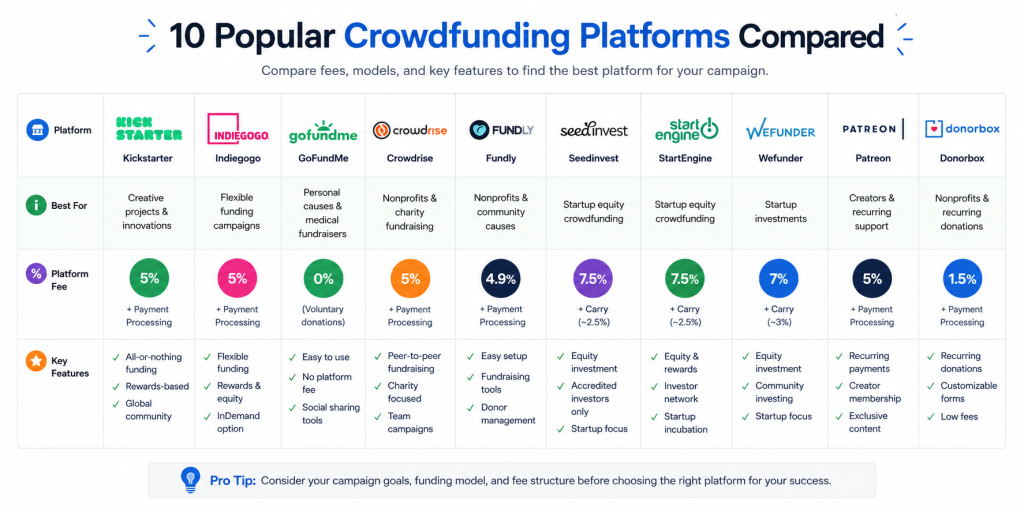
Full comparison table
| Platform | Type | Campaign models | Platform fee | Best for | Data ownership |
|---|---|---|---|---|---|
| Fundorex | Self-hosted software | Donation, rewards, equity, lending | You set it | Building your own platform | You own it fully |
| Kickstarter | Third-party | Rewards | 5% + processing | Product and creative launches | Kickstarter’s |
| Indiegogo | Third-party | Rewards (flexible/fixed) | 5% + processing | Hardware and ongoing campaigns | Indiegogo’s |
| GoFundMe | Third-party | Donation | 0% (tips-based) | Personal causes | GoFundMe’s |
| Republic | Regulated equity | Equity | 6% + warrants | US startup equity | Republic’s |
| Patreon | Creator platform | Subscription | 5-12% | Ongoing creator support | Patreon’s |
| StartEngine | Regulated equity | Equity | 7-12% | US consumer brand equity | StartEngine’s |
| Crowdfunder UK | Third-party | Equity and rewards | 5-7% | UK businesses, social causes | Crowdfunder’s |
| Fundly | Third-party | Donation | 4.9% + processing | Nonprofit and community campaigns | Fundly’s |
| Mightycause | Nonprofit platform | Donation and recurring | Free or $99/yr | Established nonprofits | Mightycause’s |
How to run a crowdfunding campaign that actually works
Posting and waiting is not a strategy. The campaigns that perform well do significant work before they go public.
1. Build your audience before launch day
The biggest mistake first-time campaign founders make is assuming the platform brings backers to them. Kickstarter’s algorithm surfaces campaigns with early momentum. That means campaigns that launch cold, with no existing audience, rarely develop that momentum at all.
Build an email list in the 4-6 weeks before launch. Run targeted ads to a landing page, collecting emails from people interested in your product or cause. A strong launch day, where a few hundred people back your campaign within the first 48 hours, does more than weeks of mediocre traction later. Crowdfunding marketing tactics that work before and during a campaign are worth mapping out before you set your launch date.
2. Set a goal you can actually hit fast
Your funding goal should be the minimum you need to deliver, not an aspirational number. A smaller goal you can credibly hit in the first week does more for a campaign than a large goal that leaves you stuck at 30% for three weeks.
Platforms like Kickstarter surface campaigns with strong early momentum in their discovery sections. Hitting your goal quickly makes the algorithm work for you. Sitting below it for weeks signals trouble to potential backers.
3. Make your campaign page earn its keep
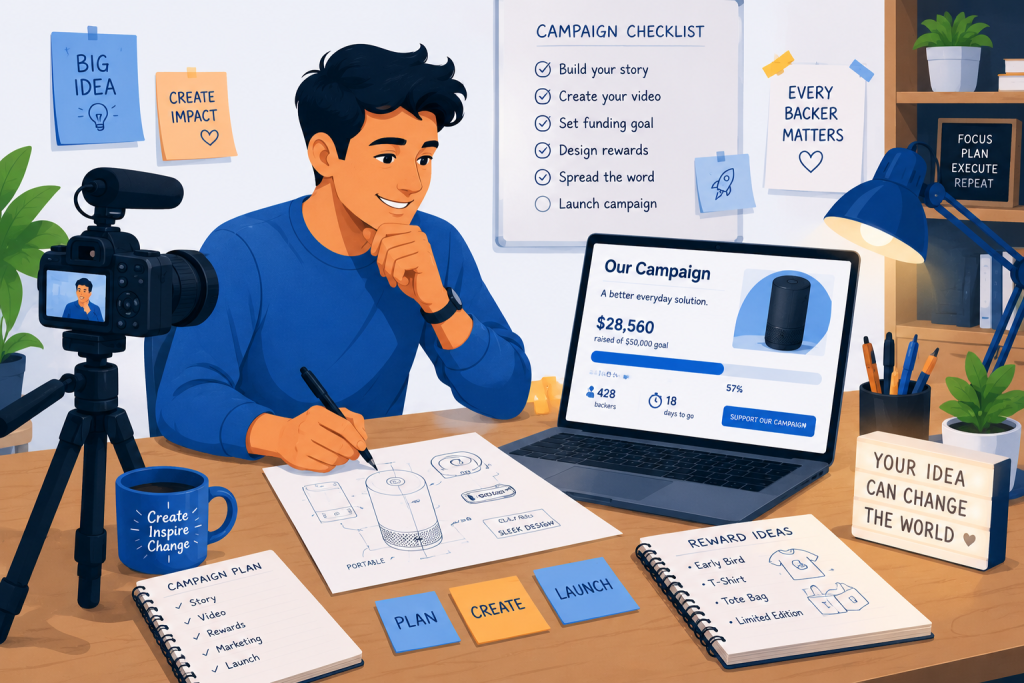
Your campaign page is a sales page. A well-written title, clear product description, strong visuals, and honest social proof matter more than any marketing tactic once someone lands on it. What makes a good crowdfunding campaign page gets into the specific elements that convert browsers into backers.
Your campaign video is usually the first thing people watch. Keep it under two minutes, open with the problem your product solves, and include a direct ask near the end. Creating an effective crowdfunding pitch video covers the production and scripting decisions that most first-time campaigns get wrong.
4. Keep momentum after you fund
A lot of campaigns hit their goal and then go quiet. Backers who contributed weeks before delivery and then heard nothing became vocal critics. Keeping crowdfunding momentum going after you fund matters as much as getting there in the first place.
Send regular updates. Share behind-the-scenes content. Tell backers when delays happen, before they have to ask. The campaigns with the best long-term reputations are the ones that communicated well, not just the ones that delivered on time.
What to do after your campaign ends
A successful campaign is the start of something, not the destination. Your backers are your earliest customers and most enthusiastic advocates. Treat them that way.
Set up your own website or store before or during the campaign. When press coverage or social mentions drive traffic, you want somewhere to capture it that belongs to you. The journey from crowdfunding to ecommerce covers how to turn a funded campaign into a sustainable ongoing business rather than a one-time event.
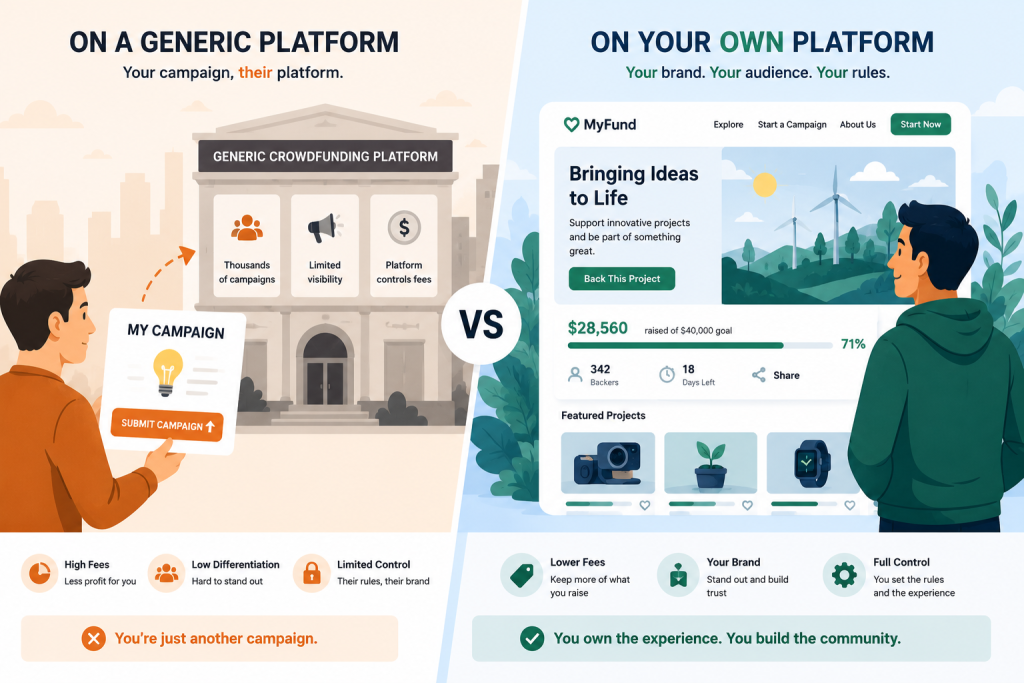
If you want to raise money again without depending on a third-party platform, that’s where owning your own crowdfunding platform starts to make sense. You’ve already built an audience. Running future campaigns through a platform you own means you keep the commission, own the backer data, and don’t pay fees to anyone.
Should you build your own crowdfunding platform?
More people should be asking this question.
If your goal is to fund one project, use an existing platform. The audience is already there. But if you see a niche that existing platforms serve badly, local real estate, halal-compliant investing, school fundraising, industry-specific equipment pre-orders — owning a platform built for that niche is a real business opportunity.
The global crowdfunding market is growing past $300 billion, and most of that value accrues to the platforms, not the campaigners. A platform doing $1 million in monthly campaign volume at a 5% commission earns $50,000 a month. That compounds.
Fundorex makes this accessible. The software handles campaign management, payment processing, commission collection, and backer communication. What you bring is the niche, the audience, and the business model. The open source and self-hosted crowdfunding options for startups is worth reading alongside the Fundorex product page if you’re comparing your options before committing.
Final thoughts
Ten platforms, four funding models, one decision that matters most: are you running a campaign or building a business?
If you’re raising money for a specific project, the platform comes down to your campaign type and audience. Kickstarter for product launches, GoFundMe for personal causes, Republic if you’re selling equity, Patreon if you have a creator audience that’ll pay monthly.
If you’re thinking bigger, the real opportunity in crowdfunding isn’t running campaigns on someone else’s platform. It’s owning the platform. The generalist sites have locked up the broad market. Niche markets, local causes, industry-specific fundraising, regionally underserved audiences, those are wide open for focused platforms that understand their community in a way Kickstarter never will.
Whether you’re raising your first $10,000 or planning a platform that processes millions in campaigns per month, the right crowdfunding platform is the one that fits your actual goal. Get that decision right first. Everything else is execution.
Frequently asked questions
What is a crowdfunding platform?
A crowdfunding platform is a website that lets individuals or organizations raise money from many contributors rather than a single investor or lender. Platforms like Kickstarter and GoFundMe host campaigns for a fee. Software like Fundorex lets you build and own your own crowdfunding platform.
Which crowdfunding platform has the lowest fees?
GoFundMe charges no platform fee for personal campaigns (payment processing still applies). Among rewards-based platforms, Kickstarter and Indiegogo both charge around 5% plus processing. If you want full control over fees and the ability to set your own commission rate, building your own platform with software like Fundorex is the only way to do that.
What is the best crowdfunding platform for startups?
It depends on what you need. For product validation and pre-sales, Kickstarter or Indiegogo. For equity fundraising from retail investors in the US, Republic or StartEngine. For a startup that wants to build and operate its own fundraising vertical, Fundorex.
How much does it cost to build your own crowdfunding platform?
With software like Fundorex, the realistic all-in launch budget including hosting and setup runs $700 to $3,000. Custom development from scratch starts at $80,000. SaaS white-label options charge $200 to $2,000 per month with no code ownership at the end of it.
Do you need a license to run a crowdfunding platform?
For donation and rewards-based crowdfunding, standard business registration is typically sufficient in most jurisdictions. Equity crowdfunding is different. In the US, platforms facilitating equity investments must register with the SEC as a funding portal under Regulation Crowdfunding. This is a compliance requirement that takes significant time and legal investment to fulfill.
Can a crowdfunding campaign replace traditional funding?
For some businesses, yes. Rewards-based crowdfunding lets you validate demand and collect pre-orders before manufacturing at scale — that’s a kind of capital efficiency bank loans and VC rounds can’t replicate. Equity crowdfunding through regulated platforms can supplement angel rounds for consumer brands with strong communities. Neither model works for every business, but both have produced real companies that couldn’t have started any other way.
What happens if a crowdfunding campaign doesn’t reach its goal?
On all-or-nothing platforms like Kickstarter, backers aren’t charged, and you receive nothing. On flexible funding platforms like Indiegogo, you keep whatever was raised, which creates a real problem if you raised far less than you need to actually deliver. Failed crowdfunding campaigns almost always come down to one of two things: not enough pre-launch audience building, or a funding goal that wasn’t grounded in what the campaign actually needed to deliver.