



Your customers are already shopping online, whether or not your business is there to sell to them. Global ecommerce sales now run into the trillions of dollars a year and keep climbing, and buyers increasingly expect to find, compare, and buy from a business on their own schedule. If your business still relies only on a physical store or a social media page, you are leaving sales on the table every day. An ecommerce website is how you capture them.
This guide walks through the 10 clearest reasons why your business needs an ecommerce website in 2026, the signs you are ready for one, and how to get started without overspending.
The short version
- An ecommerce website lets your business sell to anyone, anywhere, around the clock, instead of only during store hours to local walk-ins.
- It is usually cheaper to run than a physical store and scales without the cost of more space or staff.
- It builds credibility, captures customer data, and gives you a sales channel you own rather than renting attention on social media or marketplaces.
- The clearest signs you need one: customers ask if they can buy online, your competitors sell online, or your growth is capped by your location.
- Getting started is affordable, a ready-made ecommerce platform or script launches a real store in days for a few hundred dollars.
Table of Contents
How buying has changed, and why it matters
A decade ago an ecommerce website was a nice extra. Today it is the storefront most customers see first. The number of people buying online has grown every year, and the pandemic permanently shifted habits that have not reverted. Buyers research on their phones, compare options in minutes, and expect to purchase without picking up the phone or driving anywhere.
For a business, that shift cuts both ways. If you sell online, a customer three time zones away can buy from you at midnight. If you do not, that same customer buys from a competitor who does. The data backs this up: the number of global digital buyers has climbed into the billions, according to Statista, and ecommerce keeps taking a larger share of total retail every year. An ecommerce website is simply where the customers are.
10 reasons why your business needs an ecommerce website
Here are the ten reasons that matter most, each with what it actually means for your business.
1. Reach customers beyond your location
A physical store serves whoever walks past it. An ecommerce website serves anyone with an internet connection. The moment you sell online, your market stops being your street or your city and becomes your region, your country, or the world. For many small businesses, this single change is the difference between a few hundred potential customers and a few million. If your buyers span borders, a store with multi-currency support lets them pay in their own currency, which removes a major reason people abandon carts.
- Your market expands from your city to your country or the world overnight.
- Local gateways and multi-currency let overseas buyers actually check out.
2. Sell 24 hours a day, 7 days a week
A shop closes at night and on holidays. An ecommerce website never does. Customers buy when it suits them, which is often outside normal business hours, and every one of those sales happens without you being present.
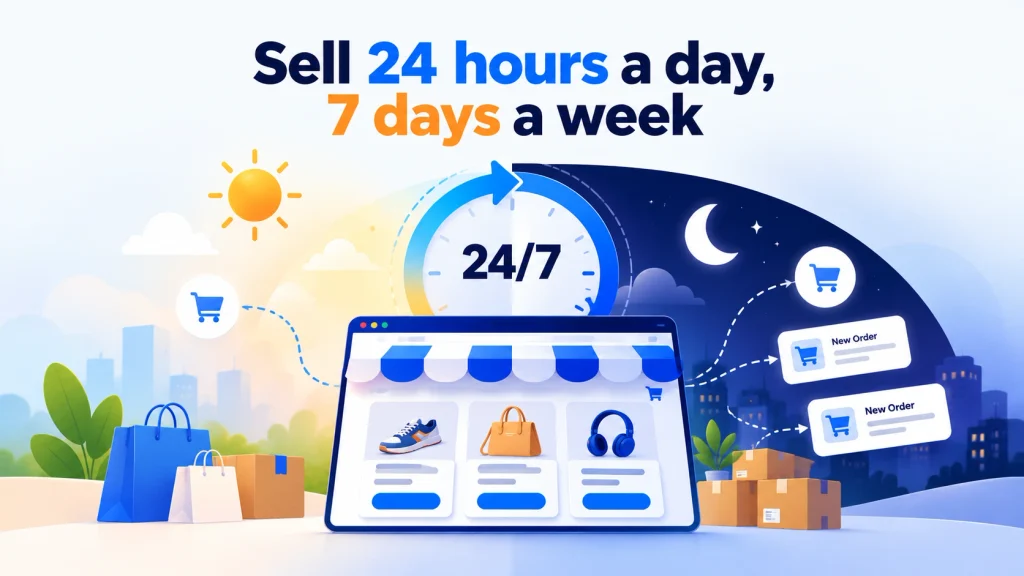
You wake up to orders placed while you slept. For a small team, that is like adding a salesperson who works every hour of every day and never takes a break.
- Customers buy outside business hours, when much online shopping happens.
- Every night and weekend sale lands without you being present.
3. Lower running costs than a physical store
Rent, utilities, and in-store staff make a physical shop expensive to keep open. An ecommerce website runs on hosting that costs a fraction of commercial rent, with no limit on how many customers can browse at once. You can start small, add products without adding shelf space, and reinvest the savings into marketing or stock. Starting is affordable too: a ready-made eCommerce PHP script gives you a complete store for a one-time cost in the low hundreds, far less than fitting out a shop.
- No rent, utilities, or in-store staff, just low-cost hosting.
- Start small and add products without paying for more shelf space.
4. Build your brand and credibility
In 2026, a business without a website looks incomplete to many buyers. An ecommerce website is where customers learn who you are, see your full range, read reviews, and decide whether to trust you with their money. A clean, professional store signals that you are a real, established business, which matters as much for a small brand as for a large one. It turns a business into a brand customers recognize and return to.
- A professional store signals you are a real, established business.
- Customers see your full range, your reviews, and your story in one place.
5. Get found by customers through search
When someone searches for a product you sell, you want to be in the results. An ecommerce website gives you pages that can rank in Google, so customers actively looking to buy find you without you paying for every click. Good product pages, clear descriptions, and the right platform make this far easier. If you are weighing which platform gives you the best balance of SEO and control, our guide to the best platform to build an ecommerce website compares the options.
- Product pages can rank in Google, bringing buyers who are ready to purchase.
- The right platform makes on-page SEO far easier to get right.
6. Sell across social media and marketplaces
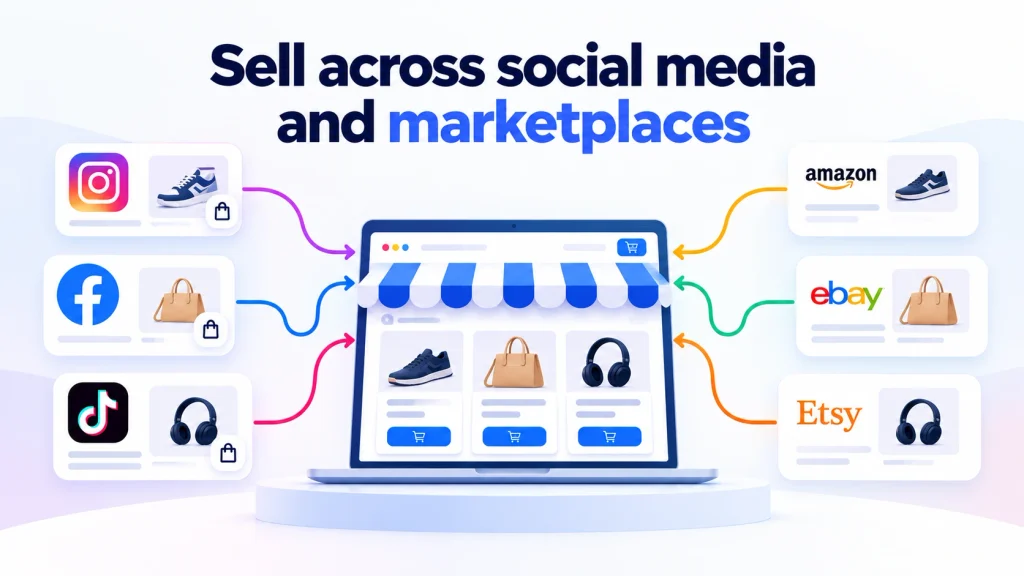
Billions of people use social media, and your ecommerce website is the hub that ties every channel together. You can sell directly through Instagram, Facebook, and TikTok shops, list on marketplaces, and still send everyone back to a store you own. Without a website, social selling scatters your sales across platforms you do not control. With one, every channel feeds a single place where you keep the customer relationship.
- Sell through Instagram, Facebook, TikTok, and marketplaces at once.
- Every channel funnels back to a store you control.
7. Collect customer data and personalize
Every order on your ecommerce website tells you something: what sells, who buys it, and how they found you. That data is gold. You learn which products to stock more of, which to drop, and which customers to bring back with an email or offer. A physical store rarely captures this. An online store captures it automatically, turning each sale into insight you can act on.
- Learn what sells, who buys it, and how they found you, automatically.
- Use the data to restock winners, drop weak products, and win customers back.
8. Scale without the limits of a storefront
A physical shop can only hold so much stock and serve so many people at once. An ecommerce website has no such ceiling. You can add a hundred products overnight, handle a traffic spike during a sale, and sell to a thousand customers at the same time without a bigger building or more staff. As your business grows, the store grows with it, and the right platform scales from your first sale to your millionth.
- Add products and handle traffic spikes without a bigger space or more staff.
- The store grows with you from your first sale onward.
9. Keep up with competitors and customer expectations
Your competitors are almost certainly selling online, and your customers increasingly expect to buy that way. A business without an ecommerce website is not just missing sales, it is signaling that it is behind. Meeting the expectation is table stakes now: customers assume they can check your range and buy online, and when they cannot, they quietly go to someone who lets them.
- Meeting the online-buying expectation is now the baseline, not a bonus.
- A store keeps you level with competitors who already sell online.
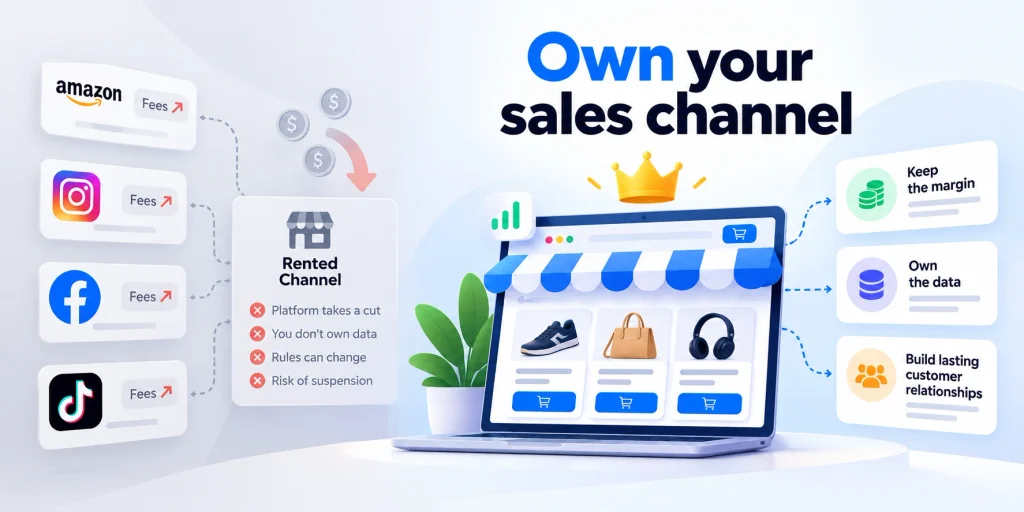
10. Own your sales channel
When you sell only through a marketplace or a social platform, you are renting access to customers on someone else’s terms, and they take a cut and can change the rules overnight. An ecommerce website is a channel you own outright. You keep the margin, the data, and the relationship. That ownership is why serious businesses build their own store rather than depending entirely on platforms that can raise fees or shut them out.
- You keep the margin, the data, and the customer relationship.
- No platform can raise fees or change the rules on a channel you own.
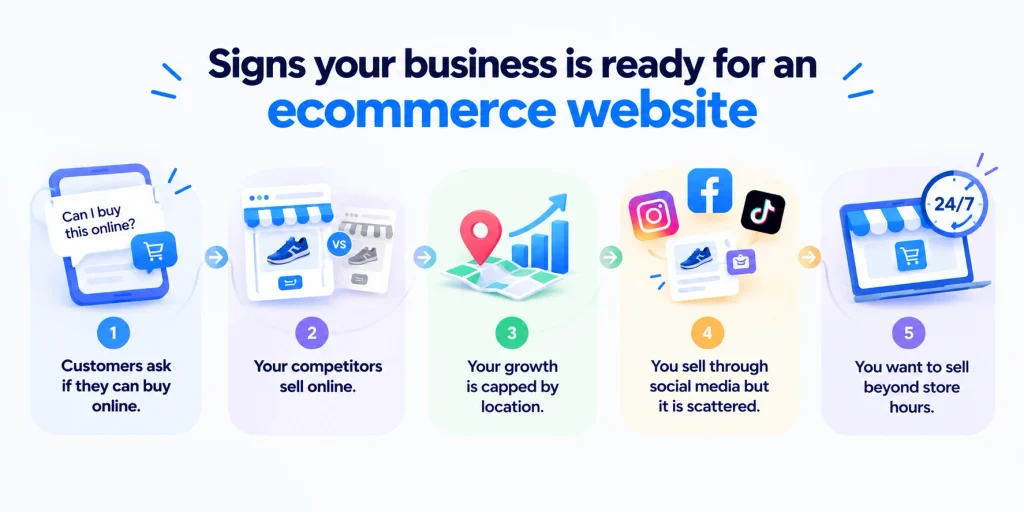
Signs your business is ready for an ecommerce website
Not sure whether now is the time? These signs mean the answer is yes.
- Customers ask if they can buy online. If people are already asking, the demand is proven, you are just not meeting it yet.
- Your competitors sell online. Every day they do and you do not, they take the customers comparing you both.
- Your growth is capped by location. If you have hit the limit of local foot traffic, an ecommerce website is the obvious next market.
- You sell through social media but it is scattered. If orders come in through DMs and comments, a real store will organize and multiply them.
- You want to sell beyond store hours. If you are turning away after-hours interest, a 24/7 store captures it automatically.
If two or more of these describe your business, an ecommerce website is not a someday project, it is overdue.
How to get started with an ecommerce website
The good news is that building an ecommerce website in 2026 is faster and cheaper than most business owners expect. You have three realistic routes.
- A hosted builder (Shopify, Wix). Fastest and simplest, with a store live in hours, but you pay monthly forever and own nothing. Best if you want zero technical involvement. Our guide to the best ecommerce website builders for small business compares these.
- A ready-made self-hosted script. You buy a finished store once, host it yourself, and own the code, with no monthly platform fee. This is the sweet spot for most businesses that want control without a custom build. We compared the leading options in our roundup of the best eCommerce PHP scripts, and if you prefer an open route, our WooCommerce alternatives guide covers the self-hosted field.
- A custom build. A developer or agency builds your store to your exact needs. Maximum flexibility, highest cost. If your requirements are unusual, our custom ecommerce development team can help.
For most small and growing businesses, a ready-made platform is the sensible start: a real store you own, live in days, for the price of a few months of a hosted subscription. You can always grow into something more custom once the model is proven.
What an ecommerce website costs
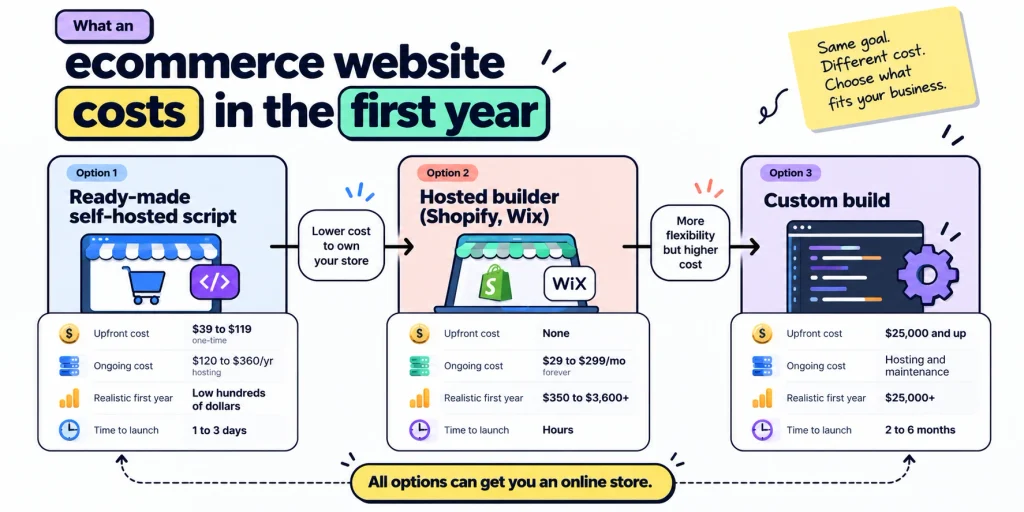
Cost is the first worry for most business owners, and it is lower than you think. Here is what each route really costs across the first year.
| Route | Upfront cost | Ongoing cost | Realistic first year | Time to launch |
|---|---|---|---|---|
| Ready-made self-hosted script | $39 to $119, one-time | Hosting $120 to $360/yr | Low hundreds of dollars | 1 to 3 days |
| Hosted builder (Shopify, Wix) | None | $29 to $299/mo, forever | $350 to $3,600+ | Hours |
| Custom build | $25,000 and up | Hosting and maintenance | $25,000+ | 2 to 6 months |
The pattern is clear. A ready-made script is the cheapest way to own a real store, a hosted builder is fastest but bills you every month forever, and a custom build is the most flexible and the most expensive. Against the cost of a physical storefront, every one of these is modest, and the ready-made route in particular pays for itself quickly once the orders start.
Wrapping up
The question is no longer whether your business needs an ecommerce website, but how soon you can launch one. Your customers already shop online, your competitors already sell there, and the cost of getting started has never been lower.
An ecommerce website gives you global reach, round-the-clock sales, lower running costs, customer data, and a channel you own, all of which compound as your business grows. If you are ready to start, a ready-made platform is the fastest affordable path: compare the options in our eCommerce PHP scripts guide.
Frequently asked questions
1. Why does my business need an ecommerce website?
Because your customers shop online and your competitors sell online. An ecommerce website lets you reach buyers beyond your location, sell around the clock, lower your running costs, and own the customer relationship, all of which a physical store or a social page alone cannot do.
2. Do I really need an ecommerce website if I have a social media page?
Yes. Social media is great for reach, but you do not own it, the rules and fees can change, and sales scatter across platforms. An ecommerce website is a channel you own that ties every social and marketplace sale back to one place where you keep the data and the margin.
3. How much does an ecommerce website cost?
A ready-made self-hosted script costs a one-time $39 to $119 plus hosting, so a realistic first year is in the low hundreds of dollars. Hosted builders charge $29 to $299 a month. A custom build starts in the tens of thousands. Most small businesses should start with a ready-made platform.
4. Is an ecommerce website worth it for a small business?
Usually yes. Even a small store captures after-hours and out-of-area sales you would otherwise lose, builds credibility, and costs far less to run than a physical shop. The return comes from sales you simply could not make without an online store.
5. What is the easiest way to build an ecommerce website?
A hosted builder like Shopify is the easiest and fastest, with a store live in hours, though you pay monthly. A ready-made self-hosted script is nearly as easy to launch and you own it outright, which is why most growing businesses prefer it.
6. How long does it take to launch an ecommerce website?
With a hosted builder, hours. With a ready-made script, a day or two once you have your products and payment details ready. A fully custom build takes weeks to months. For most businesses, a ready-made platform is live within a week.