


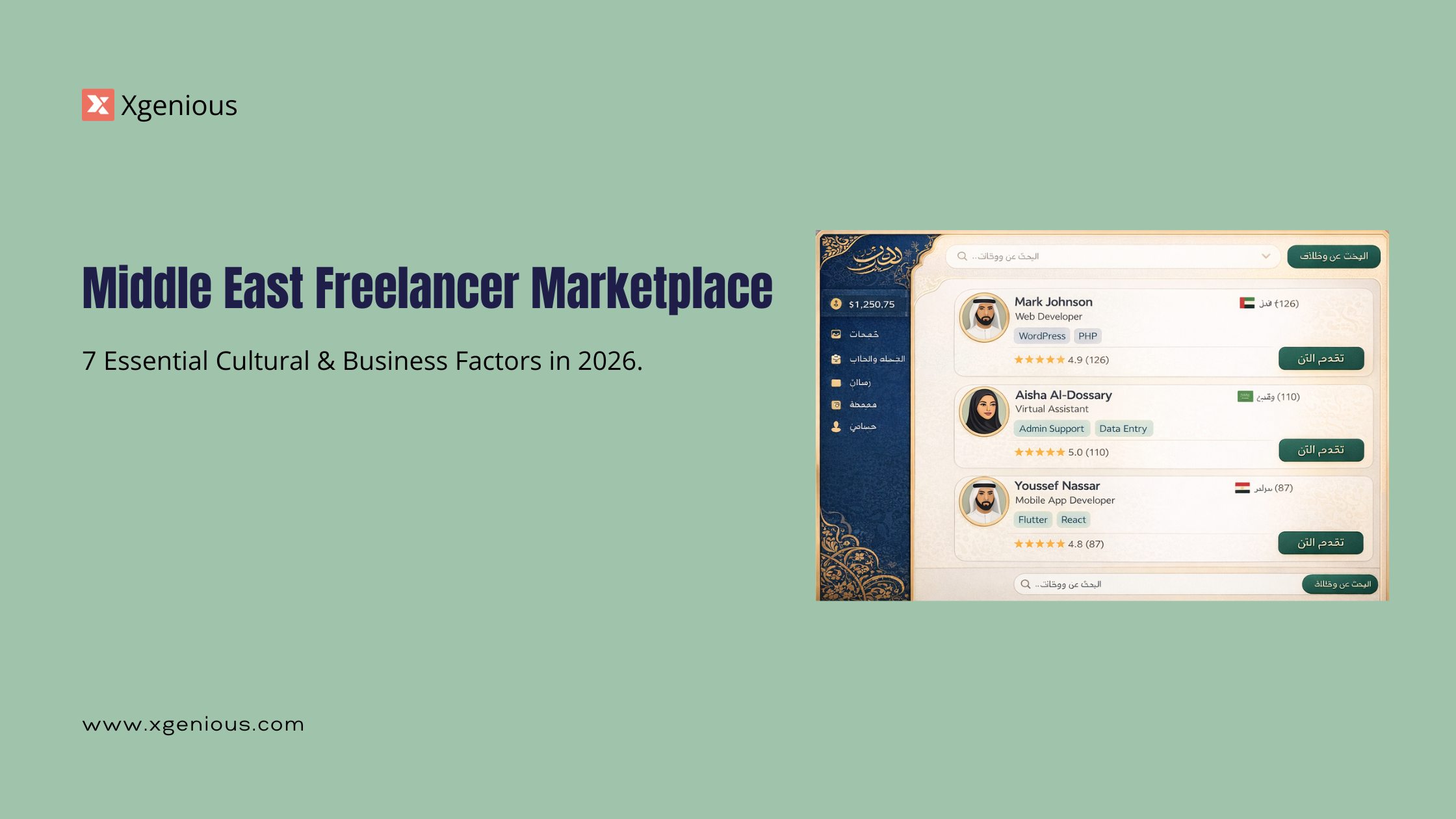

Why the Middle East Freelancer Marketplace Is the World’s Fastest-Growing Opportunity
Why the Middle East Freelancer Marketplace Is the World’s Fastest-Growing OpportunityThe Middle East freelancer marketplace is no longer an emerging opportunity, it is an accelerating one. The MENA gig economy has grown 385% since 2020 and is projected to reach $30 billion by the end of 2025. With a 16.8% compound annual growth rate through 2030, no other regional freelance market on earth is growing faster.
The numbers behind this growth are extraordinary. Over 2.25 million Saudis are now registered on official freelance platforms, contributing approximately SAR 72.5 billion to the Saudi economy. The UAE has established dedicated freelance permit systems through Dubai Economy and Abu Dhabi’s Department of Economic Development. In a survey of over 4,000 MENA professionals, nine out of ten said they are freelancing or plan to do so.
Yet for international platform builders, the Middle East freelancer marketplace remains one of the most misunderstood regions to enter. Most competitor articles on this topic are written for freelancers navigating individual platforms, not for platform operators who need to understand the full cultural, financial, legal, and technical architecture required to build a trusted marketplace in this region.
This guide fills that gap. We cover seven critical factors that no competitor article addresses in depth: regional market dynamics, cultural and religious considerations, Islamic finance compliance, Arabic localisation and RTL design, government initiatives, regional payment methods, and the legal and regulatory framework. Whether you are launching a new Middle East talent marketplace or adapting an existing platform for Gulf markets, every layer is addressed here.
What Makes the Middle East Freelancer Marketplace Unique for Platform Builders?
The Middle East freelancer marketplace operates under a distinct combination of cultural values, religious principles, government initiatives, and technical requirements that differ fundamentally from Western or European markets.
A platform that simply adds Arabic translation to an existing English-language design will fail in this market. The Middle East talent marketplace requires purpose-built architecture, from Sharia-compliant payment systems and RTL interface design to Ramadan-aware scheduling features and government freelance licence integration.
Understanding these seven factors before you build is the difference between market leadership and market rejection.

Chapter 1: Regional Market Dynamics of the Middle East Freelancer Marketplace
The Middle East freelancer marketplace is not a single homogeneous market. It is a collection of distinct country markets, each with its own regulatory environment, cultural priorities, and economic maturity. Understanding the differences between the UAE, Saudi Arabia, and Egypt is essential before selecting your launch strategy.
UAE — The Most Mature Middle East Freelancer Marketplace
The UAE is the most developed Middle East freelancer marketplace environment for platform operators. Several structural advantages make it the preferred entry point:
- Freelance Permit System: The UAE operates dedicated freelance permit programmes through Dubai Economy (AED 1,000–7,500 annually), Abu Dhabi Department of Economic Development, and multiple free zones including Dubai Internet City and twofour54 in Abu Dhabi. Integrating permit verification into your onboarding flow adds a powerful trust signal for enterprise clients.
- English Bilingual Market: The UAE has a large English-speaking expatriate professional community alongside its Arabic-speaking population. Your platform needs to serve both segments equally well from day one.
- 5% VAT Registration: The UAE introduced VAT at 5% in 2018. Platforms facilitating services above the AED 375,000 annual threshold must register for VAT. Build VAT calculation and invoicing into your payment system from launch.
- Strong Digital Infrastructure: The UAE consistently ranks among the world’s top ten countries for internet speed, smartphone penetration, and digital payment adoption — ideal conditions for a marketplace platform.
Saudi Arabia — The Largest Gulf Freelancer Market
Saudi Arabia is the largest single market within the Middle East freelancer marketplace ecosystem. Vision 2030 is driving unprecedented demand for freelance talent across digital, creative, and technical disciplines.
By late 2024, more than 2.25 million Saudis were registered on the official government freelance platform, contributing approximately SAR 72.5 billion to the national economy. The Saudi gig economy is growing at over 18% annually — the highest rate in the Gulf Cooperation Council.
Key platform considerations for Saudi Arabia:
- The work week runs Sunday through Thursday. Friday and Saturday are the weekend. Build this into your availability calendar system.
- Nationalization quotas under Saudization (Nitaqat) affect how enterprise clients engage freelancers. Understanding these quotas helps you market your platform correctly to Saudi enterprise clients.
- Arabic is the primary business language. English is widely understood in tech sectors but Arabic-first is strongly preferred for contracts, support, and official communications.
Egypt — The Largest Arabic Freelancer Talent Pool
Egypt provides the deepest pool of Arabic-speaking freelance talent in the MENA region. Egyptian freelancers dominate platforms like Mostaql and Khamsat, particularly in content writing, translation, graphic design, and software development.
| Country | Market Size | Growth Rate | Key Sectors | Platform Priority |
|---|---|---|---|---|
| UAE | $2.1B | 12% annually | Tech, Finance, Creative | Tier 1 — Launch market |
| Saudi Arabia | $19B contribution | 18% annually | Tech, Marketing, Construction | Tier 1 — Priority growth market |
| Egypt | Large talent pool | 15% annually | Content, Design, Development | Tier 2 — Supply acquisition |
| Kuwait | Growing | 10% annually | Finance, Oil & Gas services | Tier 2 — Enterprise clients |
| Qatar | Emerging | 14% annually | Events, Construction, Media | Tier 2 — Niche opportunities |
Chapter 2: Cultural & Religious Considerations for the Middle East Freelancer Marketplace
Cultural intelligence is not a soft advantage in the Middle East freelancer marketplace; it is a hard technical requirement. Platforms that ignore cultural and religious considerations lose users quickly and permanently. Trust, once broken, is not recoverable in relationship-first markets.
Ramadan Platform Adaptations
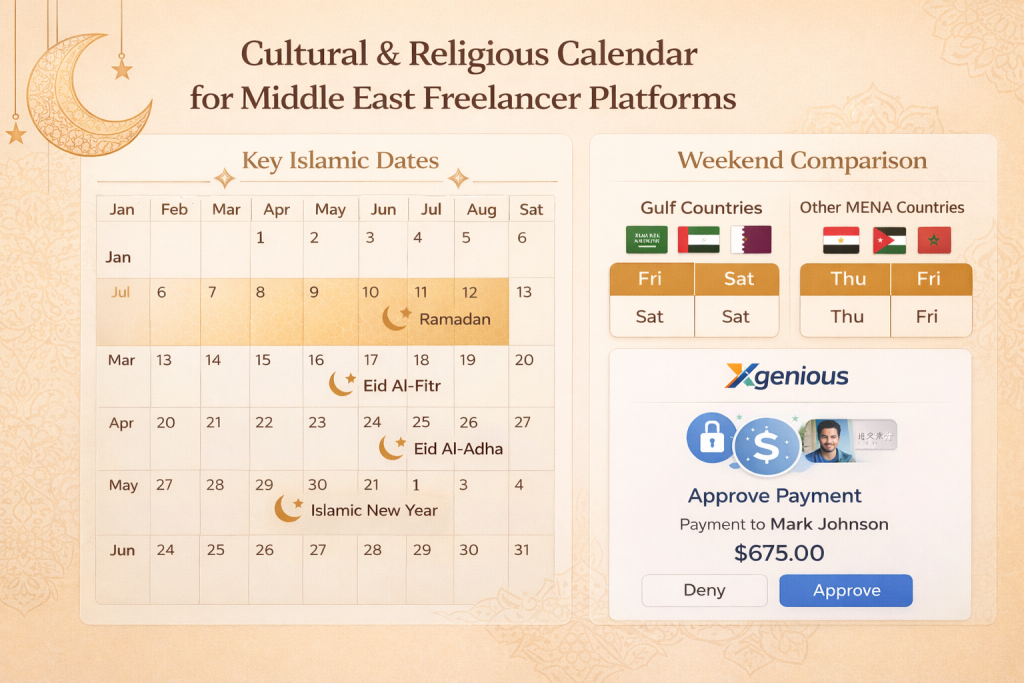
Ramadan requires deliberate platform design adaptations. During Ramadan, working hours shift dramatically — many Gulf professionals work from approximately 10 AM to 3 PM and then again from 9 PM to 1 AM. Project deadlines, notification timing, and payment processing schedules must adapt accordingly.
Build these Ramadan features into your Middle East talent marketplace:
- Ramadan Mode Toggle: Allow freelancers and clients to activate a Ramadan schedule that adjusts deadline estimates, availability windows, and notification timing to reflect fasting hours.
- Delayed Project Timelines: Automatically extend default project completion estimates by 20–30% during Ramadan. A client who expects a 5-day turnaround in January should be informed that the same project takes 7 days in Ramadan.
- Respectful Communication Templates: System-generated messages during Ramadan should include Ramadan greetings (Ramadan Kareem / Ramadan Mubarak) and acknowledge the holy month context appropriately.
- Eid Blackout Periods: Eid Al-Fitr (end of Ramadan) and Eid Al-Adha each generate a 3–7 day period of very low platform activity across the Gulf. Build client expectation management around these dates.
Relationship-First Business Culture
The Middle East business culture is deeply relationship-oriented. Trust is built through personal connection before commercial transactions — a dynamic that differs significantly from transactional Western marketplace culture.
For your Middle East freelancer marketplace, this means:
- Profile Completeness Signals Trust: Freelancers with full profiles including professional photos, detailed about sections, and verified credentials are dramatically more likely to win work than those with minimal profiles. Make profile completion incentivisation a core onboarding feature.
- Communication Response Time: In MENA business culture, slow response time is interpreted as disinterest or disrespect. Build response time tracking and nudges that encourage freelancers to respond to client inquiries within 4 hours during business hours.
- Arabic First, English Second: Even for highly educated Gulf professionals who speak fluent English, receiving platform communications in Arabic first signals respect and cultural alignment. English should be available as a secondary option, never the default.
- Avoid Content That Conflicts With Islamic Values: Do not display content categories, promotional images, or platform features that conflict with Islamic principles. This includes interest-based financial language, immodest imagery, and alcohol or pork-related service categories.
Weekend and Holiday Calendar Integration
| Country | Weekend | Key Holidays | Platform Impact |
|---|---|---|---|
| UAE | Saturday–Sunday | Eid Al-Fitr, Eid Al-Adha, UAE National Day | Adjust deadline calculations |
| Saudi Arabia | Friday–Saturday | Eid Al-Fitr, Eid Al-Adha, Saudi National Day | Adjust availability calendars |
| Egypt | Friday–Saturday | Eid Al-Fitr, Eid Al-Adha, Coptic Christmas | Different for Christian Egyptian freelancers |
| Kuwait | Friday–Saturday | Eid, National Day, Liberation Day | Adjust notification scheduling |
| Qatar | Friday–Saturday | Eid, Qatar National Day | Adjust platform scheduling |
Chapter 3: Islamic Finance Compliance for the Middle East Freelancer Marketplace
Islamic finance compliance is one of the most technically demanding and most commonly ignored requirements in Middle East freelancer marketplace development. A platform that charges late payment interest, structures escrow as an interest-bearing account, or uses conventional credit products will face rejection from religiously observant users across the Gulf market.
Core Islamic Finance Principles for Platform Operators
Islamic finance is governed by Sharia law, which prohibits several common financial practices:
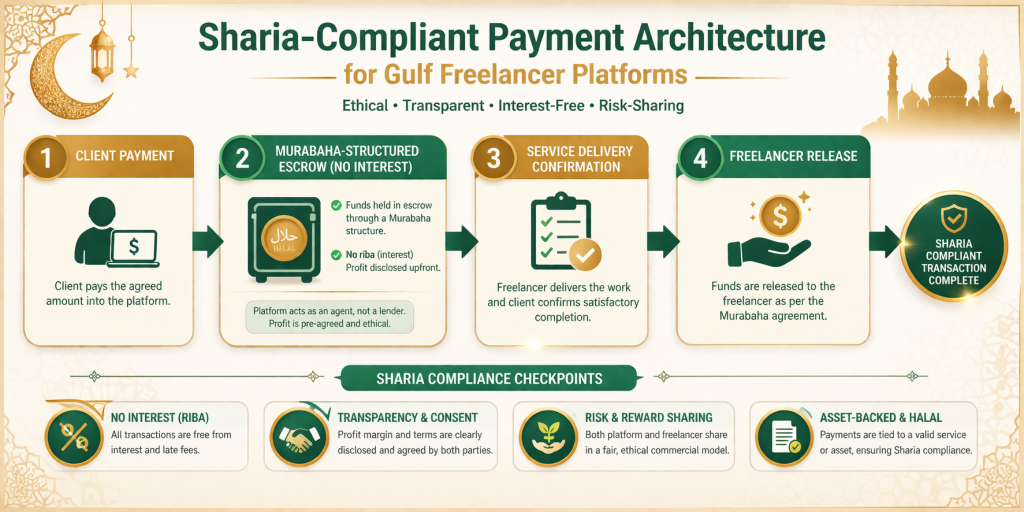
- Riba (Interest): Any form of interest or usury is prohibited. This includes late payment fees structured as percentage-of-outstanding-balance interest, interest-bearing escrow accounts, and credit products with interest charges.
- Gharar (Excessive Uncertainty): Contracts with excessive ambiguity or uncertainty are prohibited. Every project agreement on your platform must have clearly defined scope, deliverables, and payment terms.
- Maysir (Gambling): Speculative transactions are prohibited. This affects how you structure certain dynamic pricing features and auction-style project bidding.
- Haram Industries: Facilitating freelance services for industries prohibited under Sharia — alcohol, pork, conventional interest-based banking, adult entertainment — is itself problematic for a platform operating in Gulf markets.
Sharia-Compliant Payment Architecture
| Conventional Feature | Islamic Alternative | Implementation Method |
|---|---|---|
| Interest-bearing escrow | Wadiah (safe custody) account | Partner with an Islamic bank for escrow custody |
| Late payment interest fee | Fixed administrative fee (not percentage-based) | Flat penalty donated to charity (Ta’zir principle) |
| Credit line for clients | Murabaha (cost-plus financing) | Structure as product purchase, not loan |
| Conventional insurance | Takaful (mutual insurance) | Partner with Takaful providers for platform insurance |
| Interest on platform reserves | Profit-sharing investment | Structure platform cash reserves in Islamic investment accounts |
Practical Implementation Steps
Working with an Islamic bank for your escrow infrastructure is the most straightforward path. In the UAE, Emirates Islamic Bank, Abu Dhabi Islamic Bank (ADIB), and Dubai Islamic Bank all offer business banking products designed for digital platform operators. In Saudi Arabia, Al Rajhi Bank and Bank AlJazira are the primary Islamic banking partners for fintech platforms.
For your platform’s terms of service, engage a Sharia scholar to review payment terms, late fees, and cancellation policies before launch. A Sharia compliance certification — visible on your platform and in marketing materials — is a powerful trust signal for Gulf enterprise clients.
For the foundational payment infrastructure that Islamic finance compliance builds upon, see our guide on escrow payment systems for freelancer platforms.
Chapter 4: Language & Localisation for the Middle East Freelancer Marketplace
Arabic localisation is where the majority of international platforms entering the Middle East freelancer marketplace make their most costly mistakes. Arabic is not simply a language to translate into — it requires a fundamentally different interface architecture.
Right-to-Left (RTL) Technical Implementation
Arabic reads right-to-left. This is not a simple text direction change — it requires mirroring the entire interface layout, navigation structure, and visual hierarchy.
- CSS Logical Properties: Use
margin-inline-startinstead ofmargin-left,padding-inline-endinstead ofpadding-right, andtext-align: startinstead oftext-align: left. This allows your CSS to adapt automatically to both LTR and RTL contexts. - Flexbox and Grid Direction: Set
direction: rtlat the HTML root level when serving Arabic content, or use thedir="rtl"attribute on the HTML element. Flexbox and Grid layouts automatically mirror when direction is set correctly. - Icon Mirroring: Directional icons — arrows, progress indicators, navigation chevrons — must be mirrored for RTL. A “next” arrow pointing right in English must point left in Arabic. Non-directional icons (hearts, stars, user avatars) should not be mirrored.
- Number Formatting: Arabic uses both Western Arabic numerals (1, 2, 3) and Eastern Arabic numerals (١, ٢, ٣). Gulf professional platforms typically use Western numerals in digital interfaces, but your font must support Eastern Arabic numerals for users who prefer them.
- Date Formatting: The Hijri (Islamic) calendar runs alongside the Gregorian calendar. Offer both formats for date display, particularly for contract dates, payment schedules, and deadline management.
Arabic Content Strategy
Machine translation produces Arabic that reads as technically correct but culturally tone-deaf. Professional human translation by native Arabic speakers is required for all customer-facing content, including:
- Platform UI text and button labels
- Email and notification templates
- Contract and terms of service documents
- Help centre and FAQ content
- Marketing and onboarding copy
Gulf Arabic (spoken in the UAE, Saudi Arabia, Kuwait, Qatar, and Bahrain) differs from Egyptian Arabic and Levantine Arabic. Modern Standard Arabic (Fusha) is the safe universal choice for written platform content, it is understood by all Arabic speakers and appropriate for professional business contexts.
Multilingual Support Architecture
| Language | Countries | Priority | Users Served |
|---|---|---|---|
| Arabic (Modern Standard) | All 22 Arab League countries | Must-have | Primary Gulf & MENA users |
| English | UAE, Qatar, Bahrain | Must-have | Expatriate professionals, international clients |
| Urdu | UAE, Saudi Arabia (South Asian diaspora) | High value | Large South Asian freelancer population |
| Hindi | UAE, Qatar, Bahrain | High value | Indian expatriate community |
| French | Morocco, Tunisia, Algeria | Growth market | North African French-speaking markets |
For a parallel analysis of multilingual requirements in European markets, see our guide on European freelancer marketplace EU regulations and compliance.
Chapter 5: Government Initiatives & Their Impact on the Middle East Freelancer Marketplace
Government-driven economic diversification programmes are the most powerful tailwind available to the Middle East freelancer marketplace. Platforms that align with these initiatives gain access to government partnerships, subsidised user acquisition, and regulatory fast-tracking that is not available to those who operate independently.
Saudi Vision 2030 — The Largest Opportunity in MENA
Saudi Vision 2030 is the most significant government programme affecting the Middle East freelancer marketplace. Launched in 2016 under Crown Prince Mohammed bin Salman, Vision 2030 aims to reduce Saudi Arabia’s dependence on oil revenue by developing a diversified knowledge economy.
For platform operators, Vision 2030 creates several specific opportunities:
- Official Freelance Platform Partnership: The Saudi Ministry of Human Resources operates an official freelance platform. International platforms that register as approved service providers gain direct access to the 2.25 million registered Saudi freelancers.
- Haras Programme: Saudi Arabia’s freelancer support programme provides subsidised training, marketing support, and client introductions to registered freelancers. Platforms that integrate with Haras gain a ready supply of verified, government-endorsed freelancers.
- Giga-Projects Talent Demand: Vision 2030 mega-projects — NEOM, The Red Sea Project, Diriyah Gate — create massive demand for specialised freelance talent in architecture, engineering, digital marketing, content creation, and technology. A platform serving this demand is positioned at the highest-value tier of the Saudi market.
UAE Digital Economy Strategy
The UAE’s Digital Economy Strategy targets doubling the digital economy’s contribution to GDP from 9.7% to 19.4% over the next decade. This creates direct demand for digital freelance talent across government and enterprise projects.
Key UAE initiatives relevant to the Middle East freelancer marketplace:
- Dubai 2040 Urban Master Plan — Creates sustained demand for urban planning, architecture, and digital design freelancers.
- Dubai Internet City and Abu Dhabi Hub71 — Technology ecosystems that provide a ready client base of startups and scale-ups actively seeking freelance talent.
- Freelance Visa Programme — The UAE offers dedicated freelance and remote work visas that your platform can promote and help facilitate through documentation support.
Chapter 6: Payment Methods & Preferences in the Middle East Freelancer Marketplace
The Middle East freelancer marketplace has distinct payment preferences that differ significantly from European and American markets. Building the wrong payment stack will create friction at the most critical conversion point in your user journey.
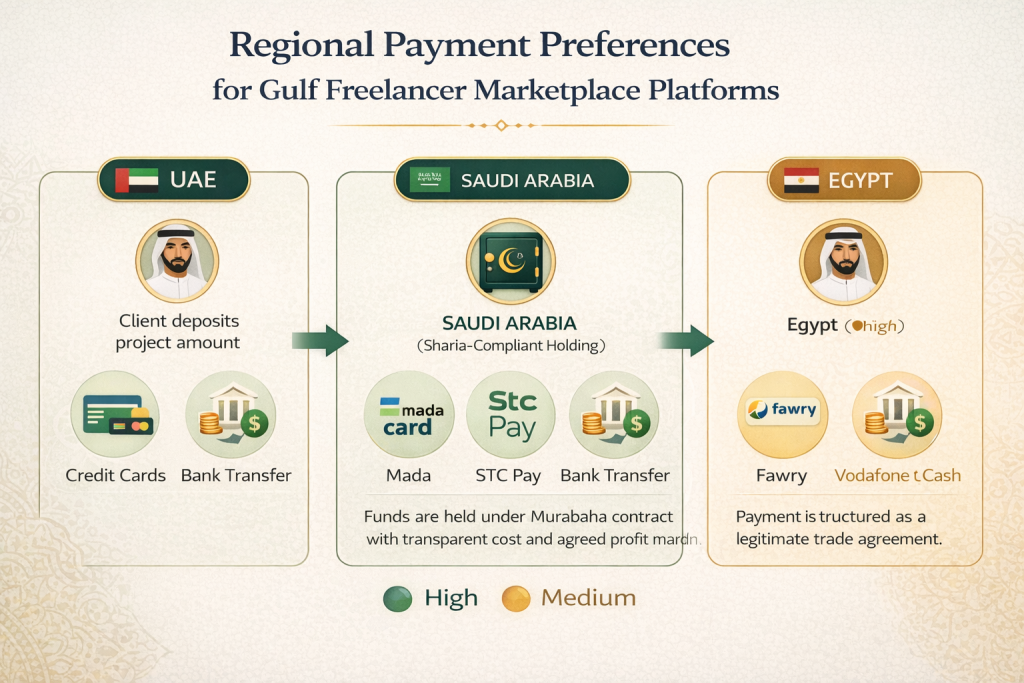
Gulf Payment Method Priorities
| Payment Method | UAE | Saudi Arabia | Egypt | Implementation Priority |
|---|---|---|---|---|
| Visa / Mastercard | Very high | High | Medium | Essential — Day 1 |
| Apple Pay / Google Pay | Very high | High | Low | Essential — Day 1 |
| Bank Transfer (SWIFT) | High | High | Medium | Essential — Day 1 |
| STC Pay | N/A | Very high | N/A | Must-have for Saudi launch |
| Mada (Saudi debit) | N/A | Very high | N/A | Must-have for Saudi launch |
| Fawry | N/A | N/A | Very high | Must-have for Egypt launch |
| Vodafone Cash | N/A | N/A | High | High value for Egypt |
| PayPal | Medium | Low | Medium | Useful for international clients |
| Cryptocurrency | Growing | Regulated | Growing | Optional — compliance dependent |
Currency Considerations
The UAE Dirham (AED), Saudi Riyal (SAR), and Egyptian Pound (EGP) are the three primary currencies for the Middle East freelancer marketplace. The AED and SAR are both pegged to the US Dollar, which simplifies cross-border currency management within the GCC.
Display project values in local currency by default. A Saudi freelancer should see project budgets in SAR, an Egyptian freelancer in EGP. Currency conversion should happen automatically based on user’s location, with the exchange rate displayed transparently at the time of the transaction.
For the complete payment infrastructure implementation guide, see our freelancer hiring marketplace development checklist.
Chapter 7: Legal & Regulatory Framework for the Middle East Freelancer Marketplace
The legal framework for the Middle East freelancer marketplace is rapidly evolving. Both the UAE and Saudi Arabia have moved from having minimal freelancer-specific regulation to building comprehensive legal frameworks within the last five years.
UAE Freelancer Regulations
The UAE operates a permit-based freelance system rather than a classification-based approach. Key requirements:
- Freelance Permit Requirement: Freelancers operating legally in the UAE must hold a valid freelance permit or trade licence. Your platform should verify permit status during onboarding and display a “UAE Licensed” badge on verified profiles.
- 5% VAT: UAE VAT applies to platform service fees above the AED 375,000 annual registration threshold. Register early — the registration process takes 2–4 weeks and penalties for late registration apply from the threshold date.
- Free Zone vs Mainland: Platforms incorporated in UAE free zones (DIFC, ADGM, Dubai Internet City) operate under different regulatory frameworks than mainland UAE companies. Free zone companies can provide services internationally without restriction but may need a separate mainland licence to serve UAE-resident clients directly.
Saudi Arabia Freelancer Regulations
Saudi Arabia’s freelancer regulatory framework is tied directly to Vision 2030 economic diversification goals:
- Freelance Work Permit (Tasaheel): Saudi nationals freelancing through official channels register through the Tasaheel system under the Ministry of Human Resources. Platform integration with Tasaheel verification adds significant trust value for enterprise clients.
- Saudization (Nitaqat) Compliance: Enterprise clients using your platform to supplement their workforce must ensure their Nitaqat ratios remain compliant. Position your platform as a Nitaqat-compliant hiring channel to attract enterprise clients specifically.
- No Personal Income Tax: Saudi Arabia does not levy personal income tax on individuals. Freelancers are responsible for Zakat (obligatory Islamic charity) on business assets above the nisab threshold — typically calculated at 2.5% of qualifying assets annually.
Tax Implications by Country
| Country | Income Tax | VAT | Platform Obligation |
|---|---|---|---|
| UAE | None | 5% | VAT registration above AED 375,000 threshold |
| Saudi Arabia | None (personal) | 15% | VAT collection on platform fees |
| Egypt | Progressive 0–25% | 14% | Withholding tax reporting for Egyptian users |
| Kuwait | None | None | No tax obligations currently |
| Qatar | None | None planned | Monitor for future VAT introduction |
Conclusion: Building a Winning Middle East Freelancer Marketplace Strategy
The Middle East freelancer marketplace represents the most significant untapped opportunity in global platform development. The MENA gig economy is growing faster than any other region. Government investment through Vision 2030 and the UAE Digital Economy Strategy is creating demand that outpaces supply. And the competitive landscape remains less crowded than Western markets.
But the platforms that win here are not those that simply translate their existing product into Arabic. The winners are those who build cultural intelligence, Islamic finance compliance, RTL architecture, and regional payment systems as core platform capabilities, not afterthoughts.
The seven factors covered in this guide, regional market dynamics, cultural and religious considerations, Islamic finance, language and localisation, government initiatives, payment preferences, and regulatory framework, are interdependent. A Sharia-compliant payment system that displays interest calculations is self-defeating. An Arabic-translated platform with a left-to-right layout alienates the users it is trying to serve. Build these layers in coordination from day one.
The platforms that establish trust in this market first will compound that trust into category leadership for decades. The Middle East talent marketplace rewards depth of commitment, not surface-level adaptation.
For a complete comparison with other regional regulatory frameworks, see our guides on American freelancer marketplace state regulations and European freelancer marketplace EU regulations.
Frequently Asked Questions: Middle East Freelancer Marketplace
Q1: What makes the Middle East freelancer marketplace different from Western markets?
The Middle East freelancer marketplace operates under a unique combination of factors that require purpose-built platform architecture rather than simple localisation of existing products. These include: Islamic finance principles that prohibit interest and excessive uncertainty, which affect how escrow and payment systems must be structured; Arabic RTL interface requirements that mirror the entire UI layout; the Friday-Saturday weekend in Gulf countries and Ramadan work schedule shifts that affect availability calendars and deadline calculations; government freelance permit systems in UAE and Saudi Arabia that require onboarding integration; and a relationship-first business culture that prioritises personal trust before commercial transactions. Platforms that understand and build for these differences from day one consistently outperform those that treat the region as a straightforward localisation exercise.
Q2: Is Islamic finance compliance mandatory for a Middle East freelancer marketplace?
Islamic finance compliance is not legally mandatory in most Gulf states for digital platforms — but it is commercially critical. The majority of Gulf professionals and enterprise clients are practising Muslims for whom interest-based financial products are a genuine barrier to adoption. A platform that structures escrow accounts as interest-bearing deposits, charges percentage-based late payment interest, or uses conventional insurance products will face consistent rejection from religiously observant users. Building Sharia-compliant financial architecture — Wadiah-based escrow, flat administrative fees instead of interest penalties, Takaful insurance partnerships — is a competitive advantage that directly impacts user acquisition and retention in this market.
Q3: How should a Middle East freelancer marketplace handle the Ramadan work period?
During Ramadan, build a Ramadan Mode feature that allows freelancers and clients to activate adjusted scheduling. Key adaptations include extending default project timelines by 20–30% to account for reduced working hours, shifting notification timing to align with post-iftar active periods (typically 9 PM to 1 AM in Gulf countries), including Ramadan greetings in all system communications, and displaying a platform-wide notice acknowledging that response times may be extended during the holy month. The most important commercial adaptation is expectation management — clients who do not account for Ramadan in their project timelines generate disputes and negative reviews. Build Ramadan into your project timeline calculator and communicate it proactively.
Q4: What Arabic localization is required for a Gulf freelancer marketplace?
Full Arabic localization for a Gulf Middle East freelancer marketplace requires: complete RTL interface implementation using CSS logical properties and HTML direction attributes; professionally human-translated content by native Gulf Arabic speakers for all UI text, contracts, emails, and help content (machine translation is not sufficient for business contexts); Modern Standard Arabic (Fusha) as the default written language for contracts and official communications; support for both Western and Eastern Arabic numerals; dual Gregorian and Hijri calendar display for date fields; and Arabic-specific SEO optimisation including Arabic keyword research and Arabic URL structures. Budget for ongoing Arabic translation maintenance as your platform evolves — a one-time translation project that is not kept current will become inconsistent and erode user trust.
Q5: Which country should I launch my Middle East freelancer marketplace in first?
The UAE is the recommended first market for the Middle East freelancer marketplace due to its combination of regulatory clarity, English-bilingual professional community, strong digital infrastructure, and established freelance permit system. It has the most mature freelance ecosystem in the Gulf and the highest concentration of international enterprise clients seeking regional talent. Once your platform is established in the UAE, expand to Saudi Arabia as your second priority — the market is significantly larger but requires deeper Arabic language support and Vision 2030 integration. Egypt is the ideal third market for supply-side expansion — it has the largest Arabic-speaking freelance talent pool in the region, particularly in content, design, and development.
Q6: What payment methods are essential for a Gulf freelancer marketplace?
At minimum, your Middle East freelancer marketplace must support Visa and Mastercard credit and debit cards, Apple Pay and Google Pay for mobile payments, and international bank transfer (SWIFT) for large project payments. For the Saudi market specifically, Mada (Saudi national debit card network) and STC Pay (Saudi Telecom’s digital wallet) are essential — without these, you will fail to convert a significant proportion of Saudi users at the payment step. For Egypt, Fawry (cash payment network) and Vodafone Cash are high-priority additions. PayPal remains important for international client payments but has lower adoption in Gulf-to-Gulf transactions. Avoid cryptocurrency as a primary payment method due to evolving regulatory uncertainty across MENA jurisdictions.
Q7: How does Saudi Vision 2030 create opportunities for freelancer platform operators?
Saudi Vision 2030 creates direct commercial opportunities for Middle East freelancer marketplace operators in three ways. First, it has generated government programmes that provide subsidised onboarding for Saudi freelancers — integrating with Tasaheel and Haras gives platforms access to over 2.25 million registered freelancers at dramatically lower acquisition cost than organic marketing. Second, the Giga-Projects programme (NEOM, Red Sea Project, Diriyah) creates massive demand for specialised freelance talent that outpaces local supply — platforms that can match Saudi enterprise clients with quality regional and international talent at scale are solving a critical business problem for Vision 2030 project managers. Third, Vision 2030’s objective to raise the contribution of small businesses to GDP creates a large and growing SME client segment that actively needs affordable freelance talent to compete.
Q8: What are the tax implications of operating a freelancer marketplace in the UAE and Saudi Arabia?
The UAE applies 5% VAT to platform service fees above the AED 375,000 annual registration threshold. Register proactively — the registration process takes 2–4 weeks and late registration penalties are strict. Saudi Arabia applies 15% VAT to platform fees, making it one of the higher VAT jurisdictions in the GCC. Neither country levies personal income tax on individuals, which is a significant advantage for freelancer recruitment marketing — many international freelancers are attracted to Gulf markets specifically because of the zero-income-tax environment. Egypt applies a progressive income tax of 0–25% and 14% VAT. Build tax calculation and transparent invoicing into your payment system for all three jurisdictions before accepting your first paying user.