





Why European Freelancer Marketplace EU Regulations Are the Most Complex in the World
European freelancer marketplace EU regulations represent the most comprehensive and rapidly evolving compliance challenge any platform builder will face. While the US gig economy operates under a patchwork of state laws, the EU has systematically built an overlapping framework of supranational regulations that apply simultaneously and the pace of new legislation is accelerating.
The European gig economy is significant in scale. Over 28 million people currently work through digital labour platforms across the 27 EU member states. That figure is projected to reach 43 million by 2025. The economic opportunity is enormous but so is the regulatory complexity that comes with accessing it.
Since 2022, the EU has enacted or enforced the Digital Services Act, the Platform Work Directive, DAC7 tax reporting requirements, PSD2 strong customer authentication rules, and GDPR enforcement, which has intensified significantly. Each of these regulations carries direct obligations for platform operators, not just for the freelancers and clients using the platform.
Most competitor articles on the European freelancer marketplace EU regulations are written for individual freelancers navigating their own tax obligations. What platform builders need is something entirely different, a structured compliance architecture guide that addresses every regulatory layer from the platform operator’s perspective.
This guide provides exactly that. It covers 8 critical compliance areas, identifies what competitors leave out, and gives you the implementation framework to build a legally sound European talent platform from day one.

What Are European Freelancer Marketplace EU Regulations and Why Do They Matter?
European freelancer marketplace EU regulations are the set of overlapping EU-level and national laws that govern how digital labour platforms operate within, or serve users in, European Union member states. They apply regardless of where your platform is incorporated.
A platform headquartered in the US, UK, or Singapore that serves freelancers or clients in France, Germany, or Poland is fully subject to European freelancer marketplace EU regulations for every transaction involving EU-resident users. This extraterritorial reach is one of the most commonly misunderstood aspects of EU platform law.
Getting this right from the start is not optional. GDPR fines alone can reach €20 million or 4% of global annual turnover — whichever is higher. DSA non-compliance carries penalties of up to 6% of global revenue. Worker misclassification under the Platform Work Directive can result in retroactive reclassification of your entire freelancer base as employees.
Chapter 1: EU Regulatory Framework — Digital Services Act and Platform Work Directive
The foundation of all European freelancer marketplace EU regulations rests on two landmark pieces of legislation that came into force between 2022 and 2024.
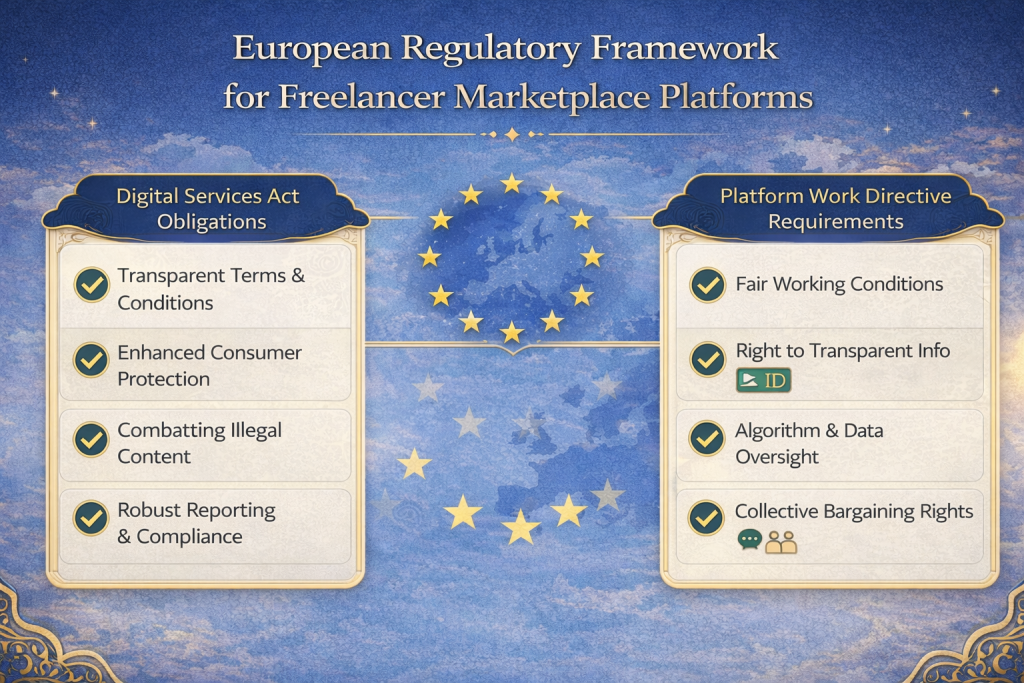
Digital Services Act (DSA) — Platform Operator Obligations
The Digital Services Act became fully applicable across all EU member states in February 2024. For European talent platform operators, the DSA creates a tiered compliance framework based on platform size and impact.
Every freelancer marketplace — regardless of size — must meet baseline DSA obligations as an online intermediary service:
- Trader Verification: If your platform allows freelancers to offer services commercially, you must implement Know Your Business Customer (KYBC) procedures. Collect and verify legal name, address, tax registration number, and bank account details before a freelancer can transact.
- Illegal Content Reporting: Implement a notice-and-action mechanism allowing users to report illegal content or services. You must respond to notices within defined timeframes or face liability for the illegal content.
- Transparency Reporting: Publish an annual transparency report covering content moderation actions, notices received, and algorithmic decision-making disclosures.
- Terms of Service Clarity: All terms, policies, and contractual documents must be written in plain language, available in the official languages of every EU member state where you operate.
Platforms with over 45 million monthly active EU users become Very Large Online Platforms (VLOPs) with significantly stricter obligations, including independent auditing, algorithmic risk assessments, and direct European Commission oversight.
Platform Work Directive (EU 2024/2831), The Employment Presumption
The Platform Work Directive is the most commercially significant development in European freelancer marketplace EU regulations in a decade. Member states have until December 2, 2026, to implement it into national law — but platform operators must begin preparing now.
The Directive introduces a rebuttable presumption of employment. If your platform exhibits certain characteristics of control or direction over workers, the law presumes those workers are employees — not independent contractors. The burden of proof falls on the platform to demonstrate otherwise.
Employment Presumption Triggers — Your Platform Must Avoid:
| Control Factor | Platform Action Required |
|---|---|
| Determining or capping remuneration | Allow freelancers to set all rates independently |
| Supervising performance electronically | Limit monitoring to deliverable quality only |
| Restricting freedom to organise work | Never dictate hours, schedule, or work method |
| Preventing work for competitors | Remove any exclusivity clauses immediately |
| Restricting building a client base | Permit and encourage off-platform client relationships |
For a comprehensive comparison with US worker classification requirements, see our guide on American freelancer marketplace state regulations and tax compliance.
Chapter 2: GDPR Implementation for European Freelancer Marketplace EU Regulations
GDPR is the most mature layer of European freelancer marketplace EU regulations — and still the most frequently violated by platform operators entering the EU market.
GDPR Obligations Specific to Freelancer Marketplace Platforms
A European talent platform collects and processes significant volumes of personal data: freelancer identity documents, bank account details, work history, client communications, performance scores, and algorithmic matching data. Each of these data categories carries specific GDPR obligations.
Lawful Basis for Processing — Platform Data Map:
| Data Category | Recommended Lawful Basis | Retention Limit |
|---|---|---|
| Freelancer identity verification | Legal obligation | Duration of account + 5 years |
| Bank account and payment data | Contract performance | Duration of account + 7 years (tax records) |
| Portfolio and work samples | Contract performance | Duration of account |
| Performance scores and ratings | Legitimate interests | Duration of account + 2 years |
| Algorithmic matching data | Legitimate interests | 90 days rolling |
| Marketing communications | Consent | Until withdrawn |
| Platform usage analytics | Legitimate interests | 12 months rolling |
GDPR Implementation Checklist for EU Freelancer Platforms
- Privacy Policy by Language: Your privacy notice must be available in the official language of every EU country where you have registered users. A single English-language privacy policy does not satisfy GDPR requirements for non-English-speaking EU member states.
- Data Subject Rights Portal: Build a self-service portal for access, rectification, erasure, portability, and objection requests. You have 30 days to respond to all requests — reduced to immediately for erasure requests where no retention obligation applies.
- Data Processing Agreements: Every third-party service integrated with your platform — payment processors, cloud providers, analytics tools, email services, AI matching engines — must have a signed Data Processing Agreement (DPA) compliant with GDPR Article 28.
- Data Protection Officer (DPO): If your platform processes personal data at scale as a core activity — which all freelancer marketplaces do — you are likely required to appoint a DPO. This person must be independent, expert in data protection law, and accessible to supervisory authorities.
- Cross-Border Data Transfers: If your platform infrastructure involves data transfers outside the EU (US cloud servers, Asian payment processors), you must implement Standard Contractual Clauses (SCCs) or another approved transfer mechanism for each transfer.
For GDPR implementation guidance integrated with your broader platform architecture, see our complete guide on freelancer hiring marketplace development.
Chapter 3: Worker Classification Under European Freelancer Marketplace EU Regulations
Worker classification is the highest-stakes legal risk within European freelancer marketplace EU regulations. Getting it wrong does not just create a compliance problem — it retroactively reclassifies every contractor on your platform as an employee, with full social security, pension, holiday pay, and sick leave obligations applied retroactively.
Country-Specific Classification Tests
The EU Platform Work Directive sets a harmonised framework, but individual member states have their own classification tests that apply in parallel. Platform operators must satisfy both simultaneously.
| Country | Classification Test | Strictest Factor | Misclassification Penalty |
|---|---|---|---|
| Germany | Scheinselbstständigkeit test | Economic dependence on single platform | Back taxes + social contributions + criminal liability |
| Spain | TRADE status assessment | Regular, direct, and predominantly personal service | Employee reclassification + fines up to €187,500 |
| France | Présomption de salariat | Platform sets pricing and access conditions | Automatic employment status + social charges |
| Netherlands | DBA Act (WDBA) | Substitution right and working within organisation | Fines + employment reclassification |
| Italy | Riders Decree | Predominantly personal, continuous service | Employee status + collective agreement application |
| UK (post-Brexit) | Worker status test | Personal service + mutuality of obligation | Worker rights entitlement + tax underpayment |
Safe Harbour Architecture for European Talent Platforms
The following structural features significantly reduce reclassification risk across all EU member state tests:
- Multi-Platform Permission: Explicitly permit and actively encourage freelancers to work on competing platforms. Document this permission in your terms of service and communicate it at onboarding.
- Rate Autonomy: Never set, suggest, or algorithmically nudge freelancers toward specific price points. Allow complete rate autonomy and document this in your platform policies.
- Deliverable Standards Only: Define quality standards for outputs — never for work methods, schedules, locations, or tools. The platform specifies what, never how or when.
- Algorithmic Transparency: Under the Platform Work Directive, you must inform workers about all algorithmic systems that affect their access to work, earnings, or account standing. Build this disclosure into your onboarding flow.
Chapter 4: Tax Compliance Framework for European Freelancer Marketplace EU Regulations
Tax compliance is where European freelancer marketplace EU regulations create the most operationally complex obligations for platform operators. Three parallel tax frameworks apply simultaneously.
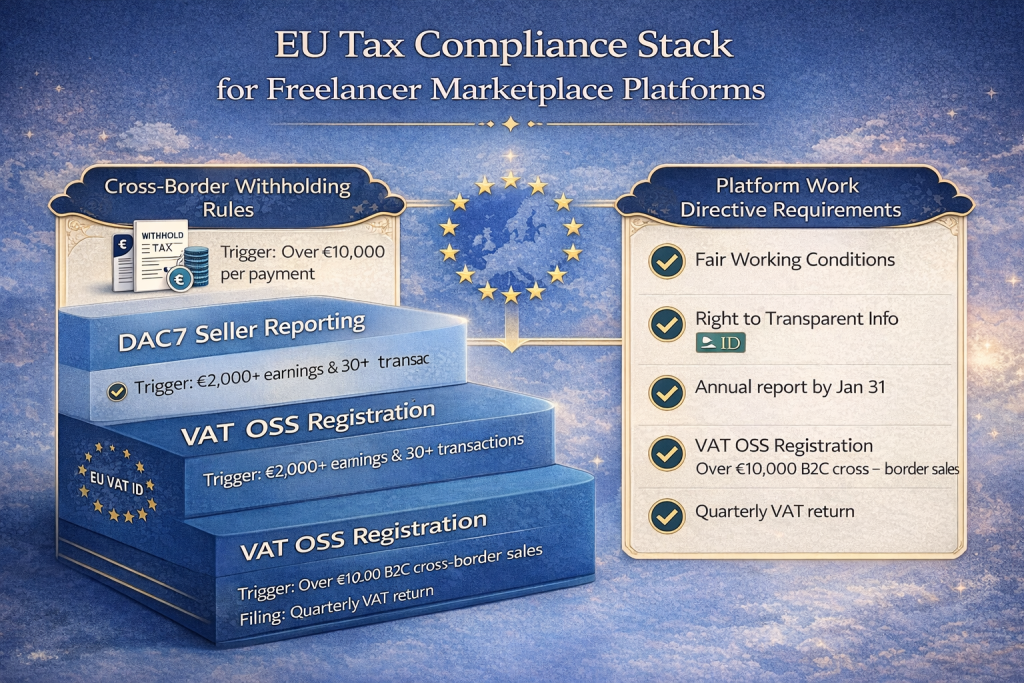
VAT Obligations for EU Freelancer Platforms
Every platform facilitating services between EU-based parties has VAT obligations from the first transaction. The key rules are:
- OSS Registration: If your platform facilitates B2C services across multiple EU member states, you must register for the One Stop Shop (OSS) scheme. This allows you to file a single quarterly VAT return covering all EU countries instead of registering separately in each.
- Reverse Charge for B2B: Freelancer services between businesses (B2B) in different EU member states use the reverse charge mechanism — the client accounts for VAT in their own country. Your platform must collect and verify VAT registration numbers for all B2B transactions.
- Digital Services VAT Rate: Platform commission fees are subject to VAT at the rate of the country where the customer is located — not where your platform is registered. Implement a real-time VAT rate lookup API to calculate the correct rate for every transaction.
DAC7 Automatic Tax Reporting
DAC7 (EU Directive 2021/514) entered into force on 1 January 2023 and represents one of the most significant new obligations in European freelancer marketplace EU regulations for platform operators.
Under DAC7, your platform must collect, verify, and automatically report seller income data to EU tax authorities. This applies to any platform facilitating the sale of services — which all freelancer marketplaces do.
DAC7 Platform Reporting Requirements:
| Data Point | Collection Method | Reporting Deadline |
|---|---|---|
| Freelancer legal name | KYC verification at onboarding | Annual — by January 31 |
| Tax Identification Number (TIN) | Self-certification form | Annual — by January 31 |
| Country of tax residence | Address verification | Annual — by January 31 |
| Total earnings per platform | Payment system aggregation | Annual — by January 31 |
| Bank account details | Payment onboarding | Annual — by January 31 |
| Number of transactions | Platform transaction log | Annual — by January 31 |
For comprehensive payment infrastructure that integrates DAC7 reporting automatically, see our guide on escrow payment systems for freelancer platforms.
Chapter 5: PSD2 Payment Services Directive for European Freelancer Marketplaces
The Payment Services Directive 2 (PSD2) governs every payment transaction on a European talent platform. It is one of the most technically demanding layers of European freelancer marketplace EU regulations for platform engineers.
Strong Customer Authentication (SCA) Requirements
PSD2 mandates Strong Customer Authentication for all electronic payments within the EU. SCA requires at least two of three authentication factors:
- Something you know: PIN, password, security question
- Something you have: Mobile phone, hardware token, card
- Something you are: Fingerprint, face recognition, voice
Platform SCA Implementation Checklist:
- Integrate a PSD2-compliant payment gateway (Stripe, Adyen, Braintree all support SCA natively)
- Implement 3D Secure 2.0 (3DS2) for all card transactions — this is the technical standard that delivers SCA for card payments
- Apply for SCA exemptions where eligible: transactions under €30, recurring subscriptions with fixed amounts, and low-risk transactions below the fraud reference threshold can be exempted
- Build an exemption management engine that automatically requests the appropriate SCA exemption for each transaction type to minimise checkout friction for legitimate users
Payment Institution Licensing
If your platform holds funds in escrow — even temporarily — between client payment and freelancer disbursement, you may require authorisation as a Payment Institution under PSD2.
The most practical solution for new platforms entering the EU market is to use a licensed Payment Institution as your payment processor (Stripe Payments Europe, Adyen N.V., or similar). This shifts the PSD2 authorisation burden to the processor and allows your platform to operate as a commercial agent under the processor’s licence.
Chapter 6: Multi-Language Platform Development for EU Compliance
Language compliance is one of the most underestimated requirements in European freelancer marketplace EU regulations. It goes beyond translation — it is a legal obligation in several EU member states and a practical necessity in all of them.
Legal Language Requirements by Country
| Country | Language Requirement | Legal Basis | Platform Obligation |
|---|---|---|---|
| France | French mandatory for contracts | Loi Toubon | All contracts, T&Cs, and invoices must be in French |
| Germany | German strongly required | UWG / Contract law | German T&Cs required for enforceability in German courts |
| Spain | Spanish + regional languages | Regional legislation | Castilian Spanish minimum; Catalan/Basque recommended |
| Poland | Polish required | Consumer Protection Act | Polish language required for B2C contracts |
| Italy | Italian required | Consumer Code | Italian T&Cs required for consumer-facing features |
| Netherlands | Dutch preferred | Contract law | Dutch T&Cs recommended for enforceability |
Technical Implementation for Multi-Language Compliance
- Language Detection and Routing: Implement automatic language detection based on browser locale, followed by user preference setting at onboarding. Store language preference in the user profile and apply it to all system-generated communications.
- Legally Reviewed Translations: Machine translation is not sufficient for contracts, privacy policies, and terms of service. Engage qualified legal translators in each target market. A poorly translated contract may be unenforceable in a local court.
- Currency and Number Formatting: Display prices in the local currency with local number formatting (comma vs period decimal separator varies across EU countries). This is both a legal requirement under EU consumer protection rules and a conversion rate optimisation best practice.
- Right-to-Left Language Support: If expanding beyond the EU into MENA markets from your European base, implement RTL layout support from the start. Retrofitting RTL into an existing design system is significantly more expensive than building it correctly initially.
For cultural and regional considerations that complement language compliance, see our guide on Middle East freelancer marketplace cultural and business considerations.
Chapter 7: Market Entry Strategies Within European Freelancer Marketplace EU Regulations
Not all EU markets carry equal regulatory complexity. A strategic market entry sequence allows you to build compliance infrastructure incrementally rather than trying to satisfy all 27 member states simultaneously.
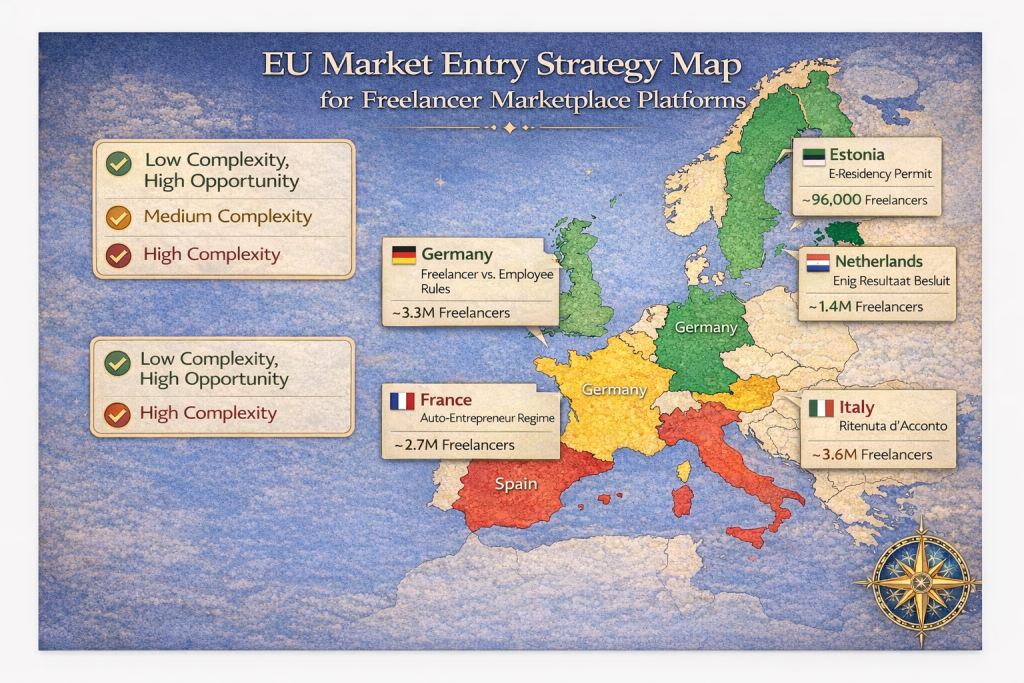
Recommended Market Entry Sequence
| Phase | Target Markets | Why Start Here | Key Compliance Focus |
|---|---|---|---|
| Phase 1 (Launch) | Estonia, Netherlands, Ireland | English-friendly, pro-startup regulation, strong digital infrastructure | GDPR, DSA baseline, VAT OSS |
| Phase 2 (Growth) | Germany, France, Sweden | Large freelance economies, high average contract value | Language compliance, local classification tests |
| Phase 3 (Scale) | Spain, Italy, Poland | Significant talent pools, growing enterprise demand | Country-specific classification + VAT registration |
| Phase 4 (Expansion) | Remaining EU27 | Full market coverage | Full multi-language + country-specific legal review |
Estonia — The Ideal EU Launch Market for Digital Platforms
Estonia deserves special attention as the preferred launch market for European talent platform operators. It offers:
- E-Residency Programme: Allows non-EU entrepreneurs to incorporate a company in Estonia entirely digitally — giving you an EU legal entity and VAT registration without physical presence.
- Digital-First Regulation: Estonia has the most advanced digital government infrastructure in the EU. Regulatory processes that take months in other member states take days in Estonia.
- English-Language Friendly: Estonian courts accept English-language contracts. Most government services are available in English.
- EU Market Access: An Estonian company gives you full EU single market access. You can scale from Estonia to all 27 member states without reincorporating.
Compliance as Competitive Advantage in the EU Market
The platforms that win in the EU are those that make compliance visible to enterprise clients. European procurement teams — particularly in finance, healthcare, and legal services — require documented evidence of GDPR compliance, DSA obligations, and worker classification policies before approving a freelancer platform as a vendor.
Build a public Compliance Centre page on your platform website. Document your GDPR policies, DSA obligations, Platform Work Directive approach, and DAC7 reporting system. This page directly impacts enterprise B2B sales conversion and positions your platform as the trusted choice in a market where trust is the primary purchasing criterion.
Conclusion: Building a Winning Strategy Around European Freelancer Marketplace EU Regulations
European freelancer marketplace EU regulations are not a barrier to market entry — they are a barrier to entry for poorly built competitors. Every new EU regulation that enters into force eliminates platforms that were not built to comply and creates space for well-architected platforms to establish category leadership.
The eight layers covered in this guide, the EU Regulatory Framework, GDPR, Worker Classification, Tax Compliance, PSD2, Multi-Language Requirements, and Market Entry Strategy, are not independent checklists. They are an integrated compliance architecture that must be designed together from the platform’s inception.
A GDPR-compliant data architecture also satisfies DSA transparency obligations. A DAC7-compliant KYC system also supports PSD2 identity verification requirements. A Platform Work Directive-safe contractor agreement also addresses national classification tests in Germany, France, and Spain simultaneously.
The EU is the world’s largest single market for digital services, with over 28 million platform workers and an enterprise demand for compliant contractor management solutions growing at 18% annually. Platforms that invest in compliance architecture today are building the moats that will define market leadership for the next decade.
Build it correctly from day one. Use our complete freelancer hiring marketplace development checklist to ensure every compliance layer is implemented before your first EU user signs up.
Frequently Asked Questions: European Freelancer Marketplace EU Regulations
Q1: What are the most important European freelancer marketplace EU regulations platform builders must comply with in 2025?
The most critical European freelancer marketplace EU regulations for platform operators in 2025 are: the Digital Services Act (applicable February 2024) requiring trader verification, illegal content reporting, and transparency disclosures; the Platform Work Directive (implementation deadline December 2026) introducing a rebuttable employment presumption; GDPR requiring comprehensive data protection architecture; DAC7 mandatory automatic tax reporting of seller income to EU tax authorities; PSD2 requiring Strong Customer Authentication for all payments; and VAT OSS registration for cross-border B2C service facilitation. These six regulatory layers form the minimum compliance architecture for any European talent platform.
Q2: Does GDPR apply to a freelancer marketplace that is not incorporated in the EU?
Yes, absolutely. GDPR applies to any platform that offers services to EU residents or monitors the behaviour of EU residents — regardless of where the platform is incorporated. A US, UK, or Australian platform that allows EU freelancers to register profiles or EU clients to post projects is fully subject to GDPR for all data relating to those EU users. Non-EU platforms must also appoint an EU Representative — a legal entity physically located in the EU that can receive communications from supervisory authorities. Failure to appoint an EU Representative is itself a GDPR violation subject to fines.
Q3: What is the Platform Work Directive and when does it take effect?
The EU Platform Work Directive (2024/2831) was adopted in November 2024 and must be implemented into national law by all EU member states by December 2, 2026. It introduces a rebuttable presumption of employment for platform workers — meaning that if your platform exhibits indicators of control or direction over workers, those workers are legally presumed to be employees unless your platform can prove otherwise. This is the most significant shift in European freelancer marketplace EU regulations for platform operators in a decade. Every platform should begin reviewing their contractor relationship architecture now, well before the 2026 national implementation deadline.
Q4: How does DAC7 affect freelancer marketplace platforms in the EU?
DAC7 requires digital platforms that facilitate the sale of services to collect, verify, and automatically report seller income data to EU tax authorities by January 31 each year for the previous calendar year. The data includes freelancer legal name, tax identification number, country of tax residence, total earnings, bank account details, and transaction count. This obligation applies from the first euro earned by a freelancer on your platform — there is no minimum threshold for the reporting obligation itself, only for when tax authorities share data with each other. Your platform must implement a DAC7-compliant KYC system before accepting its first EU-resident seller.
Q5: Which EU country is best to launch a freelancer marketplace first?
Estonia is the recommended first market for most European talent platform operators. It offers e-Residency allowing digital company incorporation without physical presence, the most advanced digital government infrastructure in the EU, English-language friendly courts and regulatory processes, and full EU single market access from day one. The Netherlands and Ireland are strong alternatives — both have English-friendly business environments, strong digital infrastructure, and established fintech regulatory frameworks. All three countries allow you to satisfy GDPR, DSA, and DAC7 obligations efficiently before expanding to higher-complexity markets like Germany, France, and Spain.
Q6: What PSD2 obligations apply to a freelancer marketplace that uses escrow?
If your platform collects client payments and holds them in escrow before disbursing to freelancers, you are likely engaged in payment services under PSD2. This triggers either direct authorisation as a Payment Institution from your home member state’s financial regulator, or an agreement to operate as a commercial agent under a licensed Payment Institution’s authorisation. Most new platforms choose the commercial agent route — partnering with a PSD2-licensed processor like Stripe Payments Europe Ltd or Adyen N.V. and operating under their licence. This shifts the regulatory authorisation burden to the processor while your platform retains control of the user experience and fee structure.
Q7: How many languages must a European freelancer marketplace support?
There is no single EU-wide minimum language requirement, but several member states impose legal obligations. France requires French-language contracts and terms of service under the Loi Toubon. Germany requires German-language terms for contracts to be enforceable in German courts. Poland, Italy, and Spain have similar consumer protection requirements. At minimum, a platform targeting the EU’s five largest economies — Germany, France, Italy, Spain, and Poland — must offer legally reviewed translations in German, French, Italian, Spanish, and Polish, in addition to English. Machine translation is not legally sufficient for contracts, privacy policies, or terms of service.
Q8: How do European freelancer marketplace EU regulations compare to US regulations?
European freelancer marketplace EU regulations are significantly more comprehensive than US regulations in three key areas. First, the GDPR is far stricter than any US state privacy law — including CCPA — with mandatory DPO appointment, data protection impact assessments, and explicit cross-border transfer restrictions. Second, the Platform Work Directive creates a presumption of employment that the US DOL’s 6-factor test does not — the burden of proof is reversed. Third, DAC7 automatic tax reporting goes further than US 1099-K obligations, applying from the first transaction without thresholds. However, US regulations are more complex at the payment layer — EU PSD2 provides a more harmonised framework than the state-by-state US money transmitter licensing regime. For a full comparison, see our guide on American freelancer marketplace state regulations and tax compliance.