
Multi-Vendor eCommerce SaaS Built for Scale
A single Laravel platform that powers 50+ independent online stores — each with their own storefront, custom domain, branding, and dashboard, managed from one admin panel.
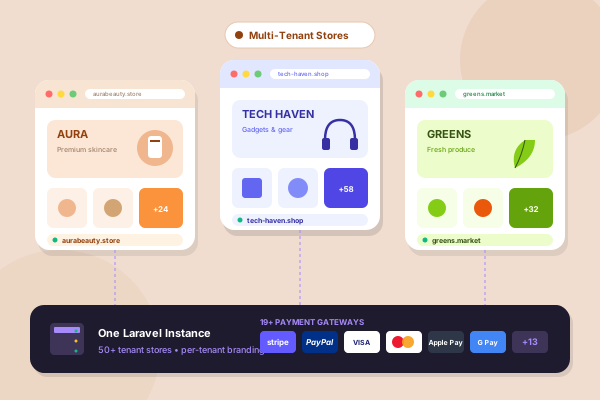
One platform, unlimited stores
Our client needed a SaaS platform where entrepreneurs could launch their own eCommerce stores under a subscription model. Every store had to feel fully independent — custom domain, branded storefront, private inventory — while running on a single shared backend.
We built a multi-tenant Laravel application with complete data isolation between tenants, a white-label theme system, and Flutter mobile apps that connect to the same API as the web storefronts. The platform supports over 50 active stores in production.
Core product message: Launch and grow an online store in minutes — no server setup, no development cost.
Making every store feel independent while sharing one infrastructure
The hardest part of multi-tenant SaaS is maintaining the illusion of a dedicated platform for each merchant. Tenant isolation, custom domains, branded storefronts, and per-tenant payment configuration all had to work seamlessly at scale.
A Shopify-style SaaS on infrastructure the client owns
We built a full SaaS eCommerce platform on Laravel with a global Eloquent scope that enforces tenant isolation on every database query. Tenants never share data, sessions, or cache. Each store resolves from the incoming domain at the middleware layer before any route logic runs.
The theme system is built on JSON-driven customization. Tenants pick a base theme and configure colors, logo, and layout options — all stored per-tenant and injected at render. A WooCommerce import tool allows merchants to migrate existing product catalogs in minutes.
Platform Features
Row-level isolation, global payment abstraction
Tenant resolution happens at the HTTP middleware layer. Every subsequent database query is scoped to the resolved tenant via a global Eloquent scope. There is no code path that can retrieve data across tenant boundaries.
The payment gateway layer abstracts all 19+ providers behind a single interface. Split payments use Stripe Connect to route merchant funds and deduct platform fees atomically in one API call — no reconciliation jobs required.
Hard problems, solved cleanly
Tenant Data Isolation
Ensuring that no tenant can ever read or write another tenant's data. Implemented via row-level tenant scoping on every Eloquent query, enforced through a global scope middleware that cannot be bypassed.
Custom Domain Routing
Each tenant can map their own domain to their store. Wildcard DNS handles subdomains; CNAME mapping handles custom domains. Laravel resolves the tenant from the incoming host header before any route is dispatched.
Payment Gateway Abstraction
Supporting 19+ payment gateways without duplicating checkout logic. A unified payment gateway interface abstracts each provider behind a common contract — add a new gateway by implementing one interface.
Theme System Per Tenant
Tenants choose from 10+ storefront themes, each customizable with their logo and brand colors. Theme assets are served from a shared CDN path; tenant customizations are stored as JSON and injected at render time.
Platform Fee Split Payments
The platform charges a configurable fee on every transaction. Implemented via Stripe Connect — funds are routed to the merchant's connected account minus the platform fee in a single atomic charge.
50+ stores, one platform, zero vendor lock-in
The platform runs 50+ active merchant stores in production with 99.9% uptime. New merchants can self-onboard, configure their store, and start accepting orders within minutes — no engineering required.
The client owns the platform outright. Adding new payment gateways, themes, or features is an internal decision — not a negotiation with a SaaS vendor. The architecture scales horizontally as merchant volume grows.


Questions about building a multi-tenant eCommerce SaaS?
Common questions from founders before starting a SaaS platform engagement.
A platform of this scope — multi-tenant architecture, 19+ payment gateways, custom domain per tenant, Flutter mobile apps, and a white-label admin panel — typically ranges from $40,000 to $100,000. Complexity, number of payment integrations, and mobile scope are the main variables. We work on fixed-price contracts.