

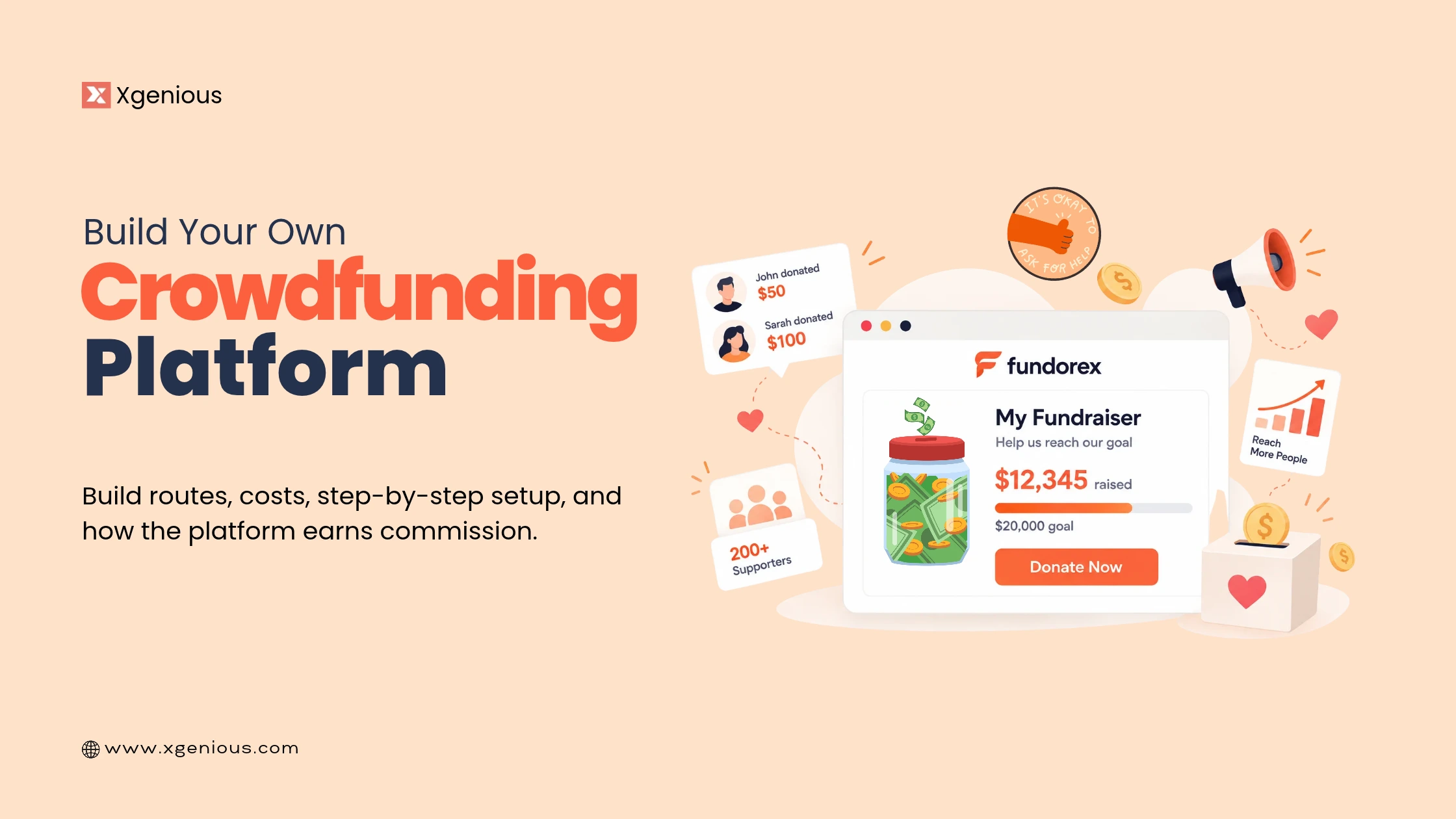


Most people who raise money online are renting space on someone else’s platform. They run a campaign on Kickstarter or GoFundMe, hand over a slice of every pledge, and walk away with none of the backer data when it ends. There is another path: build your own crowdfunding platform, become the house instead of the player, and keep the commission other people currently pay.
This guide is the practical how-to, not another list of tools. It covers the three ways to build your own crowdfunding platform, what the software actually needs, the step-by-step build, what it costs, and how the platform makes money once it is live. Full disclosure: Fundorex, mentioned near the end, is our own crowdfunding script, and I have said so where it comes up so you can weigh it yourself.
Key takeaways
- To build your own crowdfunding platform means running the site others campaign on, so you earn the commission instead of paying it.
- There are three routes: custom development, a free open-source project, or a ready-made self-hosted script, and they differ sharply on cost, time, and maintenance.
- Any crowdfunding platform needs campaign creation, multiple funding models, payment gateways, admin approval, and commission payout handling at a minimum.
- A realistic build on a ready-made script runs a few hundred to a few thousand dollars and launches in days; a custom build runs into tens of thousands and months.
- The platform earns money through commission on funds raised, listing or featured fees, and optional subscriptions, which compounds as campaign volume grows.
Table of Contents
Why build your own crowdfunding platform?
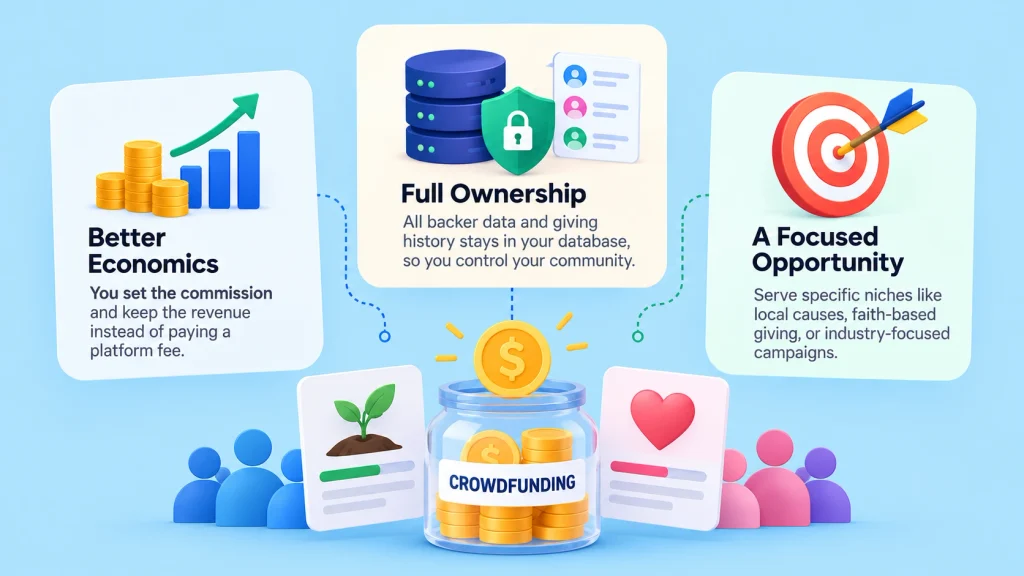
The economics are the whole reason. On a hosted platform, the operator takes a percentage of every campaign, so a site processing a million dollars a month at a 5 percent commission earns fifty thousand dollars a month. When you build your own crowdfunding platform, that operator is you. You set the commission, you decide which campaigns run, and you keep the backer relationships.
Ownership is the second reason. On any third-party platform, the contact details and giving history of every backer belong to the platform, not to the campaigns. Run your own platform and all of that data sits in your database, which matters for repeat campaigns and for privacy rules like GDPR. The third reason is focus: the big generalist sites serve the broad market, which leaves whole niches underserved, local causes, faith-based giving, school fundraising, industry-specific pre-orders, where a focused platform can win.
Being honest about the trade-off matters too. To build your own crowdfunding platform is a real project, not a weekend task. You take on hosting, security, payments, and support. The rest of this guide is about doing that with the least pain and cost.
The three ways to build your own crowdfunding platform
Before any steps, pick your route, because it decides your budget, timeline, and how much of this you do yourself.
| Route | Cost | Time to launch | Control | Maintenance |
|---|---|---|---|---|
| Custom development | $25,000 and up | 3 to 6 months | Total | You own all of it |
| Free open-source project | $0 license, plus dev time | Weeks | High, if you can code | You patch and maintain |
| Ready-made self-hosted script | $49 to a few hundred, one-time | Days | High, source included | Vendor ships updates |
- Custom development. A platform built from scratch to your exact spec. The upside is a product shaped precisely to your niche. The downside is cost and time: you are building software, not launching it. This fits funded teams with unusual requirements. If that is you, our custom SaaS development team builds platforms like this.
- Free open-source project. You download an open-source codebase and run it yourself. Free to license, but you need real development skill to deploy, secure, and extend it, and some projects are barely maintained. The field is covered in our guide to the best open source crowdfunding platform options.
- Ready-made self-hosted script. You buy a finished crowdfunding script once, host it on your own server, and own the source. It is the middle path: far cheaper and faster than custom, far more complete than wiring up a free project. The leading options are compared in our roundup of the best PHP crowdfunding scripts.
For most people who want to build your own crowdfunding platform without a developer team or a month of setup, the ready-made script is the sensible default. The rest of this guide assumes that route while noting where the others differ.
What your crowdfunding platform actually needs
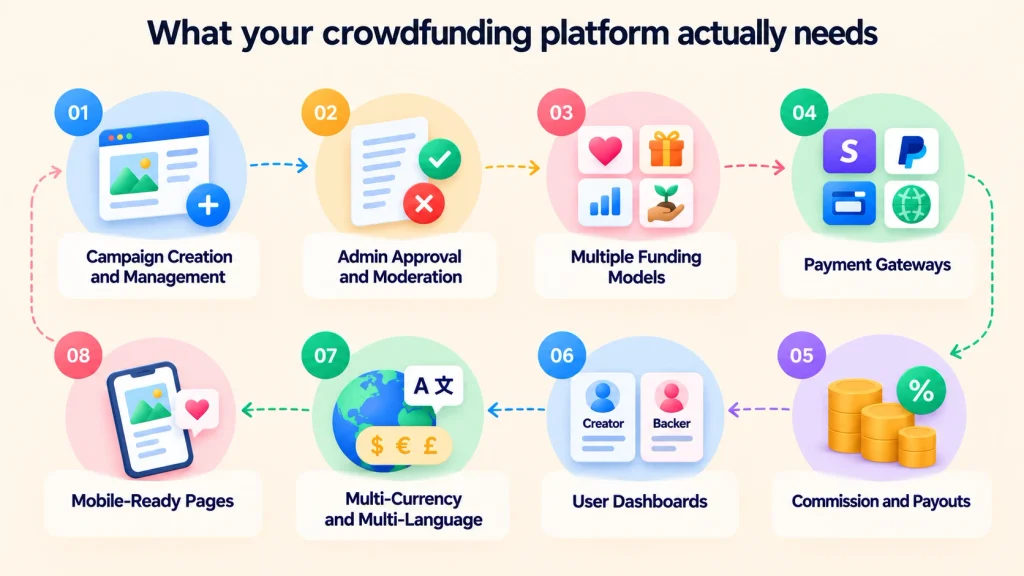
Whichever route you pick, the platform has to do these jobs. Use this as a spec when you evaluate a script or brief a developer.
- Campaign creation and management. Creators sign up, build a campaign page with a goal, story, images, and video, and submit it for review.
- Admin approval and moderation. You approve or reject campaigns before they go live, so your platform controls quality and reputation.
- Multiple funding models. Donation, reward, and sometimes equity or lending. A platform that handles more than one model serves a wider market.
- Payment gateways. More than Stripe and PayPal. Local gateways decide whether backers in your region can actually give, so coverage matters more than count.
- Commission and payouts. The core of the business: automatically take your percentage, track balances, and pay creators out on request or on a schedule.
- User dashboards. Separate views for creators (their campaigns and funds) and backers (their contributions), plus your admin control panel.
- Multi-currency and multi-language. Needed the moment your audience crosses a border.
- Mobile-ready pages. Most giving now happens on phones, so campaign pages must work cleanly on a small screen.
How to build your own crowdfunding platform step by step
Here is the full process to build your own crowdfunding platform on the ready-made-script route, with notes where the custom and open-source routes differ.
Step 1: Choose your niche and funding model
Decide who the platform serves and how money moves before you touch any software. A platform for medical and personal causes is donation-based; one for product launches is reward-based; one for startups raising capital is equity-based and heavily regulated. Picking a focused niche is what lets a new platform compete with the generalist giants, so resist the urge to serve everyone on day one.
Step 2: Pick your build route
Using the table above, choose custom, open-source, or a ready-made script. For most founders the script route wins on cost and speed. If you have a strong developer and unusual needs, weigh the open-source or custom paths instead.
Step 3: Get hosting and a domain
Your platform needs a server and an address. A standard VPS handles a new crowdfunding platform comfortably; check the PHP version, database, and memory the script or project requires before you buy. Register a short, trustworthy domain, because people are sending money through it and the name is part of that trust.
Step 4: Install the platform and configure the core
Install the script (most ship with a guided installer) or deploy the open-source project. Then configure the essentials: your commission rate, the funding models you will allow, campaign categories, currencies, and languages. This is the step where a ready-made script saves you weeks over wiring these up by hand.
Step 5: Connect payment gateways and test payouts
Nothing else matters if money cannot move. Connect the gateways your backers actually use, then run a real end-to-end test: make a contribution, confirm your commission is deducted correctly, and process a test payout to a creator. Payment and payout logic is where home-built platforms break, so test it before launch, not after.
Step 6: Brand it and build your first campaign pages
Add your logo, colors, and domain so the platform looks like a real brand rather than a default template, because donors can sense a slapdash page and it costs you conversions. Then build or seed a first campaign or two so the site is not empty on launch day. If you are unsure what a strong page looks like, our guide on what makes a good crowdfunding campaign page breaks it down.
Step 7: Launch, promote, and recruit campaigns
A platform with no campaigns raises no money, so your real job after launch is supply and demand: recruit creators to run campaigns and bring backers to fund them. Line up outreach, social proof, and a launch cohort of campaigns before you open. Our guide on how to ask for donations covers the wording that moves people to give, which your early creators will need.
What it costs and how long it takes
Budget for the whole first year, not just the license, so there are no surprises.
| Cost line | Ready-made script | Custom build |
|---|---|---|
| Software | $49 to a few hundred, one-time | $25,000 and up |
| Hosting | $120 to $360 per year | Same, often more |
| Domain and SSL | $15 to $65 per year | Same |
| Setup and customization | Optional, modest | Included in the build cost |
| Time to launch | Days to a week | 3 to 6 months |
On a ready-made script, a realistic all-in first year lands somewhere between a few hundred and a couple of thousand dollars. A custom build starts in the tens of thousands and runs for months. A hosted white-label SaaS, by contrast, charges every month and leaves you owning nothing at the end. That gap is the whole argument for choosing to build your own crowdfunding platform on a script you can run yourself.
How your crowdfunding platform makes money
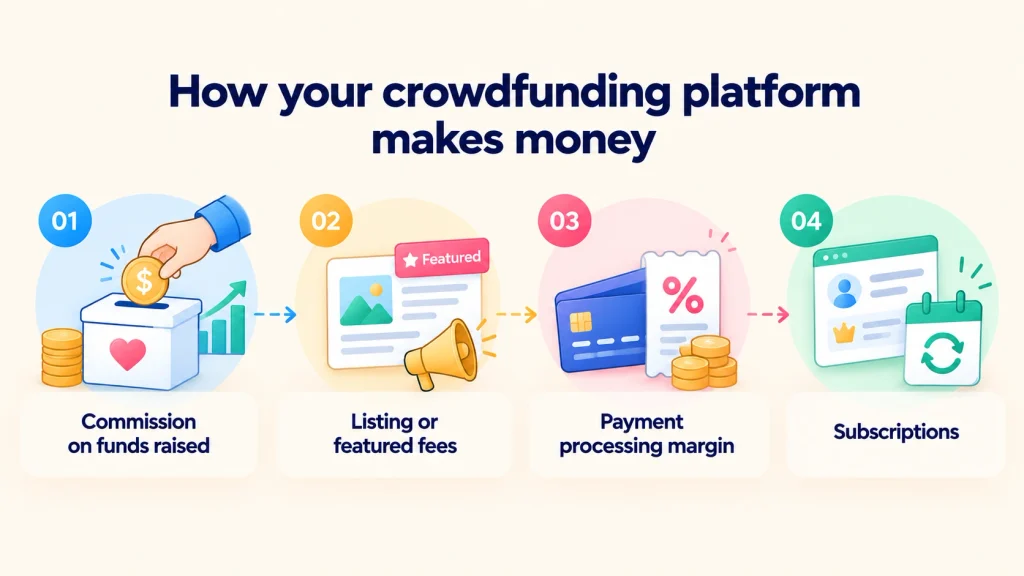
When you build your own crowdfunding platform, it only pays off if you know how it earns. There are four common revenue lines, and most platforms combine them.
- Commission on funds raised. The main one. You take a set percentage of every successful campaign. This scales directly with campaign volume, so growth compounds.
- Listing or featured fees. Charge creators to list, or to feature a campaign on the homepage or in search. Optional, but useful once you have traffic.
- Payment processing margin. Some platforms add a small margin on top of the raw gateway fee.
- Subscriptions. Recurring plans for creators or organizations that run many campaigns, which turns one-off income into predictable monthly revenue.
The reason niche focus matters here: a platform doing even modest volume in an underserved vertical, at a few percent commission, can out-earn a generic site fighting the giants for scraps.
Mistakes to avoid when you build your own crowdfunding platform
A few traps catch first-time platform owners, and each is avoidable.
- Trying to serve everyone. A generic platform competes with Kickstarter and GoFundMe directly and loses. Pick a niche you can own.
- Underestimating payment setup. Getting gateways approved, especially for nonprofits or new businesses, takes longer than expected. Start it early.
- Skipping admin moderation. Without campaign approval, your platform becomes a magnet for fraud and spam, which destroys trust fast.
- Neglecting security and updates. You are handling other people’s money. An unpatched platform is a liability, so keep the software and server current.
- Launching empty. A platform with no campaigns looks dead. Seed it with a launch cohort before you promote it.
- Choosing an abandoned codebase. A free open-source project whose last update was years ago is a risk, not a bargain. Check the activity before you build on it.
The shortcut: a ready-made script you own
If owning the platform appeals but inheriting a stranger’s abandoned code or spending months on a custom build does not, a maintained script is the middle path. Fundorex is our own crowdfunding and donation script built for exactly this. You buy it once from $49, host it on your own server, and keep everything you raise with no per-campaign commission going to anyone but you. It ships with donation, reward, equity, and lending models, 17 plus payment gateways, a full admin dashboard with campaign approval and payouts, and multi-language and multi-currency support, so the feature checklist earlier in this guide is handled out of the box.
Honest positioning: Fundorex is not free, and you have read enough of this guide to spot that dodge. The pitch is simpler. If you want to build your own crowdfunding platform without gluing an old open-source project together or paying for a custom build, a maintained script saves you that time and cost. If you have a strong developer and unusual needs, the open-source or custom routes are reasonable instead.
The Bottom Line
To build your own crowdfunding platform is to move from paying commission to collecting it. The three routes, custom, open-source, and a ready-made script, trade cost against control and time, and for most founders a self-hosted script is the fastest way to a platform you own outright. Pick a niche, handle the core features (campaigns, approval, payments, payouts), and seed the site before you promote it.
If you want to compare the specific tools on each route first, our guides to the best open source crowdfunding platform options and the top PHP crowdfunding scripts cover them in depth, and if you would rather have a team build the platform for you, our custom SaaS development service can help. Whichever route you take, the goal is the same: your platform, your commission, your data.
Frequently asked questions
How much does it cost to build your own crowdfunding platform?
On a ready-made self-hosted script, a realistic all-in first year runs from a few hundred to a couple of thousand dollars, covering the one-time license, hosting, and a domain. A custom build from scratch starts in the tens of thousands and takes months. A hosted white-label SaaS charges monthly and leaves you owning nothing.
Do I need coding skills to build my own crowdfunding platform?
Not for the ready-made script route, which ships with an installer and an admin panel a non-developer can run, though basic server setup helps. The open-source and custom routes do need real development skill. If you lack it, a maintained script or a development team is the practical path.
How does a crowdfunding platform make money?
Mainly through commission, a set percentage of every campaign you host. Platforms also add listing or featured fees, a small payment-processing margin, and subscription plans for frequent creators. Commission scales with campaign volume, so revenue compounds as the platform grows.
Which funding models should my platform support?
It depends on your niche. Donation suits personal causes and nonprofits, reward suits product and creative launches, and equity suits startups raising capital but is heavily regulated. A platform that supports more than one model serves a wider market, which is why full scripts handle several at once.
Is it legal to run my own crowdfunding platform?
For donation and reward crowdfunding, standard business registration is usually enough. Equity crowdfunding is different and regulated: in the US, platforms facilitating equity investments must register with the SEC under Regulation Crowdfunding. Check the rules for your jurisdiction and model before launch.
How long does it take to build your own crowdfunding platform?
With a ready-made script, you can be live in days to a week once your content and payment gateways are ready. An open-source deployment takes weeks depending on your developer. A fully custom build runs three to six months.