



“8 weeks” sounds like marketing copy until you see the gates. The honest saas mvp timeline is 8 to 12 weeks depending on scope, with three go/no-go decisions along the way that determine whether the launch happens on time or slips into month four. The 8-week version is real but conditional; the 12-week version is the right choice for compliance-heavy or enterprise-bound saas builds.
This guide gives the definitive saas mvp timeline week by week: what ships in weeks 1 to 2 (discovery, design, auth), weeks 3 to 4 (core workflows and multi-tenancy), weeks 5 to 6 (billing, admin, integrations), and weeks 7 to 8 (hardening, QA, launch ramp). It then covers the 10-week track for builds that add compliance or mobile, the 12-week track for regulated verticals, the team composition that supports each timeline, the four usual suspects that slip MVPs, and the slippage recovery protocol when the build is two weeks behind at week 4.
Five takeaways before reading on: the conditions under which 8 weeks is realistic, the three go/no-go gates that prevent runaway scope, what each week-pair actually produces, when to switch from 8-week to 10-week or 12-week tracks, and how to recover when the saas mvp timeline starts slipping. For the broader build framework that places this timeline in context, see how to build a saas in 2026.
The Honest Answer to “Can I Ship a Saas MVP Timeline in 8 Weeks?”
Yes, with conditions. Eight weeks is a real saas mvp timeline for the right team, the right scope, and the right stack. Eight weeks is fantasy for the wrong combination of those three.
The conditions under which 8 weeks works:
Scope condition. The MVP is scoped through the 80% Cut exercise (list features, cut to the smallest set that delivers the core promise to a single named persona, then cut another 20%). Most ambitious feature lists do not survive this exercise, which is the point.
Team condition. A senior team that has shipped saas before. A combination of one full-stack engineer, one front-end specialist, one designer, and one project lead, all working roughly full-time on the build, is the typical 8-week composition. Teams without this composition need 10 to 14 weeks for the same scope.
Stack condition. An opinionated stack picked once and not revisited. Next.js + TypeScript + Postgres + Redis + Stripe + Clerk on Vercel or AWS is the dominant 2026 default that supports the 8-week saas mvp timeline. Teams choosing exotic combinations or custom infrastructure add weeks for every non-default choice.
When all three conditions are met, 8 weeks is achievable and the failure mode becomes scope creep mid-build rather than impossible timeline. When any one condition is violated, the 8-week saas mvp timeline becomes 10 to 12 weeks. When two are violated, the build runs to 16+ weeks.
The honest framing for founders evaluating an 8-week proposal: ask whether the proposal includes scope discipline, senior team, and opinionated stack. If any of the three are vague or “to be determined,” the timeline is aspirational rather than realistic.
What “Ship a Saas MVP” Actually Means in This Saas MVP Timeline
“Ship an MVP” is one of the vaguest phrases in saas. The saas mvp timeline below is calibrated against a specific definition: an MVP that meets the five technical markers of a saas (multi-tenancy, RBAC, subscription billing, usage telemetry, compliance baseline) and can acquire, charge, and retain its second paying customer without manual intervention.
What the 8-week saas mvp timeline produces:
Multi-tenant application. Single application instance serving multiple customers with strict data isolation through Postgres row-level security or middleware-level enforcement.
Subscription billing wired end-to-end. Stripe Billing integration with proration, dunning workflow, plan changes, tax handling, webhooks tested.
Authentication with RBAC. Managed identity provider (Clerk, Cognito, or Supabase Auth) with users tied to tenants and roles enforcing permissions.
Core feature surface. The single most important workflow that the buyer agreed to pay for during pre-sell or validation. Not feature-complete, but functional and conversion-supporting.
Onboarding flow. First-run experience that walks new customers from signup to first meaningful action.
Compliance baseline. Audit logs, encryption at rest and in transit, deletion-on-request workflow, GDPR-ready architecture.
Operational instrumentation. Sentry for errors, Better Stack for uptime, PostHog for product analytics, basic on-call rotation.
What the 8-week saas mvp timeline does not produce: deep enterprise features (SSO, SCIM, custom roles), advanced reporting, public API, white-label support, or full SOC 2 Type II certification. Those land in months 4 to 12 once the MVP has paying customers and a clearer product roadmap. The MVP exists to ship the smallest version that ships the saas economics.
The 8-Week Saas MVP Timeline Cadence
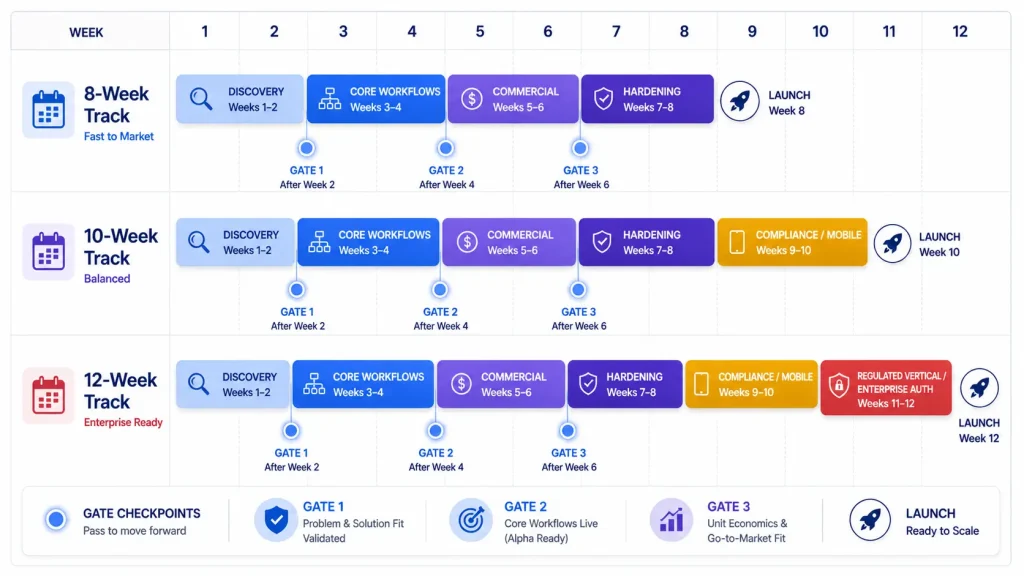
The 8-week saas mvp timeline organizes work into four 2-week pairs, with three go/no-go gates after weeks 2, 4, and 6. Each pair produces a specific deliverable that gates the next pair.
The cadence:
Weeks 1 to 2 (Discovery and Foundation). Discovery sprint, design system, authentication scaffold, base data model, first compliance primitives. Gate 1 at end of week 2: scope locked, design system signed off, auth working.
Weeks 3 to 4 (Core Workflows). The single most important user workflow built end-to-end on multi-tenant data layer. Gate 2 at end of week 4: core workflow demo-able, multi-tenancy verified, no critical architectural gaps.
Weeks 5 to 6 (Commercial and Integration). Billing wired end-to-end, admin tooling for the team, third-party integrations the MVP depends on. Gate 3 at end of week 6: a fake customer can sign up, pay, and use the product without manual intervention.
Weeks 7 to 8 (Hardening and Launch). Edge cases, error states, empty states, performance, security review, launch readiness scoring against the 12-point checklist, 48-hour soft launch.
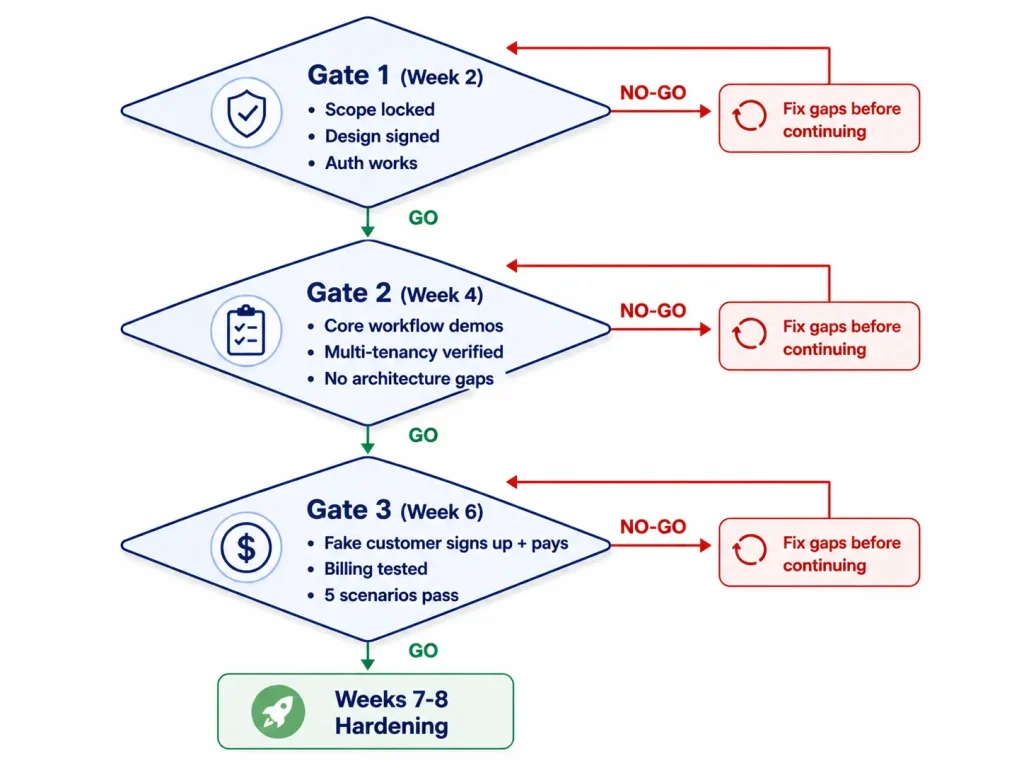
The go/no-go gates are non-optional. A failing gate at week 2 (scope unclear, design system not done, auth not working) means delaying the start of weeks 3-4 work until the gate passes. Pushing through a failed gate creates compounding problems in later weeks; the team ends up rebuilding work in week 6 that should have been right in week 2.
The 8-week saas mvp timeline assumes parallel workstreams (design and engineering working concurrently, not sequentially). The Shape Up methodology from Basecamp, documented at Shape Up, influences the gate-based structure and the constrained-scope philosophy.
The 10-week and 12-week tracks discussed below add work to specific weeks, not new phases. The four-pair structure remains the same; the work expands within phases.
Weeks 1 to 2 of the Saas MVP Timeline: Discovery, Design System, Auth (Gate 1)
The first two weeks of the saas mvp timeline are the most over-invested and under-invested phase of any MVP. Teams either spend three weeks building a beautiful design system before any feature work, or they skip the foundation entirely and pay for it in week six.
Week 1 deliverables.
Discovery sprint: confirm scope against the validation work, clarify the single most important workflow, lock the buyer persona and the core value proposition. The team should produce a one-page scope document by end of week 1 that the entire team can recite.
Design system foundation: typography, color palette, spacing scale, base component library (buttons, inputs, cards, modals). The team uses an existing component library (shadcn/ui, Mantine, or similar) rather than building from scratch. Custom design tokens layered on top.
Authentication scaffold: managed identity provider (Clerk, Cognito, Supabase Auth) integrated, user signup and login working, base tenants table created, middleware setting tenant context per request.
Week 2 deliverables.
Base data model: tenants, users, memberships tables created with row-level security policies. The first business-data table defined with tenant_id column.
Compliance primitives: audit log table created, encryption configured, basic GDPR plumbing (deletion-on-request workflow stubbed).
Hosting and CI/CD: Vercel or AWS deployment configured, GitHub Actions pipeline with build, test, and deploy stages.
Design system populated: 6 to 10 production-ready components, sufficient to build the first workflow screens in week 3.
Gate 1 at end of week 2: scope is locked and unambiguous, design system is signed off, authentication and tenant context work end-to-end, base data model is in place. If any of these are not complete, weeks 3-4 work cannot start safely.
The trap in weeks 1 to 2 of the saas mvp timeline: building too much. The team should resist the urge to ship features in week 2; the foundation work alone is enough. For the underlying stack decisions that shape this phase, see the 2026 saas tech stack.
Weeks 3 to 4 of the Saas MVP Timeline: Core Workflows and Multi-Tenancy (Gate 2)
Weeks 3 and 4 of the saas mvp timeline are where the saas becomes a saas. The core user workflow is built end-to-end on the multi-tenant foundation, and the team confirms that the architectural decisions from weeks 1-2 actually work in production.
Week 3 deliverables.
Core workflow first version: the single most important screen the user will spend time on, built end-to-end with database persistence, tenant isolation, basic permissions, and a working flow from start to finish. This is the screen that validates whether the saas’s central premise actually works.
Permission checks: every protected route, every database query verifies tenant_id and user role. Middleware-level enforcement plus application-level checks for defense in depth.
Initial onboarding flow: signup creates a tenant, user is added as the tenant’s first owner, default workspace state is created, user lands on a meaningful first screen rather than empty state.
Week 4 deliverables.
Workflow refinement: edge cases addressed, error states designed, empty states handled gracefully. The workflow is not just functional but feels intentional.
Secondary screens: 2 to 4 supporting screens that complete the user’s first session (settings, profile, basic admin views).
Multi-tenancy verification: a manual test that creates two tenants, performs actions in tenant A, and confirms tenant B cannot see them through any API endpoint or UI route. Automated tests that codify this verification.
Performance baseline: the workflow renders in under 2 seconds on first load, under 500ms on cached subsequent loads, on a typical broadband connection.
Gate 2 at end of week 4: the core workflow is demo-able to a paying customer, multi-tenancy is verified through manual and automated tests, no critical architectural gaps remain. If the team cannot demo the core workflow at week 4, the build is in trouble and probably needs scope reduction.
The trap in weeks 3 to 4 of the saas mvp timeline: trying to build too many workflows. The 8-week saas mvp timeline assumes one core workflow shipped excellently, not three workflows shipped halfway. Teams that try to build three workflows in this phase consistently end at week 8 with three half-built workflows and no shippable product.
Weeks 5 to 6 of the Saas MVP Timeline: Billing, Admin, Integrations (Gate 3)
Weeks 5 and 6 of the saas mvp timeline are where the saas becomes a business. Billing is wired end-to-end so customers can actually pay, admin tooling is built so the team can support customers, and the third-party integrations the MVP depends on are connected.
Week 5 deliverables.
Stripe Billing integration: subscription creation, plan management, customer portal, proration logic for upgrades and downgrades. Webhooks handling subscription lifecycle events with idempotency and retry safety.
Dunning workflow: Stripe Smart Retries enabled, email sequence configured for failed payments (notification, second attempt, grace period warning, cancellation notice).
Tax compliance: Stripe Tax enabled for the saas’s actual sales jurisdictions, or Paddle if the saas is using a Merchant of Record model.
Admin tooling: internal screens for the team to view customers, impersonate users for support purposes, adjust billing manually when needed, and respond to support requests. Often built with Retool, Forest Admin, or simple Next.js admin pages.
Week 6 deliverables.
Third-party integrations: the integrations the MVP depends on (often email through Postmark or Resend, analytics through PostHog, error tracking through Sentry, support through Front or Help Scout) are connected and tested.
Pricing page: tiers, features, monthly/annual toggle, clear CTAs to signup. Conversion-optimized layout following industry-standard patterns.
Trial logic: free trial duration enforced, trial expiration handling, trial-to-paid conversion flow without re-entering payment details.
End-to-end customer journey test: a fake customer goes through signup, trial start, core workflow usage, plan upgrade, billing success. The full journey works without manual intervention.
Gate 3 at end of week 6: a fake customer can sign up, pay, and use the product without anyone on the team manually intervening. Billing is tested with at least 5 different scenarios (signup, payment success, payment failure, plan change, cancellation). If gate 3 fails, weeks 7-8 cannot be hardening; they become billing rework, which compresses launch readiness work into the soft launch period and produces broken launches.
The trap in weeks 5 to 6 of the saas mvp timeline: rolling custom billing instead of using Stripe Billing. Custom billing is the second-fastest way to burn an MVP budget; the fastest is building before validating.
Weeks 7 to 8 of the Saas MVP Timeline: Hardening, QA, Launch Ramp
The final two weeks of the saas mvp timeline are about turning a functional product into a launchable one. Hardening, QA, and the launch ramp determine whether the launch survives the first 30 days.
Week 7 deliverables.
Edge case handling: error states designed and implemented, empty states for new users, loading states for slow operations, network error handling.
Security review: OWASP Top 10 check, dependency audit, security headers configured (CSP, HSTS, X-Frame-Options), penetration test if budget allows.
Performance pass: query plan review for the slowest 10 queries, indexes added where missing, image optimization, bundle size review for the frontend.
Documentation: 10 to 20 help articles covering setup, core features, billing FAQs, common errors. Hosted on the help desk tool or as a Notion page linked from the app.
Week 8 deliverables.
Launch readiness scoring: the 12-point Launch Readiness Score covered at the saas pre-launch checklist is run in earnest. Score must be 18/24 or higher before launch.
48-hour soft launch: 10 to 50 invited users (typically pre-sell customers) get access. The team monitors for patterns, fixes the issues that surface, and re-scores at hour 48.
Launch ramp: status page, support channel ready, on-call rotation in place, marketing assets prepared, public launch communications scheduled.
Post-launch monitoring plan: dashboards configured for the launch week, daily standup focused on incident response and customer feedback, escalation paths documented.
Launch decision at the end of week 8: Launch Readiness Score is 18/24 or higher, soft launch produced no critical issues, billing webhooks fired correctly across at least 5 paying signups, support response times met SLA. If any of these are not met, delay launch by 1 to 2 weeks rather than launching broken.
The trap in weeks 7 to 8 of the saas mvp timeline: skipping the soft launch and going directly to public launch. The soft launch surfaces issues at a controlled scale; the public launch surfaces the same issues at 10 to 100 times the volume, often poorly handled.
The 10-Week Saas MVP Timeline Track: When You Add Compliance or Mobile
The 10-week saas mvp timeline is the right choice when one of two conditions applies: the saas needs HIPAA-grade compliance from day one, or the saas needs a mobile companion app at launch. Either condition adds roughly two weeks of dedicated work that does not fit cleanly into the 8-week structure.
Compliance addition (HIPAA, SOC 2 Type I, financial regulations). Adds roughly 2 weeks distributed across the timeline. Week 1 adds the compliance architecture decisions to discovery (what PHI is processed, what data residency applies, what audit trail granularity). Weeks 3-4 add per-tenant audit logging, encryption key management through AWS KMS, BAA template preparation. Week 7 adds the compliance documentation pass and the optional third-party security review.
Mobile companion (Flutter or React Native). Adds roughly 2 weeks running parallel to the web build. Weeks 3-6 build the mobile app surfaces in parallel with web work, sharing API endpoints. Week 7 adds platform-specific testing (iOS and Android device coverage). Weeks 7-8 ship the mobile app to TestFlight and Google Play closed beta in parallel with web hardening.
The 10-week saas mvp timeline preserves the four-pair structure but adds work within phases rather than new phases. The three go/no-go gates remain at the same boundaries (after weeks 2, 4, 6). The launch decision moves to week 10 instead of week 8.
The trap in the 10-week saas mvp timeline: trying to add both compliance AND mobile at 10 weeks. That combination requires the 12-week track. Founders who insist on shipping both at 10 weeks consistently end up at week 14 with both surfaces incomplete.
The 12-Week Saas MVP Timeline Track: Regulated Verticals and Enterprise Auth
The 12-week saas mvp timeline is the right choice for saas selling into regulated verticals (healthcare, financial services, government-adjacent) or saas where enterprise customers are committed at launch and require SSO, SCIM, and contractual SLAs.
Regulated vertical additions. Adds roughly 4 weeks across the timeline. Compliance architecture, BAA workflow, third-party penetration testing, attorney review for industry-specific regulations (HIPAA, PCI DSS, SOC 2 Type II preparation), longer security review cycle. The compliance work runs as a parallel workstream but consumes engineering attention in weeks 3-4 (architecture) and weeks 7-10 (audit and documentation).
Enterprise auth additions. Adds roughly 2 weeks for SSO via SAML or OIDC, SCIM provisioning for user lifecycle management, enterprise-grade RBAC with custom roles, and admin audit logs surfaced to enterprise customers. Enterprise auth lands in weeks 5-6 alongside billing, then gets enterprise-customer testing in weeks 9-10.
The 12-week saas mvp timeline still uses three go/no-go gates, but adds a fourth informal “compliance gate” at week 10 that confirms the compliance documentation, BAA workflow, and security review are complete before final launch ramp.
The combined 12-week saas mvp timeline budget at agency rates lands in the $40K to $120K range, depending on team and scope. Fixed-price MVP packages in this band typically include the compliance and enterprise auth work as standard, rather than optional add-ons.
The trap in the 12-week saas mvp timeline: assuming the extra weeks compress easily back to 8. They do not. The extra work is substantive and parallel; cutting it produces an MVP that fails its first enterprise security review.
Team Composition by Saas MVP Timeline
The saas mvp timeline depends as much on team composition as on scope. The right team for the 8-week track is different from the right team for the 12-week track, and mismatched teams are a primary cause of timeline slippage.
8-week team composition.
- 1 senior full-stack engineer (TypeScript + Postgres + Stripe experience, ideally with prior saas builds)
- 1 front-end specialist (React/Next.js, can ship UI from designs without hand-holding)
- 1 designer (full-time weeks 1-3, half-time weeks 4-8 for refinements and edge cases)
- 1 project lead or technical PM (often the founder, ensures scope discipline and gate decisions)
Total team: 3 to 4 people working full-time on the build. Cost at agency rates: $40K to $80K for the 8-week MVP.
10-week team composition.
Same 8-week composition plus 1 mobile engineer (Flutter or React Native) for the mobile track, OR 1 compliance/security specialist (often part-time consultant) for the compliance track. Cost: $50K to $100K.
12-week team composition.
Same 10-week composition plus a dedicated DevOps/security engineer for compliance work, plus often a second back-end engineer for enterprise auth and SSO/SCIM work. Cost: $80K to $150K.
The teams that consistently miss the saas mvp timeline are the ones that try to ship 8-week scope with 10-week composition gaps (no dedicated designer, no senior engineer, no project lead). The composition itself is the schedule.
For the broader question of when to use an agency versus build in-house, see when to hire a saas development agency. For the build framework that contextualizes team composition with budget, see how to build a saas in 2026.
Parallel Workstreams That Compress the Saas MVP Timeline Critical Path
The 8-week saas mvp timeline is only achievable through parallel workstreams. Sequential work (design, then engineering, then QA) takes 12 to 16 weeks for the same scope.
The four streams that run in parallel:
Design and engineering parallel. Designer ships components and screens 1 week ahead of engineering. Engineering builds against finalized designs while designer works on the next batch. Avoids the “design is finished, now we wait for engineering” handoff bottleneck.
Front-end and back-end parallel. With contract-first API design (using tRPC, OpenAPI, or simple TypeScript types), front-end and back-end engineers ship against agreed contracts simultaneously. Front-end uses mocked data while back-end is being built.
Feature and infrastructure parallel. Compliance setup, monitoring configuration, billing integration, and DevOps work happen in parallel with feature development. These are often delegated to a separate engineer or a part-time specialist.
QA and feature parallel. Quality work (testing, accessibility, performance) starts in week 3, not week 7. Each feature shipped is QA’d within the week it is built. Avoids the week-7 QA crunch that kills 8-week timelines.
The constraint that breaks parallel workstreams: a single critical-path bottleneck (often “we are waiting on the designer” or “we are waiting on the API contract”) that serializes the team. The fix: identify the bottleneck within 2 days, escalate, unblock.
The Four Usual Suspects That Slip Saas MVP Timelines
Four issues account for roughly 80 percent of saas mvp timeline slippage. Each is predictable and addressable.
Suspect 1: Scope creep. A “small” feature added in week 4 cascades into 2 weeks of additional work by week 7. The fix: scope creep requests get logged but not implemented; they go into the “v1.1 backlog” for after launch. Founders who say yes to every customer request mid-build always slip.
Suspect 2: Design-engineering handoff friction. Designer ships, engineer asks clarifying questions, designer responds 2 days later, engineer is blocked for those 2 days. Multiplied across 50 design decisions, this consumes weeks. The fix: designer co-located with engineering in the same Slack channel, daily standup, design questions answered within 4 hours.
Suspect 3: Third-party integration surprises. “We will integrate Stripe in week 5” turns into 2 weeks because the team underestimated webhook complexity, idempotency handling, or tax configuration. The fix: pad integration estimates by 50 percent, or use turnkey providers (Clerk for auth, Paddle for billing) that hide complexity at the cost of slightly higher per-transaction fees.
Suspect 4: Premature optimization. The team spends a week refactoring the data model in week 5 because “we will need it later.” Almost always, “later” never comes for an MVP. The fix: explicit “no refactoring during the MVP build” rule. Refactor after launch when paying customers are using the product and the actual scaling needs are visible.
The pattern across all four suspects: the slippage happens 1 to 2 weeks before it becomes visible. Weekly retrospectives that ask “what is about to slip” catch the problem at week 3 instead of discovering it at week 5.
Slippage Recovery: When Your Saas MVP Timeline Is Two Weeks Behind at Week 4
A team that hits week 4 with the equivalent of week 2 work done is two weeks behind on the saas mvp timeline. This is recoverable, but only with structured response. The instinctive response (work harder, push later, hope for the best) almost always extends the slippage rather than recovering it.
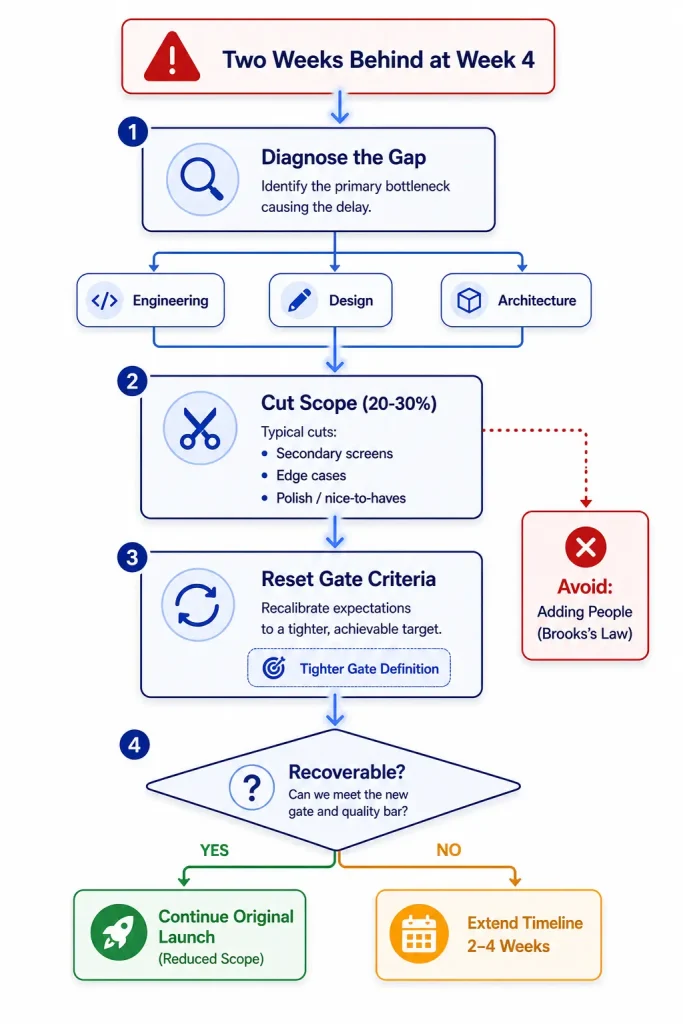
The 4-step recovery protocol:
Step 1: Diagnose the gap honestly. What specifically is missing from the gate 2 deliverables? Is the core workflow not built (engineering gap), or is the design not finalized (design gap), or is the data model wrong (architecture gap)? The diagnosis determines the recovery path; misdiagnosis wastes another week.
Step 2: Cut scope, not corners. Recovery comes from removing work, not from working faster. Identify the lowest-value 20 to 30 percent of remaining scope and cut it explicitly. Common cuts: secondary screens, edge case handling, polish, integration with non-critical third parties. Cuts get documented in the v1.1 backlog so the team has a recovery story.
Step 3: Reset the gate criteria. Gate 2 (originally “core workflow demo-able”) gets reset to a tighter version (e.g., “core workflow happy-path demo-able”). The reset is communicated to all stakeholders, including the founder. A reset gate that is met within 1 week of the original target is a successful recovery; a gate that drifts further is a launch-delay decision.
Step 4: Decide between recovery and timeline extension. If the gap is recoverable through scope reduction, continue toward the original launch date with reduced scope. If the gap reflects fundamental issues (wrong team, wrong stack, wrong scope from the start), accept a 2 to 4 week extension and rebuild the timeline from week 4.
The honest framing: a saas mvp timeline that slips 2 weeks at week 4 has a 60 percent chance of recovering to launch within 1 week of the original target if the recovery protocol is followed, and a 90 percent chance of slipping 4+ weeks if the team just “pushes through.”
The single most expensive recovery mistake: hiring more people in week 4 to “speed things up.” Brooks’s Law applies to saas builds the same way it applies to software projects generally; adding people to a late project makes it later. Recovery comes from scope reduction, not headcount addition.
Tools That Compress vs. Expand Saas MVP Timelines
Tool choices compress or expand the saas mvp timeline meaningfully. The compressors and expanders, in 2026:
Compressors (use these to ship faster).
- Managed identity (Clerk, Cognito, Supabase Auth) instead of custom auth: saves 1 to 2 weeks
- Component libraries (shadcn/ui, Mantine) instead of custom design system: saves 1 to 2 weeks
- Stripe Billing instead of custom billing: saves 2 to 4 weeks
- Vercel or Fly.io instead of custom Kubernetes: saves 1 to 2 weeks
- Prisma (TypeScript) or Eloquent (Laravel) instead of raw SQL everywhere: saves 1 week
Expanders (avoid these unless required).
- Microservices architecture instead of monolith: adds 4 to 8 weeks
- Custom authentication system: adds 2 to 4 weeks
- Custom billing infrastructure: adds 4 to 8 weeks
- Mobile companion app at launch: adds 2 to 4 weeks (use the 10-week or 12-week track)
- Greenfield design system: adds 2 to 3 weeks
The compounding effect matters. A team that picks 3 expanders (microservices, custom auth, custom billing) shifts the saas mvp timeline from 8 weeks to 18+ weeks for the same scope. The same team picking compressors throughout ships at the 8-week target. The GitHub engineering blog documents many of the compressor patterns (managed services, monolith-first, opinionated stacks) used at scale.
Conclusion: The Definitive Saas MVP Timeline as a Discipline
The definitive saas mvp timeline is 8 weeks for the right scope, team, and stack; 10 weeks when compliance or mobile is added; 12 weeks for regulated verticals or enterprise auth. Three go/no-go gates after weeks 2, 4, and 6 prevent runaway scope. Four parallel workstreams compress the critical path. Four usual suspects (scope creep, handoff friction, integration surprises, premature optimization) account for most slippage. The 4-step recovery protocol turns a 2-week slip at week 4 into a launch within 1 week of the original target.
The dominant pattern across saas mvp timeline outcomes in 2026: teams that follow the cadence, honor the gates, and resist scope creep ship in the timeline they planned. Teams that treat the saas mvp timeline as aspirational rather than disciplined ship at 1.5x to 2x the planned duration with bigger budgets and lower confidence.
Saas MVP Timeline FAQ
1. Can a solo developer ship in 8 weeks?
Rarely. The 8-week saas mvp timeline assumes a 3 to 4 person team running parallel workstreams. A solo developer doing the same scope sequentially needs 14 to 20 weeks. The exception: a senior solo developer with prior saas experience, an opinionated stack, and aggressive scope discipline can hit 10 to 12 weeks for a tightly-scoped MVP. Below that, solo development of an 8-week scope is fantasy.
2. What is the fastest realistic timeline for a HIPAA MVP?
10 weeks at minimum, 12 weeks is more realistic. HIPAA adds compliance architecture, BAA workflow, audit log granularity, encryption key management, and security review. Each adds 2 to 4 days; in aggregate they add 2 to 4 weeks to the 8-week baseline. Founders who insist on 8-week HIPAA MVPs ship something that fails the first hospital procurement review.
3. Do I need a designer the full 8 weeks?
Full-time for weeks 1-3 (design system, core workflows, onboarding flow), half-time for weeks 4-8 (refinements, edge cases, error states, marketing assets). A designer who exits at week 3 leaves the team with no one to handle the 30+ small design decisions that come up in weeks 4-8, which slows engineering meaningfully.
4. What delays saas mvp timelines the most?
Scope creep, by a wide margin. Roughly 60 percent of slipped timelines are scope creep alone. The next 30 percent is split across third-party integration surprises (especially billing), design-engineering handoff friction, and premature optimization. Architecture mistakes account for the remaining 10 percent but cause the most expensive slippage when they happen.
5. How do AI tools change the saas mvp timeline?
AI coding tools (Cursor, GitHub Copilot, Claude Code) compress saas mvp timeline build velocity by roughly 20 to 40 percent for experienced engineers, less for junior engineers. The compression comes from boilerplate generation, faster debugging, and improved test coverage. The compression does NOT come from reducing scope or skipping design work; AI tools cannot replace human judgment on what to build, only how to build it.
6. Can I compress from 12 to 8 weeks by adding people?
No. Brooks’s Law: adding people to a late project makes it later. Adding people in week 4 to a 12-week timeline does not produce an 8-week launch; it produces a 14-week launch. Compression comes from scope reduction, not from headcount addition. The right way to ship in 8 weeks is to start with 8-week scope, not to compress 12-week scope mid-build.