

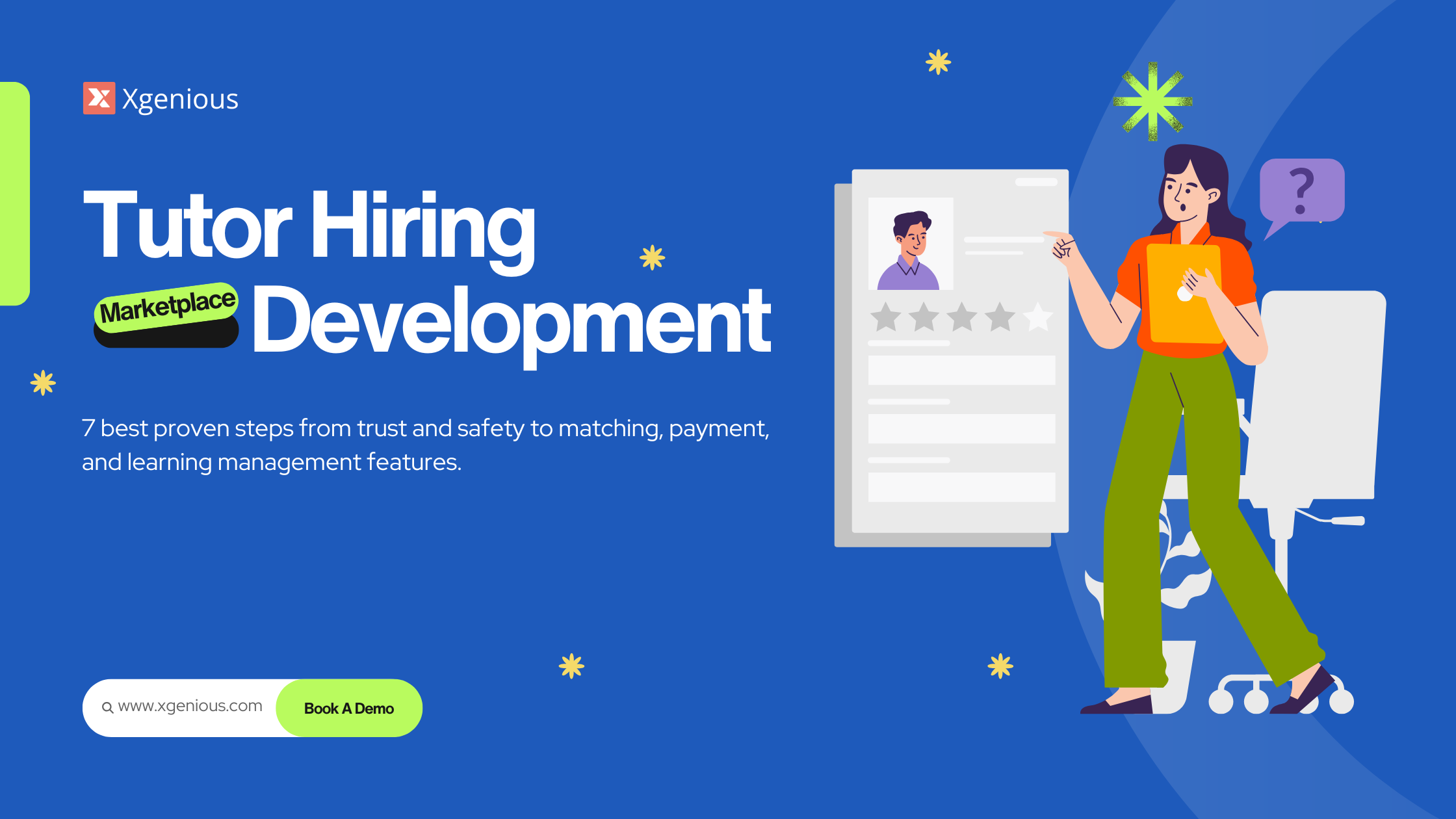


The online tutoring market has grown from a side category in 2018 to a $40 billion global industry in 2026, driven by remote learning normalization, the global shortage of qualified teachers, and parents willing to invest meaningfully in their children’s academic outcomes. Tutor hiring marketplace development sits at the center of this growth, with platforms like Wyzant, Preply, italki, Cambly, and Varsity Tutors capturing meaningful share while regional and niche-vertical platforms continue to launch every quarter.
Tutor hiring marketplace development is meaningfully more complex than other on-demand service marketplaces because of one defining factor: many users are minors. A tutoring platform that serves children under 18 inherits regulatory obligations (COPPA in the US, GDPR-K in the EU, equivalent rules in other jurisdictions), trust requirements (parents need to feel safe handing their child to a stranger), and a three-party relationship dynamic (parents pay, students consume, tutors deliver) that generic two-sided marketplace patterns do not handle out of the box. Founders who copy a generic marketplace template into the tutoring vertical underestimate this complexity and ship platforms that cannot pass parent scrutiny or regulatory review.
This guide walks through the 7 best proven steps that every successful tutor hiring marketplace development project covers: trust and safety infrastructure for minors, tutor profile and verification, AI-powered student-tutor matching, scheduling and session management, payment and pricing systems, learning management features, and quality assurance with reviews.
Five takeaways before reading on: tutor hiring marketplace development inherits unique trust requirements when minors are users; the Trust + Match + Outcome framework drives parent and student loyalty; tutor verification is the platform’s first line of defense; AI matching algorithms compound retention; and the economics depend on subject mix and session duration.
Why Tutor Hiring Marketplace Development Has Unique Trust Requirements
Tutor hiring marketplace development inherits two-sided marketplace patterns (supply: tutors; demand: students and parents) but adds requirements that no other on-demand vertical faces with the same intensity.
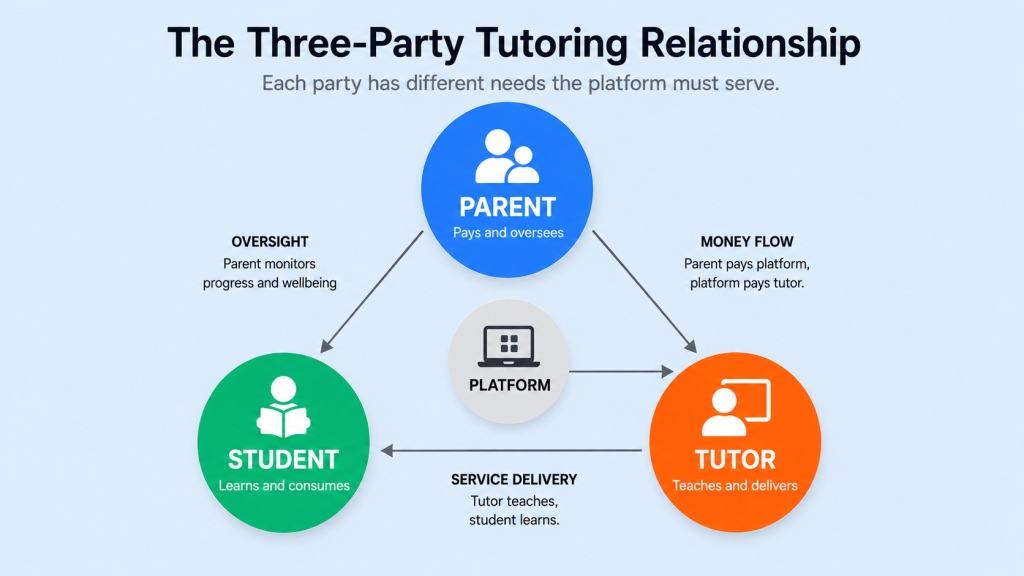
Minors as primary users. A meaningful share of tutoring sessions involves users under 18. K-12 tutoring is the largest tutoring segment globally. The platform must comply with regulations protecting minor users (COPPA, GDPR-K, state-level children’s privacy laws), restrict data collection from minor users, gate certain features behind parent consent, and protect children from inappropriate contact through tutor-student channels.
Three-party relationship dynamics. Most on-demand marketplaces have two parties: payer and provider. Tutoring marketplaces have three: parents pay, students consume the service, tutors deliver. Each party has different needs from the platform. Parents need oversight tools (session monitoring, progress reports, communication logs). Students need engaging learning experiences. Tutors need professional tools (scheduling, lesson planning, earnings management). Designing for one party at the expense of others produces platforms that lose to better-designed competitors.
Outcome expectations. Customers of a typical service marketplace want a single transaction completed. Customers of a tutoring marketplace want their child’s academic outcomes to improve, which is measured over months or years, not in a single session. The platform’s ability to demonstrate learning outcomes (progress tracking, score improvements, grade changes) determines retention and parent willingness to pay premium prices.
Subject and credential complexity. A typical service provider has one job role; a tutor teaches a specific subject at a specific level to a specific student type (K-12, college, adult, special needs). Subject expertise verification, teaching credential verification, and matching tutors to the right student-subject combinations is the central technical challenge.

Trust depth requirement. Parents trust the platform with their children. The trust standard is higher than for any other service marketplace. Background checks, identity verification, session recording options, communication monitoring, and incident response protocols are non-optional. The platform that builds trust deepest wins; platforms that treat trust as an afterthought lose share to ones that did not.
Tutor Hiring Marketplace Development: Market Opportunity and Online Education Growth
The opportunity in tutor hiring marketplace development is large and structurally durable, but it requires honest market analysis to target the right segment.
Market size. Global online tutoring market exceeds $40 billion annually as of 2026, with North America and East Asia accounting for roughly 70 percent of revenue. K-12 tutoring is the largest segment (academic support, test prep, enrichment). Language tutoring is the second-largest (Preply, italki, Cambly all operate primarily in this space). Adult professional learning (technical skills, certification prep) is the fastest-growing segment.
Growth drivers. Three forces drive sustained growth. First, remote learning normalization since 2020 made parents and students comfortable with online tutoring as a primary delivery model. Second, global teacher shortages mean schools cannot meet student needs through traditional channels, pushing demand toward private tutoring. Third, parental investment in academic outcomes has risen meaningfully, especially in markets with competitive college admissions (US, UK, South Korea, China, India).
Customer segments. Three primary student segments. K-12 students working with parental oversight (largest segment, payer is the parent). College students seeking academic support (mid-size segment, often pay their own way). Adult learners pursuing professional development or language acquisition (growing segment, willingness to pay varies widely by income tier and motivation).
Tutor segments. Three primary tutor types. Professional tutors who tutor full-time as their primary income (highest quality bar, command premium pricing). Teachers tutoring on the side (large segment, balance availability with day-job constraints). University students and recent graduates (largest segment, lowest cost, variable quality). Tutor hiring marketplace development decisions vary by which tutor tier the platform targets.
Geographic dynamics. Unlike location-based service marketplaces where hyper-local liquidity matters, tutoring marketplaces operate primarily online and benefit from global liquidity. A US student can be tutored by a tutor in the UK or India; pricing arbitrage across geographies is a structural advantage for global platforms. italki and Preply built their early dominance partly on this arbitrage.
Competitive landscape. Wyzant dominates US in-person and online K-12 tutoring. Preply leads in global language tutoring. italki competes in language with a community-centric model. Cambly focuses on conversational English with native speakers. Varsity Tutors operates premium K-12 and college tutoring. New entrants typically succeed by picking a specific vertical (test prep for specific exams, niche language, special needs tutoring, technical certifications) rather than competing horizontally against established players.
Core Platform Features in Tutor Hiring Marketplace Development
Core features in tutor hiring marketplace development span four primary surfaces: student/parent-facing booking, tutor-facing session management, admin dashboards, and the shared learning infrastructure that supports actual teaching.
Student and parent profiles. Separate profiles for students and parents, linked through a family account when the student is a minor. Student profile captures grade level, subjects of interest, learning goals, preferred tutor characteristics, and learning style preferences. Parent profile holds billing information, oversight preferences, communication settings, and consent records. The dual-profile structure is unique to tutoring and required for any platform serving K-12.
Tutor profiles. Tutor profile captures qualifications (degrees, certifications), subject expertise (with proficiency levels), teaching experience, languages spoken, hourly rates, availability windows, teaching style preferences, sample lesson plans, and historical ratings. The depth of tutor profile data directly affects matching quality.
Service catalog. Structured database of subjects, levels (K-12 grade levels, college courses, professional certifications, language proficiency levels), and session types (one-on-one tutoring, group tutoring, exam prep, homework help, ongoing weekly support). The catalog is the operational backbone; weak catalog structure produces inconsistent matching across tutors.
Booking and session scheduling. Calendar-based scheduling with tutor availability windows, time zone conversion (critical for global platforms), automatic conflict detection, and trial session booking. The booking flow handles single-session bookings, package bookings (5-session bundles), and recurring weekly bookings.
Video conferencing. Native video conferencing or integration with Zoom, Google Meet, or vendor-specific solutions (Whereby, Daily.co). Native integration is increasingly preferred because it enables session recording, shared whiteboards, screen sharing, and integrated chat without users leaving the platform. Most successful tutor hiring marketplace development projects in 2026 build native video.
Shared learning tools. Interactive whiteboard for problem-solving sessions, document sharing for homework review, screen sharing for software-based tutoring (coding, design), code editors for programming tutoring, and real-time collaborative editing for writing tutoring. These tools turn a generic video call into a tutoring-specific experience.
Session recording and replay. Optional or required session recording (with consent from both sides). Recordings serve three purposes: student review of difficult concepts, parent oversight (especially for younger students), and dispute resolution when session quality is questioned. Recording infrastructure adds 5 to 10 percent to platform hosting costs but produces meaningful trust and retention benefits.
Communication infrastructure. In-platform messaging between tutor and student (and tutor and parent when applicable), with optional moderation, profanity filters, and contact-info redaction for K-12 platforms. Direct phone or external messaging is typically prohibited to prevent disintermediation and protect minors.
Progress tracking and assignments. Tutors assign work between sessions, students submit completed assignments, tutors provide feedback. Progress tracking captures session-by-session goals achieved, areas needing more work, and longitudinal academic improvement. Strong progress tracking features differentiate premium platforms from commodity ones.
Admin dashboard. Operations team views all bookings, monitors flagged sessions (when AI moderation surfaces issues), manages disputes, suspends bad-actor tutors, processes payouts, and supports both sides. Admin tools that lag behind operational complexity are a common failure mode in early-stage tutor hiring marketplace development.
The Trust + Match + Outcome Framework for Tutor Hiring Marketplace Development
The Trust + Match + Outcome framework explains why parents and students choose one tutoring platform over another. Three forces shape every customer choice: Trust (will this tutor be safe and competent), Match (is this tutor right for this student), and Outcome (will the tutoring actually improve learning). Platforms strong on all three dominate; platforms weak on any one bleed customers.
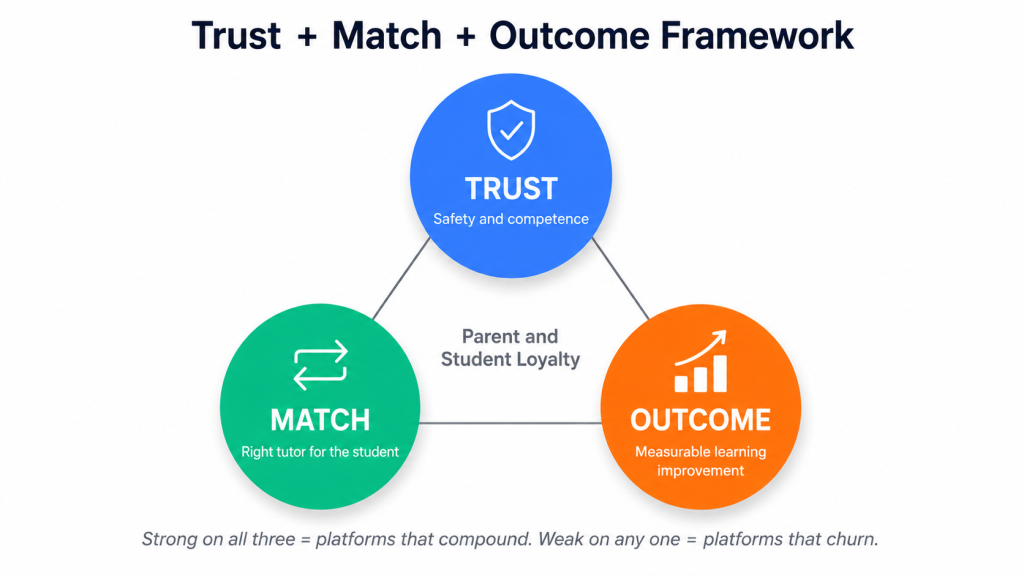
Force 1: Trust. Parents need to feel safe handing their child to a stranger for one-on-one sessions. Platforms build trust through background checks, identity verification, credential verification, session recording options, communication monitoring, and visible review history. Weak trust signals produce platforms that parents abandon at the first hesitation.
Force 2: Match. Students learn fastest when paired with tutors whose subject expertise, teaching style, and personality fit. Generic matching (sort by subject, sort by price) produces mediocre fits; AI-powered matching that considers learning style, prior tutor success patterns, and student goals produces fits that retain. Match quality is where AI investment compounds most in tutor hiring marketplace development.
Force 3: Outcome. Tutoring is paid for outcomes (grade improvements, test scores, language fluency, professional skill acquisition). Platforms that demonstrate outcomes (progress tracking, before-and-after data, longitudinal analytics) earn premium pricing and renewals. Platforms that cannot measure outcomes commoditize toward the lowest-price tutor.
All three forces are required. Unlike some triangle frameworks where two of three is the realistic compromise, tutor hiring marketplace development requires strong performance on all three. Trust without Match produces a safe one-time trial that never converts to ongoing sessions. Trust and Match without Outcome produces sessions that feel productive but do not retain because parents see no measurable improvement. Match and Outcome without Trust produces a platform that parents do not book in the first place.
Tutor Profile and Verification in Tutor Hiring Marketplace Development
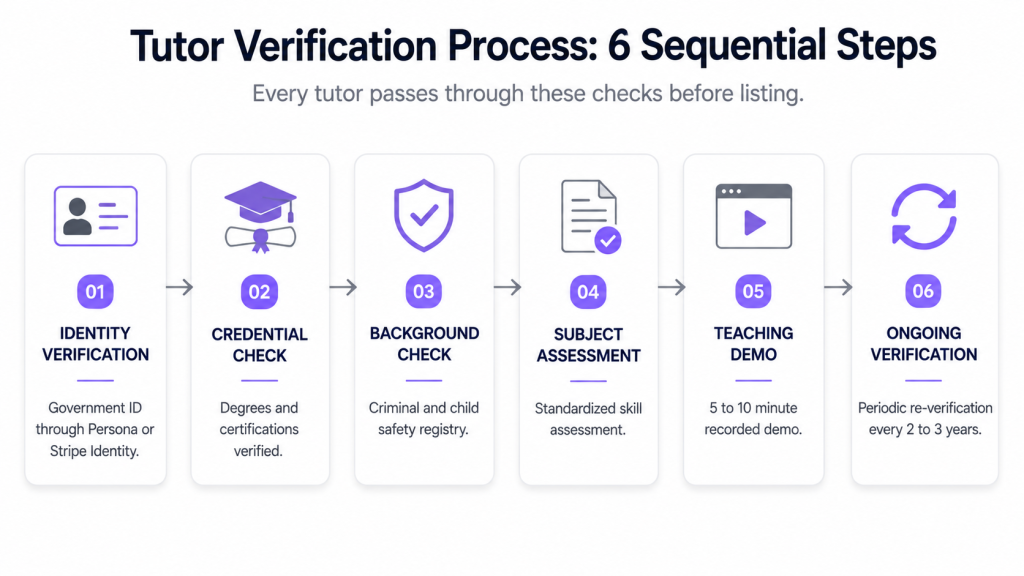
Tutor verification is the platform’s first line of defense and the foundation of the Trust force. Weak verification produces platforms that parents abandon; strong verification produces platforms that command premium pricing.
Identity verification. Government-issued ID verification through services like Onfido, Persona, Stripe Identity, or Veriff. Required for every tutor before they can list. Identity verification confirms the tutor is who they claim to be and produces an audit trail for incident response.
Educational credential verification. University degrees verified through National Student Clearinghouse (US), HEDD (UK), or equivalent national clearinghouses. Teaching certifications verified through state boards (US) or national teaching councils (UK, AU, NZ). Subject-specific certifications (TEFL/TESOL for language tutoring, College Board AP certification, and similar) verified through issuing bodies. Credential verification turns “claimed expertise” into “verified expertise.”
Background checks. Criminal record checks through services like Checkr, Sterling, GoodHire (US), DBS Checks (UK), or local equivalents. The check level depends on jurisdiction and whether the tutor will work with minors. K-12 tutoring platforms typically require enhanced checks (criminal record, sex offender registry, child protection register where applicable). Background check costs run $20 to $80 per tutor, often passed to the tutor or amortized across the platform’s onboarding budget.
Subject expertise assessment. Standardized assessments tutors complete to verify subject expertise. Math tutors complete a math assessment; language tutors complete language proficiency assessment (CEFR scale). Assessments filter out tutors who claim expertise they do not have, which is a meaningful share of self-listed tutors on unverified platforms.
Teaching demonstration. Tutors record a 5 to 10 minute teaching demonstration (explaining a concept from their subject area) reviewed by platform staff or peer tutors. Demonstrations reveal teaching ability beyond credentials and produce content that prospective students can review before booking.
Reference checks. Two to three professional references verified for tutors at the premium tier. References speak to teaching effectiveness, professionalism, and reliability. Reference checks are operationally expensive but produce the trust signal that justifies premium pricing.
Ongoing verification. Initial verification is not enough. Platforms periodically re-verify tutors (annual credential refresh, periodic background re-checks every 2 to 3 years, ongoing identity matching against new sessions). Tutors who fail re-verification are suspended from the platform.
Tutor profile presentation. Verified credentials, completed background check status, assessment scores, teaching demonstrations, and ratings are visible on the tutor profile so students and parents can evaluate before booking. Tutor profiles without these signals lose to platforms that surface them prominently.
The verification stack is operationally meaningful. Budget 5 to 10 percent of operational headcount for verification operations at scale, plus the per-tutor variable cost of background checks and credential verification.
Trust and Safety in Tutor Hiring Marketplace Development: COPPA, GDPR-K, Background Checks
Trust and safety with minors is the differentiator that separates credible tutoring platforms from generic ones. Tutor hiring marketplace development decisions in this area have legal, ethical, and commercial consequences.
COPPA compliance (US, children under 13). The Children’s Online Privacy Protection Act regulates how online services collect and handle data from children under 13. Requirements: verifiable parental consent before collecting personal information from children under 13, restricted advertising and tracking, parental access to and deletion rights for child data, clear privacy policy explaining child data practices. Failure to comply produces FTC enforcement actions; settlements have reached $170 million (YouTube’s 2019 settlement was a wake-up call for the industry). The FTC’s COPPA compliance guidance is the canonical reference.
GDPR-K (EU, children under 16 in most member states). GDPR provisions for children require parental consent for data processing of users under 16 (some EU member states set the threshold at 13, 14, or 15). Requirements: consent verification, simplified privacy notices that children can understand, restricted data processing, and stricter security obligations. Cross-border platforms must comply with the strictest applicable threshold.
State-level US laws. California’s Age-Appropriate Design Code Act, similar laws in other states, and ongoing federal legislation (KIDS Act, KOSA) add layers on top of COPPA. The compliance surface is expanding, not contracting. Platforms designing for minors should over-engineer privacy controls, not under-engineer.
Background checks and child safeguarding. For platforms serving K-12 students, background checks should include sex offender registry checks (NSOPW in the US), child protection register checks (where applicable), and enhanced criminal record checks. The cost is real ($40 to $120 per tutor for enhanced K-12 checks) but the parent trust dividend is meaningful.
Mandatory reporting obligations. Tutors in most jurisdictions are mandatory reporters for child abuse and neglect when working in professional capacity with children. The platform’s tutor terms should document this obligation and provide reporting resources. Some jurisdictions extend mandatory reporting to platform operators.
Communication monitoring and safeguards. Tutor-student messaging should be in-platform only (no direct phone, email, or external messaging) for K-12 tutoring. AI-powered moderation flags concerning messages for human review. Contact-info redaction prevents tutors from sharing personal contact details with minors. Session recording (optional or required by parent preference) provides oversight.
Incident response protocols. When concerning behavior is reported, the platform needs documented response: immediate session suspension, investigation workflow, communication with affected families, mandatory reporting to authorities when required, and clear documentation of resolution. Tutor hiring marketplace development projects that do not plan incident response in advance discover at the worst possible moment that ad-hoc response is inadequate.
Parent oversight tools. Parents need visibility into their child’s tutoring: session schedules, session recordings or transcripts, progress reports, tutor communication logs, and the ability to attend or monitor sessions. Strong parent oversight tools produce repeat business from parents who feel in control.
Trust and safety is not an afterthought in tutor hiring marketplace development; it is the foundation. Platforms that get this right earn parent loyalty that compounds over years; platforms that get it wrong face regulatory action, reputational damage, and customer flight.
Student-Tutor Matching Algorithm in Tutor Hiring Marketplace Development
The matching algorithm is where AI investment compounds most in tutor hiring marketplace development. Generic matching (sort by subject, sort by price) produces mediocre fits and high churn. AI-powered matching that considers multiple signals produces fits that retain students for 3 to 6 sessions or longer.
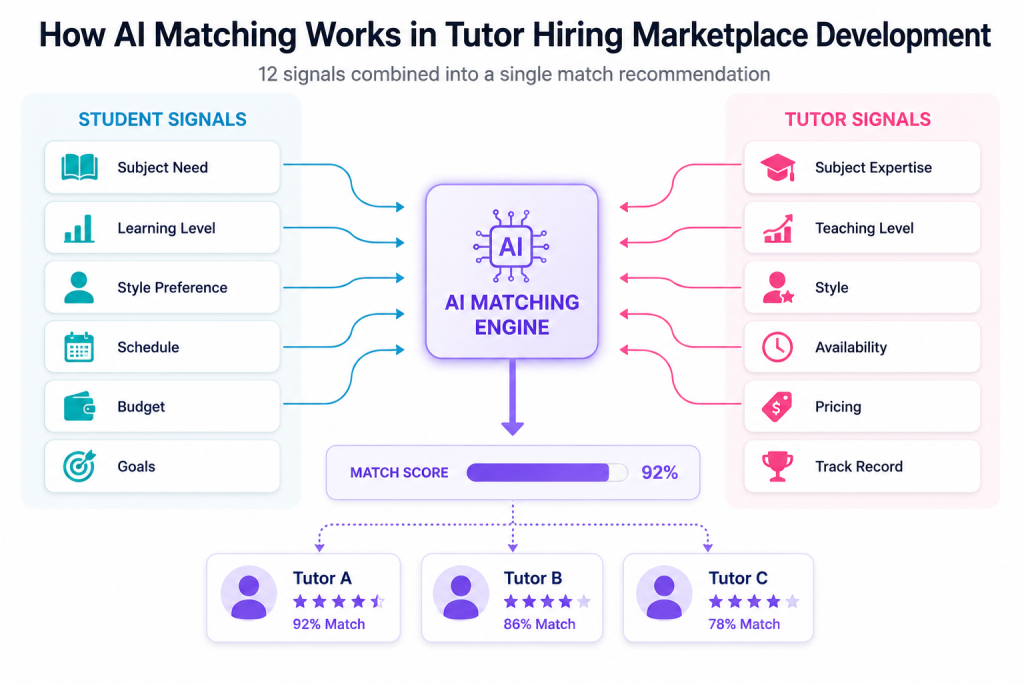
Signals that matter in matching. Subject expertise depth (not just subject, but specific topics within the subject), student learning level (current grade, current proficiency, target outcome), learning style preferences (visual, structured, conversational, intensive), schedule compatibility (timezone, preferred days, session length), language preferences (especially for language tutoring), price tier alignment, and historical tutor success patterns (which tutors have produced the strongest outcomes for students with similar profiles).
Cold-start matching. New students have no historical data. The matching algorithm relies on stated preferences, tutor ratings, and platform-level success patterns to produce initial recommendations. The first 2 to 3 sessions inform the matching for subsequent recommendations. Platforms with weak cold-start handling lose new students at high rates because the first tutor recommendation feels random.
Warm matching. After 3 to 5 sessions, the platform has enough data to refine matches based on observed student behavior. Did the student complete homework assigned by a structured tutor or a conversational one? Did they show better progress with morning sessions or evening sessions? Warm matching feeds back into ongoing tutor recommendations and drives the retention compounding that platforms depend on.
AI matching implementation. Production tutor hiring marketplace development uses embedding-based similarity (encoding tutor profiles and student preferences as vectors, finding nearest neighbors in vector space) plus collaborative filtering (students with similar profiles tend to succeed with similar tutors). Modern platforms layer LLM-based reasoning on top of the embedding match to explain the recommendation to the parent or student in natural language.
Matching quality metrics. Match acceptance rate (percentage of recommended tutors the student actually books), first-session satisfaction (rating given after the trial session), 4-session retention (percentage of students who book 4 or more sessions with the same tutor), and 12-week retention (percentage of students still active on the platform after 3 months). Strong matching platforms hit 70+ percent 4-session retention; weak matching platforms drop below 35 percent.
The matching dataset compounds over time. Every completed session, every rating, every continued engagement, every churn becomes training data. Platforms that ship matching at month 1 and iterate weekly produce meaningfully better matches at month 12 than platforms that ship matching once and forget about it. The matching layer is one of the most important investments in tutor hiring marketplace development.
Scheduling and Session Management in Tutor Hiring Marketplace Development
Scheduling is where tutor hiring marketplace development meets operational complexity. Time zones, recurring sessions, cancellations, reschedules, and parent oversight all need to work cleanly or the platform loses customers to better-organized competitors.
Time zone handling. Tutoring platforms operate across time zones constantly. A student in California booking a tutor in the Philippines, a parent in London paying for sessions with a tutor in India, a college student in New York booking weekend sessions with a tutor in Pakistan. The platform must store all times in UTC, display in each user’s local time zone, and handle daylight saving transitions correctly. Time zone bugs are the most common operational complaint on tutoring platforms; budget engineering attention here disproportionate to its apparent simplicity.
Recurring session bookings. Most successful tutor-student relationships involve weekly or twice-weekly sessions at consistent times. The platform supports “every Tuesday and Thursday at 4pm” recurring bookings, automatic generation of future sessions, and clean handling when one party needs to skip or move a single occurrence. Weak recurring booking support pushes tutors and students toward off-platform direct relationships.
Trial session flow. Most platforms offer free or discounted trial sessions to lower the barrier for new students. The trial flow must handle: trial booking without payment commitment (or with a hold-and-release), tutor decision to accept or decline the trial, post-trial conversion to paid sessions, and clear tutor compensation for trial sessions (some platforms pay tutors for trials, some do not).
Cancellation and rescheduling rules. Platforms publish clear cancellation policies: how far in advance a session can be canceled without penalty (typically 12 to 24 hours), what happens when a tutor cancels last-minute, what happens when a student no-shows. Cancellation policies favor tutors slightly (their time is the platform’s supply constraint) but must protect students from bait-and-switch tutor behavior. Dispute mediation handles the edge cases.
Calendar integrations. Tutors and students benefit from calendar sync with Google Calendar, Outlook, Apple Calendar. Native calendar sync reduces no-shows by 20 to 35 percent compared to in-platform-only scheduling. The integration is operationally complex (calendar APIs change, OAuth flows break, sync conflicts emerge) but the conversion impact justifies the investment.
Notification cadence. Booking confirmation, 24-hour reminder, 1-hour reminder, post-session prompt for rating. Notifications routed through the user’s preferred channel (email, SMS, push notification). Over-notification fatigues users; under-notification produces no-shows. The right cadence is calibrated to each platform’s user base.
Session join experience. The “join session” button needs to work flawlessly across devices, browsers, and operating systems. Most tutor hiring marketplace development teams underestimate the QA burden here. A flaky join experience produces session start delays, which trigger parent complaints, which trigger churn.
Payment and Pricing in Tutor Hiring Marketplace Development
Payment and pricing in tutor hiring marketplace development is structurally complex because of the three-party relationship (parent pays, student consumes, tutor delivers) and the variety of pricing models that work in education.
Marketplace payment infrastructure. Stripe Connect dominates tutor hiring marketplace development in 2026. Stripe Connect handles split payments (platform takes a cut, tutor receives payout), KYC for tutor onboarding, multi-currency support for global platforms, tax reporting (1099-K in US, equivalent in other jurisdictions), and payout scheduling.
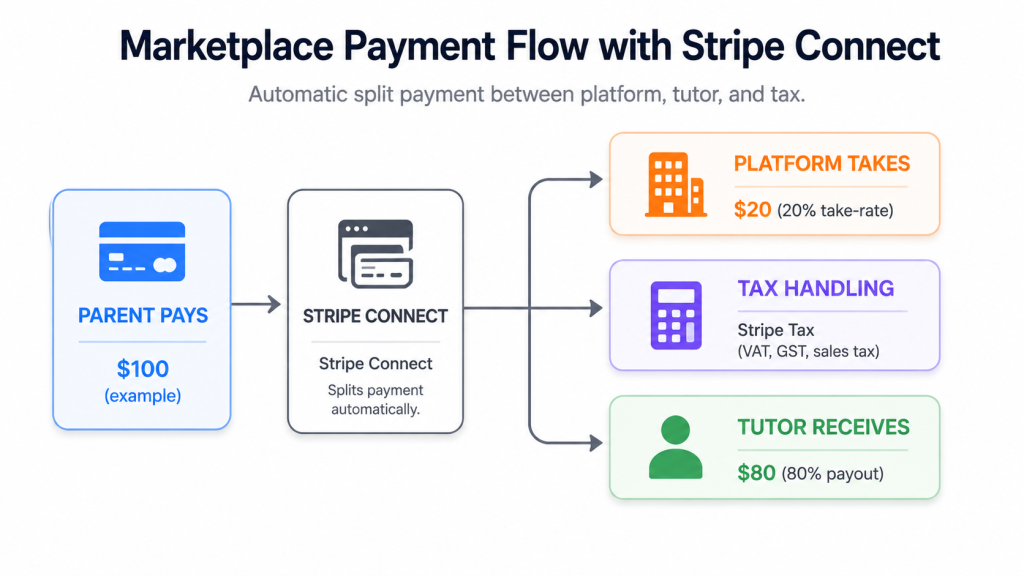
Take-rate structures. Tutor hiring marketplaces typically take 15 to 30 percent of session value. Premium platforms with strong matching and trust signals command higher take rates (Varsity Tutors at the upper end). Commodity language platforms compress to lower take rates (Preply, italki around 15 to 20 percent). The take-rate decision shapes the platform’s economics for years.
Pricing models. Hourly pricing (the most common, simplest to understand), package pricing (5-session bundles, 10-session bundles at a discount), monthly subscriptions (unlimited sessions or capped session counts per month), and group session pricing (lower per-student rate for multi-student sessions). Platforms typically offer 2 to 3 pricing models so different student segments find a comfortable fit.
Tutor pricing tiers. Tutors typically set their own hourly rates within platform-defined ranges. Subject-specific pricing (math tutors charge differently than music tutors), level-based pricing (high school vs college vs adult), and experience-based pricing (new tutors price lower, established tutors price higher). The platform may suggest pricing based on market data or let tutors price freely.
Refund and dispute handling. Sessions that fail (tutor no-shows, technical issues prevent the session, student is unsatisfied) need clear refund policies. The platform mediates disputes between students and tutors, often offering partial refunds or replacement sessions. Refund frequency above 5 percent of completed sessions signals quality or matching problems that need attention.
Subscription mechanics for premium platforms. Cambly, Preply Plus, and similar subscription tiers handle monthly billing through Stripe Billing, manage usage limits (e.g., 20 hours per month included), handle proration when subscribers change tiers, and support pause/resume for users taking breaks.
Tutor payout cadence. Weekly payouts are standard. Faster payout options (instant payout, daily payout) appeal to tutors but cost the platform additional fees. The payout cadence decision affects tutor retention; tutors who feel paid quickly stay on the platform.
Tax handling. Cross-border platforms manage VAT (EU), GST (India, Australia), and US sales tax for tutoring services. Stripe Tax handles most cases automatically; complex jurisdictions (digital services taxes in some EU countries) require additional handling. Skipping tax compliance produces audit risk down the line.
Learning Management Features in Tutor Hiring Marketplace Development
Learning management features turn tutor hiring marketplace development from a booking platform into an educational outcomes platform. The features matter because outcomes drive retention and premium pricing.
Progress tracking. Session-by-session goals, achievements, areas needing work. Tutors note progress at the end of each session; the platform aggregates progress into a parent-visible dashboard showing the student’s trajectory over weeks and months. Progress tracking is the single feature that justifies premium pricing for K-12 tutoring.
Lesson planning tools. Tutors prepare lesson plans before sessions, share materials with students in advance, and reuse plans across similar student profiles. Strong lesson planning tools differentiate professional tutoring platforms from casual ones.
Assignment and homework management. Tutors assign homework between sessions, students submit completed work, tutors provide feedback. Assignment infrastructure includes file upload (PDF, image, document), due date tracking, and submission reminders. Homework completion correlates strongly with learning outcomes; platforms with strong homework features see better retention.
Resource libraries. Tutors and platforms maintain libraries of teaching materials: worksheets, video explanations, practice problems, reading materials. Libraries are organized by subject, level, and skill. Students access relevant resources between sessions; tutors curate libraries for their specific student needs.
Curriculum alignment. For K-12 tutoring, alignment with school curriculum (state standards in US, GCSE/A-Level in UK, equivalent national standards elsewhere) helps tutors target the right content. The platform may provide curriculum guides or partner with curriculum providers.
Practice problems and quizzes. Auto-generated or curated practice problems that students complete between sessions. Performance on practice problems feeds into progress tracking and helps tutors prioritize the next session’s focus areas. AI-generated practice problems based on student weak areas are an emerging feature in 2026 platforms.
Reading and language proficiency tracking. For language tutoring platforms (Preply, italki, Cambly), tracking reading level, vocabulary acquisition, and conversational proficiency provides measurable outcomes that justify ongoing investment.
Achievement systems. Badges, certificates, milestones celebrating student progress. Achievement systems work especially well for younger students and adult learners pursuing certifications. They turn abstract progress into concrete rewards that motivate continued engagement.
Parent reporting. Weekly or monthly summary reports sent to parents showing what the student worked on, progress made, and tutor recommendations for the coming period. Parent reports are the most underrated retention feature in tutor hiring marketplace development; parents who see clear progress documentation renew at meaningfully higher rates.
Quality Assurance and Reviews in Tutor Hiring Marketplace Development
Quality assurance protects the platform’s reputation and produces the trust signal that new students rely on when choosing tutors.
Two-way rating system. Students rate tutors after each session (typically 1 to 5 stars plus optional written feedback). Tutors rate students (no-shows, preparation, communication). Both ratings inform future matching and protect both sides of the marketplace.
Rating dimensions. Beyond a single star rating, platforms collect dimensional ratings: teaching quality, communication, preparation, punctuality. Dimensional ratings give prospective students richer information and surface tutors who excel in specific areas.
Review moderation. Automated moderation filters profanity and obvious spam. Human moderation handles edge cases (defamatory reviews, reviews that violate terms, reviews that surface concerning behavior). Tutors can respond to reviews professionally; platforms mediate disputes when reviews are challenged.
Quality scoring beyond ratings. Platform-internal quality scores combine ratings, session completion rate, no-show rate, response time to messages, and longitudinal student outcomes. High-quality tutors get surfaced more in matching; low-quality tutors get suspended or removed.
Mystery shopping and audits. Established platforms send mystery students to tutors periodically to verify quality. Random session audits catch policy violations. These programs are operationally expensive but maintain quality at scale.
Tutor performance reviews. Periodic reviews of tutor performance against platform standards: are they meeting quality benchmarks, are students learning, are parents satisfied? Tutors who fall below standards face improvement plans or removal from the platform.
Incident response. When concerning behavior is reported (inappropriate tutor conduct, academic dishonesty, harassment), the platform investigates and acts. Documented response protocols, fast investigation timelines (48 to 72 hours), and clear communication with affected families are non-optional for any tutor hiring marketplace development project serving minors.
Five Real Examples of Tutor Hiring Marketplace Development
Five real platforms illustrate the patterns in tutor hiring marketplace development. Each made distinct strategic choices; each succeeded or struggled for different reasons.
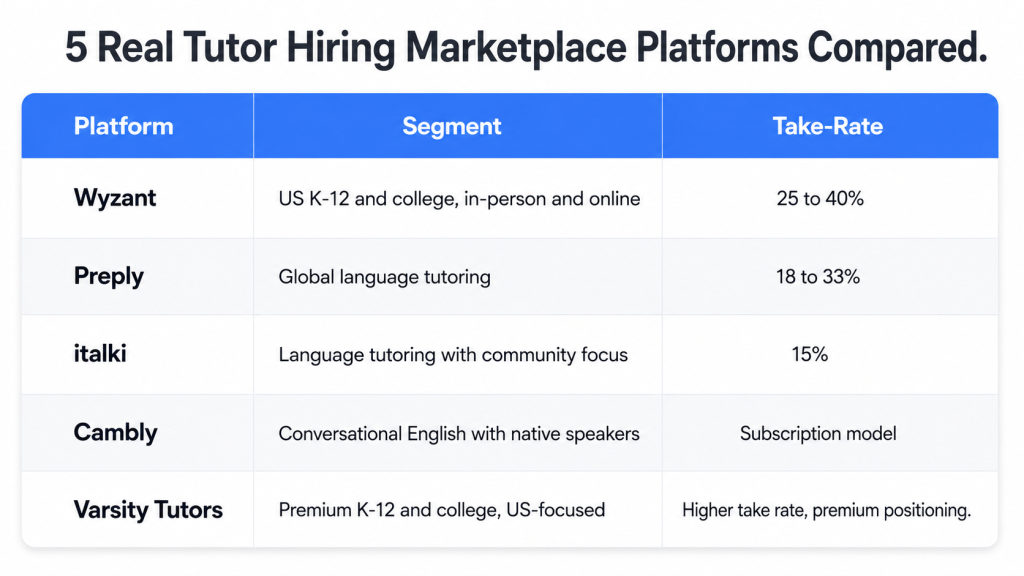
1. Wyzant (US, in-person and online). Founded 2005. US-focused, dominates in-person and online K-12 and college tutoring. Take-rate: 25 to 40 percent depending on tutor experience tier. What it teaches: high take-rates work when the platform delivers strong trust signals (background checks, verified credentials, in-person option) and student outcomes (test score improvement, grade improvement). Wyzant’s dominance in US K-12 reflects two decades of trust accumulation.
2. Preply (global, language). Founded 2013. Global language tutoring marketplace serving 50+ languages. Take-rate: 18 to 33 percent. What it teaches: global liquidity advantage for online-only platforms. Preply scaled by exploiting pricing arbitrage (students in high-income markets, tutors in mid-income markets) and by serving 50+ languages each with deep tutor supply. The model would not work for in-person tutoring; it works because language tutoring is location-independent.
3. italki (global, community-focused language). Founded 2007. Language tutoring marketplace with strong community features (language exchange partners, written discussion forums, structured progress tracking). Take-rate: 15 percent. What it teaches: community features create switching costs and retention beyond what take-rate alone produces. italki’s lower take-rate is offset by higher tutor loyalty (tutors stay because the community works) and student retention (students stay for the community, not just the tutor relationship).
4. Cambly (subscription, conversational English). Founded 2012. Conversational English platform with native speakers and a subscription model (vs per-session). What it teaches: subscription models work when the use case is regular consumption (daily conversation practice) and when supply is abundant (any native English speaker can tutor). The subscription model would not work for K-12 academic tutoring where students have specific subjects and specific tutors; it works for language conversation where any qualified tutor can deliver value.
5. Varsity Tutors (premium US K-12 and college). Founded 2007. Premium positioning with higher take-rates, vetted tutor pool, and direct delivery (the platform manages the relationship more actively than competitors). What it teaches: premium positioning works when the platform invests disproportionately in tutor quality, customer service, and outcome documentation. Varsity Tutors charges meaningfully more than Wyzant on equivalent services, justified by the premium experience.
The pattern across all five: the strongest tutor hiring marketplace development outcomes come from teams that pick a clear segment (K-12 vs language vs adult, premium vs commodity, in-person vs online), execute deeply within that segment, and resist over-expansion until the core segment is dominant.

Conclusion: Building a Tutor Hiring Marketplace That Earns Parent Trust
Tutor hiring marketplace development is meaningfully more complex than other on-demand service marketplaces because of one defining factor: many users are minors. The 7 best proven steps covered in this guide (trust and safety infrastructure, tutor verification, AI matching, scheduling, payment, learning management, quality assurance) provide the structural foundation. The Trust + Match + Outcome framework explains why parents and students choose one platform over another and where successful platforms invest disproportionately.
The dominant pattern across the five real examples (Wyzant, Preply, italki, Cambly, Varsity Tutors): platforms that pick a clear segment, execute deeply within it, and resist over-expansion compound trust and outcomes faster than platforms that chase horizontal breadth. Premium positioning works when the platform invests in trust signals and outcome documentation. Commodity positioning works when global liquidity and pricing arbitrage produce competitive economics. The wrong segment choice is more expensive than any single feature decision.
For the broader build framework that places tutor hiring marketplace development in the larger on-demand marketplace decision space, the same patterns apply to other vertical service marketplaces: clear segment, deep trust infrastructure, AI-powered matching, and outcome-focused design. For founders ready to engage a fixed-price agency for a tutoring marketplace MVP built around these patterns, Xgenious offers MVP packages calibrated to the cadence described in this guide. See our service packages for scope, timelines, and engagement options.
Tutor Hiring Marketplace Development FAQ
1. Is an AI agent just a fancy chatbot?
No. An AI agent is goal-directed, uses tools, maintains state across sessions, and embeds into product workflows. A chatbot is reactive, conversation-only, typically stateless across sessions, and lives at the product surface. The same LLM can power either, but the architectures around the LLM differ meaningfully. Treating an agent as a fancy chatbot leads to broken product expectations; treating a chatbot as a stripped-down agent leads to over-engineering. The AI agent vs chatbot category choice is a real architectural decision, not a marketing label.
2. Can I start with a chatbot and upgrade to an agent later?
Yes, and this is often the right path. A chatbot MVP validates user demand at a fraction of the cost. If usage data shows users want delegation rather than conversation, upgrade the architecture to agent. The migration is meaningful work (4 to 8 weeks typically) but is well-understood; the chatbot-first path de-risks the AI agent vs chatbot decision when product-market fit is uncertain.
3. What is the cost difference between AI agent and chatbot for saas?
Build cost: chatbot MVP at $5K to $20K; agent MVP at $40K to $200K. Operating cost: chatbot at $0.05 to $0.50 per user per month; agent at $2 to $50 per user per month. The 5x to 50x operating-cost multiplier is what most founders miss when evaluating AI agent vs chatbot. Agent unit economics require pricing that supports the higher operating cost.
4. Do I need both an AI agent and a chatbot in my saas?
Often yes. Many production saas products deploy chatbot architecture at the support surface (high-volume, low-cost deflection) and agent architecture at the workflow surface (high-value, premium-tier features). The AI agent vs chatbot question is rarely either-or at the product level; it is per-surface within the product.
5. Which is harder to build, an AI agent or a chatbot?
AI agent, by a wide margin. A chatbot ships in 2 to 4 weeks with a senior engineer. An agent requires 8 to 16 weeks with a specialized team including engineers experienced in tool integration, memory infrastructure, evaluation harnesses, and observability for multi-step LLM workflows. The architectural complexity is roughly 5x.
6. Will AI agents replace chatbots entirely by 2027?
No. The categories solve different problems. Chatbots will remain the right architecture for information delivery, FAQ deflection, and conversation-only use cases. Agents will dominate workflow automation, multi-step reasoning, and goal-pursuit use cases. The AI agent vs chatbot distinction will sharpen rather than blur as both categories mature.