
On-Demand Home Service Marketplace Platform
A location-aware marketplace connecting homeowners with vetted service providers — real-time chat, multi-service cart checkout, WhatsApp notifications, and Flutter mobile apps for both customers and providers.
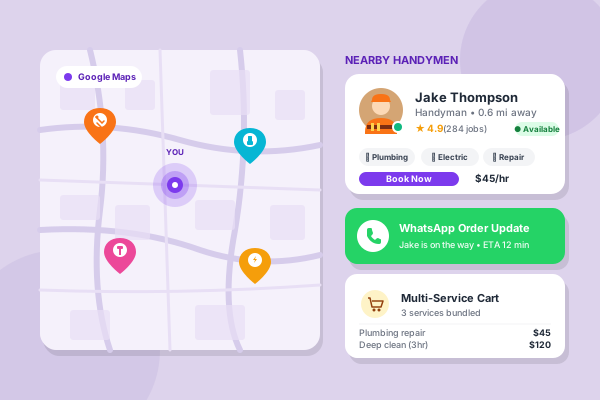
A TaskRabbit alternative built for a local market
Our client wanted to build an on-demand home service marketplace for their region — connecting homeowners with trusted plumbers, electricians, cleaners, and other service professionals. The platform had to work on both web and mobile with location-based matching and real-time communication.
We built the platform on Laravel with a Flutter mobile app covering both the customer and provider sides. Google Maps drives location-based discovery. WhatsApp Business API handles order notifications at every lifecycle stage.
Core product message: Book trusted home service professionals in your area in minutes.
Connecting the right provider to the right customer in real time
On-demand marketplaces fail when matching is slow or unreliable. The platform needed fast, accurate location matching, instant job dispatch to providers, and seamless communication — all while handling multiple service categories and payment methods.
A two-sided marketplace with geographic intelligence
Service providers set their serviceable area on Google Maps during onboarding. Customer searches filter available providers using spatial queries — only providers whose area covers the customer location appear in results. Booking confirms immediately and triggers real-time dispatch to the provider.
The WhatsApp Business API integration sends automated messages at every order state: confirmed, provider assigned, provider en route, completed. Templates are pre-approved through the Meta Business Manager during the setup phase.
Platform Features
Spatial queries, real-time dispatch, multi-channel notifications
Provider service areas are stored as spatial geometries. Customer location searches execute ST_Within spatial queries to find covering providers — significantly more accurate than simple radius-based matching for irregular service areas.
The notification layer supports three channels in parallel: in-app push via FCM, WhatsApp Business API, and email. Each notification event dispatches to all active channels for the recipient — channels can be toggled per user in settings.
Hard problems, solved cleanly
Location-Based Provider Matching
Matching customers to service providers within a defined geographic area. Providers configure their serviceable radius; the platform queries providers using Haversine distance calculations and filters by availability.
Multi-Service Cart Checkout
Customers booking multiple services from different providers in one session. The cart model accumulates services, splits payment by provider at checkout, and dispatches individual job notifications to each provider.
Real-Time Job Dispatch
When a booking is confirmed, the relevant provider receives an instant push notification and can accept or decline within a window. If declined, the job routes to the next available provider in the area.
WhatsApp Business API Integration
Integrating WhatsApp Business API for automated order lifecycle notifications — confirmation, provider assigned, en route, completed. WhatsApp templates must be pre-approved; we handle the approval workflow and fallback to SMS.
Staff Management for Providers
Larger service providers need to manage multiple staff members, assign jobs to specific staff, and track individual performance. A staff sub-account system allows providers to onboard staff without sharing their admin credentials.
A live marketplace with location-aware matching in production
The platform launched with both mobile apps alongside the web portal. Service providers self-onboard, configure their area and availability, and receive jobs directly to their phone. Customers get WhatsApp confirmation at every step.
The multi-service cart model increased average order value from day one. Staff management tools allowed larger service companies to manage a team of technicians without separate software. The architecture supports adding new service categories without code changes.


Questions about building a home service marketplace?
Common questions from founders before starting an on-demand marketplace engagement.
A full on-demand home service marketplace — with web platform, Flutter mobile apps, Google Maps integration, real-time chat, and 20+ payment gateways — typically ranges from $30,000 to $75,000. Mobile scope and the number of service categories are the main variables.