
On-Demand Car Service & Mechanic Marketplace
A vehicle-aware booking marketplace connecting car owners with mechanics and auto service shops — real-time order tracking, 19+ payment gateways, multi-branch provider support, and an Android mobile app.
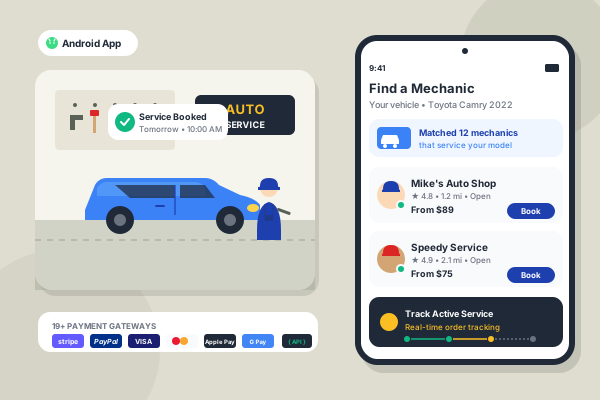
Booking a mechanic as easy as booking a ride
Our client needed to build a marketplace connecting car owners with local mechanics and auto service providers. The key challenge: car services are vehicle-specific. A booking for a Mercedes diesel requires a different mechanic than one for a Toyota hybrid — the platform had to match on vehicle compatibility.
We built a Laravel backend with an Android mobile app, a clean REST API, and an admin panel that lets the client manage service providers, configure promotions, and handle disputes — all without engineering involvement.
Core product message: Get your car serviced by a qualified mechanic — booked in minutes, tracked in real time.
Vehicle-specific matching in a fragmented market
Generic service marketplaces fail in automotive because not every mechanic services every car. The platform needed vehicle taxonomy, capability tagging for providers, and a matching layer — plus multi-branch support for larger auto shop chains.
A structured vehicle taxonomy driving smart matching
We built a vehicle catalog with make, model, and year linked to service categories. Providers tag which vehicle types they service. Bookings filter providers by vehicle compatibility first, then by location and availability — reducing irrelevant results and provider rejection rates.
Multi-branch providers configure each location independently. Jobs route to the correct branch based on customer location proximity. The admin panel consolidates all branch data under one account, giving chain operators a unified view.
Platform Features
Laravel REST API + Android app + unified payment layer
The backend is a RESTful Laravel API documented in Postman. The Android app consumes the same API as the web admin panel — a single codebase serves all clients. FCM handles push notification delivery to both customer and provider apps.
All 19+ payment gateways implement a common interface. Refund routing is handled automatically — the platform knows which gateway processed the original charge and routes the refund to the correct provider API without any manual lookup.
Hard problems, solved cleanly
Vehicle-to-Service Matching
Car services are specific to vehicle make, model, and year. Building a matching layer that filters compatible mechanics for each booking type — oil changes, brake jobs, diagnostics — required a structured vehicle taxonomy with service capability tags per provider.
Branch Location Management
Auto shop chains with multiple locations need each branch to operate semi-independently. Each branch has its own schedule, inventory of services, and serviceable area — but rolls up to a single brand owner account.
Real-Time Status Tracking
Customers expect to know when their car is being worked on. A lightweight state machine governs job lifecycle: requested → accepted → in progress → completed → reviewed. Each state transition triggers push notifications to the customer.
Refund Processing Across Gateways
Each payment gateway has a different refund API. The unified payment abstraction layer handles refund routing, ensuring that a refund for a Razorpay payment goes through Razorpay's refund endpoint — not Stripe's — without the application layer needing to know the difference.
Postman-Documented REST API
The client needed a clean REST API so future developers could extend the platform. Every endpoint was designed with RESTful conventions and documented in Postman collections, covering authentication, booking lifecycle, payment processing, and notifications.
A live automotive marketplace with vehicle-intelligent booking
The platform launched on Google Play alongside the web portal. Car owners book compatible mechanics directly from their phone. Service providers receive jobs with full vehicle details already included — fewer back-and-forth messages, faster acceptance rates.
The documented REST API means the client can onboard new developers without tribal knowledge. Multi-branch support allowed the first auto chain partners to onboard all locations in a single admin account from day one.


Questions about building a car service marketplace?
Common questions from founders before starting an automotive marketplace engagement.
A car service marketplace with web platform, Android app, real-time order tracking, and 19+ payment gateways typically ranges from $25,000 to $60,000. Complexity of vehicle matching logic, number of service categories, and whether iOS is required alongside Android are the main variables.