
AI-Powered Customer Support SaaS Platform
A self-hostable, multi-tenant SaaS platform combining semantic AI chatbots, support ticketing, a knowledge base builder, and subscription billing — a full alternative to Intercom and Crisp that clients can run and monetize on their own infrastructure.
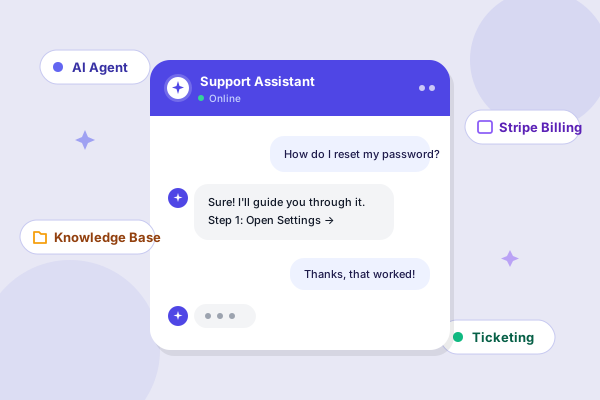
Enterprise-grade AI support, without the enterprise price tag
Our client needed to launch a SaaS platform that would let businesses deploy AI-powered customer support on their own sites — without paying $30–45 per month to Intercom, Crisp, or Tidio per seat.
We built a fully self-hostable, multi-tenant platform on Laravel. Each workspace gets its own AI chatbot trained on a custom knowledge base, a full ticketing system, real-time visitor tracking, and an embeddable chat widget — all managed from a single admin panel.
The platform owner can monetize client workspaces with Stripe and PayPal subscription billing, set usage limits per plan, and scale to unlimited clients without infrastructure changes.
Businesses were overpaying for support tools that didn't understand their customers
Existing SaaS support tools had two problems: they were expensive on a per-seat model, and their chatbots relied on keyword matching — failing the moment a customer phrased a question differently from the FAQ.
A complete AI support platform the client owns outright
We built a full-stack SaaS platform where every workspace is independently configured. Clients train their chatbot on their own knowledge base — FAQs, help articles, product docs — and the AI uses vector similarity search to answer questions semantically, not by keyword.
When the AI can't answer, the conversation escalates to a support ticket with full context — conversation history, visitor location, browsing path — already attached. Agents work from a unified dashboard with SLA timers, priority routing, and analytics.
The platform owner monetizes via built-in Stripe and PayPal billing. Plans, limits, and trial periods are configured in the admin panel — no code changes required to launch or modify pricing.
Platform Features
Built to scale from one client to thousands
Laravel handles the API, business logic, and queue workers. PostgreSQL stores tenant data with row-level scoping — no cross-tenant data leaks by design. Redis powers session caching and background job queues for AI processing.
AI responses are generated asynchronously via OpenAI or Claude, with vector embeddings stored per knowledge base entry. Pusher handles the real-time chat stream and live visitor presence — agents see visitors appear, navigate, and type in real time.
Hard problems, solved cleanly
Semantic AI vs Keyword Matching
Traditional support chatbots fail when users phrase questions differently from the FAQ wording. We implemented vector similarity search so the AI understands context and intent — not just exact keyword hits.
Multi-Tenant Workspace Isolation
Each client on the platform gets their own knowledge base, chatbot configuration, widget, and analytics — fully isolated. Tenant data is scoped at the database level to ensure zero cross-contamination.
Embeddable Widget with Minimal Footprint
The chat widget needed to load on any third-party site without slowing it down. We delivered a lightweight CDN-served script installable in one line, with async loading and zero layout impact on the host site.
Real-Time Visitor Intelligence
Support agents needed live context — who is on the site, what pages they visited, where they are. We built a Pusher-backed visitor tracking layer that feeds location, session history, and browsing path into the agent dashboard in real time.
Subscription Billing at SaaS Scale
The platform owner needed to monetize client workspaces with tiered plans, trial periods, and usage limits. We wired Stripe and PayPal billing with webhook-driven plan enforcement so the owner can launch and manage subscription tiers without code changes.
A fully owned SaaS business, not a monthly subscription
The client launched a live SaaS product they own and operate entirely — no vendor lock-in, no per-seat fees, no data on third-party servers. They can run it for one client or ten thousand without the cost curve of Intercom or Crisp.
The semantic AI engine consistently handles 40–60% of incoming support volume without agent involvement. When tickets do escalate, agents have full context immediately — no back-and-forth to understand the customer's situation.


Questions about building a SaaS platform like this?
Common questions from founders before starting a multi-tenant SaaS engagement.
A multi-tenant SaaS platform of this scope — AI integration, real-time features, subscription billing, embeddable widget, and two-tier dashboard — typically ranges from $20,000 to $60,000 depending on scope and integrations. We work on fixed-price contracts with committed delivery dates.