



The AI agent vs chatbot conversation is the most expensive misframing in saas product strategy in 2026. Founders who pick the wrong category waste 3 to 6 months building a chatbot when they needed an agent, or vice versa. Investors look at the wrong metrics. Marketing teams write the wrong copy. Engineers build the wrong architecture. The category choice is foundational, and getting it right takes 30 minutes of clear thinking rather than 30 weeks of expensive rework.
This guide walks through 5 smart decision factors that resolve the AI agent vs chatbot question for any product. Factor 1 is autonomy: does the system react to messages or pursue goals? Factor 2 is tool use: does it converse or take actions through APIs? Factor 3 is memory: is it stateless within sessions or stateful across them? Factor 4 is cost: what do tokens, latency, and engineering investment actually look like? Factor 5 is integration depth: is it a surface widget or a system component? The 5 factors combine into the Agent/Chatbot Decision Tree, which routes any product idea to the right category in under 5 minutes.
Five takeaways before reading on: AI agent vs chatbot is a category choice with real engineering cost differences; the same LLM can power either, but the systems around the LLM differ meaningfully; chatbots are not “worse agents,” they are a different category that wins specific use cases; agents cost 3 to 10x more to build and operate than chatbots; the decision tree turns the question from religious debate into structured analysis. For the broader build framework that places this AI agent vs chatbot decision in context, see master AI agent development.
AI Agent vs Chatbot: The Real Distinction
The AI agent vs chatbot distinction matters because the two systems solve fundamentally different problems despite often using the same underlying LLM.
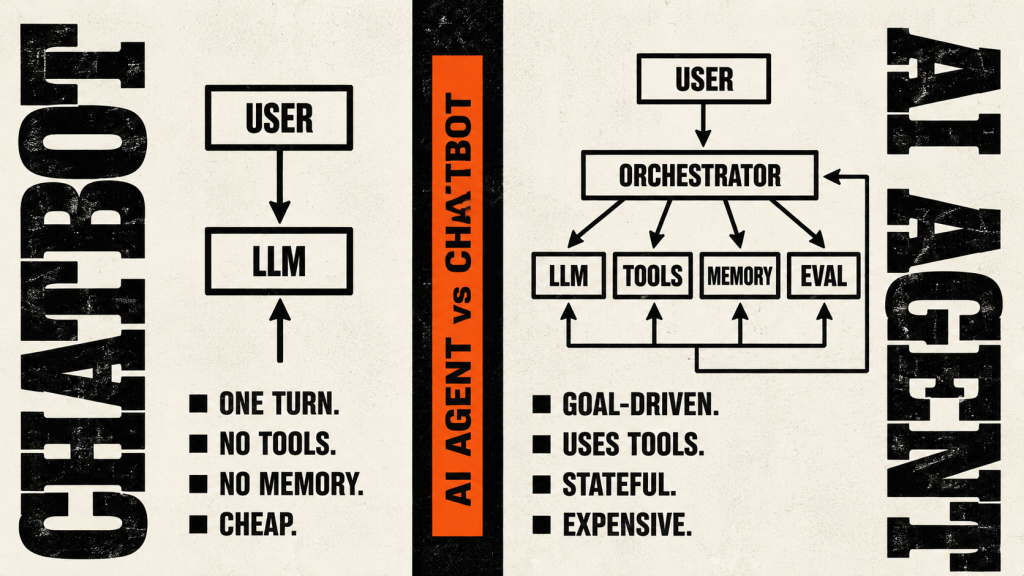
A chatbot is a conversation engine. It receives a user message, generates a response, and waits for the next message. The interaction model is question-and-answer, even if the conversation has multiple turns. The chatbot’s job is to communicate, inform, or guide; the user does the work outside the conversation.
An AI agent is a goal-pursuit engine. It receives a user goal, breaks the goal into steps, takes actions (often involving external tools, APIs, and databases), observes results, and iterates until the goal is achieved or until it determines achievement is impossible. The interaction model is delegation; the user expects the agent to do the work, not just discuss it.
The same LLM (Claude, GPT-5, Gemini, Llama) can power either system. The difference lives in the engineering scaffolding around the LLM: orchestration logic, tool integration, state management, memory persistence, evaluation harness, error handling. A chatbot’s scaffolding might be 200 lines of code; an agent’s scaffolding routinely exceeds 5,000 lines. The architectural depth difference is what makes AI agent vs chatbot a meaningful build decision rather than a marketing label.
Three shifts have sharpened the AI agent vs chatbot distinction since 2023. First, function calling APIs (OpenAI 2023, Anthropic 2024, MCP standardization 2024-2025) made tool use a first-class capability. Second, vector databases and memory infrastructure (pgvector, Pinecone, Weaviate) made stateful long-term memory practical. Third, multi-agent orchestration frameworks (LangGraph, AutoGen, CrewAI) gave teams patterns for complex agent workflows. None of these matter for chatbots; all of them matter for agents.
For founders evaluating whether their product needs a chatbot or an agent, the AI agent vs chatbot decision is not about which technology is newer or more impressive. It is about which architecture matches the user job-to-be-done.
Why the AI Agent vs Chatbot Confusion Costs Founders Money
The AI agent vs chatbot confusion is one of the most expensive misframings in 2026 saas. Three failure patterns drain founder budgets predictably.
Failure pattern 1: Scoping an agent, building a chatbot. The founder pitches investors on an “AI agent” that automates a workflow, then commissions a build with chatbot scope (single-turn responses, no tool use, no state). Six weeks in, the team realizes the system cannot accomplish the goal the founder promised. The team has to add tool use, state management, and orchestration patterns that the original architecture cannot support. Cost: 4 to 8 weeks of rework plus $20K to $50K in engineering investment beyond the original budget.
Failure pattern 2: Scoping a chatbot, building an agent. The founder needs a simple FAQ system or basic conversational interface, but the team builds a full agent with tool orchestration, memory layers, and multi-step reasoning. The product works but takes 4x longer to build, costs 5x more to operate, and introduces failure modes (tool errors, reasoning loops, memory inconsistencies) the simpler chatbot would not have had. Cost: 6 to 12 weeks of over-engineering plus ongoing $5K to $30K monthly inference costs that the simpler architecture would have avoided.
Failure pattern 3: Marketing one, delivering the other. Marketing copy promises “an AI agent that automates X,” product delivers a chatbot that explains X. Users sign up expecting delegation, get conversation, churn within 30 days. CAC payback never reaches break-even because the product mismatch destroys retention. Cost: high CAC waste, brand damage, and the strategic distraction of explaining to investors why retention is poor.
The AI agent vs chatbot category mismatch usually surfaces at month 3 or 4 of a build, exactly when the team has invested enough that pivoting is painful but not so much that the wrong path is irreversible. The decision tree in this guide exists to prevent that month-3 reckoning by forcing the category decision into the planning phase where it belongs.
The 7 mistakes that compound this category confusion across saas builds are covered at common saas mvp mistakes.
The 5 Smart Decision Factors in AI Agent vs Chatbot
The AI agent vs chatbot decision resolves cleanly when teams evaluate 5 factors: autonomy, tool use, memory, cost, and integration depth. Each factor has a clear chatbot answer and a clear agent answer; the combination determines which category fits.
The 5 factors and the decision they force:
Factor 1 (Autonomy): Does the user expect the system to do the work, or to help them do it themselves?
Factor 2 (Tool Use): Does the use case require touching external systems (APIs, databases, third-party services) to deliver value?
Factor 3 (Memory): Does value compound across sessions, or is each interaction self-contained?
Factor 4 (Cost): Can the unit economics support 3 to 10x the per-interaction cost?
Factor 5 (Integration Depth): Is the system a surface widget or a system component embedded in workflows?
Each factor scores chatbot or agent. Three or more agent scores routes the build to AI agent architecture. Three or more chatbot scores routes the build to chatbot architecture. Even splits (2 to 3) require deeper analysis covered in the decision tree later in this guide.
The framework prevents both over-engineering (treating every interaction as agent-worthy) and under-engineering (forcing complex workflows through chatbot constraints). Most AI agent vs chatbot decisions tip clearly in one direction once the 5 factors are evaluated honestly.
Factor 1: Autonomy – Reactive vs Goal-Directed
The first factor in AI agent vs chatbot evaluation is autonomy. The autonomy axis separates reactive systems (chatbots) from goal-directed systems (agents) in a single dimension that often resolves the whole question.
Reactive systems (chatbot territory). User sends a message. System responds. System waits. User decides next step. The cognitive work and the action work stay with the user. The system’s job is to inform, explain, summarize, or guide. Examples: a documentation search interface, a customer support FAQ bot, a content recommendation chat, a feature explanation assistant.
Goal-directed systems (agent territory). User states a goal. System decomposes the goal into sub-tasks, takes actions to advance each sub-task, observes the results, decides what to do next, and continues until the goal is achieved or impossible. The cognitive work and (importantly) the action work shift to the system. Examples: an agent that schedules meetings by checking calendars and sending invites, an agent that researches a competitor and writes a briefing, an agent that processes incoming invoices and posts journal entries.
The diagnostic question for Factor 1: when the user finishes interacting, does the user have a result or just information? Chatbots produce information; agents produce results.
The honest test for autonomy: write a user prompt and the ideal system response. If the response ends with the user needing to do additional work to achieve their underlying goal, the system is a chatbot. If the response ends with the goal accomplished (or meaningfully advanced toward accomplishment), the system is an agent.
Many AI agent vs chatbot debates resolve at Factor 1 alone. A founder who realizes “users want answers, not actions” recognizes they need a chatbot. A founder who realizes “users want the work done, not just discussed” recognizes they need an agent. The other 4 factors confirm or qualify the Factor 1 answer.
Factor 2: Tool Use- Conversation vs Action
The second factor in AI agent vs chatbot evaluation is tool use. Tool use is the technical capability that turns a goal-directed system from theoretical (the agent can decide what should happen) to practical (the agent can make it happen).
Conversation-only systems (chatbot territory). The system’s outputs are text or structured data returned to the user. Even sophisticated chatbots with retrieval-augmented generation (RAG), multi-turn memory, and detailed system prompts remain conversation-only when they do not invoke external functions. The LLM generates content; the user takes the content elsewhere to act on it.
Action-capable systems (agent territory). The system can invoke functions that modify external state: query databases, call APIs, send emails, schedule meetings, post to CRMs, update tickets, execute code. Function calling APIs (OpenAI, Anthropic, Google) and the Model Context Protocol (MCP) standardize how agents invoke tools. Tool use is the dividing line between systems that talk and systems that do. The OpenAI Assistants API overview and the Anthropic agentic patterns guide both center function calling as the foundational agent capability.
The diagnostic question for Factor 2: does the use case require touching external systems to deliver the value the user came for? If yes, the system needs tool use, which puts it in agent territory. If no, the system can deliver value through conversation alone, which keeps it in chatbot territory.
Tool use carries engineering weight that is often underestimated. A working agent with 10 tools typically requires 3,000 to 8,000 lines of code dedicated to tool definitions, error handling, retry logic, permission checks, and observability. The architectural patterns that support production-grade tool use are covered at AI agent architecture.
The trap in Factor 2: founders sometimes scope a single tool (e.g., “the chatbot can also look up our customer database”) and assume that makes the system an agent. One tool does not make a system an agent; multi-step goal pursuit with tool use does. A single-tool conversational system is still a chatbot with a feature.
Factor 3: Memory- Stateless vs Stateful
The third factor in AI agent vs chatbot evaluation is memory. Memory determines whether the system improves with use or starts fresh every interaction.
Stateless or session-stateful systems (chatbot territory). Each conversation is independent of past conversations. The chatbot may remember the current session’s earlier turns (working memory within the context window), but it forgets the user once the session ends. Stateless systems are simple to build and operate, and they work well for use cases where each interaction is self-contained: customer support tickets, content generation, one-off questions.
Long-term stateful systems (agent territory). The system maintains persistent memory of users, past interactions, preferences, and learned patterns across sessions. Long-term memory is stored in vector databases (pgvector, Pinecone, Weaviate) and retrieved at the start of each session to give the agent context about who the user is and what has happened before. Memory turns one-shot tools into systems that compound value over time.
The diagnostic question for Factor 3: does the value to the user grow with usage, or does each interaction stand alone? If usage compounds (the system gets more useful as it learns about the user), the system needs stateful memory and belongs in agent territory. If each interaction is independent (today’s question has nothing to do with yesterday’s), stateless chatbot architecture is sufficient.
The hidden cost in Factor 3: memory infrastructure adds 15 to 30 percent to AI agent vs chatbot build cost. Vector database choice, embedding generation, retrieval reranking, and memory write strategies all require engineering decisions that stateless chatbots avoid entirely. Founders who plan stateless architecture and later realize they need stateful memory face a 4 to 8 week retrofit.
The memory layer architecture for production agents is covered in depth at the AI agent development pillar where the Capability Stack framework treats memory as one of the five required layers.
Factor 4 in AI Agent vs Chatbot: Cost
The fourth factor in the AI agent vs chatbot evaluation is cost. The cost differential is larger than most founders realize and meaningfully shifts the unit economics of the resulting product.
Token cost. Chatbots typically consume 500 to 3,000 tokens per interaction (system prompt plus user message plus response). Agents typically consume 5,000 to 50,000 tokens per task (system prompt plus reasoning trace plus tool calls plus tool results plus final response). The 5x to 25x token multiplier compounds at scale. A chatbot serving 10,000 monthly active users at $0.20 per interaction costs $2K per month in inference. An agent serving the same audience at $2 to $5 per task costs $20K to $50K per month.
Latency cost. Chatbots return responses in 1 to 3 seconds. Agents executing multi-step workflows return responses in 5 to 60 seconds depending on tool count and reasoning depth. The latency difference forces UX accommodations in agent products (loading states, progress indicators, async result delivery) that chatbots do not need.
Engineering cost. A chatbot MVP ships in 2 to 4 weeks at $5K to $20K with a specialized agency. An agent MVP ships in 8 to 16 weeks at $40K to $200K. The 4x to 10x engineering multiplier reflects the architectural complexity covered throughout this AI agent vs chatbot guide: tool definitions, error handling, memory infrastructure, evaluation harness, observability, multi-step orchestration.
Maintenance cost. Chatbots require modest ongoing investment (prompt updates, knowledge base refreshes). Agents require sustained iteration (evaluation suite expansion, tool integration updates, model API migrations, prompt tuning based on failure data). Budget 15 to 25 percent of original agent build cost per year for steady-state maintenance versus 5 to 10 percent for chatbots.
The full breakdown of cost components across 5 build scenarios is at AI agent development cost, which covers when agent unit economics actually work and when they do not.
The diagnostic question for Factor 4: can the pricing tier absorb $2 to $50 per active user per month in agent operating cost, or does the unit economics require chatbot-level costs ($0.05 to $0.50 per user per month)? Founders who price before measuring AI cost discover at month 3 they have negative-margin paying customers.
Factor 5 in AI Agent vs Chatbot: Integration Depth
The fifth factor in the AI agent vs chatbot evaluation is integration depth. The depth axis separates surface-level conversation widgets from system-level workflow automation.
Surface integration (chatbot territory). The chatbot lives at the edge of the product or website, typically as a floating widget, dedicated chat page, or embedded support panel. It reads from a knowledge base, answers questions, and routes complex cases to humans. The chatbot does not reach into the product’s core data, does not modify business state, and does not orchestrate work across multiple systems. Surface integration is fast to ship and easy to operate.
System integration (agent territory). The agent is embedded inside the product’s core workflows. It reads from the product’s data layer, writes to the product’s database, invokes the product’s APIs, coordinates with third-party services, and modifies business state on behalf of users. System-integrated agents become part of the product itself, not a widget bolted to the side.
The diagnostic question for Factor 5: is the system best understood as a feature on top of the product (surface) or as a participant in the product’s workflows (system)? Surface understanding suggests chatbot; system understanding suggests agent.
Integration depth also determines security and compliance burden. Surface chatbots typically need lightweight controls (rate limiting, content moderation, API key management). System-integrated agents need extensive controls (per-user permission scopes, audit logs of every agent action, rollback mechanisms for failed agent operations, tenant isolation for multi-tenant saas). The deeper integration produces deeper compliance work.
The trap in Factor 5: founders sometimes ship a surface chatbot and call it system-integrated because the chatbot has access to one or two internal APIs. Real system integration means the agent’s actions are functionally indistinguishable from human actions in the system — same audit trail, same permission model, same data model, same reversibility. Integrating an agent at that depth is meaningfully harder than adding a widget; teams that under-scope the depth get burned.
The AI Agent vs Chatbot Decision Tree
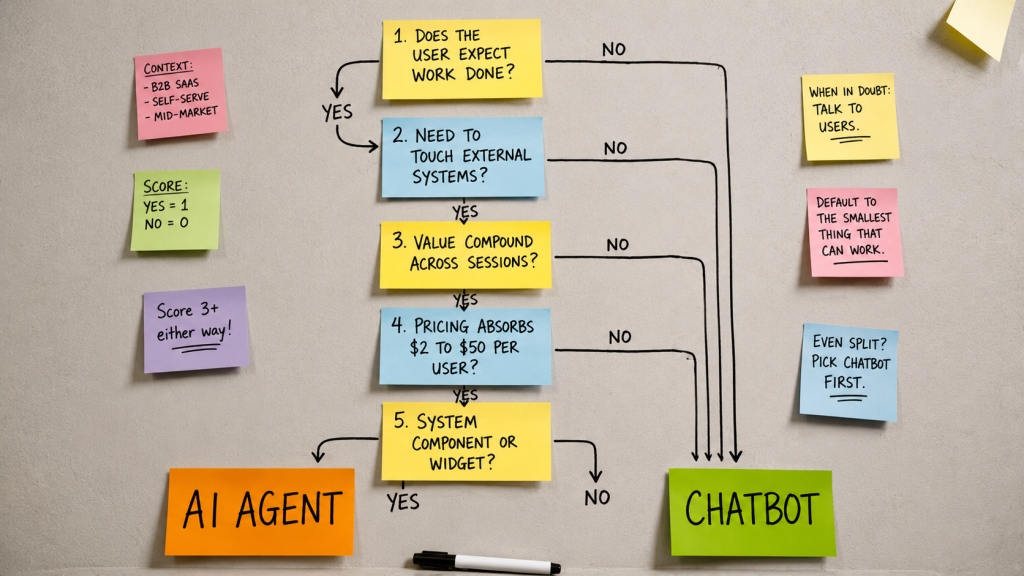
The Agent/Chatbot Decision Tree turns the 5 factors into a structured 5-question evaluation that routes any product idea to chatbot or agent in under 5 minutes.
The 5 questions:
Question 1: Does the user expect work done, or just answered? Yes (work) → agent route. No (answered) → chatbot route. This question alone resolves 60 percent of AI agent vs chatbot decisions.
Question 2: Does the use case require touching external systems through APIs and tools? Yes → agent route. No → chatbot route. Tool use is the technical capability that distinguishes the architectures.
Question 3: Does value compound across user sessions? Yes → agent route (long-term memory required). No → chatbot route (stateless or session-only memory sufficient).
Question 4: Can the product pricing absorb $2 to $50 per active user per month in operating cost? Yes → agent route (unit economics support agent investment). No → chatbot route (lower-cost architecture required to maintain margins).
Question 5: Is the system best understood as a system component or as a surface widget? System component → agent route. Surface widget → chatbot route.
Scoring the tree. 4 or 5 agent answers route the build to AI agent architecture confidently. 4 or 5 chatbot answers route the build to chatbot architecture confidently. 3 and 2 splits require deeper analysis — typically the AI agent vs chatbot decision then depends on which factors carry the most strategic weight for the specific product. When in doubt, start with the chatbot and migrate to agent architecture once usage data justifies the additional investment; the migration path is meaningfully easier than scoping an over-engineered agent that customers do not need.
The tree is downloadable as a worksheet at the end of this article along with a sample evaluation for three common saas product types.
When Chatbot Still Wins the AI Agent vs Chatbot Decision
Despite the AI agent hype cycle, chatbot architecture remains the right answer for many saas products in 2026. Three scenarios where chatbot beats agent decisively.
Scenario 1: Information-delivery use cases. Documentation search, product FAQ, feature explanation, content recommendation, knowledge base navigation. These use cases are conversation, not delegation. Users want answers; users do not want the system taking actions on their behalf. Building agent architecture for information delivery is over-engineering that costs 4x and improves the user experience zero.
Scenario 2: Pre-validation chatbot before agent investment. Many founders should ship a chatbot version first to validate the product concept, then upgrade to agent architecture once usage data confirms the demand. A chatbot MVP in 3 weeks at $15K teaches the team whether users actually engage; an agent MVP in 12 weeks at $80K teaches the same lesson with 5x the spend. The chatbot-first pattern is the right de-risking move when product-market fit is uncertain.
Scenario 3: Consumer-grade use cases with thin margins. B2C products with sub-$20-per-month pricing rarely have unit economics that support agent operating costs. Even if the use case would benefit from agent capabilities, the pricing tier cannot absorb $5 to $30 per active user per month in inference. Chatbot architecture matches B2C economics; agent architecture requires either B2B pricing or premium B2C positioning.
The honest framing: chatbots are not losing the AI agent vs chatbot race; they are a different category that wins distinct use cases. The mistake is treating chatbot architecture as inferior agent architecture rather than as its own category with its own strengths. The right product is the product that matches the use case, not the product that uses the more impressive technology. The productized example of a high-quality chatbot in the Xgenious portfolio is Helpnest, which demonstrates how a focused chatbot beats over-engineered agents in customer support deflection use cases.
AI Agent vs Chatbot for SaaS Products
The AI agent vs chatbot decision in saas products typically resolves toward agent architecture for B2B saas with $50+ ACV and toward chatbot architecture for prosumer or B2C saas with low ACV.
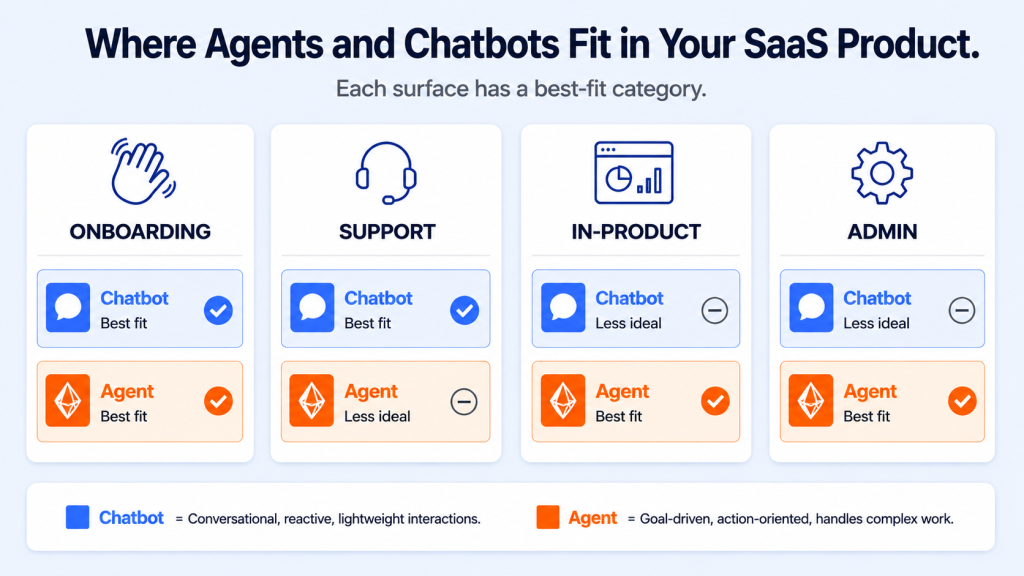
Onboarding surface. Chatbot fits when onboarding is mostly explaining features. Agent fits when onboarding involves configuring the product based on the user’s specific context (importing data, setting up integrations, generating initial workspace state). Most saas products in 2026 ship a chatbot onboarding assistant first and add agent capabilities as the product matures.
Support surface. Chatbot dominates support workflows. Customer support deflection through chatbot architecture is the highest-ROI AI investment in saas in 2026, with platforms like Helpnest demonstrating the pattern. Agents fit support workflows only when the agent needs to take resolution actions (refund processing, account recovery, configuration changes) beyond information delivery.
In-product surface. Agent architecture wins when the saas product has workflow surfaces that benefit from automation. Notion AI, Linear AI, HubSpot AI agents all sit inside their products as workflow accelerators. Chatbots in this surface are usually feature explainers that lose engagement after the first week.
Admin surface. Agent architecture wins for admin workflows that involve data manipulation, bulk operations, and cross-system orchestration. Generating reports, reconciling data, processing invoices, configuring user permissions. Admin surfaces have the highest agent ROI because each task saves meaningful operator time.
The full AI agent for saas integration patterns are covered at AI agent development, where the pillar walks through how to scope agent capabilities across saas product surfaces.
Conclusion: The AI Agent vs Chatbot Decision Is a Structural Build Choice
The AI agent vs chatbot decision is the most consequential architectural choice in any AI-product saas build in 2026. The 5 decision factors (autonomy, tool use, memory, cost, integration depth) and the Agent/Chatbot Decision Tree convert the question from religious debate into structured evaluation. Most decisions resolve cleanly when the 5 factors are scored honestly. Even splits require deeper analysis of which factors carry the most strategic weight for the specific product.
The dominant 2026 pattern: chatbot architecture for support deflection and information delivery, agent architecture for workflow automation and goal-pursuit. Many production saas products deploy both at different surfaces. The wrong AI agent vs chatbot decision costs 3 to 6 months of rework and $30K to $100K in misallocated engineering investment; the right decision keeps the build on budget and on schedule.
AI Agent vs Chatbot FAQ
1. Is an AI agent just a fancy chatbot?
No. An AI agent is goal-directed, uses tools, maintains state across sessions, and embeds into product workflows. A chatbot is reactive, conversation-only, typically stateless across sessions, and lives at the product surface. The same LLM can power either, but the architectures around the LLM differ meaningfully. Treating an agent as a fancy chatbot leads to broken product expectations; treating a chatbot as a stripped-down agent leads to over-engineering. The AI agent vs chatbot category choice is a real architectural decision, not a marketing label.
2. Can I start with a chatbot and upgrade to an agent later?
Yes, and this is often the right path. A chatbot MVP validates user demand at a fraction of the cost. If usage data shows users want delegation rather than conversation, upgrade the architecture to agent. The migration is meaningful work (4 to 8 weeks typically) but is well-understood; the chatbot-first path de-risks the AI agent vs chatbot decision when product-market fit is uncertain.
3. What is the cost difference between AI agent and chatbot for saas?
Build cost: chatbot MVP at $5K to $20K; agent MVP at $40K to $200K. Operating cost: chatbot at $0.05 to $0.50 per user per month; agent at $2 to $50 per user per month. The 5x to 50x operating-cost multiplier is what most founders miss when evaluating AI agent vs chatbot. Agent unit economics require pricing that supports the higher operating cost.
4. Do I need both an AI agent and a chatbot in my saas?
Often yes. Many production saas products deploy chatbot architecture at the support surface (high-volume, low-cost deflection) and agent architecture at the workflow surface (high-value, premium-tier features). The AI agent vs chatbot question is rarely either-or at the product level; it is per-surface within the product.
5. Which is harder to build, an AI agent or a chatbot?
AI agent, by a wide margin. A chatbot ships in 2 to 4 weeks with a senior engineer. An agent requires 8 to 16 weeks with a specialized team including engineers experienced in tool integration, memory infrastructure, evaluation harnesses, and observability for multi-step LLM workflows. The architectural complexity is roughly 5x.
6. Will AI agents replace chatbots entirely by 2027?
No. The categories solve different problems. Chatbots will remain the right architecture for information delivery, FAQ deflection, and conversation-only use cases. Agents will dominate workflow automation, multi-step reasoning, and goal-pursuit use cases. The AI agent vs chatbot distinction will sharpen rather than blur as both categories mature.