



Crowdfunding marketing is the work that decides whether your campaign funds or stalls. A great idea is not enough: the campaigns that hit their goal are the ones that build an audience before launch, tell a clear story, and keep promoting all the way through.
This guide covers 10 proven crowdfunding marketing tactics for 2026, how each one works, and how to combine them into a plan that actually raises money.
The short version
Winning crowdfunding marketing in 2026 comes down to a few things done well:
- Pick the right platform for your cause, audience, and fees.
- Tell a specific story with a short pitch video, which raises far more than text alone.
- Build an audience and pre-raise about 30 percent before you go public, so the launch has momentum.
- Promote hard through email, social media, and your personal network.
- Keep donors updated and thank them, which funds the next round.
The tactics below walk through each step, with a platform comparison, real benchmarks, and the mistakes that quietly sink campaigns.
Table of Contents
How to attract donors to your crowdfunding campaign
Before the tactics, the core idea: donors give to a clear cause they believe in, told by someone they trust. Creative, honest promotion across both online and offline channels is what pulls them in. A strong pitch video, real stories, and a specific ask do more than any single growth hack. Offering simple rewards and genuine thank-yous, the heart of donation-based crowdfunding, also encourages people to give and give again.
These crowdfunding marketing fundamentals sit under every tactic below, which is simply a way to get your cause in front of the right people and make giving easy.
The 10 crowdfunding marketing tactics
Here is the shortlist of crowdfunding marketing tactics, then the detail on each.
| # | Tactic | What it does |
|---|---|---|
| 1 | Set a clear goal | Gives donors a finish line to rally behind |
| 2 | Choose the right platform | Matches your cause to the right audience and fees |
| 3 | Create a strong pitch video | Raises far more than text alone |
| 4 | Do your research | Learns from winning and failed campaigns |
| 5 | Run a pre-launch campaign | Builds early momentum before you go live |
| 6 | Focus on SEO | Earns ongoing organic visibility |
| 7 | Respond fast to questions | Builds trust and keeps backers engaged |
| 8 | Keep the momentum going | Turns one-time givers into repeat supporters |
| 9 | Grab attention everywhere | Uses social, email, PR, and personal networks |
| 10 | Be patient and iterate | Learns from each attempt and improves |
1. Set a clear goal
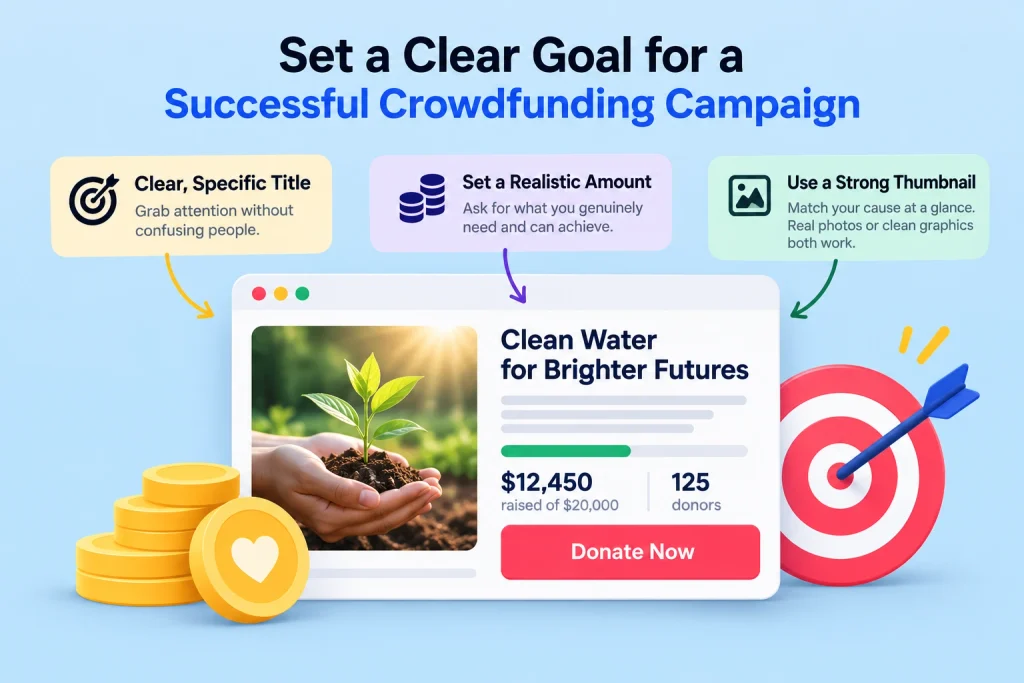
Clear goals are where all crowdfunding marketing starts, because people back a campaign only when they can see the finish line. Make your goal and purpose obvious: what you are raising for, how much, what it will achieve, and who it helps.
Three things make a goal land:
- Write a clear, specific title. Grab attention without confusing people. Brief, concrete, and aimed at your audience beats clever and vague.
- Set a realistic amount. Study comparable campaigns and ask for what you genuinely need. A goal you can credibly hit builds momentum; an inflated one stalls and scares donors off.
- Use a strong thumbnail or poster. Your main image should match the cause at a glance. A child-development fund should look like one. Real photos and clean graphics both work.
2. Choose the right platform
The platform shapes your audience, your fees, and your control, so match it to your campaign type. GoFundMe suits personal fundraising, MightyCause fits nonprofits, and general platforms like Kickstarter serve creative and product campaigns. If you want to keep the fees and own your data, a self-hosted option like Fundorex lets you run campaigns on software you own. Here are common platforms by focus:
| Platform | Best for |
|---|---|
| Fundorex | Self-hosted, all campaign types, you keep the fees |
| Kickstarter | Creative and product launches (all-or-nothing) |
| Indiegogo | Flexible funding, hardware, international |
| GoFundMe | Personal causes and emergencies |
| Mightycause | Nonprofits and recurring giving |
| Patreon | Ongoing creator membership |
| StartEngine | High-growth startup equity |
Beyond category, weigh these factors before you commit:
- Payment gateways. More options means more donors can give. Fundorex, for example, ships with 17-plus gateways including PayPal, Stripe, and bank transfer.
- Security. Look for strict admin controls over withdrawals and payouts.
- Flexibility and mobile. The platform should work cleanly on every browser and, ideally, on a mobile app, since most donors now give from a phone.
- User experience. Easy customization, social logins, and a smooth donate flow all lift conversions.
Still deciding between hosted and self-hosted? Our guide on how to build your own crowdfunding platform breaks down the trade-offs, and for a wider shortlist see the best crowdfunding platform software.
3. Create a strong pitch video
Video is the single highest-leverage asset in crowdfunding marketing: campaigns with a video raise far more than those without, often around double. A good pitch video does four things:
- Tells a story. Open with the problem and the people it affects, then explain how you got here and what the money will do. A personal, narrative tone connects where a feature list does not.
- Stays clear and short. Keep it under two to three minutes and lead with the point. Attention drops fast, so do not bury the ask.
- Uses real-life detail. Practical examples, real faces, and honest footage build the trust that converts a viewer into a backer.
- Looks and sounds decent. Clean visuals, clear audio, and a tight edit matter more than a big budget.
For a full breakdown, see our guide on creating an effective crowdfunding pitch video and how to create a killer crowdfunding pitch.
4. Do your research
Before you launch, study the market. Look at campaigns like yours that succeeded and ones that failed, and work out why. Note the titles, goals, rewards, and promotion that worked, and the warning signs that did not. Talk to people who have run campaigns and ask what surprised them. This preparation is what lets you avoid the common, avoidable mistakes rather than learning them the expensive way.
Good crowdfunding marketing is built on evidence, not guesses, so treat this research as the foundation every other tactic sits on. Keep a simple swipe file of campaign pages, headlines, reward tiers, and update emails you can borrow and improve, and note the price points and goal sizes that funded quickly in your category. Ten minutes a day of this before launch sharpens every decision that follows.
5. Run a pre-launch campaign
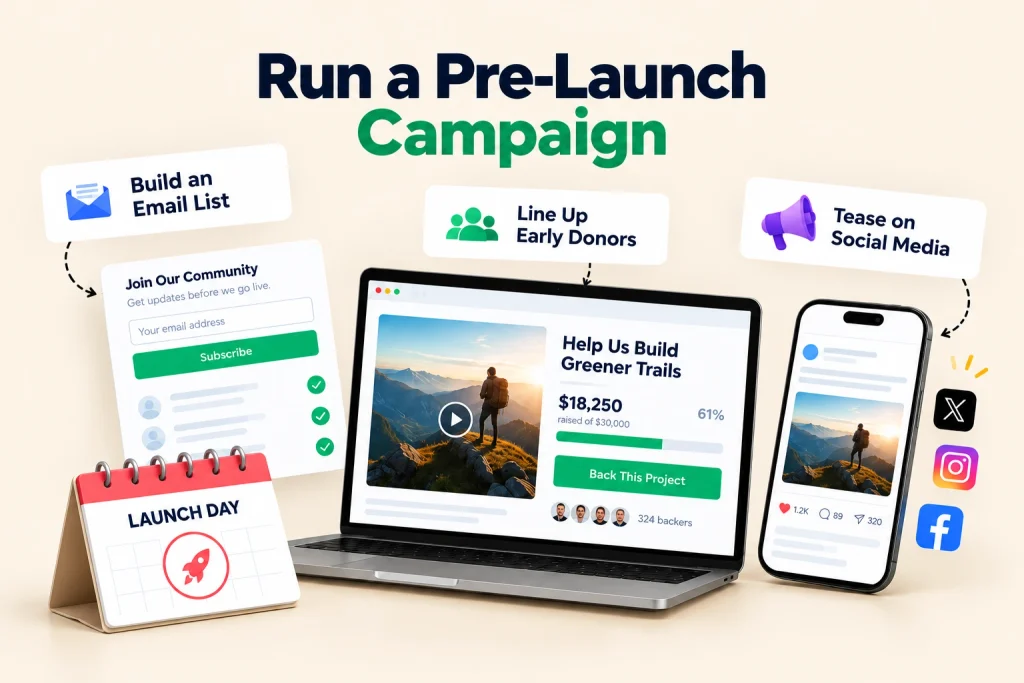
The biggest predictor of crowdfunding marketing success is early momentum. Campaigns that raise about 30 percent of their goal in the first week have a far higher chance of finishing funded, because a full-looking progress bar signals to strangers that the campaign is real.
So do the work before launch day:
- Build an email list and a small community of people ready to give on day one.
- Line up your first wave of donors, family, friends, and close supporters, and ask them to give early.
- Tease the campaign on social so there is demand the moment it opens.
Going live to an empty room is the most common way campaigns stall. A strong campaign page plus a warm audience is what turns the first 48 hours into momentum.
6. Focus on SEO
Visibility compounds, and search is where people look when they want to help a cause. Basic SEO gets your campaign and any supporting pages found: use the terms donors actually search in your title, description, and any blog content, keep pages fast and mobile-friendly, and earn links where you can.
SEO is slower than a social push, but it keeps bringing people in long after a single post has scrolled away. It is the one crowdfunding marketing channel that keeps working after launch day, so a short cause blog or a few optimized pages can feed your campaign donors for months. If you run a blog or a cause page alongside the campaign, treat it as a long-term traffic channel, not an afterthought.
7. Respond fast to questions
Crowdfunding platforms and social posts generate questions, and a quick, accurate answer is quiet but powerful crowdfunding marketing: it builds trust, while a slow or vague one loses it. Be prompt, be polite, and never guess, if someone asks a technical or financial question, give them exact, honest information.
Prepare a few template answers to the questions you know will come up (shipping, timelines, where the money goes) so you can respond fast without living in the comments. Taking the lead on the conversation keeps it positive.
8. Keep the momentum going
Raising the money is not the finish line; keeping donors engaged is what funds the next round and the one after. Four things sustain a campaign:
- Updates. Share progress every week or two: milestones hit, news, photos, and a clear thank-you. Announcing “we are halfway there” motivates people to give and to share.
- Rewards. Simple, product-centric or experience rewards encourage people to back and to come back. Price them so they protect your margin.
- A plan of action. Decide in advance how you will respond whether you hit your goal or fall short, so you are never caught flat.
- Genuine thanks. Donors who feel appreciated give again. Never skip the thank-you; it is the cheapest retention you will ever do. Our guide on keeping donors engaged goes deeper.
9. Grab attention everywhere
Use every crowdfunding marketing channel you have, online and offline, to reach the widest possible audience:
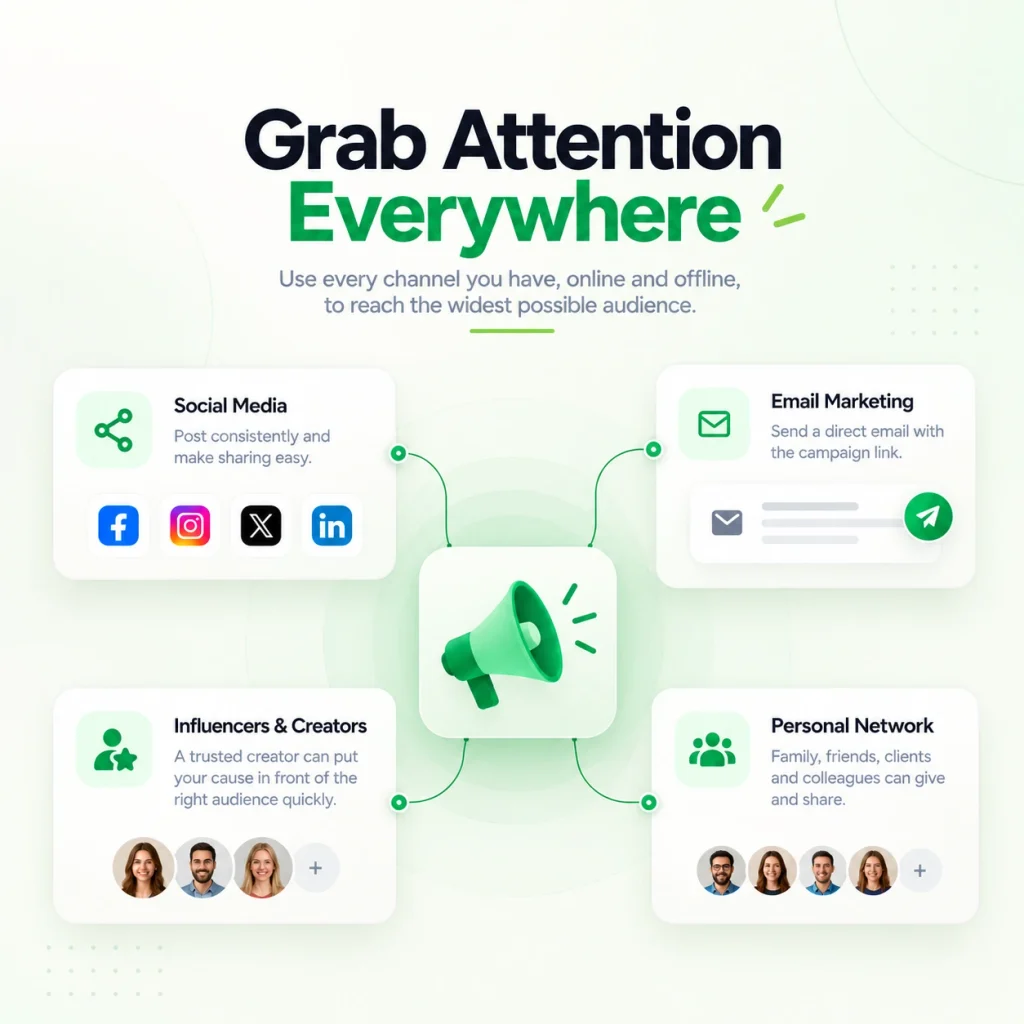
- Social media. Facebook, Instagram, and X are strong for public causes; LinkedIn is better for reaching investors. Post consistently and make sharing easy.
- Email marketing. A direct email to your list with the campaign link is one of the most effective ways to drive committed donors to act.
- Influencers and creators. A creator whose audience trusts them can put your cause in front of the right crowd quickly, which matters most for nonprofit and community campaigns.
- Your personal network. Family, friends, clients, and colleagues can give and, just as importantly, share. Even people who do not donate add reach.
10. Be patient and iterate
Success rarely comes overnight. Expect setbacks, especially on a first campaign, and treat them as data. Pick the right platform, make your final edits before launch, mind your timing, and keep improving. Slow and steady, with honest effort, beats a rushed launch every time. If a campaign falls short, the audience and lessons you built carry into the next one. Every campaign teaches you something about your audience and your message, and that compounding knowledge is what turns a first-timer into someone whose crowdfunding marketing simply works.
After the campaign: keep the relationship going
A funded campaign is a starting line. The backers who believed in you early are your first real audience, so keep them. Thank them, deliver what you promised, and tell them what their money achieved. Many successful founders turn that audience into an ongoing business, the natural transition from crowdfunding to ecommerce, where you sell to the same people without paying a platform fee each time. If you expect to raise again, owning your platform starts to pay off.
Common crowdfunding marketing mistakes to avoid
- Launching cold. Posting and hoping it spreads is the top failure. Pre-raise and line up your first donors.
- Setting the goal too high. A number that never moves signals failure. Ask for what you need.
- Going quiet. Campaigns that stop posting raise less. Keep updating.
- Ignoring mobile. Most donations come from phones; a broken mobile page turns away money.
- Skipping the thank-you. It is the easiest way to lose the next donation.
The Bottom Line
Strong crowdfunding marketing is not one clever trick; it is a sequence done consistently. Set a clear, honest goal, pick the platform that fits your cause, lead with a real story and a short video, and build momentum before you go public. Promote through email, social, and your own network, answer fast, keep backers updated, and thank them like you mean it. Do that and your campaign has a real shot, regardless of how crowded the space gets.
Frequently asked questions
What is crowdfunding marketing?
Crowdfunding marketing is the set of tactics you use to attract backers to a campaign and drive them to donate: choosing the right platform, telling a clear story with a pitch video, building an audience before launch, and promoting through SEO, email, social media, and your personal network. The goal is to turn attention into funded pledges.
How do I promote a crowdfunding campaign?
Build an email list and community before launch, pre-raise around 30 percent from your inner circle, then promote through social media, email, influencers, and personal outreach while posting regular updates. A short, honest pitch video and a clear, specific ask do most of the heavy lifting.
How much should I raise before going live?
Aim for roughly 30 percent of your goal from friends, family, and close supporters before the public launch. Campaigns that hit that early mark in the first week are far more likely to fully fund, because visible momentum convinces strangers the campaign is real.
Which platform is best for crowdfunding?
It depends on your cause: GoFundMe for personal fundraising, Mightycause for nonprofits, Kickstarter or Indiegogo for creative and product launches, and a self-hosted option like Fundorex if you want to keep the fees and own your data. Match the platform to your campaign type and audience.
Do I need a video for my crowdfunding campaign?
Strongly recommended. Campaigns with a video consistently raise much more than those without, often around double, because a short, personal video builds trust faster than text. Keep it under three minutes and lead with the problem you are solving.